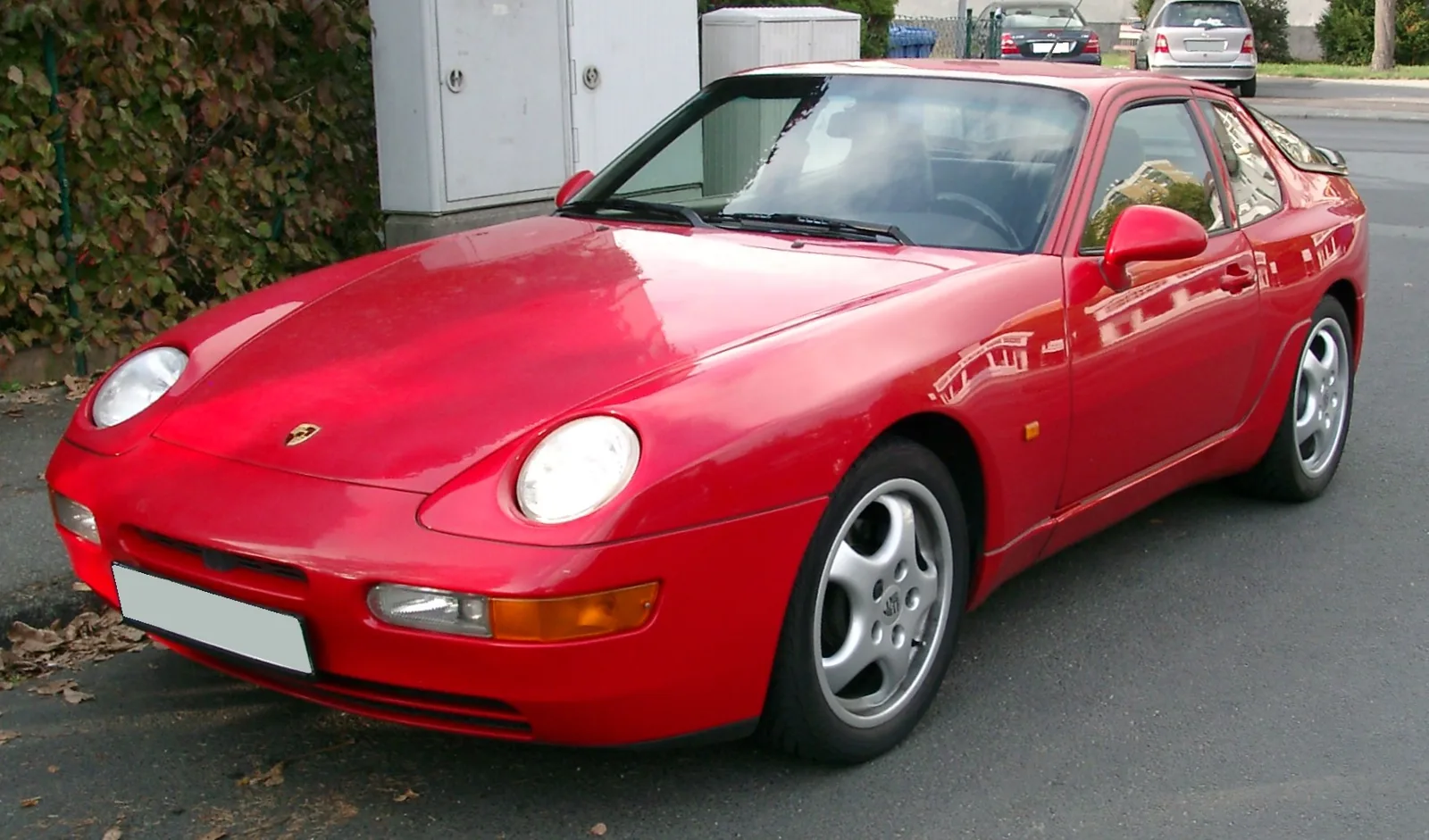
Built from 1991 to 1995 on the bones of the 944, the 968 gave Porsche a four-cylinder sports car, a lightweight Club Sport and a race-bred Turbo RS.
The Porsche 968 was a sports car built by Porsche AG from 1991 to 1995, derived from the 944 and developed through its S3 programme. It used a 3.0-litre four-cylinder rated at 240 PS, and it spawned the Club Sport, Turbo S and Turbo RS variants. It was the last front-engined Porsche before the Cayenne.
Porsche AG built the 968 as a sports car from 1991 until 1995. It was the final development of the front-engined, rear-wheel drive family that began with the 924, and it replaced the 944 from which it was derived. Its four-cylinder engine and balanced chassis made it a distinctive member of the range.
Its front-engined layout placed it apart from the mid-engined cars that dominated Porsche's later range, which made the 968 a clear step back to classic Porsche balance.
The 968 is often remembered as a transitional car. It was Porsche's last new front-engined model before the Cayenne, and its lightweight Club Sport and race-bred Turbo RS variants gave the badge a short burst of motorsport interest in the early 1990s.
Where did the 968 come from?
The 944 first appeared for 1982 as a development of the 924, and it was updated as the 944S in 1987 and the 944S2 in 1989. The company was struggling financially, and interest in its sports cars was falling, especially in the United States. The 944 was showing its age, so the company decided to develop a new entry-level model.
Engineers began work on a further upgrade while the S2 was still in production. A planned final S3 variant turned into a new model, dubbed the 968, because so many parts had been modified or replaced. Porsche said that four-fifths of the 944's mechanical parts had been reworked or swapped out.
Manufacturing also changed. Production moved from the Audi plant in Neckarsulm to Porsche's own factory in Zuffenhausen. The move was intended to reduce production costs.
Porsche's last front-engined sports car before the Cayenne, built on the 944 and sharpened into a race-ready Turbo RS.
How did the 968 look?
The 968 was largely a restyling of the 944, and the design links to its predecessor are easy to spot. Harm Lagaay, who had designed the 924 and the 944, led the work. The nose echoed the 928, with the same exposed pop-up headlamps and a bumper built into the body.
That frontal design would eventually appear on the 911 (993) two years later, which gave the 968 a place in the lineage of Porsche's later styling. The rear was also redesigned, with fully coloured rounded taillamps and PORSCHE badging between the lights.
The interior was largely unchanged from the 944 S2, with the exception of switches and control knobs. Upgrades included a Fuba roof-mounted antenna, Cup-style 16-inch alloy wheels and a wider choice of interior and exterior colours.
The convertible kept the coupe's bodywork and design cues, so the open-top car carried the same lines without a visible compromise in style.
What engine did the 968 use?
The 968 used an updated version of the 944's straight-four, which displaced 3.0 litres, with a 104 mm bore and 88 mm stroke. Peak output was 240 PS (177 kW; 237 hp) at 6,200 rpm, and torque reached 305 Nm (225 lb ft) at 4,100 rpm. The compression ratio was raised to 11.0:1 to extract that output.
Porsche's VarioCam variable valve timing was introduced on the 968 and later became part of the Type 993 air-cooled engine. The car also gained a dual-mass flywheel and updated engine management electronics, which were part of the update.
The engine was the fourth-largest four-cylinder gasoline unit ever offered in a production car at that time. Its size and layout were part of the car's identity, and it kept the four-cylinder character that had defined the 944 family.
What transmissions did the 968 offer?
A new 6-speed manual replaced the 944's older 5-speed gearbox. Porsche's dual-mode 4-speed Tiptronic automatic was offered as an option. Both were recent developments for the company, which had introduced Tiptronic on the 1989 Type 964 911.
Buyers who chose the manual got the more involving drive, since the gearbox was the car's main point of driver contact.
How fast was the standard 968?
The standard 968 with the manual transmission reached 252 km/h (157 mph) and completed 0-100 km/h in 6.5 seconds.
For 1993 the car received minor changes, including a pollen filter for the air conditioning and new packages. The seat package added heated driver and passenger seats, while the suspension package brought larger 17-inch wheels and cross-drilled discs.
What was the Club Sport?
From October 1992 through 1995 Porsche offered a lighter Club Sport version for enthusiasts who wanted more track performance. Much of the luxury equipment was removed, and less sound deadening was used. Power windows were replaced with crank-driven units.
The Club Sport gained manually adjustable Recaro racing seats and a suspension lowered by 20 mm for possible track use. Its tyres were 225 at the front and 255 at the rear, compared with 205 and 225 on the standard car, and the steering wheel lost its airbag in favour of a thicker three-spoke design.
Porsche used the car's sharper focus in its marketing, and the Club Sport helped to lift flagging sales in the mid-1990s.
Its declared weight was 1,320 kg (2,910 lb), about 100 kg (220 lb) lighter than the regular 968. The Club Sport covered 0-97 km/h in 5.6 seconds and reached a top speed of 260 km/h (162 mph). Those figures made it the most focused road 968.
Owners who took the car to track days found the lighter weight and firmer suspension the most rewarding part of the package.
How many Club Sports and 968 Sports were built?
Of a total of 1,538 cars, 1,232 were registered as Club Sports. The remaining 306 were registered as 968 Sports, a UK-only version offered in 1994 and 1995 that used Club Sport chassis numbers with a luxury option pack.
The 968 Sport added an alarm, power windows and mirrors, central locking, a sunroof and cloth comfort seats. At 32,995 pounds it was priced 4,500 pounds below the standard 968, and it outsold the regular coupe by a large margin, with 40 standard coupes sold in the UK against 306 Sports.
The Club Sport was recognised as Performance Car of the Year in 1993 by Performance Car magazine in the UK. Its colours that year were Grand Prix White, black, Speed yellow, Guards red and Maritime blue, and Riviera blue replaced Maritime blue for 1994.
What made the 968 Turbo S unusual?
For a short run in 1993, the Weissach engineers built a turbocharged 968 Turbo S. The name was an unexpected choice for Porsche, which normally reserved the S suffix for tuned versions of a model. The Turbo S shared its body and interior with the Club Sport.
The Turbo S sat 17.8 mm (0.7 in) lower and weighed 70 kg (154 lb) less than the standard car. It made 305 PS (224 kW; 301 hp) at 5,600 rpm, with 500 Nm (369 lb ft) of peak torque at 3,000 rpm, and it reached 0-100 km/h in 5.0 seconds. Only 14 were produced, and all were for mainland Europe.
Those 14 cars were built by the works team at Weissach rather than on the production line, which made each one a special order and a rare find for collectors.
What was the Turbo RS?
From 1992 to 1994 the company's racing development arm prepared a complete race car, the Turbo RS, for customer teams. It was based on a stripped Turbo S and came in two specifications, one for the German ADAC GT series and one for international racing.
The ADAC version made 342 PS (252 kW; 337 hp) with a K27 turbocharger and carried ballast to meet a 1,350 kg minimum weight. The international version made 355 PS (261 kW; 350 hp), used a KKK L41 turbo and weighed 1,212 kg (2,672 lb). Only four were produced, which makes them the rarest 968s.
Privateer teams, however, found the contemporary 911 Carrera RS 3.8 race car more interesting, which is why only four Turbo RS cars were built.
In the ADAC GT Cup, the Joest team finished fourth at Avus in 1993 with Manuel Reuter driving. In the BPR series a Turbo RS took sixth at the 4-hour race at Dijon in 1994. Seikel Motorsport also entered a Turbo RS at the 1994 24 Hours of Le Mans, but the car retired after 84 laps.
The results were modest, but they showed how the Turbo RS could be pushed in endurance events.
Why did the 968 end production?
The 968 was discontinued in 1995 because of poor sales. Its end coincided with that of the 928, Porsche's only other front-engined car at the time, and it closed the front-engined line until the Cayenne arrived in 2003.
Its four-cylinder engine also made it the last of its kind from Porsche until the Macan arrived in 2014. That gives the car a small but distinct place in the company's history, as the end of an engine family that had run for two decades.
Looking back, the 968 sits between two eras. It kept the front-engined layout that Porsche was moving away from, yet it introduced VarioCam, a technology that would shape later engines. That mix makes it a useful study of a transitional car.
Enthusiasts now value the 968 for its balance and its rarity, which places it among the more appealing Porsche sports cars of its generation.
Specifications at a glance
The table below lists the key figures for the standard car and its main variants. Where a value belongs to one version, the table names it so the figures do not blend together.
| Version | Key figures |
|---|---|
| 968 (manual) | 3.0 L four-cylinder; 240 PS (177 kW; 237 hp) at 6,200 rpm; 252 km/h (157 mph); 0-100 km/h in 6.5 seconds |
| Club Sport (1992 to 1995) | 1,320 kg (2,910 lb); 0-97 km/h in 5.6 seconds; 260 km/h (162 mph); suspension lowered 20 mm |
| Turbo S (1993) | 305 PS (224 kW; 301 hp) at 5,600 rpm; 500 Nm (369 lb ft) at 3,000 rpm; 0-100 km/h in 5.0 seconds; 280 km/h (174 mph) |
| Turbo RS, ADAC GT | 342 PS (252 kW; 337 hp); K27 turbocharger; 1,350 kg minimum weight |
| Turbo RS, international | 355 PS (261 kW; 350 hp); KKK L41 turbocharger; 1,212 kg (2,672 lb) |
Frequently asked questions
How many Turbo RS cars were made?
Only four Turbo RS race cars were produced between 1992 and 1994. They are the rarest 968s, and most were built for customer teams. Privateer teams had preferred the 911 Carrera RS 3.8, which helps explain why so few were made.
Was there a UK-only 968?
Yes. The 968 Sport was sold in the UK in 1994 and 1995, using Club Sport chassis numbers and a luxury option pack. It was priced at 32,995 pounds, which undercut the standard 968 while offering most of its comfort features.
How much did the 968 Sport outsell the standard coupe?
The 968 Sport sold 306 units, against 40 standard coupes in the UK. Its extra equipment at a lower price drove that gap, and the figures show how strongly UK buyers responded to a well-equipped car at a sharper price.
What replaced the 968 in Porsche's line-up?
Porsche did not replace the 968 with a direct successor. The Cayenne in 2003 was the next front-engined vehicle the company built, and the Macan in 2014 was the next four-cylinder.