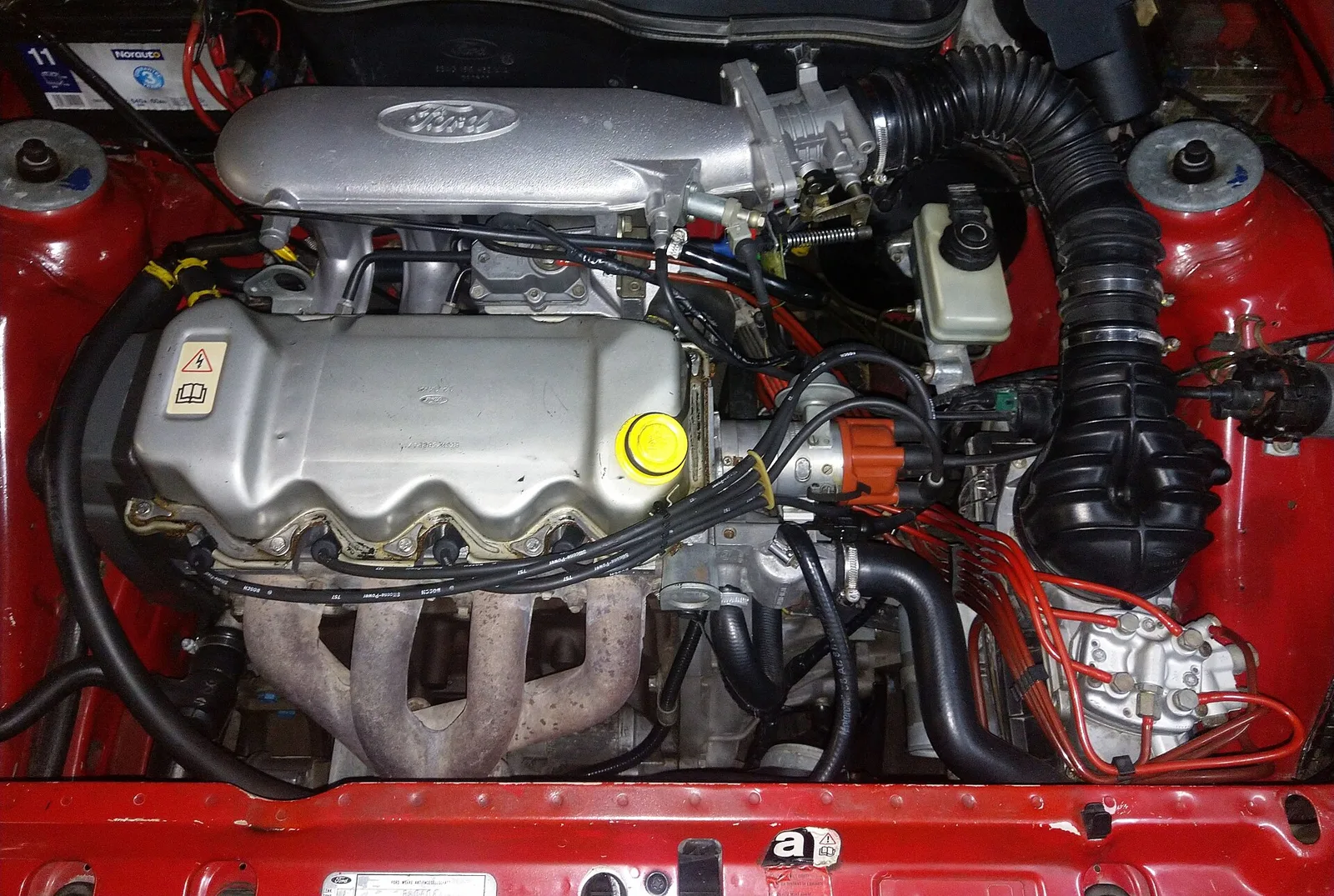
Ford's Electronic Engine Control series ran from a 12-bit Toshiba processor in the 1970s to PowerPC and CAN-based units, and EEC-IV became the most widely fitted design.
Ford's EEC series of engine control units began with EEC I, produced from 1974 on Toshiba's 12-bit TLCS-12 processor. The series then moved through Motorola, Intel and PowerPC designs, and EEC-IV became the design used in more Ford vehicles than any other.
EEC stands for Electronic Engine Control, the series of engine control units that Ford Motor Company designed and built over several decades. The first system, EEC I, used processors developed by Toshiba and began production in 1974, before mass production in 1975. Later generations moved to Motorola and Intel designs and then to PowerPC microcontrollers with CAN networking.
The series is worth understanding because it shows how engine management moved from simple fuel and spark control on fixed hardware to networked systems with much richer diagnostics. Each generation changed the processor, the memory and the interface, and the EEC-IV family became the most widely used of them all.
What was in the first EEC systems?
EEC I and EEC II shared a common processor and memory design built around Toshiba's 12-bit TLCS-12 chip, whose design work ran from 1971 to 1973. The processor had no stack, and all code was written in assembly language. Strategy and calibration sat in a bolt-on memory module.
The TLCS-12 covered 32 square millimetres and held about 2,800 gates on a 6 micrometre process. Its memory included 512-bit RAM, 2 kb of ROM and 2 kb of EPROM. Ford's internal name for the chip was PM-11, nicknamed Poor Man's 11, although the chip itself was never sold commercially.
The memory module was a deliberate design choice. It used masked ROM, which could not be changed after manufacture, so the strategy and calibration were fixed once the module left the factory. Updating software therefore meant replacing hardware, a limitation that later generations were designed to remove.
Voltage was a real engineering problem. The analog-to-digital reference was 10 volts, yet supply voltage varied during cranking. Ford used ratiometric sensing so that readings stayed accurate, and it timed the spark from engine reference pulses during start-up.
EEC-II also controlled the air-fuel ratio through Ford's 7200 Variable Venturi carburettor, the last carburettor Ford designed in the United States. Each 7200 was hand calibrated inside a pressure-controlled room, which shows how much manual work surrounded the electronics of the time.
Early units hard-wired their software into a memory module, and the family that followed was built to be changed rather than replaced.
How did EEC-III change spark and fuel control?
EEC-III was used on certain 1980 to 1983 vehicles and came in two modules, one for feedback carburettors and one for throttle-body injection. The two modules had differently keyed connectors so that they could not be fitted to the wrong vehicle, and their size and shape were close to EEC-II.
The ignition changes were significant. Spark could fire anywhere within a 50-degree range set by calibration, and the distributors dropped mechanical and vacuum advance. Timing was now controlled entirely by the engine computer, which is why EEC-III distributors needed larger cap spacing to prevent cross-firing.
Motorola designed the EEC-III processor, which had an 8-bit data length and a 10-bit instruction length. Addressing was paged across four pages, so a program could not reach all of its memory directly without special instructions. Like its predecessors, the code was written in assembly language.
On fuel-injected cars the module fired injectors at about 40 psi, mounted in a throttle body on the 5.0 litre engine. That gave EEC-III a direct electronic fuel-metering role, a step that the carburettor-based EEC-II units could not offer.
What made EEC-IV the most widely used design?
EEC-IV was the design behind more Ford vehicles than any other family. It used an Intel 8061 processor and a TFI-IV ignition module, and its debut was the Escort EFI, a 1.6L car from the 1983-1/2 model year. Preliminary design work had begun before EEC-III reached production, which shows how closely the generations overlapped.
Many modules were built around the processor, each tailored to its engine's cylinder count and I/O needs. The 1984 line-up included a 2.3L HSC engine, and a 2.8L truck engine joined the family that year, showing its reach across the range.
The diagnostics improved as the family matured. KOEO and KOER self-tests were available, along with a wiggle test that checked wiring by flexing components. Early EEC-IV cars could not stream sensor data to a scan tool, but by the early 1990s the Data Communications Link added two data bus wires for that purpose.
The processor design was unusual. The 8096 was a close variant of the 8061 that sold widely, and Intel's multiplexed 8-bit bus carried address and data together. Because of that bus, custom memory chips were needed, and bus loading limited each design to two external memory devices.
Module hardware changed quickly. The first module used an edge-card connector that was abandoned for reliability reasons, and it held 8K of MROM and 128 bytes of RAM. Later packages used staggered pins on all four edges, which made all of the available inputs and outputs usable.
Ford also reshaped its supply chain for the processor. Intel agreed to share the 8061 design with Motorola, which could then make chips for Ford's own use.
Did EEC-IV reach Formula 1?
Yes. A series of EEC-IV modules was designed for Formula 1 race cars, and a 1985 Ford/Cosworth 1.5L turbo engine used EEC-IV. Haas/FORCE F1 also used the EEC-IV engine, and that team employed Ross Brawn and Adrian Newey as engineers on the programme.
The Formula 1 use made Ford an early adopter of digital electronics on the racetrack.
What came after EEC-IV?
EEC-V used the 8065 processor, expanding memory from 64K to 1 megabyte and extending the family to almost 20 years in production. Later generations moved to PowerPC microcontrollers, and EEC-VII runs on CAN networking with Ford's own MS-CAN layer, giving the family a networked architecture.
EEC-V built on EEC-IV technology, and its additional interrupts let much of the earlier code keep running. That continuity helped the family last so long on the production line, since engineers could reuse proven software rather than starting again.
European diesels used the EEC-V DPC series from model year 2000, in the Duratorq engines of the TDDi and TDCi era. Those units were later replaced by engine management systems from other suppliers as diesel requirements changed.
The Visteon Levanta 'Black Oak' PCM was the first Ford ECU to use PowerPC architecture. It served Mondeo, Galaxy, Focus and Ka cars, and it marked a clear break from the Intel-based designs.
EEC-150 used PowerPC for 3.0 and 4.0 V6 engines and the 4.6 SOHC engine. EEC-VI followed as a PowerPC microcontroller used up to 2013 models, with diagnostics that ran over the UDS protocol. That made diagnostic compatibility a central concern for the later generations.
EEC-VII is the latest system documented here. It uses a PowerPC microcontroller with mostly CAN networking and Ford's proprietary MS-CAN layer, and the other variations in the family are less well documented.
EEC generations at a glance
| Generation | Processor | Defining feature |
|---|---|---|
| EEC I and II | Toshiba TLCS-12, 12-bit | Bolt-on masked ROM memory module, production from 1974 |
| EEC-III (1980 to 1983) | Motorola, 8-bit data, paged addressing | Spark anywhere in a 50-degree range, no mechanical or vacuum advance |
| EEC-IV | Intel 8061, multiplexed 8-bit bus | The most widely fitted Ford design |
| EEC-V | 8065 | Memory up to 1 megabyte, almost 20 years in production |
| Visteon Levanta | PowerPC | First Ford ECU with PowerPC architecture |
| EEC-VI | PowerPC | Used up to 2013 models, UDS diagnostics |
| EEC-VII | PowerPC | CAN bus and MS-CAN architecture |