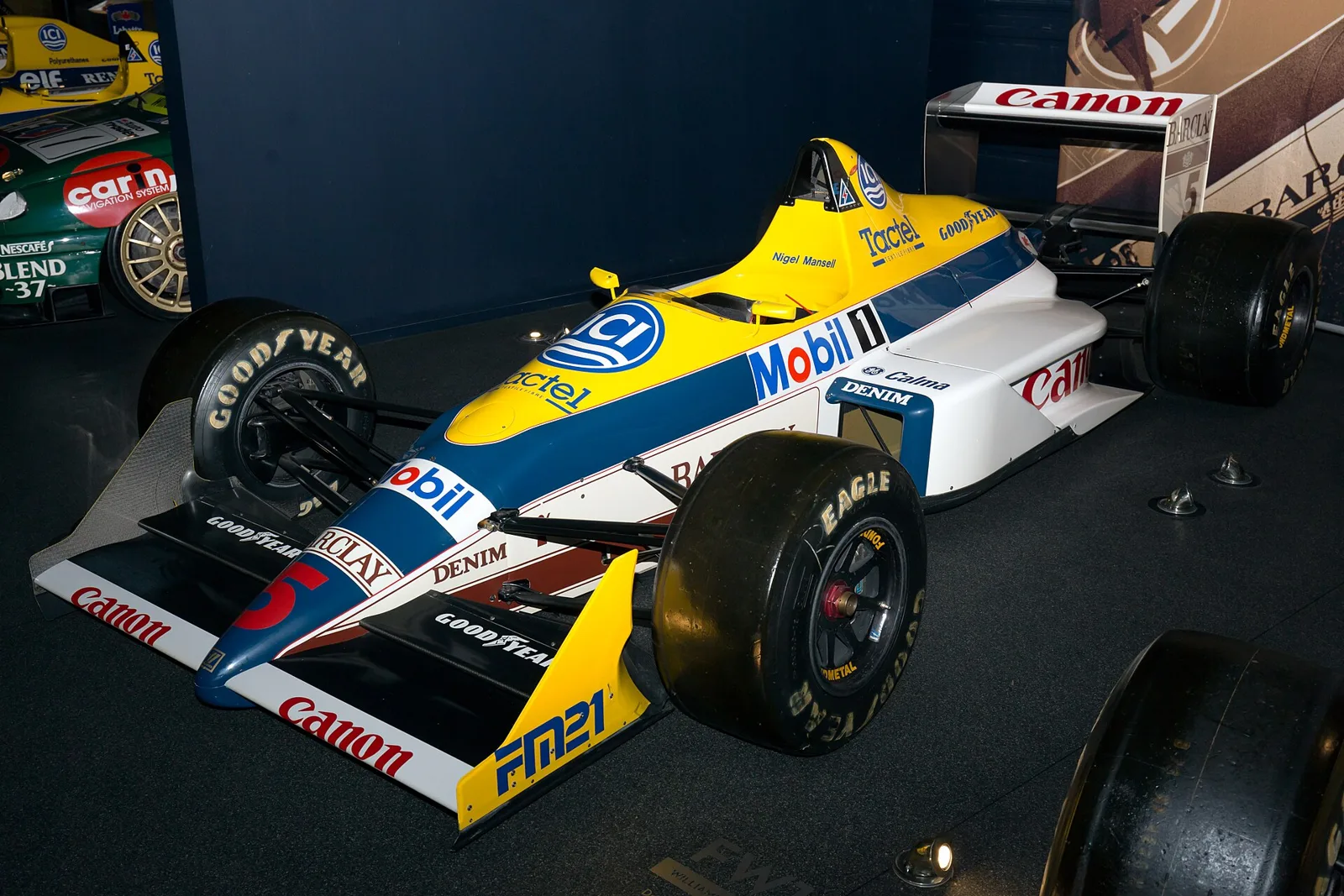
A troubled 1988 car with a computer suspension and a Judd V8, rebuilt into the Renault-powered FW12C that won Williams a race in 1989.
The Williams FW12 was a Formula One car used by Williams in the 1988 season, powered by a Judd V8 after the Honda turbo partnership ended. The FW12C, a Renault-powered update, raced in 12 of the 16 races in 1989 and won the Canadian Grand Prix with Thierry Boutsen. It was the first naturally aspirated Williams since the FW08 cars of 1982 and 1983.
The Williams FW12 was the team's 1988 Formula One car, built around a Judd V8 once the Honda turbo partnership had ended. Its updated version, the FW12C, ran with a Renault V10 in 1989 and gave Williams its only win with the design. The story is one of a poor start, a rushed rebuild and a useful second life.
Why did Williams lose its Honda engines?
Honda's relationship with Williams soured after the team refused to drop Nigel Mansell in 1986 and was reportedly unhappy about Nelson Piquet's status. Honda then withdrew, and at the 1987 Hungarian round it confirmed a three-year agreement to power McLaren from 1988.
Williams was still under contract to use Honda engines for 1988, but the manufacturer walked away from that agreement. The refusal that caused the rift involved removing Mansell in favour of Honda's Satoru Nakajima for the 1986 season. Honda also believed the team had failed to honour Piquet's contract, which had promised him number-one status.
The rivalry between the two drivers had cost the team dearly. Piquet and Mansell both lost the 1986 title to Alain Prost, and in 1987 Mansell almost beat Piquet to the championship. The Honda partnership, which had powered those seasons, was over.
A computer suspension that failed, a rushed bodge at Silverstone, and then a Renault-powered sequel that won in Canada.
What went wrong with the FW12 in 1988?
The Judd V8 produced about 600 bhp in its first year, which left the FW12 badly short of straight-line speed. The Reactive Ride suspension was also troubled, with air in the hydraulics changing its settings, and the computer added weight and drained some of the engine's power.
Early in the season the car was painfully slow on the straights. In qualifying at Brazil it managed 265 km/h (165 mph), measured on the 900 metre back straight, while McLaren and Lotus, with Honda turbos, passed 290 km/h (180 mph). Mansell and Patrese both complained that the car was hopeless in a straight line, and Patrese's sixth place at Monaco was the only point scored before the British Grand Prix.
Mansell, who had won 11 races across 1986 and 1987 (more than anyone else), failed to finish any of the first seven races of 1988. He moved on to Ferrari when the year ended.
Williams's first computer-controlled suspension had made its debut on the FW11 at the 1987 Italian round, when Piquet won with it. The team called it Reactive Ride because Lotus held the copyright on the Active Suspension name. The revised system for the FW12 was meant to give the non-turbo cars a chance against the turbo teams, but it had the opposite effect.
How did Williams fix the car at Silverstone?
At Silverstone the team replaced Reactive Ride with conventional steel springs and dampers, a job done overnight that technical director Patrick Head called a bodge. The change helped Mansell qualify 11th and Patrese move from 30th to 15th, and Mansell then finished second in heavy rain.
Mansell improved his time by 1.3 seconds in qualifying, while Patrese improved by 17.864 seconds. That second place was the team's first points of the season, and Mansell also recorded the quickest lap in the race, one of just two fastest laps by a non-turbo car that year. The team had found the grip it needed at its home race, a race it had won in each of the two previous seasons.
Who stood in for Mansell in 1988?
Mansell missed the Belgian and Italian races with chickenpox. Martin Brundle, who had spent 1984 to 1987 with Tyrrell and Zakspeed, stood in first. Jean-Louis Schlesser then took over for his only World Championship race.
Schlesser was a two-time Dakar Rally winner and a two-time World Sportscar Champion, but he is best remembered for his drive at Monza. On lap 49 of 51 he collided with Ayrton Senna at the Rettifilio chicane, which put the McLaren out. It was McLaren's sole setback of the year, and it gave Ferrari a 1-2 finish via Gerhard Berger and Michele Alboreto a month after Enzo Ferrari's death.
How did the FW12 finish its season?
Mansell and Patrese retired from Portugal, but in Spain Mansell finished second behind Alain Prost. That was his second and last points finish of the year. Patrese was fined US$10,000 for brake-checking Julian Bailey in qualifying, yet still finished fifth after the penalty.
Mansell's final races ended in Japan, after an accident with Piquet's Lotus, and in Australia, with brake failure. Those retirements closed his spell with the team, which had lasted four seasons and produced 13 wins. Williams dropped to seventh in the standings with 20 points, while McLaren's MP4/4 won 15 of the 16 races in 1988.
What changed with the FW12C in 1989?
Williams switched to a Renault RS1 3.5-litre V10 for 1989, the first Renault-powered Williams and the return of Renault as an engine supplier. The updated FW12C ran in 12 of the 16 races before the FW13 took over, although the FW12C came back for the Spanish round.
Renault's engine had been designed under the direction of Bernard Dudot, and its development began at least a year after Honda had started work on its own V10. Williams built an FW12B test mule to accommodate the longer V10, which was based on the Judd car. The FW12C debuted in Brazil, where Patrese qualified second and led from the start. That was his 176th start, matching the mark jointly held by Graham Hill and Jacques Laffite. He set the fastest lap before a broken harmonic balancer forced him out in front of the pits.
How did the FW12C perform in 1989?
The FW12C's only win came at the rain-hit Canadian Grand Prix, where Thierry Boutsen won and Riccardo Patrese finished second. Patrese took the car's only pole at Hungary, but a hole in the radiator caused overheating and cost him the lead. Across the Judd and Renault cars, Williams scored one win, one pole, two fastest laps and nine podiums in 29 races.
Patrese had his best season to date, following second places in Mexico, Phoenix and Canada with a third in France. At Hungary he led comfortably until lap 51, when the radiator problem overheated the engine and the reigning champion Ayrton Senna passed him. Nigel Mansell, now at Ferrari, also got past, and Patrese dropped out at the pit exit with a dead engine on lap 55. Boutsen finished third.
By the Italian Grand Prix it was obvious that the FW12C had reached the limit of its design, even though the Renault V10 kept improving. Williams fell behind McLaren's Honda V10 and Ferrari's V12, while Benetton's Ford V8 was the lightest of the top engines and the most frugal. The team retired the FW12C after Italy and debuted the FW13 at Portugal. The FW13 had been designed for Reactive Ride and had to be reworked with passive suspension.
Patrese went back to the FW12C for Spain to chase third in the championship. He qualified sixth and finished fifth, which ended the car's racing career. James Hunt later tried the FW12C privately at Paul Ricard in December 1989, going quickly, but he chose against a comeback and remained with BBC TV.
Specification and results at a glance
| Item | Detail |
|---|---|
| Engine, 1988 | Judd CV 3.5-litre V8, around 600 bhp |
| Engine, 1989 | Renault RS1 3.5-litre V10 |
| Williams points, 1988 | 20, seventh in the constructors' standings |
| Mansell's points finishes, 1988 | Second at Silverstone and second in Spain |
| Race win | Thierry Boutsen, Canadian Grand Prix 1989 |
| Pole position | Riccardo Patrese, Hungarian Grand Prix 1989 |
| Totals for both versions | 1 win, 1 pole, 2 fastest laps, 9 podiums in 29 races |