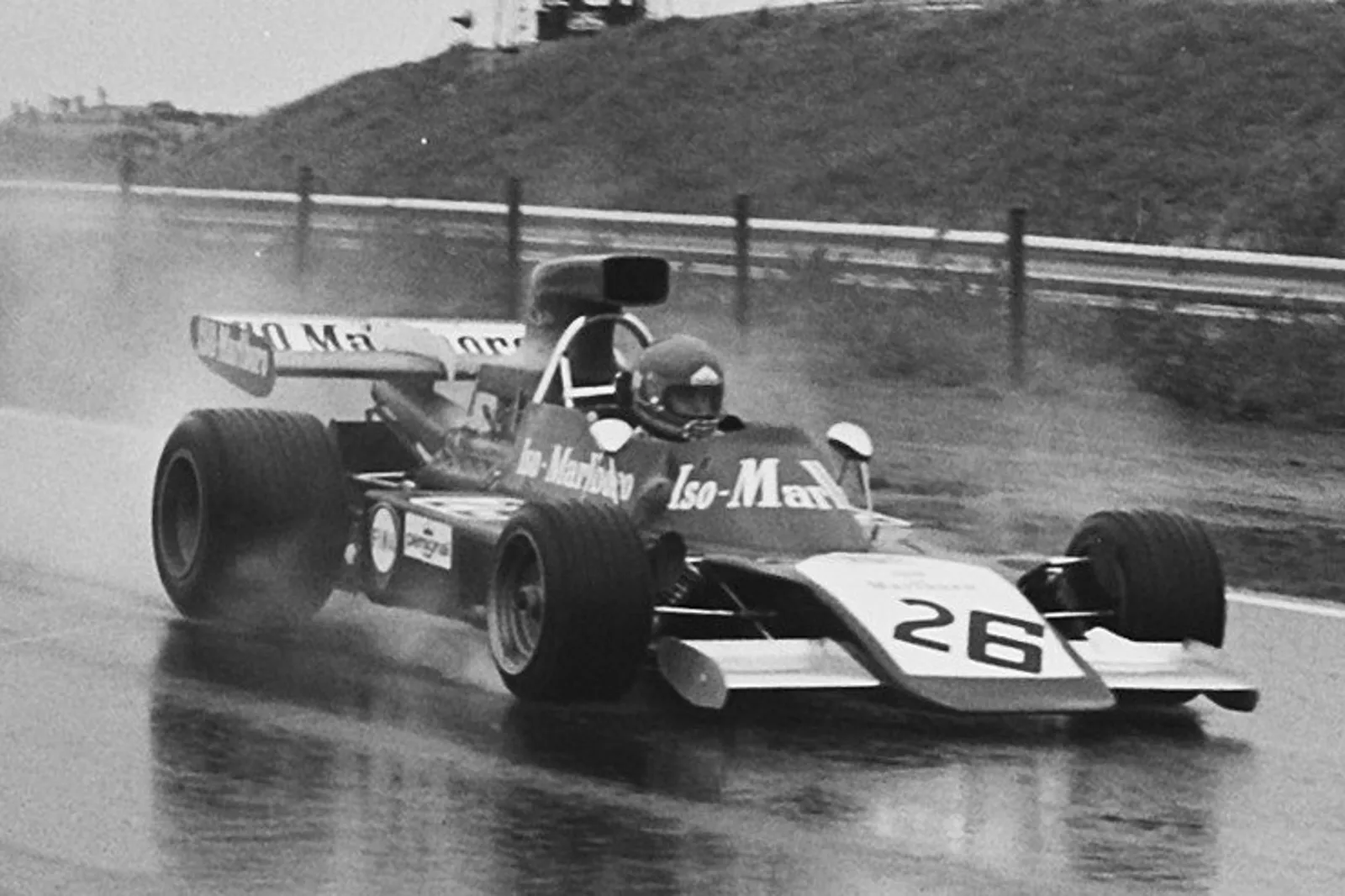
John Clarke's conventional design started as the Iso-Marlboro IR, then changed name and identity as its backers left and Frank Williams took over.
The Williams FW was a Formula One car used by Frank Williams Racing Cars across the 1973, 1974 and 1975 seasons. John Clarke designed it as the Iso-Marlboro IR, and it was renamed twice as its sponsors changed. Its best finish was fourth place at the 1974 Italian Grand Prix.
Frank Williams Racing Cars ran the FW from 1973 to 1975. The car began life as the Iso-Marlboro IR, a conventional chassis built after the team's existing car fell foul of new structural rules, and it was reworked into the FW once its backers stepped away. Results were modest, but it scored points in all three seasons and produced one notable fourth-place finish.
The story of the car is one of resourcefulness. Chassis were repaired, renumbered and renamed, and drivers came and went from race to race. Following it means tracking the same small group of cars through three different designations, on a budget that rarely stretched far enough.
Where did the Williams FW come from?
The car was a response to regulation. The team's existing car, the Iso-Marlboro FX3B, failed to meet the deformable structure rules that took effect in 1973, so a replacement had to be designed. That work produced the IR, which started the 1973 season with Marlboro and Iso as backers.
Designer John Clarke had to produce the new car in time for the season, and the team ran its first examples with a mix of drivers. The name Iso Rivolta was used for the initials of the IR, although the Italian firm was not involved in building the design.
When both backers withdrew before the 1974 season, the car took the name Iso-Marlboro FW. A third chassis was completed during 1974, and for 1975 the surviving cars took Williams names under the designations FW01, FW02 and FW03, even though they were all the same type.
Three names, one basic design, and a Canadian race in which a safety car first changed the order of the field.
What made the IR design different?
The IR was a conventional design by ex-March engineer John Clarke, following the low centre of gravity and wedge shape ideas set by the Lotus 72 and McLaren M23. Double wishbones handled the front, and the rear used upper and lower links. Springs sat outboard at every corner.
Italian engineer Giampaolo Dallara joined the team during 1973 to redesign the rear suspension, and Ron Tauranac made further development changes later in the season. The angular body was broken up only by a rounded cockpit, which gave the car a distinctive silhouette in the paddock.
The design was not revolutionary. It was a sensible answer to the rules, and its layout was typical of the period. That explains why the car stayed in contention for points across three seasons, even though by 1975 the design was becoming outdated.
How did the 1973 season unfold?
The original FX3B drove the first three races of 1973, with Howden Ganley and Nanni Galli at the wheel. The new IR made its debut at the Spanish Grand Prix, the fourth round. The first point for an Iso-Marlboro came at the Dutch Grand Prix, where Gijs van Lennep finished sixth.
Galli finished 11th in Spain, while Ganley ran out of fuel. Both drivers retired at Belgium, one with an engine failure and the other after an accident caused by a sticking throttle. At Monaco both suffered half-shaft failures, and after that race Galli left the team and retired from Formula One.
Tom Belso was a stand-in in Sweden, but he took part only in practice, and Ganley finished 11th in the car Belso had used. Henri Pescarolo overheated in France while Ganley came home 14th. Graham McRae retired on the first lap at Britain, and Ganley started 18th and finished ninth.
Germany brought the biggest setback. Ganley crashed heavily in practice after his brakes misbehaved, and the chassis was a write-off. A replacement was rushed through, keeping chassis number 02, and van Lennep came back for Austria, where he finished ninth. The rest of the year brought a mix of finishes and retirements, and at the United States Grand Prix Jacky Ickx took seventh place, the last race for the car under the IR name.
What happened at the 1973 Canadian Grand Prix?
The Canadian Grand Prix was run in very wet conditions and marked the first time a safety car was used in Formula One. Ganley briefly led the race once the safety car came in, and he finished sixth. That result gave the team its second point of 1973.
The safety car was a Porsche 914 driven by Eppie Wietzes, a former privateer. Wietzes failed to pick up the leader and kept Ganley stuck behind him, a mistake that let several drivers, among them eventual winner Peter Revson, gain a lap. Colin Chapman believed the leader was Emerson Fittipaldi, and others thought it was Ganley.
When the safety car pulled off, Ganley's IR was in front. He spent eight laps ahead of Fittipaldi and Jackie Stewart, then fought off Stewart, Hailwood, Revson and Hunt on the way to the flag. Fittipaldi crossed the line, yet the flag went to Revson instead, and Ganley was classified sixth. Tim Schenken finished 14th, five laps down.
Ganley later said he believed a first or third place was his due, and team lap charts kept during the race suggested he had been ahead at one point. The result stands as a reminder of how confused the order can become under a safety car.
How did the car fare in 1974?
With Iso and Marlboro gone, the car ran as the Iso-Marlboro FW, and at first only one example was entered for Arturo Merzario. He scored the team's first point of the year in South Africa and took the car's best finish, fourth, at the Italian Grand Prix. The team finished tenth in the Constructors' Championship.
Merzario's season was a mix of misfortune and progress. He qualified ninth in Brazil but his engine failed before the start, forcing him into the spare car. In Spain he went off on lap 38 while lying fourth, and his car went over the barriers and landed among photographers. Nobody was injured.
A second car, chassis 01, was entered for Tom Belso at South Africa, and the Dane finished eighth in Sweden after qualifying 21st. That was the best result of his career. Jacques Laffite then took over the second seat for the rest of the season after a string of non-qualifications.
Merzario's fourth place at Italy scored three points, and the team's four points for the year came from that result and a sixth place in South Africa. Laffite retired with an engine failure at Italy, and at the United States Grand Prix he outqualified Merzario for the first time, 11th to 15th, before both retired.
What changed when the car became a Williams in 1975?
Ray Stokoe revised the three surviving chassis, which took Williams names for 1975, although the design was ageing. The team ran the FW03 for most of the year while the new FW04 was prepared, and the FW04 later earned all of the team's points.
Money was tight. The team was run on a low budget and sometimes had to buy second-hand tyres from rivals. Laffite and Merzario both stayed for 1975, and the FW02 was used only for the first three races before it was retired.
Tony Brise took Laffite's place at the Spanish Grand Prix and finished seventh in the FW03. He qualified 18th, while Merzario qualified 25th in the new FW04. Spain was also overshadowed by Rolf Stommelen's accident, in which his rear wing failed and his car hit the crowd, killing five people. The Monaco grid was then cut to 18 cars.
Damien Magee took over in Sweden and finished 14th, while Ian Scheckter crashed the FW04 there. Scheckter qualified 19th and finished 12th at the Dutch Grand Prix. Ian Ashley suffered serious ankle injuries in German practice, and Laffite then surprised everyone with second place in the FW04, bringing much-needed money to the team.
Jo Vonlanthen qualified 28th in Austria and retired with engine failure, while Renzo Zorzi qualified 22nd and finished 14th in Italy. A second FW04 was built, but both cars failed to start at the United States Grand Prix. The team finished ninth in the Constructors' Championship with six points, all of them scored by the FW04.
Season by season
| Season | Designation | Main drivers | Best finish | Constructors' place | Points |
|---|---|---|---|---|---|
| 1973 | Iso-Marlboro IR and FX3B | Ganley, Galli, van Lennep, Schenken, Ickx | 6th (Ganley, Canada; van Lennep, Netherlands) | 10th | 2 |
| 1974 | Iso-Marlboro FW | Merzario, Belso, Laffite | 4th (Merzario, Italy) | 10th | 4 |
| 1975 | Williams FW01 to FW04 | Laffite, Merzario, Brise, Magee, Scheckter | 2nd (Laffite, FW04) | 9th | 6 |
What became of the car after Williams?
In 1976 the FW03 changed hands, moving from Frank Williams to Loris Kessel, who revised it heavily and renamed it the Apollon. Kessel entered the car for the 1976 Italian Grand Prix, but it did not run. A year later he was more than six seconds short of qualifying and crashed in the final qualifying session.
The Apollon was the last chapter for a car that had begun as the IR. Its later history shows how a single chassis could be rebuilt and sold on, while the Williams team moved its attention to the FW04 and to the designs that followed it.
Why does the Williams FW still matter?
The Williams FW matters because it carried a small team through regulation change, sponsor withdrawal and a change of name. Its points tally grew from two to six across the three seasons, and its best finish, fourth at Italy in 1974, came from a chassis that had started as the Iso-Marlboro IR.
The car is also a useful case study for independent teams. It shows how new rules could force a fresh design, how a backer leaving could change a car's name overnight, and how a tight budget could turn even tyre supply into a matter of planning.