A one-off 1985 Australian sports racer that John Bowe drove to a dominant 1986 title, then to a final appearance against world-class rivals at Sandown.
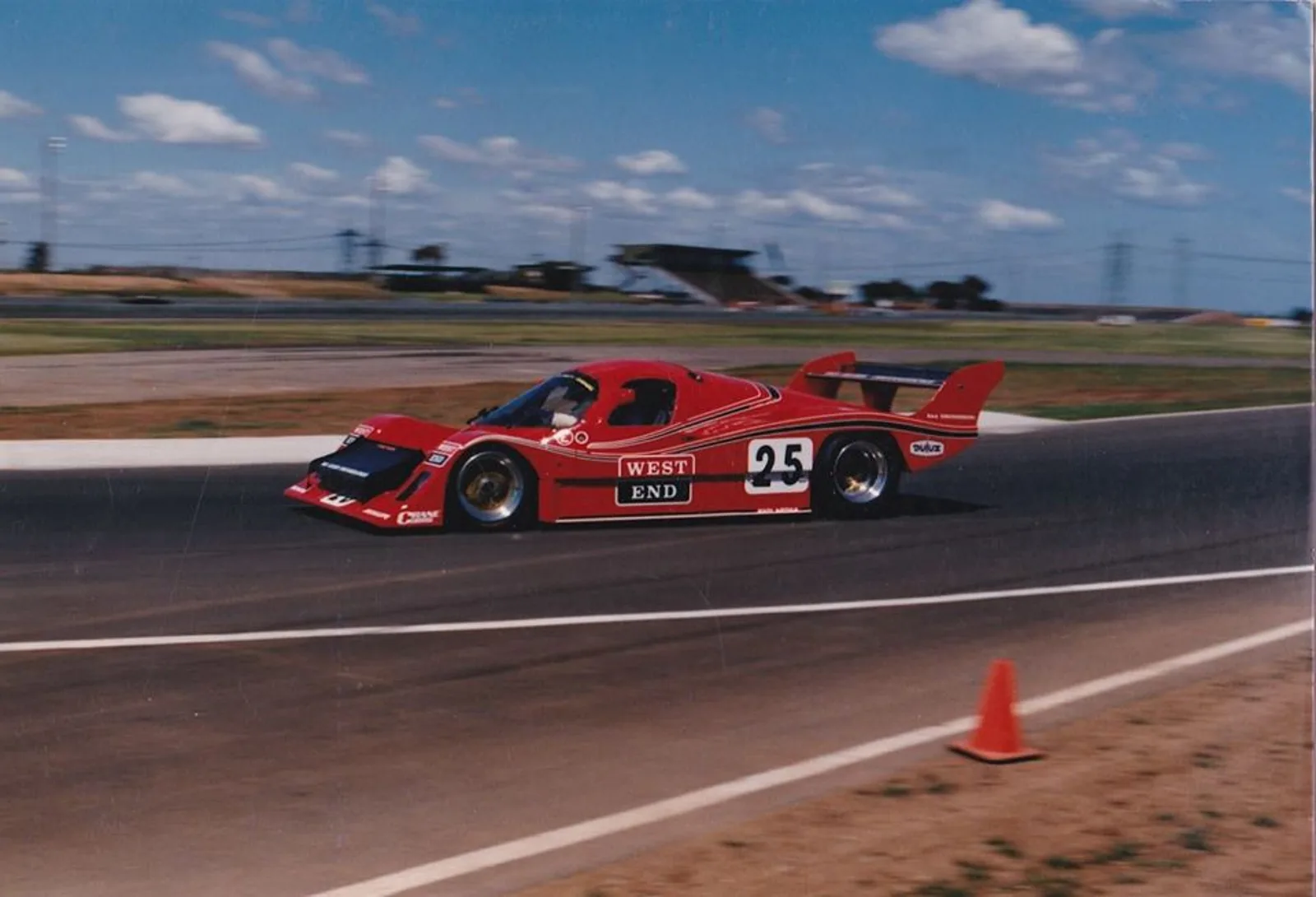
The Veskanda C1 was a one-off closed-top racing car built in Adelaide and designed and built in Australia in 1985. Powered by a Chevrolet V8, it was driven by John Bowe to a dominant 1986 national championship and is generally regarded as the fastest sports car ever built in Australia.
The Veskanda C1 was a single example of a racing sports car, conceived and assembled in Adelaide in 1985, and it still ranks among the quickest race cars Australia has produced. Its closed-top, mid-engined body carried ground effect aerodynamics and a Chevrolet V8. John Bowe drove it to a dominant 1986 national championship, and it made a final competitive appearance at Sandown in 1988.
Why was the Veskanda built?
The idea came from a race held in December 1984. That month Australia hosted its first FIA World Championship event, a 1000 km contest at Melbourne's Sandown Raceway, roughly eleven months before the 1985 Australian Grand Prix in Adelaide. Among the people watching was Bernie van Elsen, an Adelaide photographer who also competed in the Australian Sports Car Championship. He resolved to build a sports car for the Australian Group C category.
Van Elsen intended to campaign the car in the 1985 and 1986 World Sportscar Championship rounds planned for Sandown. Both of those rounds were called off, so the project turned its attention to national racing, where it did far better than its creators could have expected at the outset.
A one-off Australian racer that won every race it could in 1986, then stood on the same grid as the world's best at Sandown.
Who built the car, and what did they use?
Van Elsen gave the work to K&A Engineering, a firm in Adelaide run by Dale Koennecke and Harry Aust. Koennecke had previously been an engineer with Garrie Cooper's Ansett Team Elfin. The brief was demanding: the car had to satisfy CAMS Group A rules, FIA Group C requirements and American IMSA GT regulations simultaneously.
K&A had a strong record in Australian motorsport. The firm had rebuilt John Briggs' Dekon Chevrolet Monza and had worked on the Alfa Romeo Alfetta GTV owned by Don Elliot, which Tony Edmonson took to the national sports car titles in 1980 and 1981. For the new car, van Elsen acquired an aging Lola T400 F5000 and kept its suspension, gearbox and 5.0 litre Chevrolet V8. That engine was good for roughly 520 hp (390 kW).
What set the Veskanda's design apart?
The chassis was an aluminium monocoque, and the rear wing was a full-width unit inspired by the Porsche 956. A smaller front wing could be fitted when extra downforce was required. Porsche later tested similar wings in a wind tunnel and found they disturbed the airflow and increased drag, a fact that was apparently not passed on to customers and was unknown to K&A.
The regulations shaped the layout as well. To meet the Group C and IMSA GTP rules the pedal box sat roughly in line with the front axle, and the bodywork was entirely fibreglass. The name itself was an acronym of van Elsen's surname and the builders' initials, Van Elsen Special K AND A.
The Veskanda was not the first machine of its kind in the country. The Romano WE84, built in Queensland by Barry Lock in 1982, held that distinction. Lock had begun with the Kaditcha K583, and the Romano ran a former McLaren Cosworth DFV Formula One V8. In 1984 the Romano dominated the national championship under its owner, Bap Romano. By the time the Veskanda appeared in 1985, the Romano had moved from a 3.0 litre Cosworth DFV rated at 430 hp (320 kW) to a 3.9 litre Cosworth DFL V8 rated at 530 hp (400 kW), which gave the Chevrolet-powered newcomer a serious rival.
How did the car make its debut in 1985?
By June 1985 the Veskanda was ready, and van Elsen signed John Bowe, the 1984 and 1985 CAMS Gold Star winner, to pilot it in the national sports car series. A test session at Adelaide International Raceway ended with a wheel failure, and the setback pushed the debut back two months. Bowe finally appeared in Round 4 at that same circuit.
His first success arrived in the following round at Calder Park in Melbourne. He defeated Chris Clearihan, who had previously dominated in a Kaditcha Chevrolet and would later take the series crown, along with Terry Hook, whose ex-1982 Le Mans Lola T610 carried a 3.9 litre Cosworth DFL. Bowe's late-season efforts were enough to finish seventh overall. The Kaditcha had been the car to beat until then, so the Calder Park result marked a clear change in the balance of the series.
Why did Bowe dominate the 1986 championship?
CAMS raised the capacity limit for over 3 litre cars for 1986, moving it from 5,000 cc (305.1 cu in) to 6,000 cc (366.1 cu in). Van Elsen took the opportunity and swapped the 5.0 litre engine for a Chevrolet 350 (5.7 litre) V8 rated at 590 hp (440 kW). The 5.7 litre was preferred to a 6.0 litre unit because the race fuel allowance made the bigger engine less attractive. The fuel limit also brought the national series into line with World Sportscar Championship rules, which Australian cars would later need to meet at Sandown.
With the upgraded powerplant Bowe was untouchable. He secured pole at each of the five rounds, took victory in all seven races that counted toward the title, and recorded the fastest lap in every one of them. Several of those laps were outright circuit records, including at Calder Park and at the quick Surfers Paradise International Raceway.
| Year | Result | Note |
|---|---|---|
| 1985 | Bowe 7th overall | One race win at Calder Park |
| 1986 | Bowe champion on 120 points | Pole at all 5 rounds, 7 race wins |
| 1987 | Bowe 2nd, 19 points behind Andy Roberts | Only three rounds were run |
| 1988 | Sandown World Sportscar race, 8th before disqualification | The car's final competitive race |
Bowe ended 1986 with 120 points, a maximum, which left him 34.5 clear of Terry Hook's Lola and 42.5 clear of the reigning champion, Clearihan. His lap of 52.69 at the 2.280 km (1.417 mi) Calder Park circuit had not been bettered by June 2025. At the 3.219 km (2.000 mi) Surfers Paradise layout his 1:04.3 stood until that circuit shut in 1987.
What went wrong in the 1987 season?
The 1987 national championship was reduced to three rounds after three planned rounds were cancelled for lack of entries. Some observers believed the Veskanda's dominance had kept rivals away. Engine trouble in the wet opener at Calder Park made back-to-back titles unlikely, and the car lost ground straight away.
Bowe fought back at Amaroo Park and Sandown, but he finished the year second, 19 points adrift of Andy Roberts. Roberts had built his own Roberts SR3, which used a 1.6 litre Ford making around 220 hp (160 kW). CAMS scoring favoured smaller cars that finished high in the outright order, so Roberts earned 27 points for his second place at Amaroo, while Bowe's win there was worth only 25. Fourth places in the first and last rounds sealed the title for Roberts. The points system, rather than raw speed alone, decided that title.
Bowe's Amaroo victory also produced a circuit record of 44.36 seconds, which lasted until the track closed in 1998.
Why did the 1988 Sandown race matter?
Bowe joined the full-time Group A touring car program in 1988, so the Veskanda was not entered in that year's national sports car championship. That series turned out to be the last one CAMS ever ran. The car still raced in South Australia, and Mick Monterosso set the short circuit lap record at Adelaide International Raceway in it.
The final round of the 1988 World Sportscar Championship returned to Sandown for a 360 km race. Australian machines had been excluded from the 1984 event because they did not meet WSC rules, but the Veskanda was compliant, so van Elsen entered it with Bowe. His co-driver was Dick Johnson, the four-time Australian Touring Car Champion, who had raced a Chevrolet Monza in 1984. Johnson had won a support event in the car at the 1988 Australian Grand Prix to prepare.
For Sandown the car received a 600 hp (450 kW), 6.0 litre Chevrolet V8. The opposition was formidable: Jaguar XJR-9s from Tom Walkinshaw Racing carried 750 hp (560 kW) 7.0 litre V12s, the Sauber C9s used 800 hp (600 kW) turbocharged 5.0 litre Mercedes-Benz V8s, and the turbo Porsche 962s made 780 hp (580 kW) from their 3.0 litre engines.
The team openly accepted that its car lacked the outright power and fuel sophistication of the works machines, yet Bowe still qualified eighth in 1:35.510. That was the quickest time an Australian driver and car had recorded at the 3.9 km Sandown track, but it was 6.89 seconds off the pace of pole sitter Jean-Louis Schlesser, whose Sauber C9 set the lap of 1:28.620. Johnson reported heavy understeer through the tight infield.
Bowe and Johnson finished eighth, six laps behind the winning Sauber, but both were later disqualified for exceeding the 190 litre fuel allowance. CAMS closed the national sports car series after 1988, and with Sandown once again a one-off, that race became the Veskanda's last competitive outing.
What happened to the Veskanda after racing?
The car sat idle until former Sports Sedan racer John Briggs bought it and restored it. It returned to track at the Historic Sandown meeting in 2007, running a V8 Briggs called very tired. In 2011 he raced it against historic sports cars, among them a Porsche 956, at the Phillip Island Classic.
In Europe the car has been campaigned by Western Australian driver Paul Stubber in classic events. At the Le Mans Legend race in 2012 the Chevrolet reached 259 km/h (161 mph) on the Mulsanne Straight on its way to eighth. Stubber competes in the Group C C1 historic series, which visits circuits such as Le Mans, Silverstone and Spa-Francorchamps, and he placed 10th in 2012 and 5th in 2013.
The engine now in the car is a 650 hp (480 kW), 6.0 litre Chevrolet V8 built by KRE Race Engines in Queensland. KRE is best known in Australia for supplying V8 Supercars teams and a number of the country's leading sprint cars.
What is the Veskanda's place in history?
The car holds a respected place in Australian sports car history, and its 1986 season remains a benchmark for dominance in the national series. Its Calder Park lap record was still unbeaten by June 2025, which gives its results a lasting place in the record books.
The Veskanda also shows what a small Adelaide team could achieve with a donor chassis, a clear rulebook and a strong driver. Its engine changes over the years, from the 5.0 litre unit to the 6.0 litre V8 now fitted, track the growth of Australian sports car racing in the 1980s. Its story runs from a local spectator's idea to a national title and then to a historic revival in Europe.
For fans of Australian motorsport the car is a reminder of an era when local teams built their own machines to take on the best cars in the world.