A double-diffuser design that never reached a Grand Prix, the car was caught in Toyota's exit and passed between rival teams for a year.
The Toyota TF110 was a 2010 Formula One car designed by Pascal Vasselon for Toyota Racing. Toyota withdrew in November 2009 before the car could race, and rival teams then tried to acquire it without success.
The Toyota TF110 was a Formula One single-seater built for the 2010 championship, and it never started a Grand Prix. Its main feature was a double diffuser that its designers regarded as the most extreme of its time. Toyota quit the sport before the car could race, and it was then passed between rival teams for a year, none of which managed to put it on the grid.
What was the Toyota TF110?
Pascal Vasselon, a Frenchman who was the team's technical director at the time, designed the TF110 for the 2010 season. It ran a Toyota RVX-09 V8 of 2.4 litres (2,398 cc) and was shod with Bridgestone tyres. Two chassis were completed, and both were built to a design that Vasselon called extreme.
The car was intended to be the next step in a programme that had yet to win a race. Its aerodynamics were an evolution of the earlier TF109, but the TF110 carried a raised nose and the diffuser that drew the most attention in the paddock.
A double-diffuser car with no race record still shaped the designs of the teams that came after it.
How did Toyota reach its 2009 position?
Toyota announced its entry into Formula One in 1999, on the back of a World Rally Championship record of seven drivers' and constructors' titles and a presence at Le Mans. The team was based in Cologne, where the rally and endurance programmes were housed alongside a wind tunnel and facilities for engines and gearboxes.
A planned V12 engine was ruled out by the FIA, and that forced the debut back to 2002. The team tested a prototype, the TF101, in 2001 and entered with a large budget and two drivers, Allan McNish and Mika Salo. The TF102 finished ninth in the constructors' table, and the 2003 and 2004 seasons each ended in eighth place.
The team then reached its high point. In 2005 Jarno Trulli and Ralf Schumacher delivered five podium finishes, and the team climbed to fourth in the constructors' table. Things soon slipped again, and sixth places followed in 2006 and 2007. Timo Glock replaced Ralf Schumacher in 2008, and with Trulli the team reached fifth in the table. The TF109 of 2009 used a double diffuser in the style of the Brawn BGP 001, and it produced three podiums in the first four races, but inconsistent qualifying and racing left the team fifth overall.
Why did Toyota withdraw from Formula One?
Honda had left at the end of 2008 because of the global economic crisis, and Toyota at first kept going by extending its partnership with its main sponsor, Panasonic. It cut its budget to about 165 million euros, let dozens of temporary staff go and ended its hosting of the Japanese round at Fuji Speedway. Over eight seasons it had spent around $3 billion, more than any other team.
The board met in Tokyo on 4 November 2009, the day after the final race at Abu Dhabi, and confirmed the exit. The decision followed discussions with drivers including Kimi Raikkonen, Robert Kubica and Kamui Kobayashi about racing the TF110. Toyota's president, Akio Toyoda, had briefly considered staying until 2012 before the board voted to leave. Sales of cars had dropped by a quarter by mid-2009, and the company's losses ran past 5 billion euros.
Toyota left as the third manufacturer to quit in twelve months, after Honda and BMW Sauber. The company said it would focus on its core business and keep backing young drivers in lower categories.
How was the TF110 engineered?
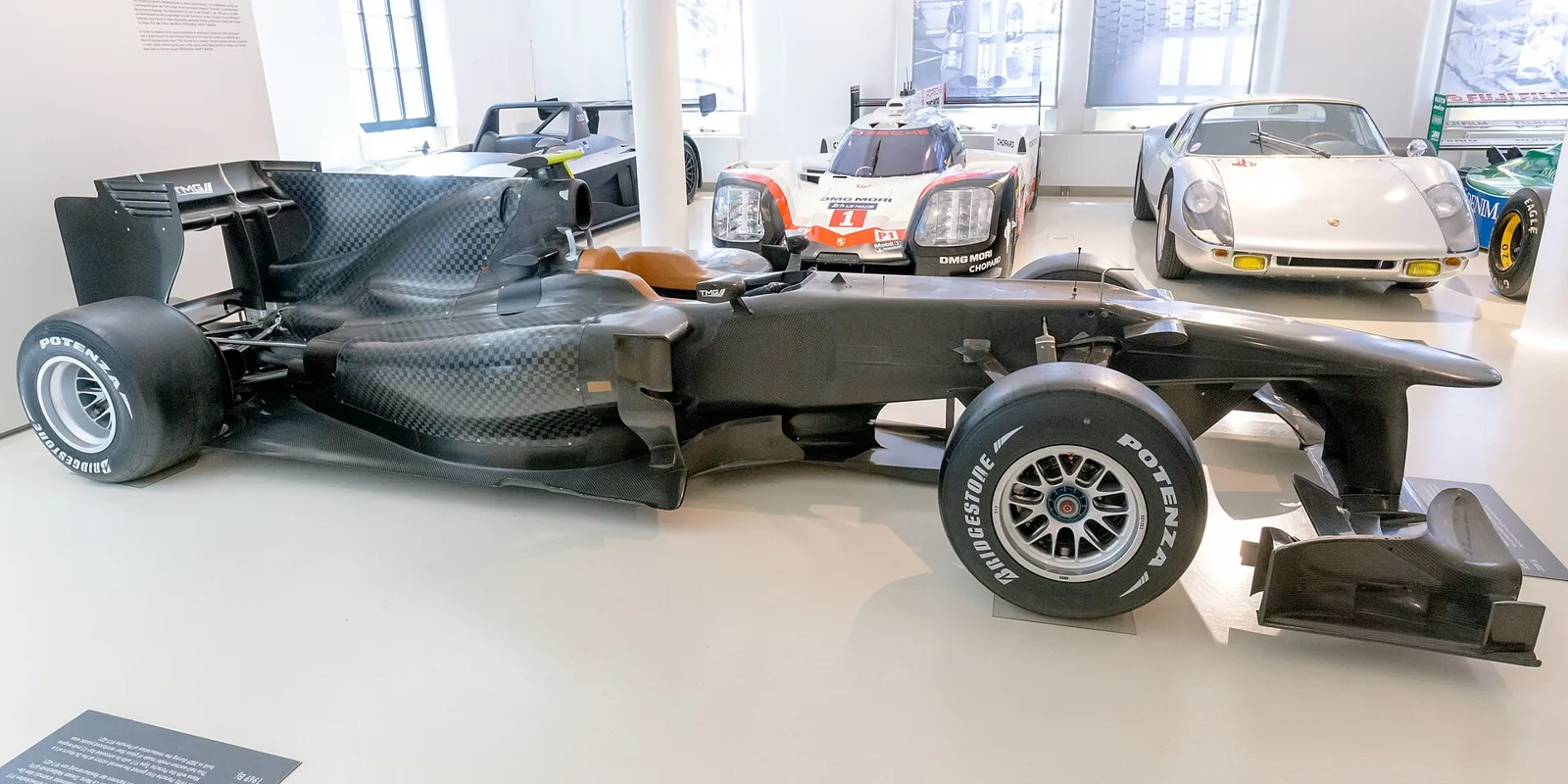
Vasselon described the car as extreme. It weighed 620 kg (1,370 lb) with the driver, plus 45 kg (99 lb) of ballast, and it measured 5,050 mm (199 in) long and 1,800 mm (71 in) wide. Its monocoque was moulded from carbon fibre, and its wheelbase of 3,300 mm (130 in) was 210 mm (8.3 in) longer than the TF109's. The extra length was a response to the new ban on refuelling during races, which also helped limit the excessive tyre wear that had been a flaw of the earlier car.
| Item | Toyota TF110 |
|---|---|
| Engine | Toyota RVX-09 V8, 2.4 litres (2,398 cc) |
| Gearbox | Seven-speed titanium semi-automatic sequential, designed in-house |
| Fuel tank | 220 litres |
| Length | 5,050 mm (199 in) |
| Width | 1,800 mm (71 in) |
| Wheelbase | 3,300 mm (130 in) |
| Weight with driver and ballast | 620 kg (1,370 lb), plus 45 kg (99 lb) of ballast |
| Tyres and wheels | Bridgestone on BBS wheels |
| Dampers | Ohlins |
Its gearbox cooling duct sat above the unit, much as it did on the Red Bull RB6, and the larger tank and refuelling ban prompted that choice.
What made the TF110 aerodynamically unusual?
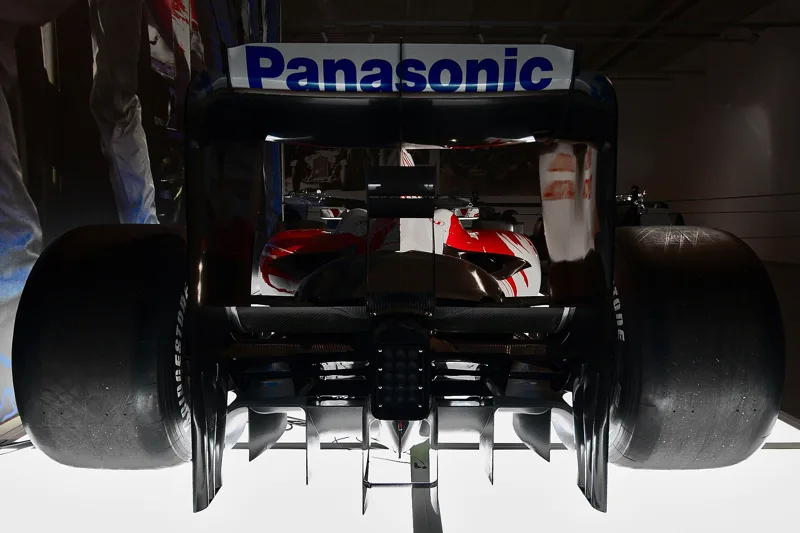
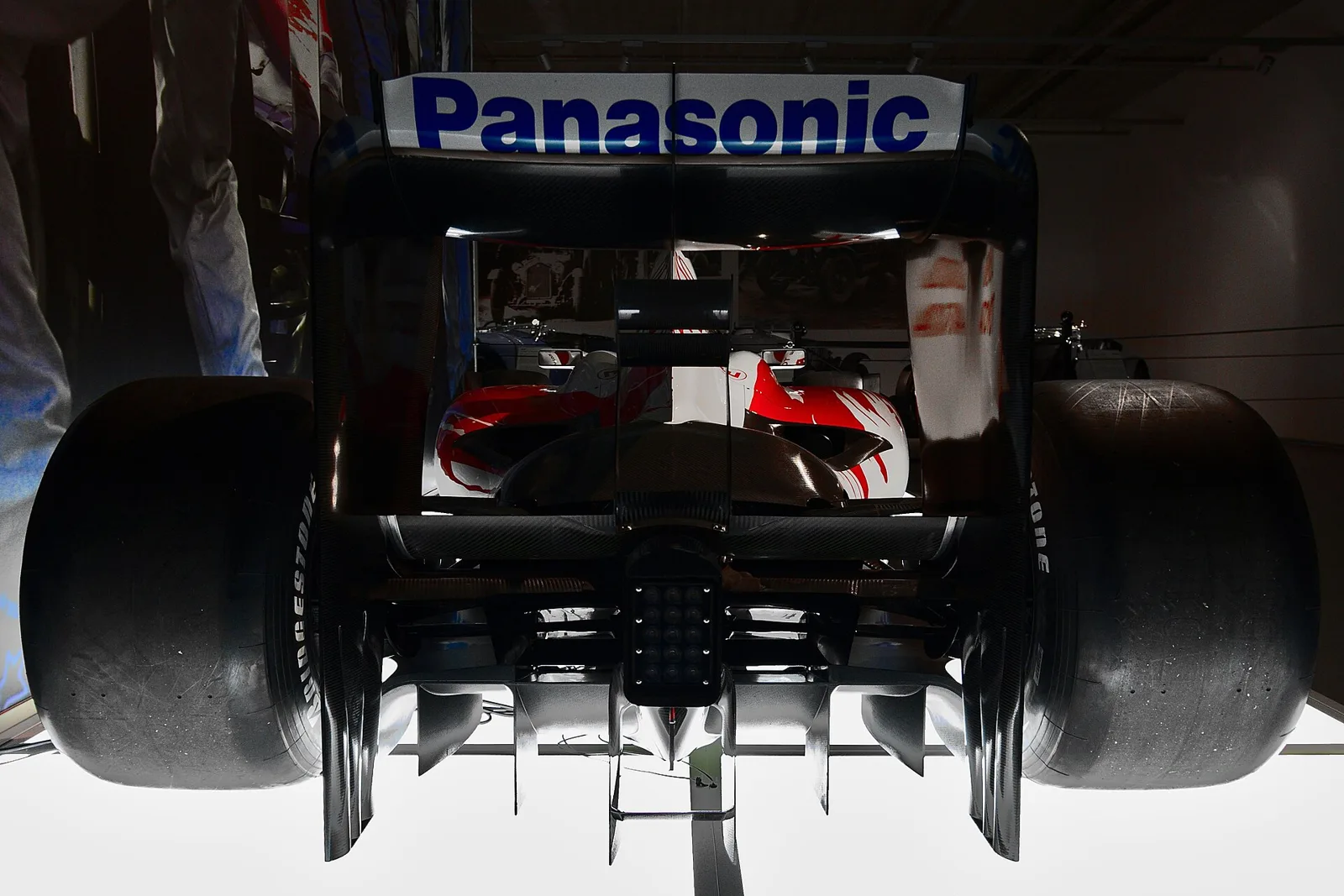
The rear diffuser was the feature that drew attention. Designed by the Italian engineer Giuseppe Azzollini, it carried tiny wings beside the brake ducts and deflector plates on top, and Vasselon regarded it as the most advanced of its time. Azzollini later joined Scuderia Ferrari, and the double diffuser was adopted for the Ferrari F10 after Toyota's withdrawal.
At the front the highly raised nose improved airflow around the car. Sauber later produced a similar shape for its C29. The suspension used carbon double wishbones with pushrods, plus a rocker and torsion bar, and the rear wishbones carried a Cambridge inerter that had first been tested on the TF109 late in 2009.
How good was the TF110 on paper?
Timo Glock spent significant time in the simulator with the car and said it was tailored to his style. He believed he could have won races or challenged for the title. Glock also said that engineers who had moved from Toyota to Ferrari told him Toyota's aerodynamic points were ahead of Ferrari's when it left the sport. Ferrari went on to win five Grands Prix in 2010.
Vasselon described the aerodynamic position in similar terms. He said that when development stopped, the car had 20 to 30 additional downforce points, and that the targets had been exceeded by a wide margin. A blown diffuser was due at the season opener, and Vasselon argued that Toyota and Red Bull would have led the way with it. Those claims cannot be tested, since the car never raced.
Did the TF110 ever take to the track?
It did once. In May 2010 the Japanese driver Kazuki Nakajima ran a shakedown in the car park of Toyota Motorsport's factory in Cologne, in front of British and Japanese journalists. The car was painted red in the colours of Stefan GP, the team that had hoped to take it over.
That was the TF110's only running. Two chassis were built, and the first, TF110-01, was later damaged by John Howett, the team's president, during a farewell drive when he hit a wall. The second, TF110-02, remains unpainted and sits on show in Hamburg, at the Automuseum Prototyp.
Who tried to take over the TF110?
Toyota's withdrawal left a vacant 13th slot on the 2010 grid, which was eventually given to Sauber. The most advanced effort to fill the gap was led by Zoran Stefanovic, a Serbian businessman whose team, Stefan GP, signed a partnership with Toyota on 29 January 2010. The agreement took in technical help, access to the Cologne plant, the car itself, its engine and gearbox, and Kazuki Nakajima's services.
The team was rebadged the Stefan S-01 and started its car in Cologne on 19 February 2010. It was not, however, entered by the FIA for 2010. Equipment was shipped to Bahrain and Malaysia ahead of the opening rounds, and the team looked at drivers for the second seat, but the FIA's entry list in March did not include the team. The partnership was then terminated.
Other groups tried as well. Durango Automotive, an Italian team that had withdrawn from GP2 for financial reasons, planned to buy the chassis in April 2010 and then partnered with Jacques Villeneuve in July, forming Villeneuve Racing. Pirelli, selected as the sole tyre supplier for 2011, bought a TF109 for testing rather than the TF110. Hispania Racing considered the TF110 plans as a basis for a 2011 car, but talks collapsed in late 2010.
Why did Toyota's results stall after 2005?
Toyota's results stalled after its 2005 peak, with fourth place in the constructors' table giving way to sixth in both 2006 and 2007. The TF106 had been expected to challenge for race wins, but it disappointed, and the team's direction came under scrutiny.
Mike Gascoyne had come from Renault to replace Gustav Brunner as technical director, but he was dismissed early in 2006 and replaced by Pascal Vasselon. His rapid decision-making was criticised for clashing with the corporate culture, which put a premium on a careful and measured process.
The 2006 rules brought mandatory V8 engines and a change of tyre supplier to Bridgestone, and the balance of power shifted again. Vasselon's arrival did not immediately restore the team's form, and the TF106 stayed at the centre of the criticism.
What doubts surrounded the Stefan GP project?
Stefan GP had ambition but thin foundations. The team had about 60 employees of its own, while the Cologne factory employed 180 staff, yet the company linked to the project had capital of only 500 euros. Toyota itself expressed doubts about whether the project was viable.
The S-01 had passed FIA crash tests in late December 2009, though its rear had to be lightened, and Mike Coughlan, a British engineer, had been hired as technical director. Stefanovic insisted the car was ready and that only tyres stood in the way. Bridgestone supplied tyres only to registered teams, so Stefan GP had to fall back on GP2 Series tyres. A four-day test at Portimao from 25 to 28 February was cancelled three days before it was due to begin, because of the tyre position and safety concerns.
The team also talked about a merger with USF1, which had asked to delay its entry until the fifth race. Those talks failed. On 3 March 2010 the FIA published its entry list, USF1 had withdrawn for lack of funds, and Stefan GP was not selected, because a new tender was needed.
Stefanovic's wider claims added to the doubts. He said an affiliated firm had supplied drones to the Bundeswehr and helped with the Ariane 5 rocket, but both organisations denied those claims.
What is the legacy of the TF110?
The TF110 is remembered as a car that never raced yet still influenced the sport. Its diffuser design went to Ferrari, and the raised nose appeared on rival cars, which showed that a car with no race record could still shape the designs of others.
It also stands as a reminder of how quickly a team's plans can end when economic conditions change. Toyota had spent large sums on Formula One for eight years, and the car it left behind became a symbol of an engineering programme that never reached the grid.