Toyota's works Formula One team ran from 2002 to 2009 from Cologne, scored points in most seasons, came close to victory several times and never won a race before quitting.
Toyota ran Panasonic Toyota Racing, a works Formula One team based in Cologne, from 2002 to 2009. It never won a Grand Prix, its best finish was second, and it withdrew in November 2009 before returning through a Haas partnership in 2024.
Panasonic Toyota Racing was a Formula One team owned by the Japanese manufacturer Toyota Motor Corporation and based in Cologne, Germany. It debuted in 2002, grew out of Toyota's rally and sportscar organisation, and was withdrawn by Toyota in November 2009 after eight consecutive seasons without a Grand Prix win.
What was Panasonic Toyota Racing?
Toyota announced its plans to join Formula One in 1999. After extensive testing with its first car, the TF101, the team made its debut in 2002. It grew from Toyota Motorsport GmbH, which had previously competed in the World Rally Championship and at Le Mans.
Despite scoring a point in its first-ever race, Toyota never won a Grand Prix. Its best finish was second, which it achieved five times. The company was criticised for that record, because it had one of the sport's biggest budgets and was the world's largest car manufacturer, yet its results were never consistent.
Toyota spent eight seasons in Formula One without a Grand Prix win, yet came close enough to podiums to keep a big name in the sport.
How did Toyota's motorsport roots lead to Formula One?
Toyota's early motorsport entry came in 1957, when a Toyopet Crown took part in the Round Australia Trial. The Formula One team's roots reach back to 1972, when Ove Andersson, a Swede, ran a Celica 1600GT on the RAC Rally.
The team was later renamed Toyota Team Europe and, after Toyota bought it in 1993, Toyota Motorsport GmbH. Its rally crews claimed four drivers' titles in the World Rally Championship, Carlos Sainz's among them, plus three constructors' crowns. The FIA banned it from competition for 12 months at the end of 1995 for running illegal parts.
In 1997 the team branched into sportscars, and its Le Mans entries failed to win twice. In January 1999 Toyota confirmed its move into Formula One, and it ended its rallying and Le Mans programmes to concentrate on the new venture.
Why did Toyota start its own works team?
By mid-2000 the team had its slot as the twelfth entrant for 2002. Toyota had originally intended to enter in 2001, but it forfeited an 11 million dollar deposit by delaying its entry. Unusually, it chose to start its own works team rather than partner with a specialist race team and chassis maker.
The team was also set up away from the UK's Motorsport Valley, the traditional centre of Formula One manufacturing. During 2001 Toyota tested its prototype TF101 at eleven F1 circuits, gathering telemetry that helped with the TF102. Finn Mika Salo, who could speak Japanese, and Scotsman Allan McNish, who had driven the GT-One at Le Mans, were its test drivers.
How did the 2002 debut go?
Toyota made its Formula One debut in 2002 with McNish and Salo driving the TF102, designed by Gustav Brunner. Despite reportedly having one of the biggest budgets in the sport, Toyota scored only two points all year.
Its first point came in its first race, the Australian Grand Prix, where half the field was eliminated by a first-corner accident involving Ralf Schumacher and Rubens Barrichello. Another point was lost in Malaysia, where Salo suffered an electrical misfire and the team fumbled McNish's pit stop. The second and last point came in Brazil, scored once again by Salo.
McNish then suffered a severe crash in practice for the Japanese Grand Prix and missed the race on medical advice. Neither driver was offered a seat for 2003.
What changed in 2003 and 2004?
For 2003 Toyota signed Cristiano da Matta, the American ChampCar champion of the previous year in a Toyota-powered car, and Olivier Panis, a former BAR driver. A wider points system suited the team, which scored sixteen points and finished eighth in the constructors' championship, ahead of Jordan and Minardi.
The high points included Toyotas running first and second at the British Grand Prix, thanks to pit stops made while the safety car was out, and Panis qualifying third at the United States Grand Prix. The best race finish of the season was fifth in Germany.
The 2004 season was harder. Both Toyotas were disqualified from the Canadian Grand Prix for running illegal parts. Da Matta left after the German Grand Prix and was replaced by Ricardo Zonta, who was then succeeded by Jarno Trulli, who had left the Renault works team. Panis retired from racing before the Brazilian race.
Mike Gascoyne, an ex-Jordan and Renault designer, was hired early in the year to oversee development. The car improved, and the team equalled its best finish of fifth at the US Grand Prix with Panis, while keeping eighth in the constructors' championship.
That year Toyota was also accused of industrial espionage over stolen Ferrari data files. The Cologne prosecutor led the investigation, and Toyota refused to return the data because Ferrari's material had been mixed in with its own.
How good was the 2005 season?
In 2005 Toyota's fortunes improved. Trulli stayed, and Ralf Schumacher joined from Williams. Schumacher said during the launch of the TF105 that he had a better chance of winning the title at Toyota than he had at Williams. The team also supplied leased engines to Jordan.
Trulli qualified second at the opening round in Australia and finished second at the following two races in Malaysia and Bahrain. He added third place in Spain, while Schumacher took third at Hungary and China and a pole at the Japanese Grand Prix. The team's form then slipped away slightly.
Nevertheless, 2005 was Toyota's most successful Formula One season by far, with points scored in all but the opening race and the United States Grand Prix. At that race Trulli took pole, but like all the Michelin-shod drivers he retired before the start.
Why did 2006 disappoint?
Toyota kept its drivers for 2006 but switched to Bridgestone tyres. It was the first team to unveil its new car, which was meant to give it an advantage, but the TF106 was average in testing. Schumacher's third place in Australia was the team's only podium of the year.
Trulli came close to another podium at Monaco, but his engine failed in the late stages. Schumacher took fourth in France, and Trulli came through from the back of the grid to beat Fernando Alonso's Renault at Indianapolis. The team finished sixth with 35 points, one point behind BMW Sauber.
Toyota dropped Gascoyne after the Melbourne race, which surprised observers given his role in the 2005 rise. Pascal Vasselon was eventually promoted to technical director, with the company saying a department run by one man alone was old-fashioned.
What happened in 2007 and 2008?
The TF107 was launched in Cologne on 12 January 2007, and the engines now came from Williams, which had moved away from Cosworth. Schumacher scored Toyota's first point of the season with eighth in Melbourne, and Trulli scored in the early races before the team went through a long drought.
On 1 October 2007 Schumacher announced he would leave at the end of the season, having not been offered a new contract. Toyota finished the year with 13 points, its lowest tally since 2004, and admitted it had not fulfilled its pre-season promises.
For 2008 Toyota replaced Schumacher with the reigning GP2 champion Timo Glock. The TF108 was launched on 10 January 2008, and the season opened well. Trulli finished fourth at Sepang, and then took third in France, the team's first podium in over two years. He dedicated it to Ove Andersson, who had died in a car accident the week before.
Glock took second at Hungary for his first Formula One podium, and Trulli took fifth at Valencia. At Brazil, the Toyotas stayed out on dry tyres in a torrential rainstorm, and Glock gave up fifth on the final lap to Lewis Hamilton, which was enough for Hamilton to win the title by a point.
Toyota finished 2008 with 56 points, a huge improvement on the 13 of the year before, and ranked fifth in the constructors' standings.
How did the 2009 season and the withdrawal unfold?
Toyota kept Glock and Trulli for 2009 and introduced the TF109. The team began the season strongly, scoring seven times in the first four races, with three podiums and a pole in Bahrain. Part of that form came from a loophole in the new technical rules, since Toyota was one of only three teams to start with a double diffuser.
The form dropped during the European leg, and the team was overtaken in the constructors' championship by both Ferrari and McLaren. A late recovery brought podiums in Singapore and Japan and fifth place in the constructors' title, but no victory. Glock was hurt in a qualifying crash in Japan, and Kamui Kobayashi took over for the final two rounds.
The parent company suffered its first ever financial loss in 2009. Toyota then decided to withdraw from Formula One with immediate effect on 4 November 2009. The TF110 had been almost fully developed by then, and it was never raced.
What happened to the TF110 and the grid place?
Two TF110 prototype chassis had been prepared. An agreement was reached for the Stefan Grand Prix team to take the chassis and engines, but it never competed. The struggling HRT team also tried to buy a chassis, and the deal was never completed.
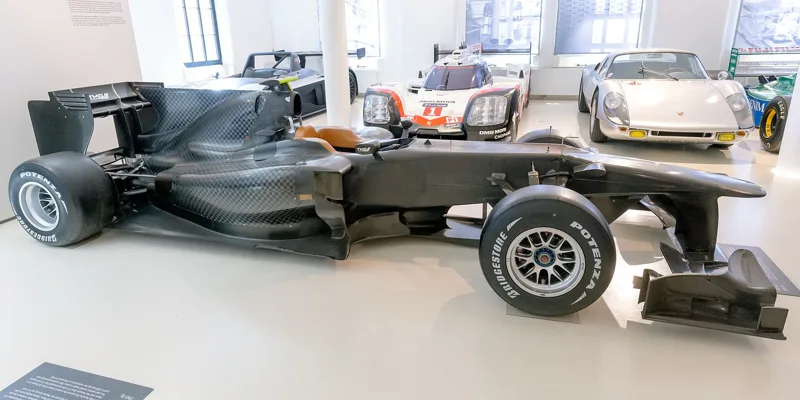
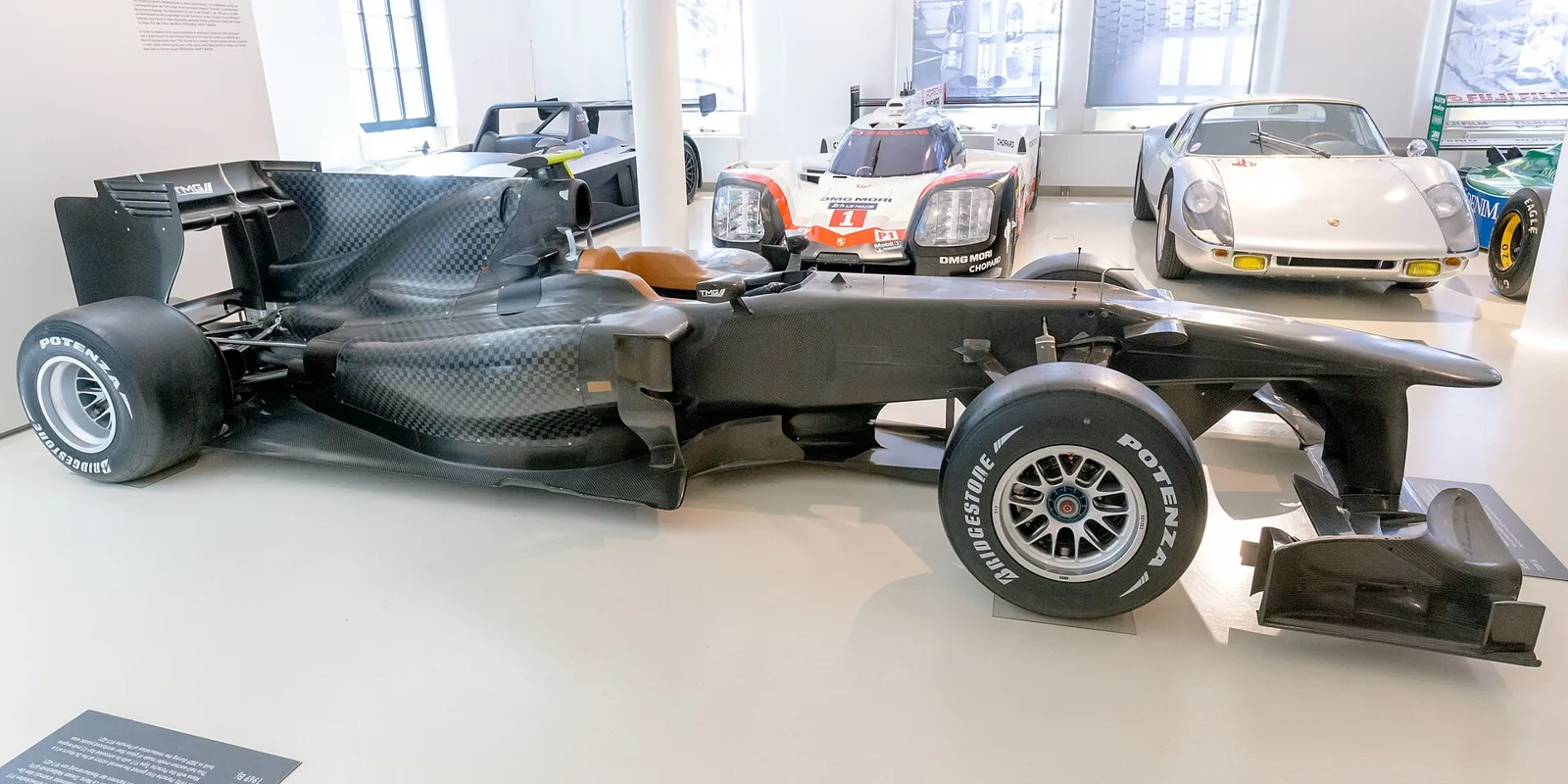
Pirelli considered using the Toyotas as development sleds for its tyres, but it chose a race-proven car instead. The second chassis remains unpainted and is on display at the Automuseum PROTOTYP in Hamburg. Many in the industry believe race wins could have come with the TF110, which had very advanced aerodynamics.
Toyota's grid place for 2010 went to Sauber, which raced as BMW Sauber despite BMW's withdrawal from the sport.
How did Toyota supply engines to other teams?
Toyota also supplied engines to other teams. Jordan used Toyota engines in 2005, and when that team was rebadged as Midland F1 in 2006, Toyota kept supplying it. Williams used Toyota engines from 2007 to 2009.
What is the link with Haas and TGR?
On 11 October 2024 Haas F1 Team announced a technical partnership with Toyota, which provides design, technical and manufacturing services through Toyota Gazoo Racing. Ferrari continues to supply power units and other components until 2028. Akio Toyoda stressed that the deal did not signal a full return to the sport, but an opportunity for staff and drivers to experience Formula One.
In December 2025 Haas and Toyota announced a title sponsorship, and Haas enters the 2026 season as TGR Haas F1 Team.
What are the key results?
| Season | Result | Points |
|---|---|---|
| 2002 | Debut season, first point at the Australian Grand Prix | 2 |
| 2003 | Eighth in the constructors' championship | sixteen |
| 2004 | Eighth, equalled best finish of fifth | Around half of 2003 |
| 2005 | Peak season, second place at three races | Most successful |
| 2006 | Sixth, one point behind BMW Sauber | 35 |
| 2007 | Points drought, lowest since 2004 | 13 |
| 2008 | Fifth, first podium in over two years in France | 56 |
| 2009 | Fifth, podiums in Singapore and Japan | Not totalled here |
What is the legacy of Toyota in Formula One?
Toyota's Formula One story is one of large resources and few trophies. Its team showed that a manufacturer with a huge budget could still struggle, and its eight seasons produced some of the best results of the era, including the 2005 peak and the 2008 podiums.
The 2024 Haas partnership brings the Toyota name back to the sport in a different form. Whether it becomes a full return will depend on how the TGR Haas team performs in the seasons ahead.