A narrow flat-eight, a Dan Gurney win in France and one season of racing before Porsche stepped back from Formula One in 1962.
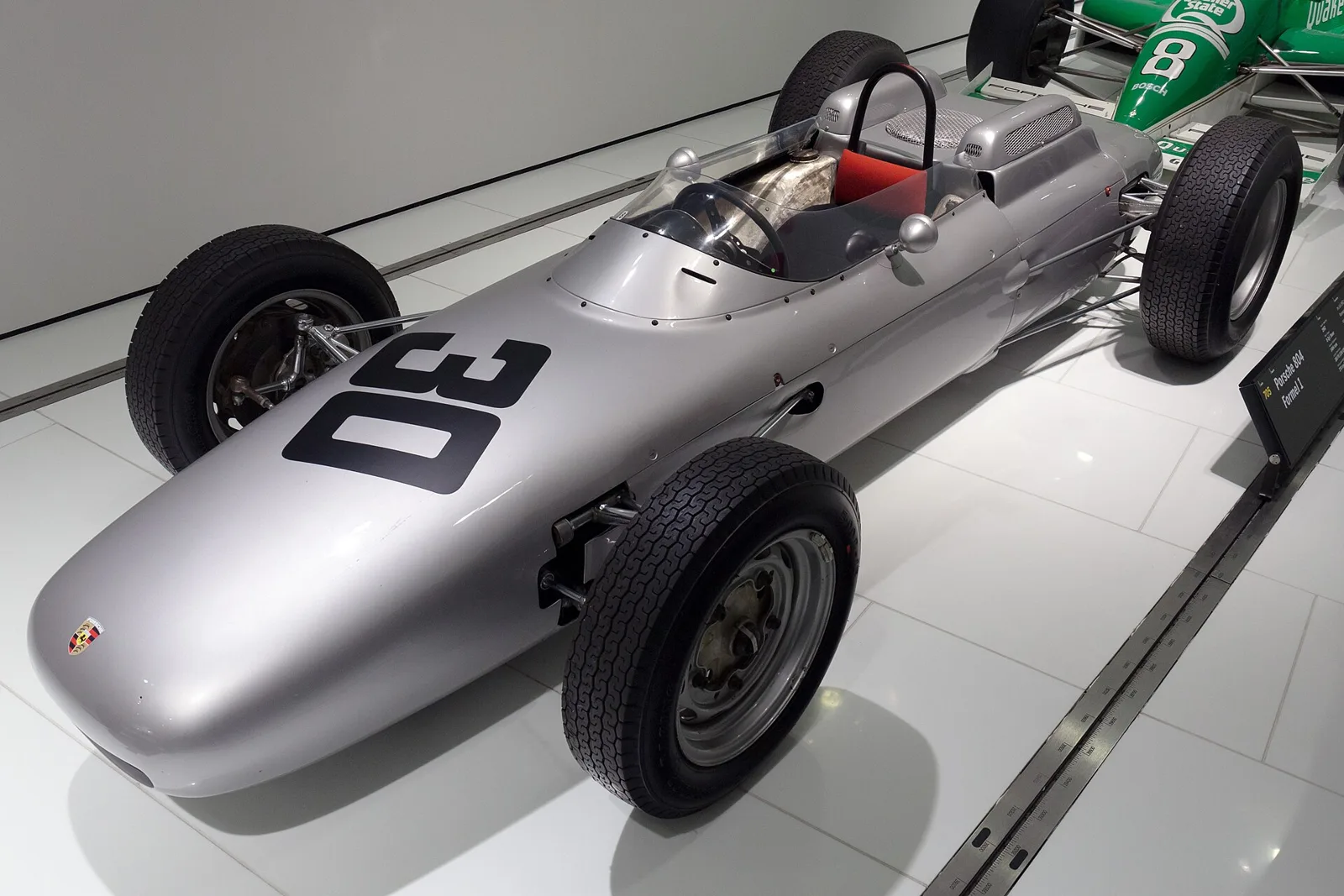
The Porsche 804 was a single-seat Formula One car that Porsche built for the 1962 season under the 1.5 litre rules. It paired a flat-eight engine with a tubular steel chassis, and Porsche withdrew from the sport after that one year.
The Porsche 804 was a single-seat racing car that Porsche built for Formula One. It raced for one season, in 1962, under the 1.5 litre formula that had been agreed for the sport. Its flat-eight engine and tubular steel chassis gave the company its only Formula One wins as a constructor.
Why did Porsche build a Formula One car in 1962?
Porsche built the 804 because the sport's rules changed. The FIA allowed enveloped bodywork in 1957 and set a 1.5 litre engine limit for Formula One from 1961, which let Porsche carry its Formula Two experience into a single-seat car. The 804 was the company's answer for the 1962 season.
Porsche's earlier cars laid the groundwork. In 1957 the company entered three 550/1500RS Spyders at the German Grand Prix Formula Two event, with only small changes such as removing the passenger seats and spare tyres.
For 1958 Porsche built the RSK Mittellenker, a modified sports car with its single seat in the centre of the cockpit. Jean Behra won the Formula Two race at Reims with it, Edgar Barth placed sixth overall at the German Grand Prix, and Masten Gregory won the heat and class at AVUS in Berlin.
The October 1958 rule change changed the plan. From 1961 Formula One engines were limited to 1.5 litres, the same as Formula Two, so Porsche could reuse its Formula Two cars with little modification.
A flat-eight built for one season, and two wins that made Porsche's only Formula One mark.
How did the 718 and 787 lead to the 804?
The 1959 Type 718/2 was an open-wheeled prototype that combined the 718 mechanicals with a traditional single-seat body. It was entered at the 1959 Monaco Grand Prix, where Wolfgang von Trips qualified twelfth but crashed on the second lap. Joakim Bonnier finished third at Reims that year.
The production 718/2 arrived for 1960 with revised bodywork, a six-speed transaxle and a wheelbase 100 mm longer. A total of five cars were built, and some of these four-cylinder machines later raced in Formula One under the 1962 rules.
The Type 787 of 1961 used a longer chassis to accommodate the Type 753 flat-eight that was still in development. The first car ran a four-cylinder engine with fuel injection and retired at Monaco when the injection cut out. A second 787 appeared at the Dutch Grand Prix, and the two cars finished tenth and eleventh. Their lack of power and poor handling persuaded Ferry Porsche to end the model.
Porsche therefore committed to a new eight-cylinder car. The 804 that resulted was narrower and lower than the 787 and used a flat-eight engine designed specifically for Formula One.
Who designed the Porsche 804?
Ferdinand Alexander Porsche, known as Butzi, designed the 804. He was the son of Ferry Porsche and the grandson of the company's founder, and the project was assigned to him by the long-serving chief body engineer, Erwin Komenda.
Wilhelm Hild and Hubert Mimler, two engineers from the racing department, worked with him on the car. Fritz Huschke von Hanstein, the racing director, oversaw the programme from the company side.
Helmuth Bott, Porsche's chassis engineer, headed the chassis design. The car used a tubular steel frame and an aluminium body, as the 787 had, but the 804 was narrower and lower with a smoother surface. Part of that smoothness came from a horizontal cooling fan mounted on top of the new engine.
The 804 was also the first Porsche to use synthetic materials for some factory body panels. Its nose and cockpit surround were made of fibreglass later in the season.
Four cars were built, and the fourth chassis was never raced. The second chassis was briefly fitted with the air-cooled four-cylinder engine from the 787 while the eight-cylinder was not ready, and it was later converted back to eight cylinders.
What made the flat-eight engine special?
The Type 753 was an air-cooled flat-eight with a 1,494.38 cc capacity, a boxer layout and an oversquare bore and stroke. Its designers kept the engine narrow and out of the airflow along the sides of the tub, although it was still wider than the V6 and V8 engines of its rivals.
| Specification | Detail |
|---|---|
| Engine | Type 753 air-cooled flat-eight, 1,494.38 cc |
| Bore and stroke | 66.0 mm x 54.6 mm |
| Power at first outing | 177 hp (132 kW) at 9200 rpm |
| Power by 1963 | 200 hp (149.1 kW) |
| Compression ratio | 10.0:1 |
| Gearbox | Six-speed with ZF limited-slip differential |
| Top speed | 270 km/h (167.8 mph) |
| Weight | 455 kg (1,003.1 lb) |
| Fuel capacity | 150 L (33.0 imp gal; 39.6 US gal) |
| Wheels | 15-inch steel |
The engine was first run on a test bench on 12 December 1960, and that first unit produced 105 hp (78.3 kW). With a compression ratio of 10.0:1, the production engine reached 132 kW (177 hp) at 9200 rpm on its first outing, which was still less than the new Coventry-Climax and BRM V8 engines.
Michael May, a Swiss engineer who had moved from Mercedes-Benz, was brought in to work on the 753 but ended up improving the four-cylinder 547/3 instead. His modified unit, called the 547/3B, produced a reliable 182-186 hp (135.7-138.7 kW). May believed the 753 was making only 140 hp (104.4 kW) at the time, and just three 547/3B engines were built.
The chassis brought other firsts. The 804 was the first Porsche to come standard with disc brakes and the first to use rack-and-pinion steering. It ran 15-inch steel wheels, while some rivals used magnesium, and its tyres measured 5.00-15 at the front and 6.50-15 at the rear.
Weight was roughly 455 kg (1,003.1 lb), only a little above the minimum of 450 kg (992.1 lb). Fuel was carried in tanks in the nose and beside the driver, with a total capacity of 150 L (33.0 imp gal; 39.6 US gal).
How did the 804 race in 1962?
The 804 debuted at the Dutch Grand Prix at Zandvoort on 20 May 1962. Gurney started eighth, and Bonnier started thirteenth. Gurney climbed to third but retired on lap ten with a broken shift linkage, while Bonnier took seventh, trailing Carel Godin de Beaufort's four-cylinder 718.
Porsche was reluctant to commit to another race. Dan Gurney spent time tuning the car and persuaded the chairman to field a single 804 at Monaco on 3 June. Gurney qualified fifth there, but a collision at the first corner involving Richie Ginther's BRM damaged the transaxle and ended his race.
The factory stayed away from the Belgian Grand Prix because of metalworkers' strikes in Germany, and Godin de Beaufort finished seventh in his 718/2. The factory used the pause for development and testing, including a revised front suspension, a redesigned gear-shift mechanism and a lower, more reclined seating position.
The French Grand Prix on 8 July, held at Rouen-Les-Essarts, was the breakthrough. Gurney qualified sixth and Bonnier ninth. Gurney won at an average speed of 163.98 km/h (101.89 mph), ahead of Tony Maggs in a Cooper, while Bonnier's race ended on lap 42 when his fuel pump failed.
Seven days on, Gurney led the Solitude Grand Prix from start to finish, with Bonnier second. The race was not part of the World Championship, but it is one of the two wins credited to Porsche as a constructor.
At Aintree on 21 July, Gurney qualified sixth and finished ninth after his clutch began to slip. Bonnier had a poor start, recovered, and then retired with gearbox trouble.
| Race | Gurney | Bonnier |
|---|---|---|
| Dutch Grand Prix | Third, retired on lap ten | Seventh |
| Monaco | Out after a first-corner collision | Fifth in a four-cylinder 718 |
| Belgian Grand Prix | Not entered | Not entered; factory out on strike |
| French Grand Prix | Won | Retired on lap 42 of 54 |
| British Grand Prix | Ninth | Retired with gearbox trouble |
| German Grand Prix | Third | Seventh |
| Italian Grand Prix | Retired on lap 67 | Sixth |
| US Grand Prix | Fifth | Did not finish |
The German Grand Prix on 5 August at the Nurburgring Nordschleife was a high point. Gurney took pole in the rain, but Graham Hill passed him on the third lap. A loose battery then forced Gurney to brace it with his foot, and he ran wide, allowing Surtees past. Gurney finished third behind Hill's BRM and Surtees's Lola, while Bonnier took seventh.
Bonnier also raced an 804 at the Kanonloppet at Karlskoga in Sweden on 12 August, where he finished third. At the Ollon-Villars hill-climb in Switzerland, the car set a record of 107.5 km/h (66.8 mph) in the 1100-1599 cc class.
Monza on 16 September brought a round of weight-saving and cooling experiments. The front tubes of the upper wishbones were removed, lightly stressed parts were drilled, and a driver-operated electromagnetic clutch was added to the cooling fan. Bonnier finished sixth, while Gurney retired on lap 67 with gearbox damage.
The last race was the US Grand Prix at Watkins Glen on 7 October. Gurney started fourth and finished fifth. Bonnier damaged his gear selector on lap ten, made two pit visits for repairs and did not finish.
Why did Porsche leave Formula One after 1962?
Porsche ended its Formula One activity before the South African Grand Prix, after the programme had cost the company 500,000 pounds sterling. Huschke von Hanstein said the company would concentrate on endurance racing and the European Hillclimb Championship, and that owners of production cars could not relate to Formula One machines.
The wider picture was harder. German strikes meant that domestic companies would not sponsor or produce special parts, tyres and fluids, so these had to be sourced in Britain. Porsche also questioned whether Formula One spending would produce technology for its production cars.
At the time Porsche was preparing the successor to the 356 and taking over the Reutter bodyworks. The company remained tied to Volkswagen and to the air-cooled flat engine design that sat at the heart of its road cars.
Work continued on paper into 1963. By then the rear end had gained upper and lower radius rods, and engine changes lifted the power to 200 hp (149.1 kW). Nothing more was raced with the car, but the flat-eight units went on to power sportscars.
Where can you see a Porsche 804 today?
A Porsche 804 is part of the Porsche Museum collection. After an eight-month restoration, the car appeared at the Grand Prix Historique in Monaco in 2016, and later at the 2018 Goodwood Festival of Speed.
Several books cover the car, including a 2009 title on the 718 and 804 that details the programme.