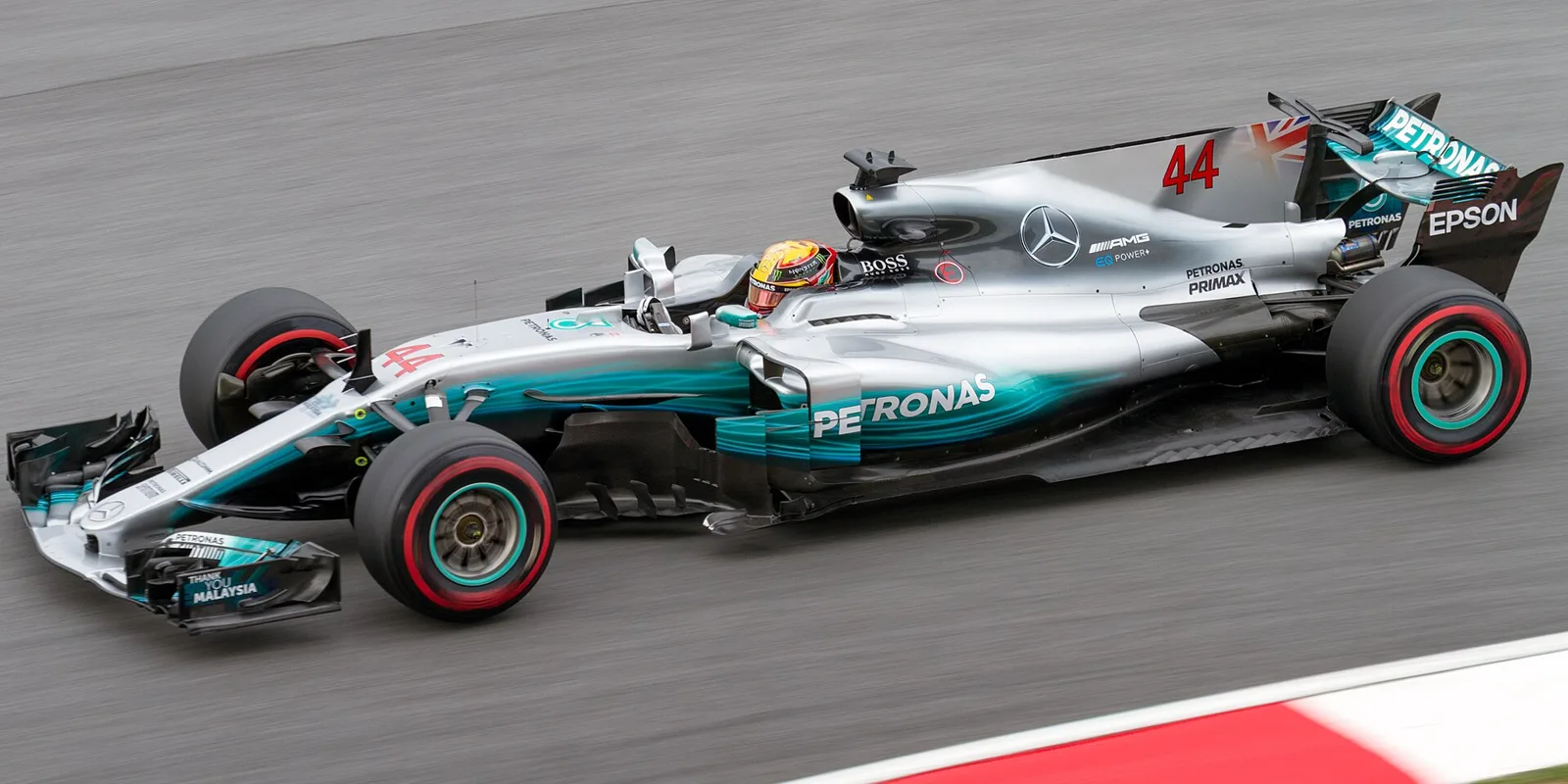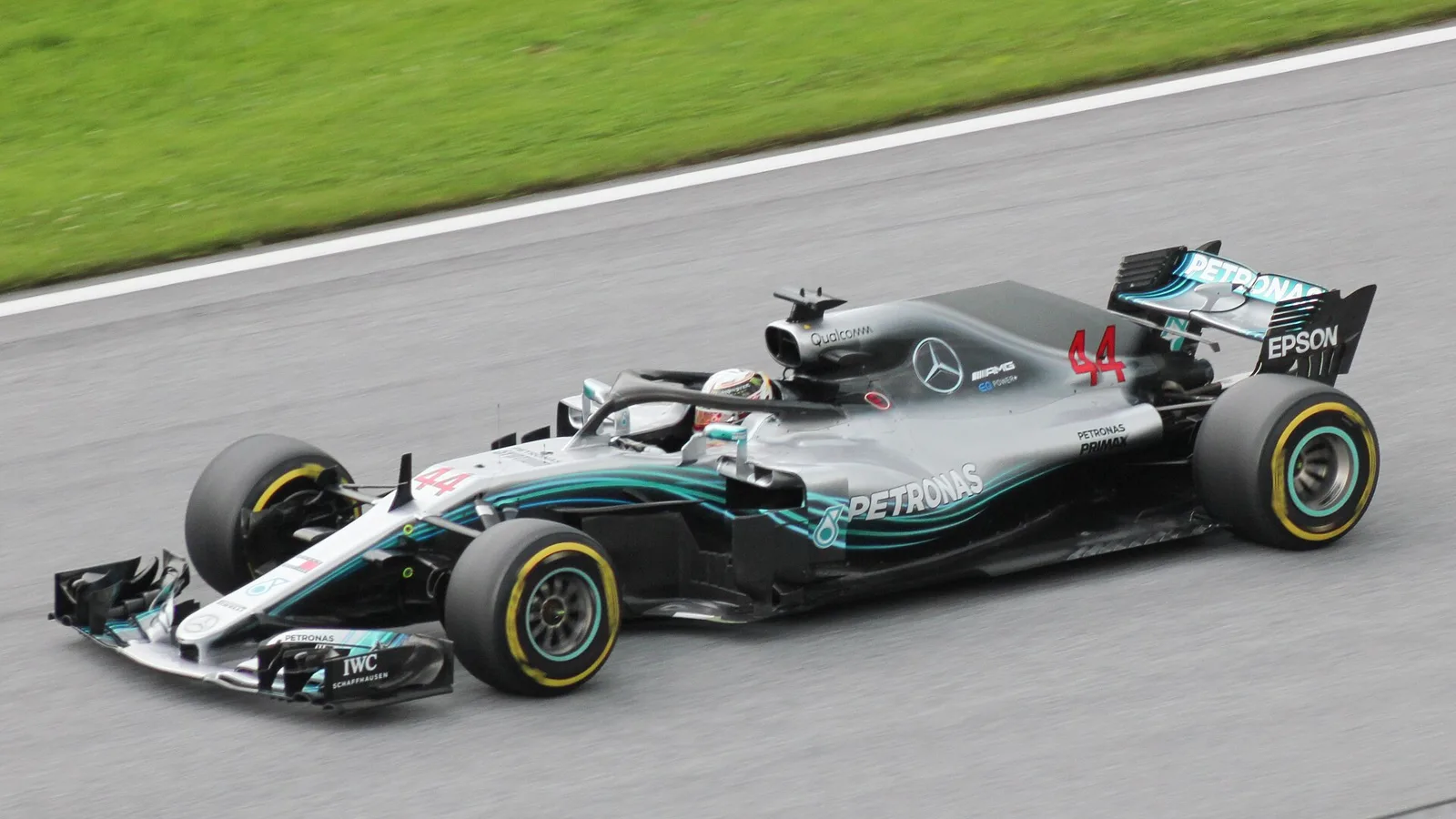
Eleven wins for Lewis Hamilton, a rake change, a titanium extension and a power unit that fell short on straight-line speed, yet enough for Mercedes to win both titles again.
Built for 2018, the Mercedes W09 won eleven races, all for Lewis Hamilton, and took thirteen poles. It carried Hamilton to a fifth world drivers' title and gave Mercedes a fifth consecutive constructors' championship. Hamilton's title came at the Mexican Grand Prix, with two rounds to spare.
The Mercedes AMG F1 W09 EQ Power+ carried Lewis Hamilton to his fifth World Drivers' Championship in 2018, and it helped Mercedes win its fifth consecutive constructors' title. It won eleven races, every one of them for Hamilton, and it took thirteen pole positions across a season that was far closer than the team had expected.
The car was a clear evolution of the W08. The team kept its wheelbase, adjusted its rake and reworked its aerodynamics and power unit through the year. The fight with Ferrari was hard-fought, and the title was not settled until the closing rounds of the season.
What was the W09 designed to do?
The W09 was designed under James Allison, Aldo Costa and Mark Ellis, with John Owen and several other engineers, including Eric Blandin, in the design group. It was the ninth Formula One car Mercedes had built since 2010. Its name carried over the EQ Power+ branding from the W08, which promoted the company's electric road cars, while the AMG part recognised the link between Mercedes-AMG and Mercedes-Benz.
Hamilton, a four-time World Drivers' Champion, was in his sixth season with the team. Bottas was starting his second, and the two drivers were the same pairing that had carried the team through 2017. The car made its competitive debut at the Australian Grand Prix and made its final appearance at the Abu Dhabi Grand Prix at the end of the year, having taken part in 21 rounds.
A car that won eleven races and still had to be nursed through a season of close fights with Ferrari.
How did the W09's dimensions compare with its rivals?
The W09 kept the same wheelbase as its predecessor, 3,726 mm (146.7 in), which made it one of the longest in the 2018 field. Rake went up by three-tenths of a degree, from 0.9 to 1.2. That was still shallower than the Ferrari SF71H at 1.5 degrees and the Red Bull Racing RB14 at 1.9 degrees, but the car was seen as a close match for the Ferrari in performance.
A titanium extension ran from the rear wheel hub to the outboard end of the upper wishbone, lifting that point high above the top edge of the wheel hub. The idea gave the air travelling from the side-pods to the gap between the rear tyres and the diffuser a clearer route than a conventional layout. Moving the wishbone's pivot point also lowered the rear roll centre, which helped the car's centre of gravity and centre of pressure.
What were the W09's main aerodynamic upgrades?
At Azerbaijan Mercedes trialled a spoon-shaped central section on the main wing profile, with serrations on its trailing edge to create vortices. The spoon shape cut drag and downforce at the outer ends of the wing, which helped straight-line speed when the drag reduction system was open. The serrations, bonded to the underside, worked to energise the airflow and recover some of the downforce lost at the narrower ends.
The car's biggest problem was tyre temperature, and the team tackled it with a revised front suspension and steering assembly. The new layout used standard rockers and torsion bars, plus a central inertial damper and a displaced extra rocker. It offered more set-up flexibility and disturbed the airflow less.
Major aerodynamic changes came at the Austrian Grand Prix, with slimmer radiator inlets and reworked barge-boards around the side-pods to speed up the external airflow beneath the car. Rear wing end-plates were developed over the season and gave the rear more balance and grip.
At Singapore a concave rear brake drum arrived, paired with a rear wheel rim design first used at the Belgian Grand Prix. The aim was to keep rear tyre temperatures from climbing too high and to build up core heat without overheating the surface. The concave carbon drum helped pull hot air away from the wheel more quickly.
What changed in the power unit?
Mercedes redesigned its power unit for 2018, to keep developing it until the next generation was due in 2021. One feature drew special attention: an engine mode nicknamed party mode, which gave a temporary boost over a single lap and was used in qualifying. The first specification covered seven straight races, Australia through Canada.
A second specification was planned for Canada, but reliability problems pushed the team to introduce a Phase 2.1 unit at the French Grand Prix instead. A third specification arrived at the Belgian Grand Prix. For the first time in the turbo-hybrid era that began in 2014, the Mercedes unit was down on straight-line speed compared with the Ferrari 062 EVO used in the SF71H.
How did the W09 perform in testing?
The car was unofficially unveiled at Silverstone on 22 February 2018, when Hamilton and Bottas completed a first shakedown. Pre-season testing at Barcelona ran from 26 February to 1 March and again from 6 to 9 March. The team completed 1040 laps over eight testing days, or 4,841 km (3,008 mi), which was equal to more than 15 race distances.
George Russell, a Formula 2 driver in 2018, tested the car during the season at the Hungaroring, where he set a lap of 1:15.575. That time was the outright circuit record at the point he set it.
How did the opening rounds go?
Hamilton took his 73rd pole in Australia, lowering the outright lap record to 1m 21.164s. Bottas was penalised five places after a gearbox change and qualified fifteenth. During the race Mercedes brought Hamilton in early to cover Kimi Raikkonen. Both Haas cars then retired after loose wheel nuts had been fitted, and the race director brought out a Virtual Safety Car to recover one of them. Sebastian Vettel pitted under that period and went on to win, while Hamilton and Mercedes later said a software glitch had cost them the victory.
Bahrain was a weaker weekend. Mercedes managed only the second row, and Hamilton was docked five places for a gearbox change he had not planned, and started ninth. Raikkonen's second stop ended with an unsafe pit release, which lifted Hamilton onto the podium after a strong recovery. Bottas got within DRS range of Vettel but had to settle for second. Vettel's championship advantage stretched to 17 points, and the incident prompted the FIA to examine wheel guns and pit procedures.
China brought another second row and another Ferrari front row. Bottas passed Raikkonen at the first corner and then undercut Vettel at the first stop to take the lead. A collision between the two Toro Rosso cars on lap 30 brought out a safety car, but Mercedes's timing did not allow Bottas to benefit. Daniel Ricciardo took the win, his first, and Hamilton trimmed Vettel's championship lead to nine points.
What happened in Azerbaijan and Spain?
Azerbaijan was the third race in a row where Mercedes could not match the Ferrari pace, with Vettel on pole ahead of Hamilton and Bottas. A string of contact on lap one brought out a safety car, and Hamilton pitted early after flat-spotting his tyres. Vettel and Hamilton both pitted under the second safety car, and Bottas took the lead and then pulled clear. On lap 49 Bottas picked up a puncture from debris on the start-finish straight and had to retire, and the win went to Hamilton. Ferrari moved ahead of Mercedes in the constructors' table by four points, while Hamilton took the lead of the drivers' table by four points.
Spain was the turning point of the early season. Hamilton took pole with a lap of 1m 16.173s, and Bottas locked out the front row alongside him for the first time that year. Romain Grosjean spun at turn three and started a huge first-lap accident, which brought out a six-lap safety car. After the restart the two Mercedes cars were in a class of their own, and they finished first and second. Hamilton's championship lead expanded to 17 points, and Mercedes led Ferrari by 27 points.
Why did Monaco and Canada frustrate Mercedes?
Monaco showed again that the layout did not suit the Silver Arrows. Ricciardo took pole ahead of Vettel, with Hamilton third and Bottas fifth. Ricciardo lost power on lap 18 when his MGU-K failed, but rivals could not find a way past him on the tight street layout. The top six finished in grid order, and Vettel cut Hamilton's drivers' lead to 14 points.
Canada was harder still. Vettel took pole and an uncontested win, with Bottas second. Hamilton qualified fourth and then lost out to Ricciardo's late pit strategy, finishing fifth. Vettel regained the drivers' lead by a single point, and Ferrari reduced Mercedes's constructors' advantage to 17 points.
How did the French and Austrian rounds go?
France was a triumph for Hamilton. He took pole at the revived French Grand Prix, the first held there after a ten-year absence, and Bottas locked out the front row again. At the start Vettel locked up, slid into Bottas, punctured his tyre and damaged his own front wing. A safety car followed a clash between Pierre Gasly and Esteban Ocon. After the restart Hamilton kept the lead, and Vettel was given a five-second penalty for an avoidable collision. Hamilton won ahead of Verstappen and Raikkonen, and Bottas finished seventh. Mercedes extended its constructors' lead by 23 points, and Hamilton took the drivers' lead by 14 points.
Austria, with major sidepod and rear-end updates, was dominant in practice and qualifying. Hydraulic problems and a poor strategy call cost the team a likely one-two, and both cars retired.
What did the summer break bring?
Germany produced a comeback. Hamilton lost power during qualifying and had to stop on the track, and he started fourteenth, his worst grid position since 2017 Monaco. Bottas qualified on the front row behind Vettel. Vettel retired in damp conditions, and Hamilton won with Bottas second. That result put Hamilton back in front of Vettel by 17 points and returned the constructors' lead to Mercedes by five points.
Hungary belonged to Hamilton. He took pole and won, his sixth victory at the Hungaroring. Bottas slipped to fifth early on from second on the grid, and Vettel and Raikkonen both passed him. Suspicion about Ferrari's energy recovery system grew during the weekend. Mercedes claimed Ferrari's version had surpassed its own, but the FIA approved the system after additional sensors had been fitted to the red cars since Monaco.
How did the second half of the season unfold?
Ferrari hit back at Belgium, where Vettel passed Hamilton from second at the start. Mercedes turned up with a fresh engine and a ribbed rear rim, but Hamilton could not get past. At Italy Ferrari took a one-two in qualifying after Raikkonen had been towed by Vettel. During the race Hamilton passed Vettel, spun him, then used a strategy advantage to pass Raikkonen late on. Bottas was nudged by Verstappen but completed the podium in third.
Mercedes improved in the late rounds, which was put down to a better understanding of its update package. Hamilton broke the track record at Marina Bay in qualifying for Singapore, where Vettel could only manage third. Hamilton won, and Bottas, who could not match his teammate's speed, finished fourth.
Russia and Japan gave Mercedes back-to-back one-twos, the first time it had managed that since the end of 2016. Bottas gave up the win to Hamilton in Russia after a tough team order from Toto Wolff. In Japan Hamilton dominated, and Vettel spun while trying to pass Verstappen at Suzuka. Mercedes had been running blown holes in the rear wheels, which were believed to aid cooling, and it closed them for the next three races. Performance dipped in that period.
How was the title won?
The United States Grand Prix was a rare bad weekend for Hamilton, caused by a cross-weight set-up error after a rushed build-up. He still finished on the podium, and Vettel recovered from a spin to take fourth. Hamilton clinched the drivers' title in Mexico with a subdued fourth place, behind Ricciardo's car, which had suffered an engine failure.
Mercedes clinched the constructors' title at Brazil. Hamilton struggled with power unit problems and Bottas with tyre performance, and Mercedes denied a suspected link to the closed wheel holes. Hamilton took an opportunistic win after Verstappen, who had moved from behind into the lead, collided with a lapped Ocon and spun into second. Ferrari, which had chosen soft tyres, struggled in the race.
Abu Dhabi ended the year with a dominant qualifying effort and a Hamilton win, although rain interrupted the race in the middle and concerns about his power unit lingered after the damage he had taken in Brazil. Bottas finished fifth after Raikkonen retired. It was the first season since Nico Rosberg's 2013 campaign in which a Mercedes driver ended the standings below fourth.
What did the W09 leave behind?
The car gave Mercedes a fifth consecutive double of drivers' and constructors' titles, and the team became only the second in Formula One history to win both championships five times in a row. Scuderia Ferrari had achieved that feat between 2000 and 2004.
The W09 is remembered as a car that won a series of close battles rather than dominating every weekend. It was the platform on which Hamilton reached his fifth title, and it showed how a team could hold on when its rival had the upper hand on some tracks.