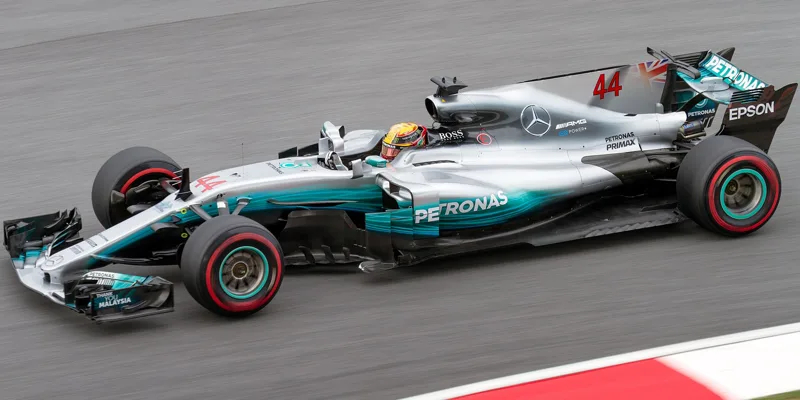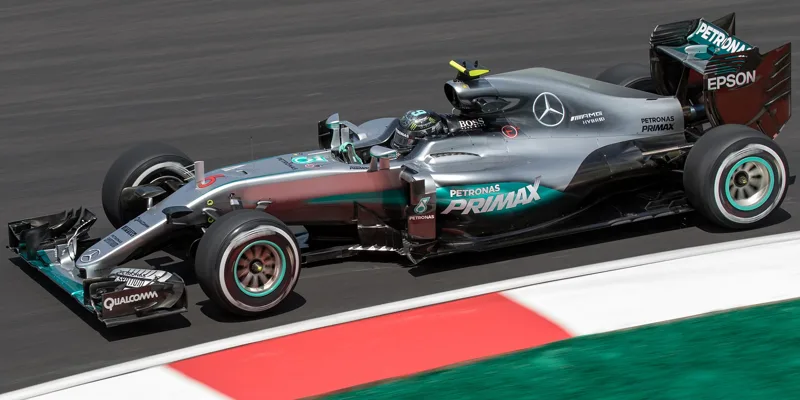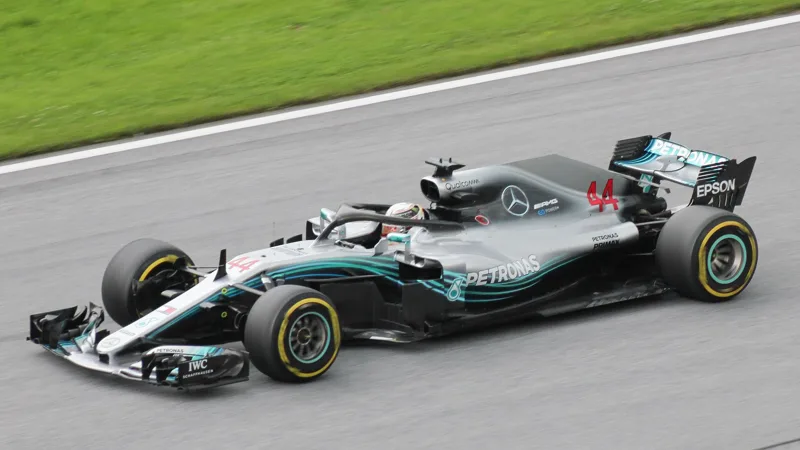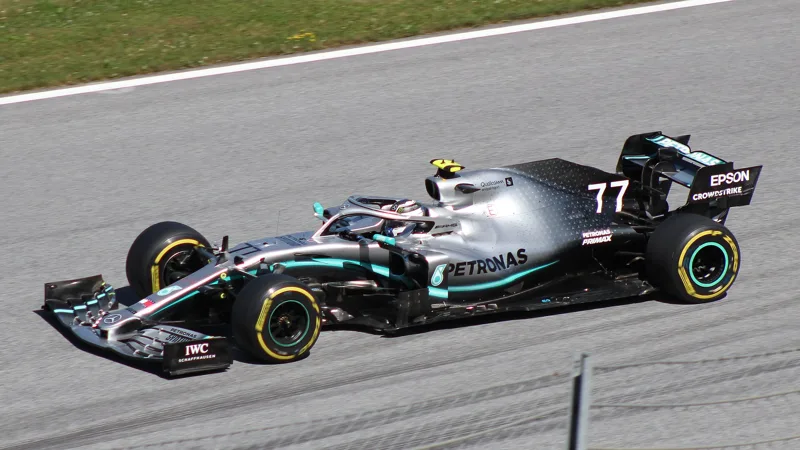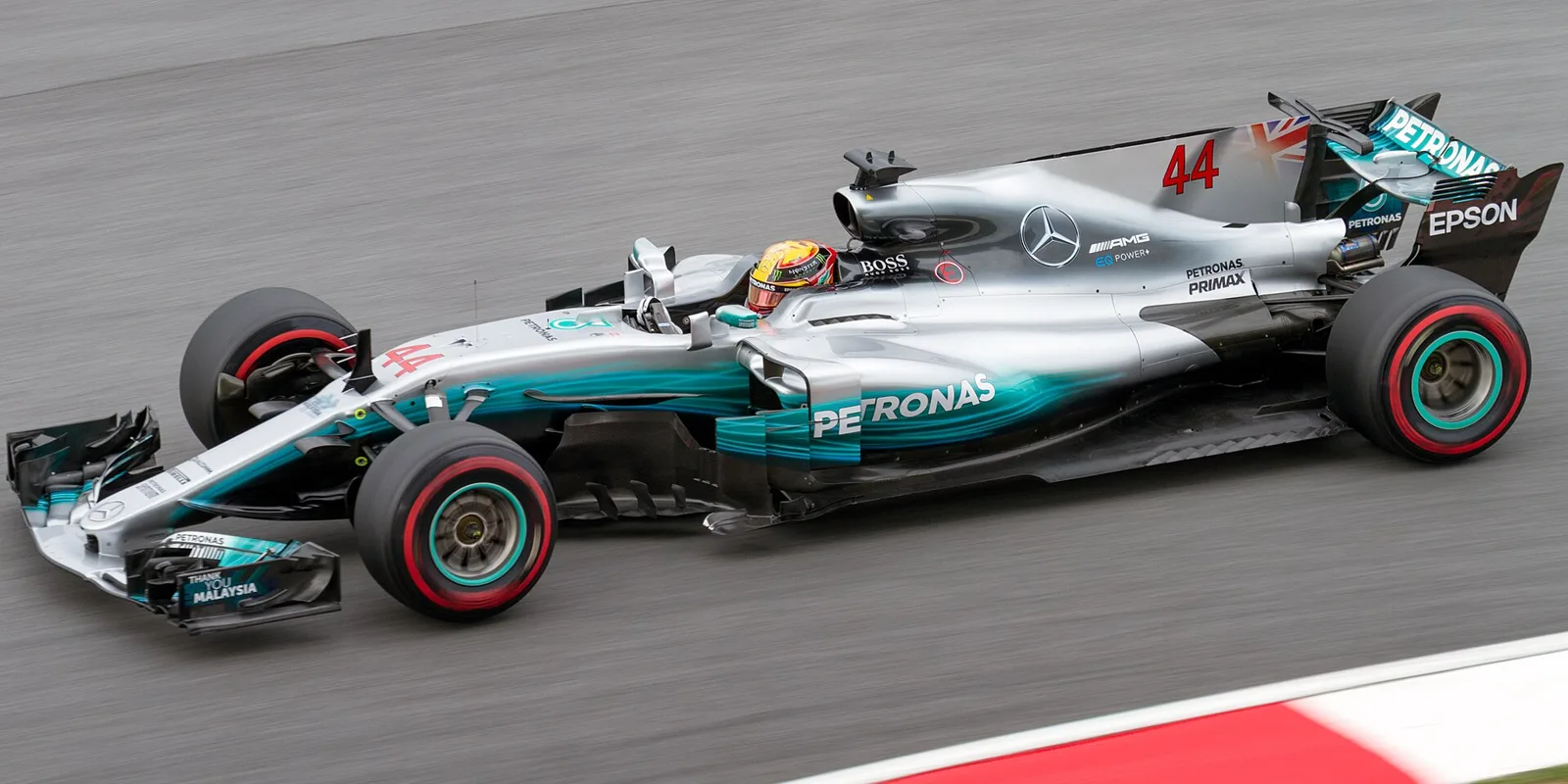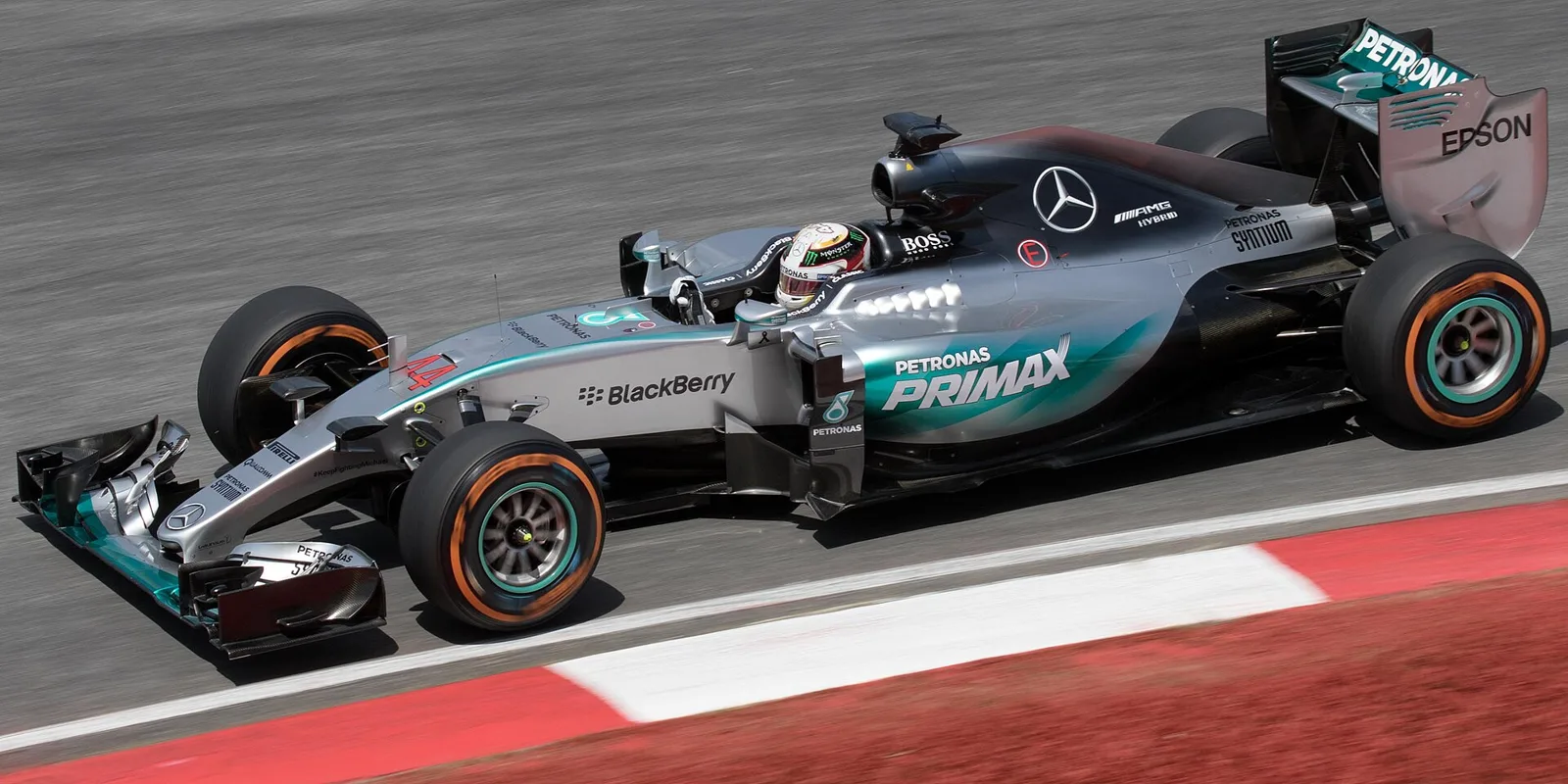
Rosberg and Hamilton shared a car that won 16 of 19 races, broke a stack of records and carried Mercedes to a second straight constructors' title.
Built for 2015, the Mercedes W06 was driven by Nico Rosberg and Lewis Hamilton. Across 19 races it won 16 times, secured a second straight constructors' title and carried Hamilton to a third drivers' championship. Its 703 points set a new single-season record for the team.
The Mercedes F1 W06 Hybrid carried Lewis Hamilton and Nico Rosberg through the 2015 Formula One season, and it was one of the strongest cars the sport had seen in years. Its 16 wins from 19 races were enough to secure the constructors' championship for a second year running and to give Hamilton his third drivers' title.
The numbers tell only part of the story. The car scored 703 points out of 817 available, and it set or matched a long list of benchmarks for poles, one-two finishes and front row lockouts. Most of those marks were later overtaken by its successor, the W07 Hybrid, but in 2015 the W06 defined what dominance looked like.
What was the Mercedes W06 designed to do?
The W06 was built for the 2015 FIA World Championship. It marked the sixth Mercedes Formula One car built since 2010, and its name reflects the fully integrated hybrid power units the rules required. Paddy Lowe and Aldo Costa led a design group that included Geoff Willis and Loic Serra.
The car followed the W05 Hybrid, which many fans still regard as one of the strongest machines the team has produced. Engineers kept the W06 close to its predecessor. Apart from rule-mandated noses and front wings, most changes were small, and they were concentrated in the upper suspension.
A car that won 16 of 19 races and turned a strong design into a season that record books still reference.
How did the W06 change during 2015?
The car evolved through the year, although not every update stayed on the car. Mercedes tried new arches and cut-outs in China, narrower sidepods in Spain, a bigger monkey seat at Monaco and a curved rear wing from Belgium. Some changes were tried for a single race and then removed.
China brought square arches beside the front wing endplates, along with cut-outs near the rear wing endplates, designed to add straight-line speed. In Spain the sidepods were narrower and carried a small air duct at the bottom, which the team believed helped either cooling or airflow around the diffuser.
Monaco needed downforce for its slow corners, so the team enlarged the monkey seat, the smaller wing mounted under the main rear wing. In Canada, where the power unit's energy recovery system had failed the year before, a larger radiator was fitted, and the engine cover needed a bulge to accommodate it.
The most noticeable aerodynamic change was the curved rear wing, introduced at Belgium to reduce drag without costing much downforce. It returned at Monza for the Italian Grand Prix.
When did the car first run?
The car was unveiled on 1 February 2015 on the opening day of pre-season testing at Jerez. Its competitive debut came at the Australian Grand Prix, and its final appearance was at the Abu Dhabi Grand Prix at the end of the season.
Over 12 days of pre-season running at Jerez and Barcelona the car logged 1340 laps and 6,121 km (3,803.4 mi). Early on, Hamilton judged the car to be much like its predecessor. The 2015 DTM champion Pascal Wehrlein also drove it during in-season testing.
How did the season start?
The season opened with a Hamilton pole and a Mercedes one-two in Australia, more than half a minute ahead of Ferrari. Sebastian Vettel's rain-affected form in Malaysia ended Mercedes's front row streak, but both Mercedes cars still reached the podium.
China brought another front row lockout and a one-two, and Hamilton's pole, fastest lap and win made a second hat-trick in the first three rounds. Bahrain brought his fourth consecutive pole and his third win, while Rosberg lost a podium place to Kimi Raikkonen on the penultimate lap after brake trouble. Four rounds in, Mercedes led Ferrari by fifty-two points.
Spain brought Rosberg's first pole of 2015 and his first win of the year. Hamilton finished second after a three-stop strategy that held off Vettel, and the team completed another one-two.
What happened at Monaco?
Monaco turned on a Virtual Safety Car, the first time that procedure was used officially in Formula One. Hamilton had built a lead of more than twenty seconds before his pit stop, but a pitwall error let Rosberg take the lead, and Rosberg won for the third straight year at Monaco.
The race turned on lap 64, when Max Verstappen and Romain Grosjean collided at turn one. The Virtual Safety Car was quickly replaced by the normal safety car. Hamilton pitted under it, and the team misjudged the gap, so Rosberg emerged in front. With the safety car coming in on lap 70 of 78, Rosberg held on to the flag, and Hamilton, unable to get past Vettel, finished third.
How did the summer races go?
Canada brought a Mercedes one-two, led by Hamilton from pole, and Austria followed with another one-two after Rosberg made the better start. Silverstone produced the team's sixth one-two of the year, with Hamilton on pole.
At Austria Hamilton took his seventh pole, but Rosberg got away better and led from there. At the British Grand Prix the two cars qualified one-two for the seventh time in nine races, and Hamilton took his eighth pole. His early first stop let him use the undercut to pass Felipe Massa, and light rain at lap 35 caught out both Williams drivers. Rosberg got past Valtteri Bottas at Maggotts on lap 39.
Hungary gave Hamilton his ninth pole, with Rosberg second and the team's seventh front row lockout of the year. Both cars made poor starts. Hamilton took a drive-through penalty and ended sixth, while Rosberg dropped to eighth after a late puncture caused by contact with Daniel Ricciardo. That ended a run of nine double podiums and 28 straight races with a podium finish.
How did Belgium and Italy go?
Hamilton took pole at Belgium, almost half a second ahead of Rosberg. That secured the FIA pole position trophy, with 10 poles from 19 races. Rosberg lost places at the start as new procedures were introduced, and Hamilton beat him by two seconds for a one-two.
At Monza Hamilton claimed his second career grand slam: pole, fastest lap, leading every lap and the win. He had also set the fastest times in all three practice sessions and in all three segments of qualifying. Rosberg's new engine was contaminated by a failed component before qualifying, and he had to run a power unit already used in five race weekends. That cost him fourth on the grid, and he later retired when the engine failed.
Where did the W06 struggle?
Singapore was the W06's weakest weekend, because the car did not suit the layout. Hamilton and Rosberg qualified fifth and sixth, and Hamilton retired for the first time that season while Rosberg took fourth.
Japan restored the order. Mercedes locked out the front row for its tenth time that season, and Hamilton led every lap and set the fastest lap. Hamilton had forced Rosberg wide at the first corner, which dropped him to fourth, but Rosberg recovered to second, 19 seconds adrift. That gave Mercedes its eighth one-two.
Russia was harder for Rosberg, who retired from pole after a throttle pedal damper failure blocked his throttle control. Hamilton qualified second, won by six seconds from Vettel, and secured the second straight constructors' title.
In the United States Rosberg took his third consecutive pole, but poor weather hit the final qualifying segment, so the grid was set on Q2 times. Hamilton got the better start, took the lead at turn one, and Rosberg slid with wheelspin on lap 48. Hamilton pulled away to win and claimed his third drivers' title.
How did the final rounds go?
Mexico gave Rosberg his fourth consecutive pole, with Hamilton second. That secured a record 13th front row lockout for the team. Rosberg controlled the 71 laps, his first win since Austria four months earlier, and took the fastest lap for his first career hat-trick.
Brazil brought Rosberg a pole by eight hundredths of a second over Hamilton and another one-two, the team's eleventh of the season. At Abu Dhabi he took his sixth consecutive pole and led Hamilton to the flag for a third straight win. That gave the team its twelfth one-two, a record for any constructor in one season.
The season closed with 703 points, beating the 701-point record the team had set the year before.
What records did the W06 set?
The W06 finished with 703 points, 86.04% of those available, and 32 podiums from 38 entries. It won 16 races, took 18 poles and recorded 15 front row lockouts, several of which were season records at the time.
| Measure | Result |
|---|---|
| Constructors' points | 703 of 817 (86.04%) |
| Podiums | 32 from 38 entries (84.21%) |
| One-two finishes | 12 (63.15%) |
| Front row lockouts | 15 (78.94%) |
| Straight races with both cars on the podium | nine |
| Wins | sixteen: Hamilton ten, Rosberg six |
| Poles | eighteen: Hamilton eleven, Rosberg seven |
| Fastest laps | thirteen: Hamilton eight, Rosberg five |
Several of these figures were the best recorded at the time, and the W07 Hybrid later overtook most of them.
Who drove the W06 to its titles?
Hamilton and Rosberg shared the car evenly enough to make the double possible. Hamilton won ten races and his third drivers' title, while Rosberg won six and built a run of late wins.
Hamilton's eleven poles and eight fastest laps formed the bulk of his contribution. Rosberg's seven poles included a sequence that reached six in a row by Abu Dhabi, and his late-season wins kept the teammate contest close until the end.
Was there a tribute on the car?
Yes. At Hungary the nosecone carried the code JB17, a tribute to Jules Bianchi that was visible on the car.
Why does the W06 still matter?
The W06 matters because it shows a car that changed little yet still dominated when the engineering was strong. It set benchmarks in points, lockouts and one-two finishes, and it marked a high point of the hybrid era.
Its design was evolutionary, but the team made the most of its strengths through a steady stream of updates. The 2015 season became a reference point for what a well-run team could achieve in the hybrid era.