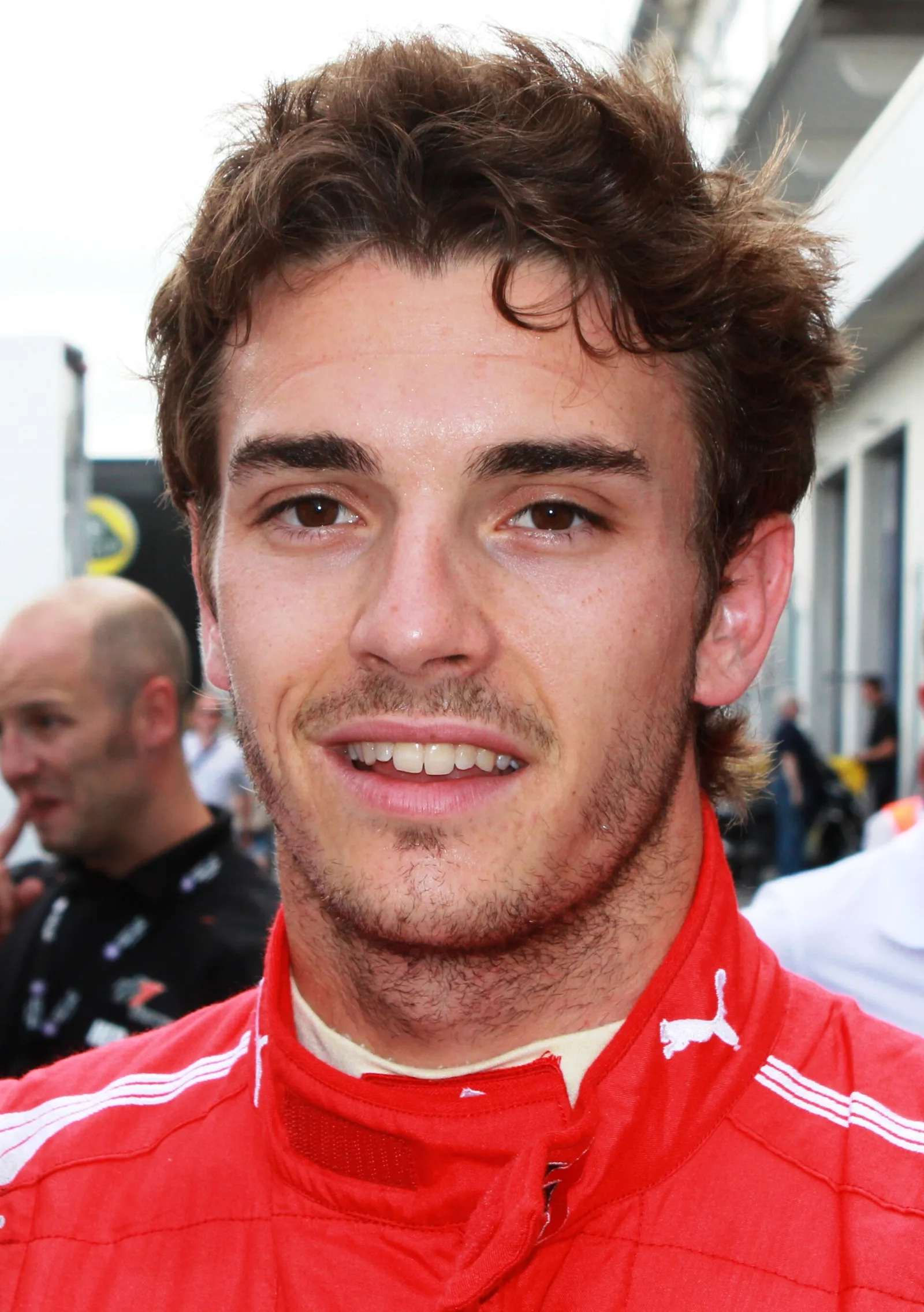
The French driver whose 2014 Suzuka accident and death changed Formula One's cockpit safety rules and brought the halo into the sport.
Jules Bianchi was a French racing driver who competed in Formula One for Marussia from 2013 to 2014. A ninth place at Monaco in 2014 gave him his first points, and a serious injury at Suzuka later that year preceded his death in July 2015, aged 25.
Few drivers have shaped Formula One's safety rules as directly as Jules Bianchi, a French driver who raced for Marussia between 2013 and 2014. He scored his first points at the 2014 Monaco Grand Prix, then suffered a serious head injury at Suzuka later that year and died in July 2015. His accident led to the halo cockpit protection being made mandatory from 2018.
Who was Jules Bianchi?
Jules Lucien Andre Bianchi was born in Nice on 3 August 1989 and grew up there with two siblings. He was the grandson of endurance racer Mauro Bianchi and the great-nephew of the Formula One driver Lucien Bianchi. His exposure to motorsport began at around the age of three, helped by a family kart track.
He was godfather to Charles Leclerc, who later became a Formula One driver himself. Bianchi's favourite racing driver was Michael Schumacher, and from the age of 17 he was managed by Nicolas Todt.
A French driver whose first points came at Monaco and whose accident at Suzuka changed how Formula One protects its drivers.
How did his junior career progress?
Bianchi moved from karting into junior single-seaters in 2007, when he claimed the French Formula Renault 2.0 title for SG Formula, with five victories. That year he also raced in the Eurocup, scoring one pole and one fastest lap in three races. He signed with ART Grand Prix for the Formula 3 Euro Series later in 2007.
In 2008 he took the Masters of Formula 3 crown at Zolder, and he placed third in the Euro Series standings. In 2009 he claimed the crown with eight victories, clinching it before the final round at Dijon-Prenois, and he added a ninth victory in the last round at Hockenheim.
He moved up to the GP2 Series with ART and finished third in the championship in both 2010 and 2011. In 2010 a first-lap crash at the Hungaroring fractured his second lumbar vertebra. He was fourth in the standings at the time, and he recovered in time to take part in the next round.
In 2011 he finished runner-up to Romain Grosjean in the GP2 Asia Series. In 2012 he was runner-up in the Formula Renault 3.5 Series with Tech 1 Racing, losing the title to Robin Frijns at the final round.
What was his role with Ferrari before Formula One?
Bianchi joined the Ferrari Driver Academy in 2009 after a test at Jerez, and he became the first recruit to the academy. In November 2010 Ferrari confirmed him as its test and reserve driver for 2011. In 2012 Ferrari loaned him to Sahara Force India, for whom he took part in nine Friday practice sessions.
In September 2011 he completed 70 laps at Fiorano alongside fellow academy member Sergio Perez, who was then driving for Sauber in Formula One.
How did his Marussia debut go?
Marussia named Bianchi as Luiz Razia's replacement on 1 March 2013, after Razia's deal ended because of sponsorship problems. He qualified 19th for his debut at the Australian Grand Prix, beating teammate Max Chilton by three-quarters of a second, and he finished 15th.
In Malaysia he started 19th again, 0.3 seconds short of Q2, and finished 13th, ahead of Chilton. By the Hungarian Grand Prix he had beaten his teammate in every qualifying session and every race both had finished. At Japan he and Charles Pic received grid penalties for accumulated reprimands, and his race ended in a collision with Giedo van der Garde.
What did the 2014 season bring?
The season began poorly, with a non-classified finish in Australia. At Monaco Bianchi finished ninth after starting 21st, scoring the first World Championship points for himself and for Marussia. Across the nine races in which he and Chilton both finished without retiring, he was the quicker driver in eight.
Marussia confirmed in October 2013 that he would stay for 2014. Shortly before his accident he said he was ready to step into a Ferrari race seat if the team needed him, as Fernando Alonso's departure loomed.
What happened at the 2014 Japanese Grand Prix?
The race at Suzuka on 5 October was run in heavy, intermittent rain. On lap 42 Adrian Sutil crashed at the Dunlop Curve. On the next lap Bianchi lost control in the same area and struck a recovery vehicle that was dealing with Sutil's car. Officials halted the race on lap 44 and awarded the win to Lewis Hamilton.
Bianchi was unconscious at the scene and was treated there before moving to the circuit's medical centre. A helicopter was not possible in the weather, so he was driven to a Yokkaichi hospital by ambulance, a 32-minute journey with a police escort. The FIA later said scans showed a severe head injury.
His parents reached Japan within days. Three days later the rest of the family joined them, along with Lorenzo Leclerc, his closest friend and the older sibling of his godson. A statement described the injury as a diffuse axonal injury and his condition as critical but stable. After emergency surgery he was placed into an induced coma. In November 2014 he came out of the coma and began breathing unaided, and he was later moved to Nice, where he remained unconscious.
What did the investigation conclude?
A panel of former drivers and team principals reported four weeks after the crash. Its verdict was that no single factor caused it; track conditions, car speed and a recovery vehicle on the circuit all contributed. It also concluded that changes to the cockpit design would not have made his injuries preventable.
At a conference held during the Russian Grand Prix, the FIA presented initial findings. It said Bianchi had slowed at Turn 7 but did not give the margin or the speed of impact. It also noted that the ambulance journey added only 37 minutes compared with a helicopter, with no adverse effect on his condition. The FIA confirmed research into closed cockpits, protective skirting for recovery vehicles and ways of slowing cars in crash zones better than double yellow flags do.
The panel found that Bianchi had pressed both the throttle and the brake, which should have shut off the engine. The team's brake-by-wire setup could not work with the FailSafe, which meant the engine stayed running. Marussia escaped blame. From 2015 recovery procedures changed, and races could not start within 4 hours of sunset or dusk, unless they were official night events.
Closed cockpits were studied as part of the response. In July 2015 Peter Wright, who chairs the FIA Safety Commission, argued that a closed cockpit would have done nothing to prevent the head injuries. The FIA had also tested a virtual safety car during the final three Grands Prix of 2014.
How did the halo become mandatory?
From 2018 the FIA required the halo cockpit protection device in all of its open-wheel championships. Made of curved titanium, the bar is meant to shield the driver's head from serious trauma and keep accidents like his from repeating. The FIA also retired race number 17 from Formula One in his honour.
At the 2020 Bahrain Grand Prix, Romain Grosjean's car split in two and burst into flames in a serious crash. Grosjean credited the safety changes that followed Bianchi's death with saving his life.
What tributes followed his death?
He died on 17 July 2015 at the age of 25, nine months after the crash. The last Formula One driver to die of injuries from a Grand Prix before him was Ayrton Senna, in 1994. His family's statement spoke of an immense and indescribable pain.
The funeral took place at Nice Cathedral on 21 July 2015, and many current, former and future drivers attended. His ashes were placed at Monte Carlo Cemetery, and some were released into the Mediterranean. Marussia ran a JB17 livery on its car, every driver wore a helmet sticker reading Tous avec Jules #17, and there was a minute's silence before the next race.
Hamilton, the winner at Suzuka, dedicated his win to Bianchi. Sebastian Vettel dedicated his 2015 Hungarian Grand Prix win to Bianchi and his family, and Daniil Kvyat dedicated his maiden podium to him. Max Chilton also dedicated his first Indy Lights pole and race win, which came on the weekend Bianchi died, to his memory. Those tributes sat alongside the formal steps taken by the sport. In May 2016 the family announced plans to take legal action against the FIA, the Marussia team and Formula One Group.
What does his career look like at a glance?
| Year | Series | Team | Highlight |
|---|---|---|---|
| 2007 | French Formula Renault 2.0 | SG Formula | Champion with five wins |
| 2009 | Formula 3 Euro Series | ART | Champion with eight wins |
| 2010-2011 | GP2 | ART | Third in the championship both years |
| 2012 | Formula Renault 3.5 | Tech 1 Racing | Runner-up to Robin Frijns |
| 2013 | Formula One | Marussia | Debut at the Australian Grand Prix, 15th |
| 2014 | Formula One | Marussia | Ninth at the Monaco Grand Prix |
| 2015 | Death | Not applicable | Died on 17 July 2015, aged 25 |
What is his legacy?
Bianchi's legacy rests on the safety changes that followed his accident, most visibly the halo, and on the foundation created in his name in December 2015. The foundation aims to find and support young drivers throughout their careers, and it has the backing of Prince Albert of Monaco.
Rue du Sapin, the address of the Allianz Riviera stadium in Nice, took his name in 2016 and became Rue Jules Bianchi. His godson Charles Leclerc has honoured him with tribute helmets, including one at the 2019 Monaco Grand Prix. Bianchi also appeared as an extra, using archived footage, in the Formula E docudrama And We Go Green, released in 2020. A song by Benjamin Biolay, titled Grand Prix, describes the accident and death and won Best Album at the 2021 Victoires de la Musique.
Up to the 2026 Singapore Grand Prix, he is still the most recent driver to have died in the Formula One World Championship.