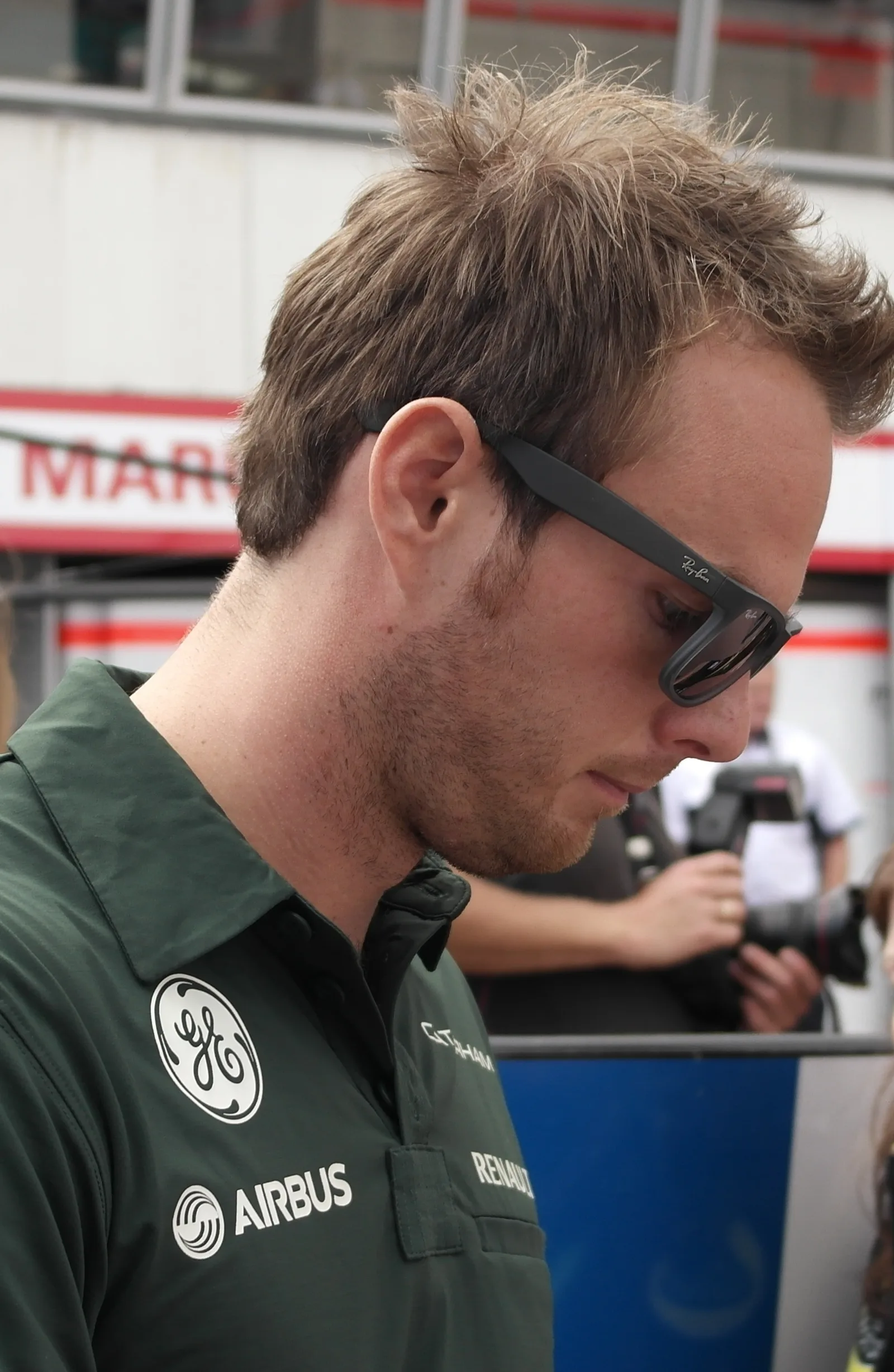
A Dutch driver who raced for Caterham in 2013, fought a contract battle with Sauber, then won the 2016 European Le Mans Series before turning to commentary.
Giedo van der Garde is a Dutch former racing driver and broadcaster, born on 25 April 1985 in Rhenen. He raced in Formula One in 2013 and in the FIA World Endurance Championship from 2016 to 2023, and he won the 2016 European Le Mans Series with G-Drive.
Giedo van der Garde rose from karting to Formula One with Caterham in 2013, and his later career took him into sportscars and television. After a contested exit from Sauber he won the 2016 European Le Mans Series, then retired from racing at the end of 2023 to become a commentator for Viaplay.
Who is Giedo van der Garde?
Van der Garde is a Dutch driver who spent 2013 racing for Caterham in Formula One and later became a regular in sportscar racing. He was born on 25 April 1985 in Rhenen, Netherlands, and retired from competition at the end of 2023. He then joined Viaplay as a full-time analyst and pundit.
Born and raised in Rhenen, he took up kart racing at the age of nine. That early start gave him a route through junior single-seater championships, a sportscar programme and, eventually, a second career on television.
From a 2008 title to a Caterham debut and a 2016 European Le Mans Series crown, a career that crossed three disciplines.
How did karting and junior formulae prepare him?
Van der Garde won the Dutch karting championship in 1998 and was the best rookie in Super A in 2001 before becoming senior world champion in 2002. He then moved into Formula Renault 2000, finishing sixth for Van Amersfoort Racing, and was taken into the Renault F1 Driver Development programme on the strength of that season.
Jos Verstappen was a mentor during these years, and the karting results gave him a platform for the step into single-seaters. The Renault programme opened the door to Formula Three, where his results would be consistent rather than spectacular.
How did his Formula Three years go?
He finished ninth in the 2004 Formula 3 Euro Series with Signature-Plus, but Renault dropped him from its driver programme at the end of that year. A move to Team Rosberg for 2005 brought another ninth place in the series.
In 2006 he joined the ASM team, which had been a strong force in the category. Van der Garde's team-mates Paul di Resta and Sebastian Vettel finished at the top of the leader board, while he ended the year sixth with a single victory.
How did he win the 2008 Formula Renault 3.5 title?
Van der Garde raced for Victory Engineering in the 2006 Formula Renault 3.5 Series, finishing sixth overall and third in the rookie standings. He then signed with P1 Motorsport for 2008 and won the championship with two races remaining.
The title season began strongly at Monza, where he took pole for the feature race and won both the sprint and the feature race. At Spa he narrowly missed pole by 0.033 seconds, after topping the timesheets in every practice session.
After that strong start he was never headed in the championship, and he clinched the title with two races remaining. The title confirmed the form he had shown in Italy.
What did his GP2 seasons deliver?
Van der Garde began his GP2 career with iSport International in the 2008-09 GP2 Asia Series and the 2009 GP2 Series. He took his first victory in the sprint race at the Hungaroring, added two more wins before the end of the year, and finished seventh in the championship.
In 2010 he drove for Barwa Addax and matched his seventh-place finish in the drivers' championship, while his team-mate Sergio Perez finished as runner-up. The following season he stayed with the same team in the GP2 Asia Series and finished third, behind Romain Grosjean and Jules Bianchi.
The 2011 GP2 Series produced his first series pole position and fastest lap, both at Catalunya. He took pole for the Monaco round too, but a penalty for an incident in qualifying wiped out that result and cost him the points for the weekend. He held second place in the standings until a disastrous weekend at Monza dropped him to fifth.
In 2012 he joined the Caterham team's GP2 operation as part of his reserve deal with the Formula One team. He returned to the winner's circle at Catalunya and Singapore, but a sixth-place finish in the points standings showed he was still short of the consistency needed to mount a title challenge.
How did the Formula One reserve role begin?
In December 2006 Super Aguri named him its test and reserve driver for the 2007 season. Spyker then announced him as its own test and reserve driver on 1 February 2007, and Super Aguri responded that its contract with him was still valid.
The dispute was settled by the time he tested with Spyker at Silverstone on 20 June 2007. Spyker had planned to use him as its Friday driver at the Australian Grand Prix, but he could not obtain the necessary superlicence from the FIA in time. A possible Virgin seat for 2011 went to Jerome d'Ambrosio instead.
How did Caterham's 2013 season go for him?
Van der Garde was Caterham's reserve in 2012 and completed six Friday practice sessions that year. He was then promoted to the second race seat for 2013, alongside Charles Pic, and finished his first Formula One race 18th at the 2013 Australian Grand Prix.
At Monaco he qualified 15th, Caterham's best grid position to that point and the first time a Caterham reached Q2 that season. He equalled that position in the race itself. His best finish came at the Hungarian Grand Prix, where he crossed the line 14th, ahead of Pic and the Marussia drivers.
The Belgian Grand Prix was a mixed weekend. He qualified 14th after choosing slick tyres on a drying track, which was his best qualifying position to that point, but he finished 16th after being unable to improve on his grid position.
Why did the Sauber dispute reach a court?
Van der Garde joined Sauber as a reserve and test driver for 2014, taking part in the first free practice session at seven races that season. By his own account, the team guaranteed him one of its two race seats for 2015 in June 2014, but in November it told him he was no longer required.
Sauber named Marcus Ericsson and Felipe Nasr as its 2015 race drivers, and van der Garde filed an international arbitration complaint in December 2014 with the Swiss Chambers' Arbitration Institution. The case then moved into courts in Switzerland and Australia.
What happened at the 2015 Australian Grand Prix?
On 2 March 2015 the Swiss institution released a partial award upholding his contract. On 11 March he obtained court orders in Australia enforcing that award, which required Sauber to let him take part in the Australian Grand Prix in Melbourne.
Sauber appealed and said it would not put him in the car for safety reasons. It also argued that the contract had been terminated in February 2015. Because of the risk of its assets being seized for disobeying court orders, the team opted out of Friday's first practice session, and its drivers only took part in the afternoon session.
On 14 March 2015 van der Garde announced that he would forgo racing in Melbourne while a longer-term solution was sought. The dispute ended on 18 March, when the two sides confirmed a settlement that ended his rights to race for the team. Compensation of US$16 million was reported, and van der Garde said the case was about the rights of racing drivers whose contracts are not honoured.
How did his sportscar career begin in 2016?
In 2016 van der Garde joined G-Drive Racing in the LMP2 class of the European Le Mans Series and the FIA World Endurance Championship. Partnering Simon Dolan and Harry Tincknell, he won the European title in his debut season, with the team winning at Silverstone and Estoril along the way.
That same year he made his first appearance at the 24 Hours of Le Mans. He went on to spend five further seasons in the WEC and the IMSA SportsCar Championship, and he made six appearances at Le Mans in total.
How did his television career develop?
Between 2015 and 2021 van der Garde was often called upon for analysis on Dutch television, particularly about Max Verstappen as the Dutch driver reached Formula One. He was a regular guest on several shows.
From 2022 he joined the analyst team at Viaplay, the new Dutch sports channel. He worked alongside former Formula One driver Christijan Albers and racing driver Tom Coronel, and when he retired from racing at the end of 2023 he became a full-time commentator and pundit for the channel.
What is van der Garde's legacy?
Van der Garde is remembered for his 2008 Formula Renault 3.5 title, his 2016 European Le Mans Series championship and his 2013 Formula One debut. The 2015 contract battle with Sauber also became a public talking point about the rights of racing drivers whose agreements are not honoured.
His route through karting, single-seaters, sportscars and television shows a career that moved across several disciplines rather than following a single path.
Today he works as a commentator and pundit for Viaplay. His record in each category stands on its own, from the 2008 title to the six Le Mans starts.
What were his main results by series?
| Series | Season | Team | Notable result |
|---|---|---|---|
| Karting | 1998 to 2002 | Various | Dutch champion in 1998; senior world champion in 2002 |
| Formula Renault 2000 | Season after karting | Van Amersfoort Racing | Sixth overall |
| Formula 3 Euro Series | 2004 | Signature-Plus | Ninth overall |
| Formula 3 Euro Series | 2005 | Team Rosberg | Ninth overall |
| Formula 3 Euro Series | 2006 | ASM | Sixth overall; one victory |
| Formula Renault 3.5 Series | 2006 | Victory Engineering | Sixth overall; third in rookie standings |
| Formula Renault 3.5 Series | 2008 | P1 Motorsport | Champion, with two races remaining |
| GP2 Series | 2009 | iSport International | Seventh overall; three wins |
| GP2 Series | 2010 | Barwa Addax | Seventh overall |
| GP2 Asia Series | 2011 | Barwa Addax | Third overall |
| GP2 Series | 2012 | Caterham | Sixth overall; wins at Catalunya and Singapore |
| Formula One | 2013 | Caterham | Best finish 14th at the Hungarian Grand Prix |
| European Le Mans Series | 2016 | G-Drive Racing | Champion, with a debut-season title |
Read down the table and the arc is clear. Early results in karting and junior formulae gave way to a title in 2008, a Formula One season with Caterham, and a sportscar championship in his first year in that category.