A home-built W12 engine, a recycled First Racing chassis and a season that ended with Life pulling out after 14 Grands Prix.
Built by a small Italian team for 1990, the Life F190 carried a W12 engine designed by Franco Rocchi on a chassis from First Racing. Life entered 14 Grands Prix before withdrawing after the Spanish round, and its drivers never managed to pre-qualify.
The Life F190 was a 1990 Formula One car built by a small Italian operation that tried to race an unusual W12 engine on a chassis first designed for another team. It was heavy, slow and unreliable, and the team withdrew after 14 Grands Prix. The car's history is largely the history of its engine, so the W12 receives close attention below.
What was the Life F190?
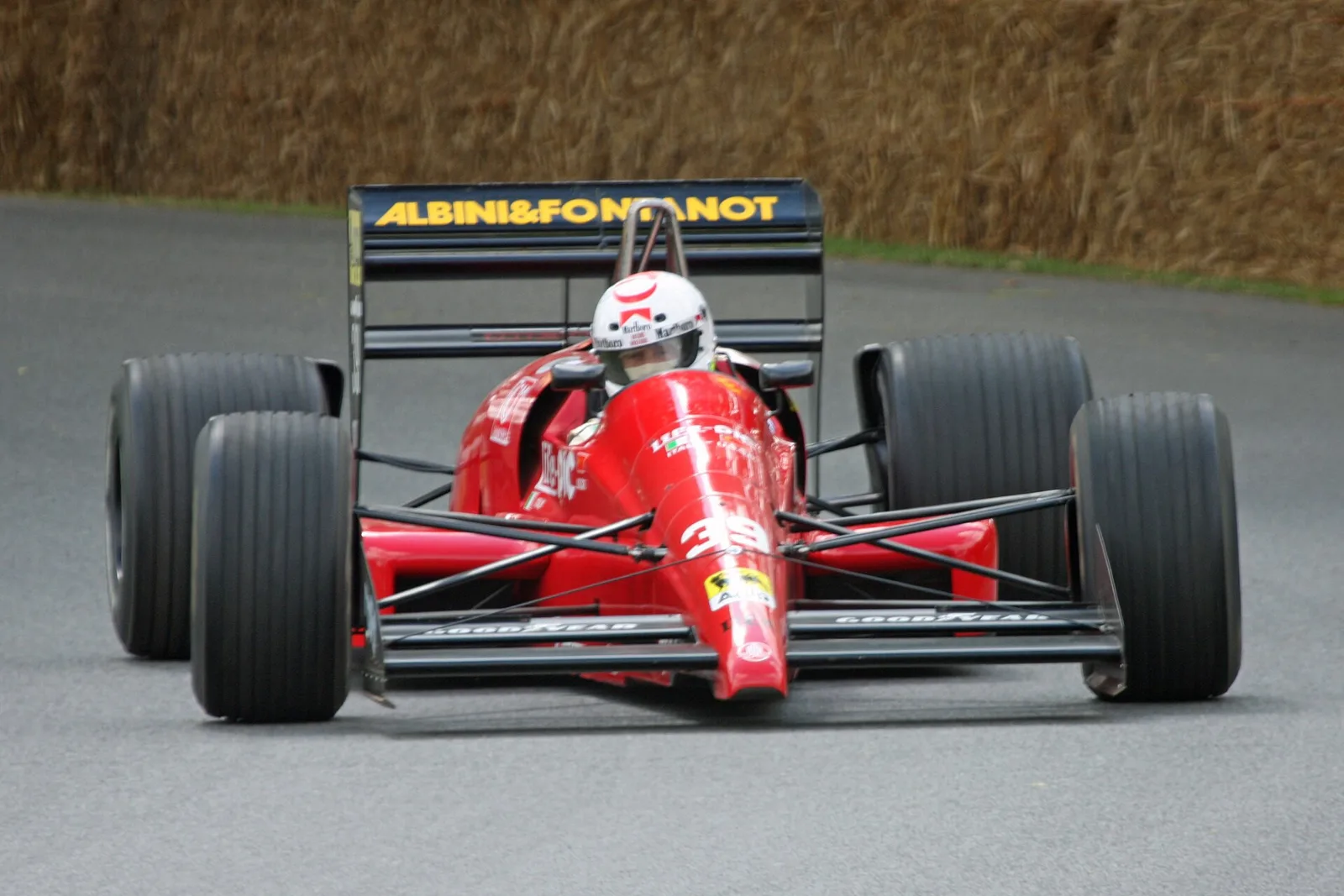
The Life F190, also written as Life L190, was a Formula One car for the Life team in the 1990 season. Its designers were Richard Divila and Gianni Marelli. The car was essentially a reworked First Racing chassis fitted with an unconventional W12 engine, and it was the heaviest car on the grid that year.
The F190 was fairly conventional in its layout, and its major weakness was weight. Its shallow cockpit also left the driver exposed, a danger Divila raised with Gary Brabham before he ever drove the car. Brabham was the first name on the team's driver list.
A W12 engine, a recycled chassis and a season of pre-qualifying failures made the F190 one of Formula One's great cautionary tales.
Where did the W12 engine come from?
The W12 was the work of Franco Rocchi, a Ferrari engineer since 1949 who left the company in 1980 to design a W-configuration racing engine. Rocchi finished the engine by mid-1989 and claimed it weighed 140 kg, against 155 kg for Cosworth units. Businessman Ernesto Vita bought the rights and founded Life Racing Engines to run it.
Rocchi's idea ran against the grain, because V configurations dominated top-level racing. He believed a W12 could be more compact and more agile than a V12, and that belief was the foundation of the whole project.
The 1980s rule changes shaped the market Vita entered. A ban on turbocharged engines pushed teams towards naturally aspirated units, and suppliers such as Ilmor, Judd, Lamborghini and Yamaha came into Formula One. Carlo Chiti's Motori Moderni B12 engines were underperforming, while Renault and Honda were working on V10s for Williams and McLaren.
Vita saw an opening in that climate. He hoped the unusual engine would draw sponsors, but most experts and large corporations doubted it would succeed, and no sponsor arrived. He then decided to run the W12 himself, with a team named Life after his own surname, which means life in Italian.
How did a First Racing car become the F190?
Vita did not design his own car. He bought a chassis from First Racing, a team founded by former driver Lamberto Leoni, which had raced in Formula 3000 since 1987. The FIRST F189 had been planned as a Formula One entry for 1989 and was based on a Formula 3000 March 88B to keep costs down.
The F189 had problems from the start. Gabriele Tarquini, who was due to drive for First Racing, found the rolling chassis badly built, and the car failed its mandatory crash tests before the season. Richard Divila, who had designed it, left to join Ligier and called the car a time bomb.
Without a workable car, money or tyres, Leoni gave up. Pirelli and Goodyear refused to supply rubber, and First Racing returned to Formula 3000.
Vita then installed the W12 in the F189 shell. Gianni Marelli handled most of the mechanical work, the roll bar was altered to pass crash tests, and outside suppliers provided the braking and damping parts. Brembo/CI supplied the carbon disc brakes and Koni the shock absorbers. Marelli left the team in the spring, while the season was under way.
Why did the W12 struggle?
The W12 had three rows of four cylinders, two in a V and one standing vertically between them. It claimed 470 bhp (350 kW; 477 PS), although some sources put the output at only 360 bhp (268 kW; 365 PS). That was well short of rival power units of the day.
The gap to the leaders was enormous. Honda's V10 in McLaren was credited with about 700 bhp (522 kW; 710 PS), and the Life F35 was the weakest power unit of the 1990 season. Each cylinder had five valves, and the engine used four camshafts in total. It was matched to a six-speed manual gearbox developed with Hewland.
The chassis could not make up for that shortfall in power. The F190 was the heaviest machine on the grid and had a very narrow nose, and the team had a single chassis, a pair of engines and no spare parts to fall back on.
What were the specifications?
| Item | Life F190 (1990) |
|---|---|
| Engine | Life F35, W12, claimed 470 bhp (350 kW; 477 PS) |
| Gearbox | Six-speed manual, developed with Hewland |
| Valves and camshafts | Five valves per cylinder, four camshafts |
| Brakes | Carbon discs by Brembo/CI |
| Shock absorbers | Koni |
| Origin of chassis | First Racing FIRST F189 |
| Grands Prix entered | 14, withdrew after the Spanish round |
Read alongside the race record, the table shows a car that was never close to its rivals on paper. Power, weight and reliability all worked against it, and the team had no margin for error when something went wrong.
How did the 1990 season begin?
Testing offered little. Gary Brabham was the first driver and Franco Scapini the reserve, and the team completed only a few laps across the early outings. The first run took place at Vallelunga on 18 February, and the F190 handled poorly, was slow and weighed between 25 and 30 kg more than other cars.
The season opened on 11 March 1990 at Phoenix. Brabham recorded 2:07.147 and a top speed of 185.57 km/h, while Derek Warwick managed 271.44 km/h at the same track. The engine overheated after just two timed laps, and the mechanics had to borrow a pressure gauge from another team to check the tyres.
Brazil was worse. Mechanics were on strike over unpaid wages and did not fill the engine with oil, so the car managed only 400 metres. A connecting rod broke, and Brabham blamed a lack of professionalism and the resources needed for repairs. His manager said Life did not meet the standard expected of a Formula One team.
Brabham urged Vita to switch to Judd V8 engines and suggested Rony Salt, an engineer he knew from his Formula 3000 days. Vita refused, and Brabham left the team for Formula 3000 soon after.
Who replaced Brabham?
Vita first tried to hire Bernd Schneider, but Schneider turned him down after seeing how poor the F190 was. The team then signed Bruno Giacomelli, a former McLaren, Alfa Romeo and Toleman driver who had raced from 1977 to 1983. His record stood at 83 starts, 14 points, a single pole and one podium.
Giacomelli was candid about the car. He knew it was very slow but said he had missed the Formula One environment. The team also looked for other help. Goodyear announced it would stop supplying tyres, then reversed the decision, while Bernie Ecclestone, the FIA vice president, met Vita and urged him to reconsider because of the team's thin resources and lack of competitiveness.
Vita then sold 67% of the team to Verona industrialist Daniele Battaglini, after an agreement with Soviet businessman Mikhail Pichkovsky. The deal was intended to let Vita buy Judd engines of the kind used by Brabham and Lotus, which would have addressed the W12's power deficit.
Franco Scapini did not receive an FIA Super Licence, and Rob Wilson feared becoming a reserve driver. Schneider refused Vita's offers a second time, so Giacomelli remained the only driver in the car. Peter Wyss, a former Zakspeed technical director, later joined as an adviser at Giacomelli's invitation.
How slow was Giacomelli's qualifying?
Giacomelli's qualifying was painfully slow. At San Marino a snapped belt left him with third gear only, and his best time of 7:16.212 was the slowest lap in Formula One history, leaving out the 1957 Pescara Grand Prix, until Perry McCarthy's 1992 effort. His Monaco lap was 1:41.187.
The San Marino session was worse than the lap time suggests. His top speed was 104.44 km/h, while Riccardo Patrese reached 313.95 km/h. He also feared being hit from behind, given the crawl he was making around the circuit.
Monaco gave him two timed laps in a row for the first time that season, but the result was still poor. He reached 213 km/h against 272 km/h for Ayrton Senna, and his lap trailed 26th-placed JJ Lehto by more than 15 seconds. It was also slower than every Formula Three car in a support race on the same circuit.
At Canada the 1:50.253 left him almost half a minute adrift of Senna. His 216 km/h was the slowest top speed on the circuit, and Nelson Piquet's 297 km/h was the quickest. Mexico brought a 4:04.475 lap, and his top speed fell short of Satoru Nakajima's, the quickest on the track, by almost 200 km/h.
After Peter Wyss joined, Giacomelli approached Leyton House, a team he had tested for in 1989, to buy Judd engines before Mexico. At the same time Vita held talks with Brabham and Lotus. Sporting director Sergio Barbasio then announced the purchase of Judd CV units from Team Lotus, and said the designers were adapting the chassis to take a V8 instead of the W12.
Silverstone was grim too. Giacomelli set 1:25.947, more than 14 seconds behind Gabriele Tarquini, though his time was three seconds quicker than the Formula Three cars racing at the same event.
Did the Judd engine change anything?
The Judd V8 was fitted before the Portuguese Grand Prix, after a 10-day rebuild in which the chassis, bodywork and engine mounts were modified. The car came out about 80 kg lighter, but Giacomelli failed to leave the pit lane at Estoril when an electrical fault struck. Only a little progress followed.
At the Spanish Grand Prix the engine cover finally fitted, but the team had brought no jack, so mechanics lifted the car by its suspension arms. Giacomelli set 1:42.699, while Claudio Langes, second to last, managed 1:25.736. Giacomelli had hoped the car would reach 300 km/h, but the gain was small.
Before the Judd switch, the W12 had stayed in the car through Hungary, Belgium and Italy. Giacomelli trailed the second-last qualifier by 15 seconds in Hungary, 18 seconds in Belgium and 20 seconds in Italy, and his Italian time was slower than every Formula One car from the 1969 season.
Why did Life leave Formula One?
Life pulled out of the Japanese and Australian Grands Prix because overseas travel was too expensive, and the FIA fined the team $200,000. Vita then promised to keep developing the W12 and to invest 5 to 8 billion lire, but the investment never came, and the team left Formula One after 1990.
Vita had also promised a larger staff for the following year, and none of that happened either. The 14 Grands Prix were the team's entire Formula One career, and its drivers never managed to get through pre-qualifying.
Is any Life F190 still around?
The only F190 was sold to a private collector. It reappeared at Goodwood's festival in 2009, running with an engine that Lorenzo Prandina had rebuilt, and Derek Bell drove it. The car appeared with its original engine, so visitors could see the W12 that had defined its career.
The F190 is now remembered as a warning. Its borrowed chassis, its unusual engine and its results all point to a team whose ambitions ran far ahead of its money. The W12 remains one of the least conventional engines to reach the Formula One paddock, and the car's story is often told as a lesson in limits.