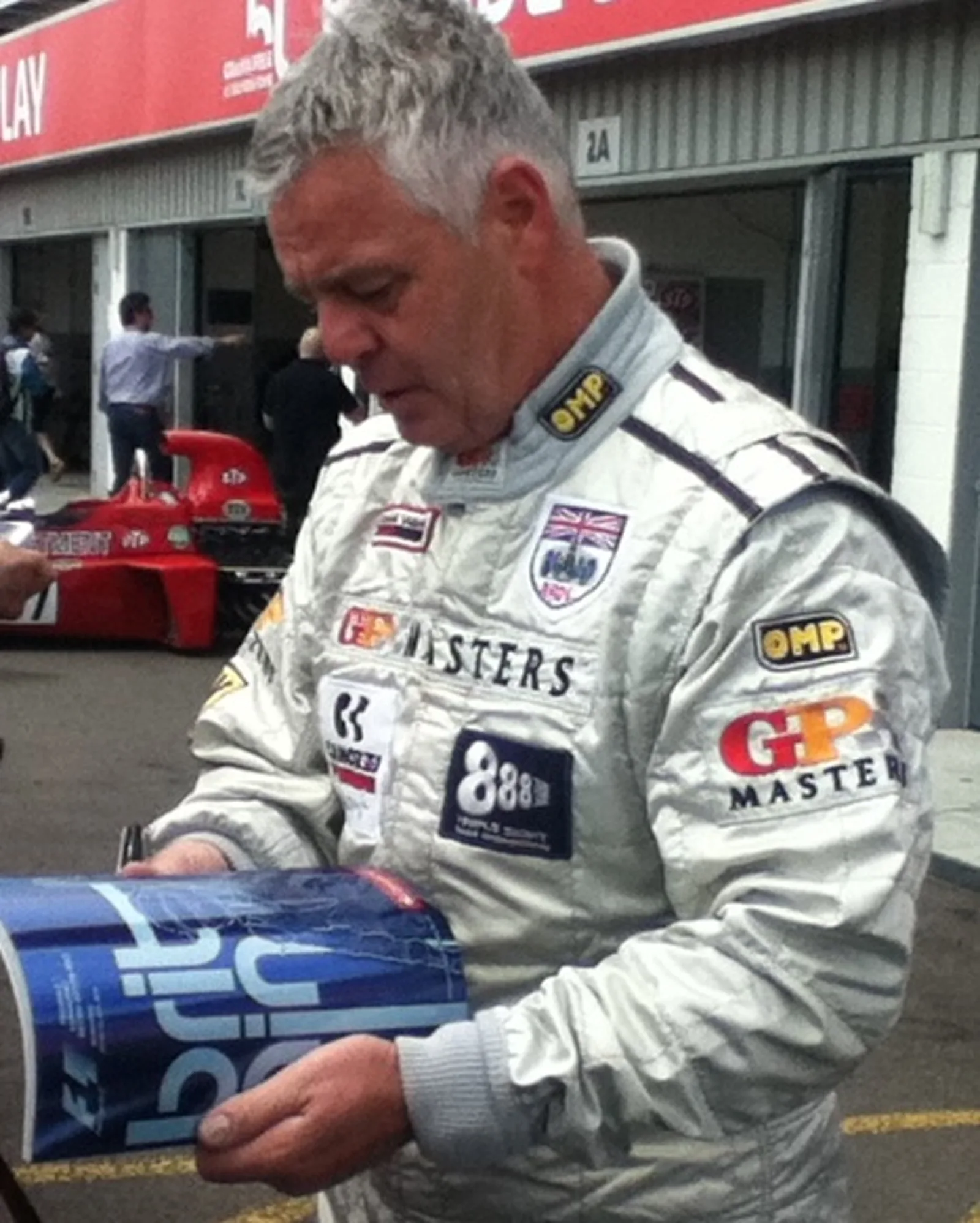
A stock car champion who became a Formula One regular, a 1992 Le Mans winner with Peugeot and a touring car team founder, Warwick's career ran across three decades.
Derek Warwick is a former British driver who raced in Formula One from 1981 to 1993 without winning a Grand Prix. He won the 1992 Le Mans 24 Hours and the World Sportscar Championship with Peugeot, and he finished his Formula One career with 71 points.
Derek Warwick is a former British racing driver who competed in Formula One from 1981 to 1993. He never won a Grand Prix, but he won the 24 Hours of Le Mans and the World Sportscar Championship in 1992 with Peugeot. His career also included stock cars, touring cars and a long spell as a team owner.
How did Derek Warwick's motorsport career begin?
Warwick was born in Alresford, Hampshire, in 1954. He first raced stock cars under the Spedeworth banner, with his home track of Aldershot Stadium among the venues. A Superstox English title came in 1971, when he was only 16, followed by the world crown at Wimbledon Stadium in 1973. Those early titles gave him the racing confidence that carried him into single-seaters.
Single-seaters followed the stock car years, and in 1978 he finished runner-up in the British Formula 3 Championship. That result was enough to put him on the radar of Formula One teams, and in 1981 he joined the fledgling Toleman team for his first season in the sport.
His first year in Formula One was a difficult one. Warwick qualified for only one race, the season finale at Las Vegas, and he spent most of 1981 and 1982 at the back of the grid. He recovered in 1983, scoring points in the final four rounds of the championship with a car that finally gave him a fair chance.
Two decades of racing, a Le Mans win and no Grand Prix victory: Derek Warwick's career was defined by near misses and a long, loyal commitment to the sport.
Did Derek Warwick ever win a Grand Prix?
No, Warwick never won a Formula One Grand Prix. He came closest in 1984, when he led the Brazilian Grand Prix on his first drive for Renault before suspension failure ended the race. He finished second in the Belgian and British Grands Prix that season, and he finished seventh in the championship.
Later that year he gained four podiums for Renault, and he won the Hawthorn Memorial Trophy, a distinction he repeated in 1988. The BBC later described him as the strongest British driver never to win a Grand Prix, a label that reflected how often he was competitive without the result to match.
In 1989 victory eluded him in two painful ways. At the Brazilian Grand Prix two slow pit stops cost him 17 seconds in the final classification behind winner Nigel Mansell. At the Canadian Grand Prix he led the wet race until his Ford V8 engine failed on lap 40, while he was in second place.
Why did Warwick turn down Williams in 1985?
Warwick chose to stay with Renault for 1985 instead of accepting a seat at Williams-Honda. The Williams seat went to Nigel Mansell, who won two races at the end of the season. Renault had a poor year and withdrew from Formula One at the end of 1985, leaving Warwick without a team for 1986.
His decision was a turning point. Ayrton Senna had refused to let Warwick join him at Lotus, using his status as the team's number one driver to insist on a pure number two. The loss of those two options left Warwick looking for a drive, and his decision to stay loyal to Renault has been described as the turning point of his career.
Why did the Brabham and Arrows years go wrong?
The 1986 season opened with a sports car programme. Warwick signed up with Tom Walkinshaw's TWR Jaguar team for the World Sportscar Championship. Then Elio de Angelis died in a testing accident in May 1986, and Warwick was invited to take his place at Brabham. Because no Grands Prix clashed with his sports car commitments, he raced in both world championships that year.
In 1987 he moved to Arrows alongside Eddie Cheever, scoring three points. The 1988 season was better. The Megatron engine, a rebadged BMW M12, gave Arrows the power it needed, and Warwick finished in the top six seven times, earning 17 points and eighth place in the championship. At Monza he finished fourth, only half a second behind Cheever.
The 1989 season brought seven points and more reliability problems. He had three years at Arrows and left with a respectable record for a team that was struggling to keep up with the leaders.
What happened at Lotus and Monza in 1990?
For 1990 Warwick finally joined Lotus, four years after Senna's refusal had blocked the move. The Lotus team was using a Lamborghini V12 engine, but the glory days of the team were over. The Lamborghini LE3512 was underpowered and unreliable, and Warwick scored only three points for the season.
His most notable result came at the Spanish Grand Prix, where team-mate Martin Donnelly suffered a severe crash. Warwick qualified in the top ten to help team morale, but the gearbox failed ten laps from the end. At the Italian Grand Prix a crash at the Parabolica flipped his Lotus, and he ran back to the pits to take the spare car after the race was red-flagged. He admitted the error was his, having run too wide at the exit of the turn.
Did Warwick race sports cars and touring cars?
Yes. He claimed the World Sportscar Championship in 1992, a season in which he also shared in Peugeot's Le Mans victory. He had driven sports cars for Jaguar in 1986 and 1991 as well. His touring car career came after Formula One, when he raced in the British Touring Car Championship.
In 1995 he drove for the Alfa Romeo works team, which had dominated the previous year but had an underdeveloped car in 1995. At Donington Park his car was involved in a crash, and debris broke a television camera lens. Murray Walker joked on the BBC highlights that Warwick owed the broadcaster six thousand pounds for the damage.
After a year out, he co-founded Triple Eight Racing with Roland Dane and took over the works Vauxhall entry for 1997. He drove one of the cars himself, won a wet race at Knockhill in 1998, and retired at the end of that year. He remained involved with the team for another three years, while also owning three car dealerships in Southampton and Jersey.
What did Derek Warwick do after leaving the grid?
After leaving the cockpit he took on a range of commentary and officiating roles. In 1998 he deputised for Martin Brundle as Murray Walker's co-commentator on ITV at the Canadian Grand Prix. He raced in the inaugural Grand Prix Masters series in 2005 and 2006, and in 2010 and 2011 he served as a fourth steward at several Grands Prix, advising the stewards from a driver's perspective.
He was president of the British Racing Drivers' Club from 2011 to 2017, succeeding Damon Hill. Paddy Hopkirk replaced him in 2016. He now operates a Honda franchise in Jersey, which keeps him close to the car trade he has worked in for most of his life.
Did Warwick test for a move to American open-wheel racing?
Yes, but he did not make the move. In 1992 Hall/VDS Racing gave him a two-day test of an IndyCar Lola T92/00 at Mid-Ohio, to assess a possible move to CART for 1993. The test took place in the off-season, while he was still racing sports cars.
He decided against the switch and returned to Formula One instead. Before that, he had received firm offers of paid drives for 1993 from Jordan and Footwork, and he ultimately chose the latter. The choice set up the final chapter of his Formula One career.
What was Warwick's final Formula One season like?
Warwick returned to Formula One after a three-year sabbatical and drove the full 1993 season for Footwork. He scored only four points, which took his Grand Prix career total to 71 points. The season was his last in the sport, and it closed a career that had started with Toleman in 1981.
His career record included four podiums in 1984 with Renault and a fourth place at Monza in 1988. Those results stood out against the lean seasons that followed, when the cars he drove rarely gave him the chance to finish close to the leaders.
What was the Honda CR-X Challenge?
The Honda CR-X Challenge was a series in which Warwick took part, first as a celebrity driver in its inaugural season in 1988. By 1990 he was running a two-car team of his own, with Robin Brundle and Roland Dane among his drivers. He raced himself at Donington Park, where he finished fifth.
His brother Paul also drove for him in a few rounds, and Paul peaked with third place at Snetterton. The side project kept Warwick racing in the years between his major commitments.
How did the Arrows engine change Warwick's results?
Arrows used the Megatron engine in 1988, a rebadged BMW M12 whose power finally let both drivers run near the front. Heini Mader, the team's engine specialist, had solved a long-running problem with the FIA's mandatory pop-off valve, which had restricted turbo boost since the start of 1987.
The breakthrough came at Monza in 1988, where Warwick finished fourth, half a second behind Cheever. For the first time the two drivers could fully use the engine's power, which the rules restricted that year.
What did Warwick think of the 1990 Lotus?
Warwick later described the Lamborghini engine in the Lotus as loud but lacking in go, a verdict that matched the team's struggles that year. He also found the Lotus 102 unpleasant to drive, because its chassis would flex under power as well as under braking.
The Honda V10s in the McLarens were rated far higher and were more reliable, which put the Lotus at a clear disadvantage. For a driver of his experience, that gap in the car was hard to overcome.
Career summary
| Measure | Detail |
|---|---|
| Born | 27 August 1954 |
| Formula One seasons | 1981 to 1993 |
| Grand Prix points | 71 |
| Le Mans win | 1992 with Peugeot |
| World Sportscar title | 1992 |
| BRDC presidency | 2011 to 2017 |