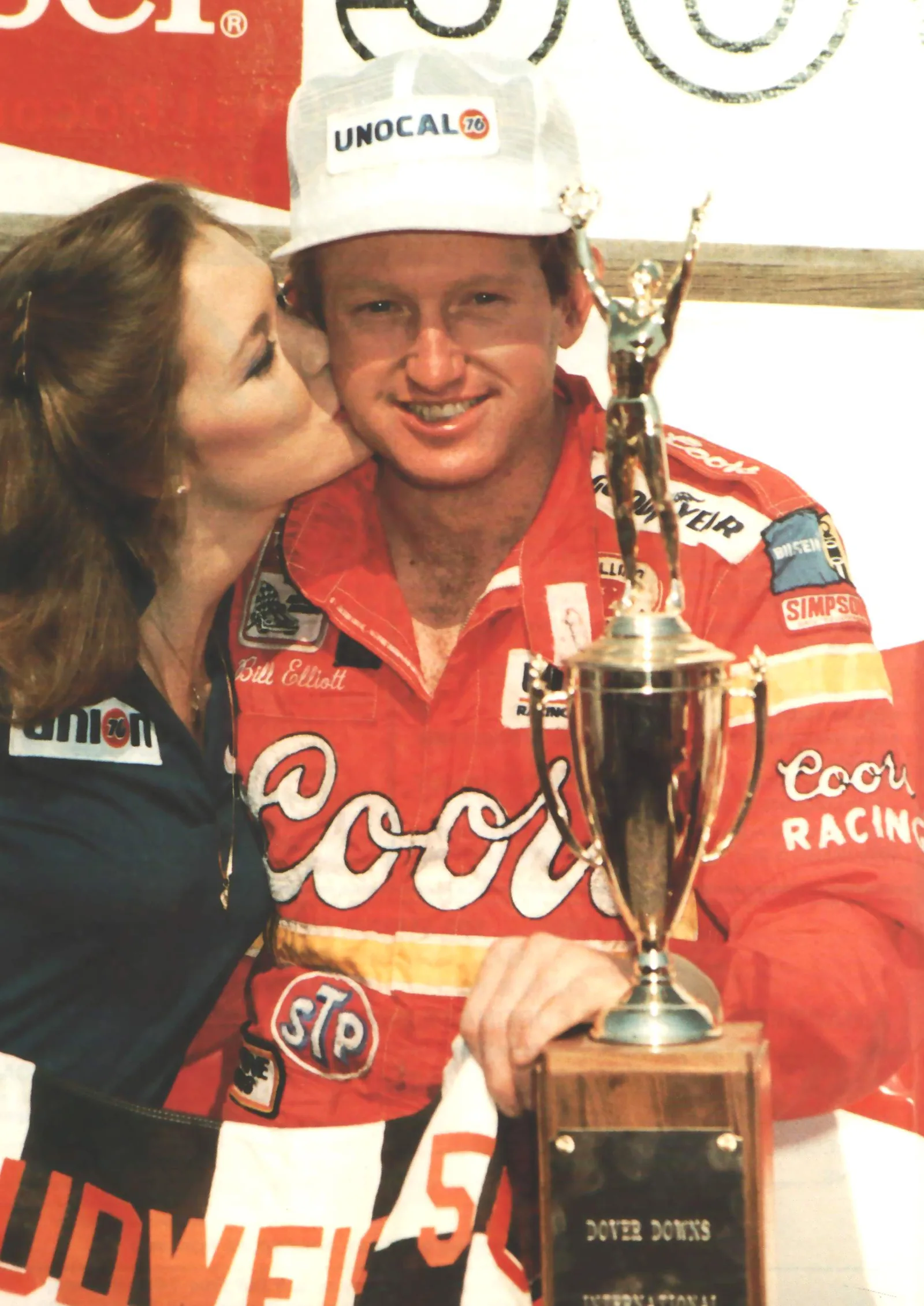
A tire war, a career-ending crash for Bobby Allison and a championship settled by a single 11th-place finish at Atlanta.
Bill Elliott of Melling Racing won the 1988 NASCAR Winston Cup championship by 24 points over Rusty Wallace. He clinched the title at Atlanta in November with an 11th-place finish, in a season shaped by a tire war. Ken Bouchard was named Rookie of the Year.
The 1988 title went to Bill Elliott, who finished 24 points clear of Rusty Wallace after an 11th-place finish in the season finale at Atlanta. The year was shaped by a tire war between Goodyear and Hoosier, and by a career-ending crash for Bobby Allison at Pocono in June.
Who won the 1988 NASCAR Winston Cup championship?
Elliott crossed the line 11th, which sealed the championship. He had held the points lead since the Bristol race in August, and Melling Racing's driver kept it to the end. That came after a season of steady finishes across the schedule.
Wallace had won the final race from pole and led the most laps, but Elliott's consistency across the season was the decisive factor. Wallace's late charge came too late to close the gap, and the championship was decided by a single finishing position.
Ken Bouchard was named Rookie of the Year, winning the honour by 59 points over Ernie Irvan. Bouchard made only eight more Cup starts after that season, while Irvan went on to win fifteen races over the next twelve years.
A tire war, a career-ending crash for Bobby Allison and a title decided by one 11th-place finish at Atlanta.
How did the tire war shape the 1988 season?
The 1988 season hosted the first of two tire wars between Goodyear and Hoosier. Drivers without an exclusive contract could change tire brands between races, which meant no team had to stay with one brand all year. That flexibility shaped how teams approached every weekend.
Goodyear withdrew its tires after practice for the Coca-Cola 600 at Charlotte, when it found that its compound was too soft for the track. Almost every driver switched to Hoosiers, and NASCAR issued a mandatory caution on lap 25 to check the tires.
The tire rules caused confusion at Richmond in September, when roughly half the field switched brands between qualifying and the race. That included four of the top five drivers in points, and officials had to work through the day to sort out the starting lineup.
How did the 1988 season open at Daytona?
The Busch Clash on February 7 was won by Dale Earnhardt, with Geoff Bodine on pole. The Gatorade 125s followed on February 11, with Ken Schrader and Davey Allison taking the poles for the two qualifiers. Both events set the stage for the Daytona 500 that followed.
The Daytona 500 on February 14 was won by Bobby Allison, and it was the final career victory of his long career. Ken Schrader started from pole, and Davey Allison finished second, while Phil Parsons came third in the race.
Michael Waltrip drove Jim Sauter's No. 89 Pontiac after failing to qualify on his own.
Why was the Pontiac Excitement 400 at Richmond disputed?
Neil Bonnett won the Pontiac Excitement 400 at Richmond on February 21, but a scoring error had missed that he was one lap down after a green-flag pit stop. Ricky Rudd's car owner, Kenny Bernstein, protested the result, but the win stood.
Later review of the footage suggested Rudd deserved the victory, and the controversy made the result one of the most debated of the season. It was also the last race on the old half-mile Richmond track before it was rebuilt.
The win gave RahMoc Enterprises its first victory since the Atlanta Journal 500 in 1983, and it was the penultimate race of Bonnett's first stint with the team.
What happened at the Winston 500 and the Goodwrench 500?
The Winston 500 at Talladega on May 1 was won by Phil Parsons, the only Winston Cup victory of his career. The race was marked by A.J. Foyt's behaviour, which included a deliberate wreck with Alan Kulwicki and several pit-road penalties.
Foyt was issued a six-month ban by NASCAR after the race, although that was later reduced to two months on appeal. Bobby Allison's last top-five finish in a points race also came in the Winston 500.
The Goodwrench 500 on March 6 was won by Neil Bonnett, his final Cup victory and the last win for RahMoc Enterprises. Elliott started from pole, and the race underlined how close the battle at the front remained.
How did Bobby Allison's season end?
Bobby Allison's season and career effectively ended in June, when he suffered career-ending injuries in a first-lap crash at Pocono. He had won the Daytona 500 earlier in the year, and his final top-10 finish came at the Budweiser 500 at Dover in early June.
At Pocono, Allison spun on the opening lap and was struck by Jocko Maggiacomo. The crash left him unable to continue, and Mike Alexander took over the No. 12 Buick for the rest of the season.
The injuries ended a long and successful career.
Which drivers won the summer and late-season races?
Bill Elliott won the Budweiser 500 at Dover, the Pepsi Firecracker 400 at Daytona by 18 inches and the Southern 500 at Darlington. His Daytona win came after he charged from 38th on the grid, and it gave him a strong run through the summer.
Rusty Wallace won the Budweiser 400 at Riverside on June 12, the final NASCAR race held at that track. He later won the Oakwood Homes 500, the Holly Farms 400 and the AC Delco 500, and those three straight wins cut Elliott's lead to 79 points with two races left.
Davey Allison won the Champion Spark Plug 400 at Michigan and the Miller High Life 400 at Richmond, which was his first short-track win in the series and his first win from pole.
What was the Goodyear NASCAR 500 in Melbourne?
The Goodyear NASCAR 500 was a non-points exhibition held on February 28 at the Calder Park Thunderdome in Melbourne, Australia. It was the first high-banked paved oval built outside North America to host a NASCAR-sanctioned race, and Neil Bonnett won the pole and the race itself.
The race was run over 500 kilometres, or about 310 miles, which made it roughly the same distance as a Busch Series event. Seven of the 32 starters were Australian, and only Allan Grice had previously raced in a Winston Cup points event.
The Thunderdome track was modelled on a scaled-down version of the Charlotte Motor Speedway, and it had opened the year before. The race showed how far the series could travel, though it remained a one-off exhibition.
What happened in the Coca-Cola 600 at Charlotte?
The Coca-Cola 600 on May 29 was won by Darrell Waltrip, with Davey Allison on pole. The race was marred by several hard accidents that caused serious driver injuries, and the damage to the field was one of the worst in the season.
Harry Gant suffered a compound fracture in his leg and missed the next five races. Buddy Baker crashed at lap 243 and suffered a blood clot in his brain, which ended his season, and Neil Bonnett cracked several ribs in a separate incident.
Rick Wilson led 107 laps before a tire failure sent him into a crash that broke his shoulder blade. Bud Moore was also injured when Brett Bodine ran over him during a pit stop, and Dale Earnhardt was penalized five laps after spinning out Geoff Bodine early in the race.
Who won the spring races of 1988?
Lake Speed won the TranSouth 500 at Darlington on March 27, his sole Cup win. Bill Elliott won the Valleydale Meats 500 at Bristol on April 10, and Terry Labonte won the First Union 400 at North Wilkesboro on April 17.
At North Wilkesboro, Labonte passed Dale Earnhardt with 10 laps to go after Earnhardt's right-rear tire began to lose air. Earnhardt went on to win the Pannill Sweatshirts 500 at Martinsville a week later, and his Atlanta win on March 20 was his first points-paying victory with Goodwrench as sponsor.
The spring races gave the top drivers a clear picture of the year. Earnhardt was the most consistent winner in the early part of the season, while Elliott and Labonte built their points lead through the warm months.
How did the August races at Talladega, The Glen and Michigan go?
Ken Schrader won the Talladega DieHard 500 on July 31 for his first career Winston Cup victory, and it was the final victory for crew chief Harry Hyde. Buddy Baker finished tenth in that race, his final top-10 finish of the season.
The Budweiser at The Glen on August 14 went to Ricky Rudd, and it was the last race of Jocko Maggiacomo's career. Hoosier was disallowed after its tread was found to be too wide, a repeat of the Goodyear problem at Pocono.
The Champion Spark Plug 400 at Michigan on August 21 went to Davey Allison, who had led the field to the checkered flag. Allison's win was one of the strongest rookie-era results of the year, and it kept the Ford teams in contention for the title.
How did Benny Parsons's career end in 1988?
Benny Parsons made his 525th and final career start at Atlanta, where he crashed out on lap 140 and finished 34th. It was the last race of a long career in the series, and the season ended with Bill Elliott as champion.
Earlier in the year, Parsons had finished 12th at Charlotte in the Oakwood Homes 500 after leading 13 laps, the last laps he would lead in his career. He had built his reputation on consistent finishes across many seasons.
The end of Parsons's career was a quiet one, without the big finish that some drivers hope for. His contribution to the sport, though, was recognised by his peers and the teams he had worked with.
What were the key results of the 1988 season?
| Race | Winner | What it meant |
|---|---|---|
| Daytona 500 | Bobby Allison | His final career victory |
| Pontiac Excitement 400 | Neil Bonnett | Scoring error; Rudd appeared to have won |
| Winston 500 | Phil Parsons | His only Winston Cup win |
| Coca-Cola 600 | Darrell Waltrip | Several serious crashes and injuries |
| Budweiser 400 | Rusty Wallace | The last NASCAR race at Riverside |
| Champion Spark Plug 400 | Davey Allison | A win for Davey Allison at Michigan |
| AC Delco 500 | Rusty Wallace | Third straight win; Elliott's lead cut to 79 points |
| Atlanta Journal 500 | Rusty Wallace | Elliott's 11th place clinched the title by 24 points |