Forty years of endurance racing, a rule that made Porsche build 25 cars in ten months, and the loopholes that gave the 935 its flat nose.
Running from 1953 to 1992, the World Sportscar Championship was an FIA endurance series for sports cars. Group 5 and Group 6 were the rule classes behind its 1966 to 1982 cars, including the Porsche 917 and 935. It collapsed in 1993 and returned in 2012 as the World Endurance Championship.
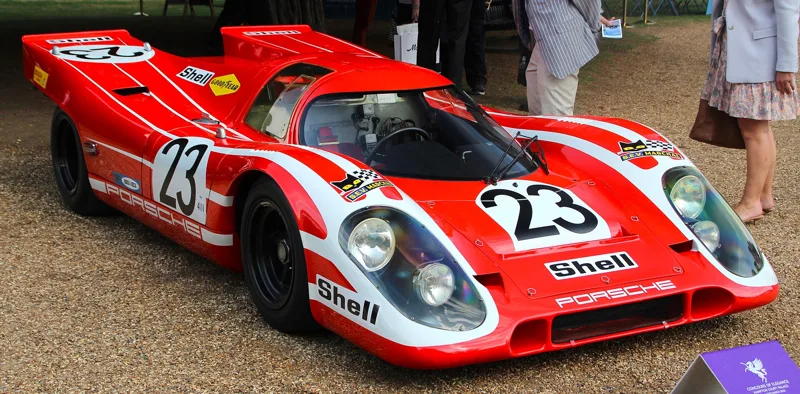
On 20 April, Porsche parked 25 examples of the 917 in front of its factory for the sport's rule-makers. Ten months earlier the car had not existed. Inspectors had visited once already and found only three finished cars, with 18 more in the process of assembly and parts for seven others, and they had refused to approve it. Ferdinand Piech then offered them a drive in one of the 25. They declined. That scene sits at the centre of the World Sportscar Championship, a series where a rule written to coax manufacturers in produced the 917 in just ten months.
The story runs from the Mille Miglia in 1953 to the cancelled 1993 season, through the Group 5 and Group 6 categories that governed the 1960s and 1970s, and on to the 2012 revival as the FIA World Endurance Championship.
What was the World Sportscar Championship?
It was the FIA's world endurance series for sports cars, run from 1953 to 1992. It started as a small set of the most important sportscar, endurance and road races in Europe and North America, with plenty of gentleman drivers filling the grids. By its peak it had become a professional series in which the biggest automakers spent millions of dollars a year. Alongside Formula One, it was one of the two major world championships in circuit racing.
Its title kept changing. It was the World Sportscar Championship for sports prototypes from 1953 to 1961, then the International Championship for GT Manufacturers from 1962 to 1965. Later names included the International Championship for Makes, the World Championship for Makes, the World Endurance Championship and the World Sports Prototype Championship. Until 1984 the titles went to manufacturers, and from 1985 to 1992 to teams. A drivers' championship arrived in 1981.
Porsche had ten months, 25 cars and one goal: win Le Mans outright.
The early years, 1953 to 1961
The early calendar read like a list of legends: the Mille Miglia, Carrera Panamericana, Targa Florio, the Tourist Trophy, the Nurburgring 1000 km, Sebring and Le Mans. Ferrari, Maserati, Mercedes-Benz, Porsche and Aston Martin all entered, often with drivers who had Formula One experience, but most of the grid was made up of privateers in cars from the likes of Nardi and Bandini.
Cars were split into two camps. Sports prototypes were purpose-built and sat at the top. Grand tourers were based on road cars and in general were slower. Both were divided again by engine size. Ferrari and Maserati fought through much of the decade, though Maserati never took the title despite winning many races. Mercedes-Benz left after 1955 because of its crash at Le Mans. Aston Martin struggled in 1957 and 1958 before winning in 1959. Jaguar's works team, curiously, entered only Le Mans despite the potential of the C-Type and D-Type.
The GT years, 1962 to 1965
In 1962 the FIA shifted its attention to production-based GT cars. The old title was discontinued and replaced by the International Championship for GT Manufacturers, with three engine categories: under one litre, under two litres and over two litres. Hillclimbs, sprints and small races pushed the calendar to about 15 rounds a season. Points valuation proved untidy, so the FIA went back to the original shape of six to 10 races. A prototype category returned in 1963. For 1965 the classes became under 1300 cc, under 2000 cc and over 2000 cc, and the last of these had no upper limit on displacement, a class designed to attract more American manufacturers.
Why 1966 to 1971 is called the golden age
This period is described as possibly the most successful in the championship's history. The S class was for 5 litre sports cars and the P class for 3 litre prototypes, and the grids included the Ferrari 512S and 330 P4, the Ford GT40, Lola T70, Chaparral, Alfa Romeo 33 and Porsche's 908 and 917. They raced on Sebring, the Nurburgring, Spa-Francorchamps, Monza, the Targa Florio and Le Mans, where Fords won four years in a row.
Behind the glamour sat a new rule book. In 1966 the FIA introduced Group 6 for prototypes and Group 4 for sports cars. Group 4 demanded at least fifty examples. Group 6 had no minimum production requirement and, at first, no engine limit, though weight and dimension rules applied. For two seasons each class had its own championship, and races such as Le Mans counted for both.
The unlimited Group 6 prototypes became a problem. At the 1967 Le Mans the 7 litre Fords were so fast that the governing body, then the Commission Sportive Internationale, wanted to slow things down and tempt makers of 3 litre Formula One engines into endurance racing. From 1968 it capped Group 6 at 3 litres and merged the two championships into a single International Championship for Makes. Few manufacturers were ready, so the CSI let in 5 litre Group 4 sports cars too, a move aimed at the ageing 1965 Ford GT40 Mk.I and the Lola T70 coupe.
The 917 and the 25-car rule
Entries stayed thin. In April 1968 the CSI cut the Group 4 production minimum from 50 cars to 25 starting in 1969. Porsche read the new figure as an invitation. From July 1968, in secret, it began designing a whole new car with one goal: an overall win at Le Mans. The 917 took ten months to develop from the 908 and carried Porsche's first 12-cylinder engine, with parts in titanium, magnesium and alloys developed for lightweight hillclimb racers. Some of the weight savings were simple. The gear lever knob was made of balsa wood.
When the inspectors arrived, Porsche argued that assembling every car would mean stripping them down again for racing. The inspectors were unmoved. They wanted 25 assembled and working cars, and on 20 April they got them. Ferrari answered. In June 1969 Enzo Ferrari sold half of his company stock to FIAT and used part of the money to build 25 cars with a 5 litre V12. Within nine months there were enough Ferrari 512S models to win homologation.
The two programmes were supported differently. Ferrari's factory cars were tuned by SpA SEFAC, but customer teams such as Scuderia Filipinetti and N.A.R.T. got less help and were treated as field fillers, never as candidates to win. Porsche gave full factory support to JWA Gulf, then Martini Racing, and treated privateers like AAW Shell Racing and David Piper Racing far better. The 917 also had a problem of its own. After the FIA restricted adjustable wings in May 1969, it became unstable, and the fix in late 1969 was a revised rear hatch, creating the short-tailed 917K. A long-tailed 917L also existed. Ferrari's late 1970 reply was the 512M, whose bodywork resembled the 917K.
Group 5 and Group 6, side by side
| Class | Years | What it was |
|---|---|---|
| Group 5 Special Touring Cars | 1966 to 1969 | Heavily modified touring cars, used in the British Saloon Car Championship from 1966 and the European Touring Car Championship from 1968 |
| Group 5 Sports Cars | 1970 to 1971 | The old Group 4 class, 5 litre engines, minimum production of 25 |
| Group 5 Sports Cars | 1972 to 1975 | 3 litre engines, no minimum production, the main World Championship for Makes cars |
| Group 5 Special Production Cars | 1976 to 1982 | Silhouette formula based on homologated production cars |
| Group 6 Prototype-Sports Cars | 1966 to 1971 | No minimum production, 3 litre limit from 1968 |
| Group 6 Two-Seater Racing Cars | 1976 to 1982 | 5000cc on a production block, 3000cc naturally aspirated, 2140cc turbocharged |
What changed in 1972
For 1972 the FIA reorganised everything. The Group 6 prototype class was redesignated as a new Group 5 Sports Car class, limited to 3 litres with no minimum production, and it raced in the newly named World Championship for Makes from 1972 to 1975.
The change cost the sport dearly. The big 917s and 512s, built to the 5 litre rules, had to retire, and Ferrari gave up official work on the 512 in 1971 to prepare the 3 litre 312PB. Many 512s stayed in private hands, mostly converted to M specification. Sports car racing lost popularity, and did not recover until the next decade, when Group C arrived. Manufacturers gradually lost interest in the 3 litre formula.
The Porsche 935 and its flat nose
From 1976 the championship changed direction again. The World Championship for Makes opened to Group 5 Special Production Cars and other production-based categories, including Group 4 grand tourers. These were extensive modifications of homologated cars, and the rules restricted width, so teams kept the standard body widths and bolted on wide mudguard extensions. Only the bonnet, roof, doors and rail panel had to remain untouched. The wide arches and boxy bodies became the category's signature.
The rules did not mention headlight height. Porsche spotted this when it prepared the 935, and so instead of keeping the production headlights it built the car with its hallmark flat nose. The 935 went on to dominate the championship and was nearly invincible. Group 5 cars were also used by the Deutsche Rennsport Meisterschaft from 1977 to 1981, in the Giro d'Italia rally and in the Australian GT Championship from 1982 to 1985. The category was banished from the world stage after 1982 in favour of Group B, though it continued in the JSPC and the IMSA GTX class.
Group 6 returns
Prototypes came back in 1976 as Group 6 Two-Seater Racing Cars, with a title of their own, the World Championship for Sports Cars. The cars ran to three engine limits, with a factor of 1.4 for turbocharging. After two seasons of small fields and little factory support, it was downgraded in 1978 to a European Sports Car Championship, which was abandoned after one year. From 1979 Group 6 cars could join the world rounds but only production-based cars scored points for a manufacturer. The 1981 drivers' title was open to Group 6 entries, and in 1982 they were allowed to keep racing, up to 3000cc, with drivers scoring points though manufacturers could not.
At Le Mans, in the second era from 1976, the category won outright every year except two. In 1979 heavy rain put several 911-based Porsche 935s on top, and in 1982 the new Group C Porsche 956 began its run. Before that the Porsche 936 won three times, in 1976, 1977 and 1981, with Renault victorious in 1978 and Rondeau in 1980.
Group C and the end of the original series
In 1982 the FIA tried to deal with climbing power in Group 5 by introducing Group C, a category of closed sports-prototypes with limited fuel consumption. The thinking was that, with fuel limited, engine rules could be relaxed, and that even naturally aspirated engines might compete with the expensive forced induction units that had dominated. Most races ran for 500 or 1000 km, usually over three and six hours. Group B GT cars were allowed but entries were sparse, and after fatal rally accidents the class and European GT racing vanished from the series.
Porsche was the first constructor to join with the 956, followed by Jaguar, Mercedes-Benz, Nissan, Toyota, Mazda and Aston Martin. A C2 class, at first called C Junior, served privateers and small makers, mostly using BMW M1 or Cosworth DFL engines, with Alba, Tiga, Spice and Ecurie Ecosse among the best. Porsche's 956 and 962 still dominated. Crowds of 50,000 to 70,000 turned out at events, similar to a modern European Grand Prix, and more than 350,000 attended Le Mans.
Then the rules changed again. For 1991, at the behest of FIA vice president Bernie Ecclestone, new Group C Category 1 cars arrived: 750 kg machines with purpose-built 3500cc normally aspirated engines, intended to mandate Formula One-style power. They made around 650 bhp against around 750 bhp or more for existing Group C cars, but are considered among the quickest sportscars ever. Only a handful were ready for 1991, so old-spec cars were admitted as Category 2, handicapped on weight, fuel and grid positions. The new rules took full effect for 1992.
The intent was lower costs and better competition. The result was the opposite. Works teams developed cars that could qualify around halfway up a Formula One grid, though they weighed some 200 kg more, and costs rose massively. Manufacturers realised they now had an engine suited to F1 and left. Mercedes and Peugeot concentrated on F1. Teams such as Spice and ADA could not afford the exotic engines. A lack of entries meant the 1993 season was cancelled before the first race.
The races that counted
The 24 Hours of Le Mans counted in every season except 1956, 1975 to 1979 and 1989 and 1990. Daytona was a near-constant fixture until 1982, when the series dropped it in a bid to cut costs, keep teams in Europe and run shorter races. Others counted for a time:
- Mille Miglia, 1953 to 1957
- Targa Florio, 1955 to 1973
- RAC Tourist Trophy, 1953 to 1964
- 1000 km Buenos Aires, 1954 to 1972
- 1000 km Zeltweg, 1966 to 1976
- Watkins Glen 6 Hours, 1968 to 1971 and 1973 to 1980
- 1000 km Monza, from 1963 to 2008
What came after 1993
In 1994 the World Sportscar name moved to North America, where the International Motor Sports Association used it for the top prototype class of its GT series until 1998. The BPR Global GT Series also launched in 1994, ending a decade-long absence of an international GT series, and the FIA took it over in 1997 as the FIA GT Championship. Prototypes largely vanished from European tracks outside Le Mans until 1997, when the International Sports Racing Series began; it became the short-lived FIA Sportscar Championship from 2001 to 2003. After that, prototypes came under the Automobile Club de l'Ouest, through the American Le Mans Series and the Le Mans Series. The FIA's GT championship gained world status in 2010, the year the ACO launched the Intercontinental Le Mans Cup.
The ACO cup's success led the FIA to agree a new FIA World Endurance Championship for 2012, using the Le Mans 24 Hours as a round. Hypercar replaced LMP1 as the top class in 2021, running LMH and LMDh cars, the same as in the top IMSA class, GTP. LMGT3 replaced GTE in 2024.
What the history means for fans today
The old championship explains why modern endurance racing looks the way it does. The homologation minimums are why Porsche and Ferrari each built 25 of the 917 and 512S. The 935's flat nose shows how a single line missing from a rule book can reshape a category. And the 1993 collapse followed rules whose stated intent was cost reduction. For anyone watching the World Endurance Championship now, the Hypercar class, with its LMH and LMDh cars, is the top category.
Where this goes next
The latest changes are Hypercar as the premier class since 2021, drivers' and constructors' titles in the GT category from 2017, and LMGT3 in place of GTE since 2024.