From a 9,500 km road race to a Brazilian series created by General Motors, three championships that went their own way.
Turismo Carretera is Argentina's stock car championship, launched in 1937 and billed as the world's longest-surviving active racing series. Stock Car Brasil began in 1979 under General Motors, and the TC2000 is an Argentine touring car series, also dating to 1979, now run with turbocharged two-litre cars.
In 1948 a field of Argentine drivers set off on a stage race from Buenos Aires to Caracas, a run of nine and a half thousand kilometres that became known as the South American Grand Prix. It is remembered as the most infamous event of the post-war years for Turismo Carretera, and the series that staged it is still racing today. Racing's oldest surviving championship is not in Europe or North America. It sits in Argentina, and two other touring car championships, Brazil's Stock Car Pro Series and Argentina's own TC2000, grew up beside it.
What is Turismo Carretera, the Argentine stock car series?
Turismo Carretera, which translates roughly as road touring, is a popular stock car series organised by the Asociacion Corredores de Turismo Carretera. It was launched in 1937 as the Campeonato Argentino de Velocidad, run by the Argentine Automobile Club, and took its present name two years later. Its roots go back further still, to the informal Grands Prix de Carretera run in the 1910s.
In those early years events were run on open roads, over asphalt and dirt, both as circuit races and as rally-style stages. Competitors drove lightly modified production coupes and needed navigators, given the nature of the roads. Juan Manuel Fangio, a future Formula One world champion, was one of the first to succeed, taking consecutive titles in the early 1940s. After the Second World War the brothers Oscar and Juan Galvez took fourteen of fifteen titles in a row between them.
The 1960s brought experiment. Prototype versions of locally built saloons replaced the coupes, among them the Liebre Torinos that won in 1967 and 1969 and broke the Ford and Chevrolet grip on the championship, and the Trueno Naranja that won in 1968. In 1970 the title was divided in two, one for road races and one for permanent circuits, but only for that single season. Three years later Nasif Estefano was crowned champion after his death, the only time that has happened in the series, having died in a crash at the third-to-last round.
Through the 1970s the prototypes were abandoned in favour of rules that returned the series nearer to its production-car origins, with home-built cars still required. The prototypes got a separate championship, which gradually dwindled and eventually turned into the TC2000 Championship. Hector Gradassi and Juan Maria Traverso were the first to win in the new formula, built around Chevrolet, Ford, Dodge and IKA Torino. Then a quarrel between two governing bodies, ACA and CADAD, stretched the 1979 season and led, in 1981, to the formation of the ACTC, an independent body that has run the competition since.
Dodge ruled the 1980s with its new GTX, taking 8 of 10 championships, four of them with Roberto Mouras. In 1989 Chevrolet and Ford received concessions on engine compression that left Dodge and the ageing Torino at a clear disadvantage. The imbalance was only fixed in 1995, when Jeep Cherokee engines were homologated to keep them competitive after competitors began leaving. Deaths of Mouras and Osvaldo Morresi brought the end of road races, the last at Santa Teresita in 1997, and in 2007 Guillermo Castellanos died in a crash at Comodoro Rivadavia, after which navigators were banned, a custom by then kept largely for tradition's sake.
Racing's oldest surviving championship is not in Europe or North America.
How Turismo Carretera works today
Modern Turismo Carretera has four tiers. Turismo Carretera itself is the top tier. Below it come TC Pista, established in 1995, TC Mouras, established in 2004 and named after Roberto Mouras, and TC Pista Mouras, established in 2008 as the first step for drivers coming from regional series. A fifth category, TC Pick Up, arrived in 2017, though in 2022 current or former TC drivers took every Final but one of its eleven.
A normal race weekend has one qualifying session on Saturday and four races on Sunday. The first three are heats, called Series, each a five-lap sprint, with the field split into three groups from qualifying. The heat results then set the grid for the Final, usually 25 laps in the afternoon. Heat winners take the first three places, and drivers who were not on the lead lap at the end of their heat go to the back. Up to four special races can also be added to a season. In 2023 these included a race with a compulsory refuelling stop in La Pampa, the Carrera de los Milliones at Rafaela, which paid its winner a special cash prize, and the Desafio de las Estrellas at Villicum, with a lottery deciding the grid and two compulsory stops.
Since 2008 the title has been decided by a NASCAR-style playoff called the Copa de Oro, or Gold Cup, normally over the final five events. The top twelve drivers qualify, everyone starts from zero points, the championship leader gets 15 bonus points and each driver who won a Final gets 8 more per win. Three drivers who missed the cut are admitted before the last round as last-chance qualifiers. Playoff runners are easy to spot, with gold numbers on the rear side windows and gold paint under the nose.
One rule stands out: a caution period is signalled with a horizontal triband of blue, white and red, the same pattern as the old flag of Serbia and Montenegro. For contact, the offender is repositioned behind the affected driver in the results, and is disqualified if the other driver cannot finish.
Turismo Carretera cars: Chevrolet, Dodge, Ford and Torino
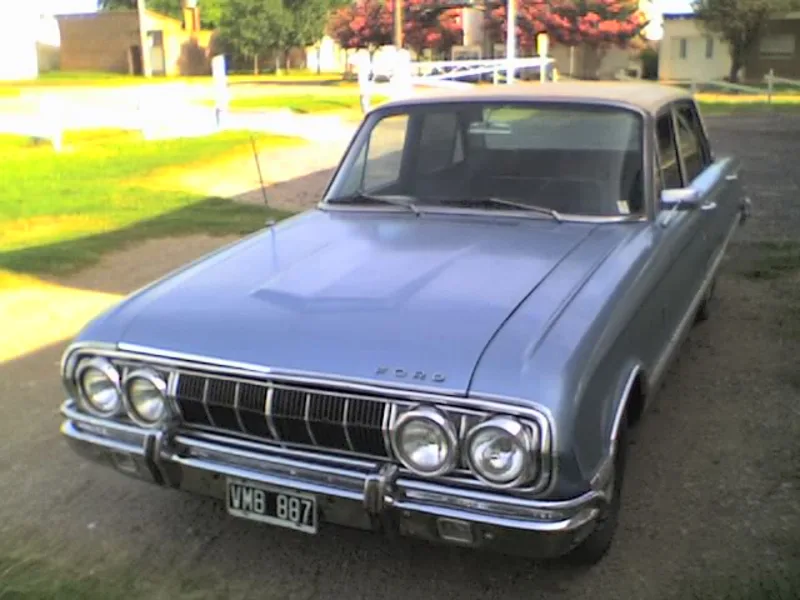
The cars are built by teams and constructors to parity regulations. Since the 1970s four makes have raced together using Argentine-built models: the Chevrolet Nova, the Dodge GTX, the Ford Falcon and the Industrias Kaiser Argentina Torino. Toyota joined in 2022 with a Camry XV70. In 2024 the field switched to modern counterparts that kept more of their original styling, since the earlier cars had all grown to look much alike. Chevrolet, Dodge and Ford moved to the Camaro, Challenger and Mustang, Toyota kept the Camry with a redesigned nose, and a concept Torino was drawn up, since IKA had gone out of business in 1975. From 2026 Mercedes-Benz and BMW will join, with cars based on the CLE 53 and the M4.
| Series | Began | Engine | Chassis |
|---|---|---|---|
| Turismo Carretera | 1937 | Naturally aspirated inline-six, 3,260 to 3,310 cc, about 450 hp (336 kW) | Tubular silhouette |
| Stock Car Pro Series | 1979 | Chevrolet V8 from 2003; turbocharged four-cylinder for 2025 only | Tubular from 2000, monocoque from 2020 |
| TC2000, 2024 rules | 1979 | Turbocharged 2.0 litre four-cylinder, about 380 hp (283 kW), front-wheel drive | Tubular |
Under the bonnet, the engine is an inline-six of 3,260 to 3,310 cc, depending on manufacturer, fed by two dual-body Weber 48-48 IDA carburettors. Fuel capacity is 100 litres (26 US gal), wheels carry 16-inch tyres, and minimum weight runs from 1,300 kg (2,866 lb) to 1,315 kg (2,899 lb). Power is about 450 hp (336 kW) at between 8,800 and 9,000 rpm, sent through a Saenz TT3 six-speed sequential manual gearbox. The Dodge and Torino switched, in the mid-1990s, from Slant Six and Tornado units to Chrysler Cherokee engines, and Toyota has used a Cherokee engine since 2022.
The Stock Car Brasil story: a series General Motors built
The Bradesco Stock Car Pro Series, formerly Stock Car Brasil, is organised by Vicar and regarded as the major Brazilian and South American motorsport series. General Motors created it in 1979 as the Campeonato Brasileiro de Stock Cars, a rival to the Division 1 championship that featured Chevrolet Opalas and Ford Mavericks. Chevrolet dominance had drained public interest and sponsors, so GM built a new category with a name that recalled NASCAR and standard performance and parts for all.
The first race was on 22 April 1979 at the Autodromo Internacional de Taruma in Rio Grande do Sul. Nineteen cars started, every one a six-cylinder Chevrolet Opala. Jose Carlos Palhares held pole and Affonso Giaffone won. In 1987 a fairing built by coachbuilder Caio improved aerodynamics and performance, and in 1994 the Chevrolet Omega became the standard model. The 1990s belonged to Ingo Hoffmann, who won eight titles, three in partnership with Angelo Giombell, his only real threats coming from Paulo Gomes in 1995 and Chico Serra in 1999.
From 2000 Vicar Promocoes Desportivas, owned by former driver Carlos Col, took over the running of the series. Safety improved with a tubular chassis called the JL G-09, engineered by Edgardo Fernandez, who had done similar work for Argentina's Top Race V6, with construction by JL Racing, the firm of Zeca Giaffone. In 2003 the Chevrolet six-cylinder engine, used with changes since 1979, gave way to an imported V8 like those in the NASCAR Busch Series.
New makers followed. Mitsubishi entered with the Lancer Evolution in 2005, the first time Chevrolet had not been the only manufacturer, and Volkswagen joined with the Bora in 2006. The 2007 season had the most makes ever, with Chevrolet, Mitsubishi, Peugeot with the 307 Sedan, and Volkswagen on the grid. Volkswagen withdrew in 2008 and Mitsubishi a year later. On 30 October 2005 the series held its first race in Argentina, at the Autodromo Juan y Oscar Galvez, alongside the TC 2000, in front of 70,000 spectators, and Giuliano Losacco won ahead of Mateus Greipel and Luciano Burti.
A NASCAR-style points system and a Super Final for the best ten drivers arrived in 2006 and were dropped for 2012. Ethanol fuel and electronic injection came in 2010. Chevrolet brought the Sonic in 2012 and the Cruze in 2016, and when Peugeot withdrew in 2017 the series became a one-make championship, every driver in a Cruze. Toyota Gazoo Racing arrived in 2020 with a Corolla, the same year the series returned to a monocoque chassis, replacing the tubular design used since 2000. Hankook has supplied tyres since 2023.
The biggest recent change is the 2025 crossover formula, picked to follow Brazilian passenger-car sales. Out went the existing cars, replaced by the Chevrolet Tracker and Toyota Corolla Cross, Mitsubishi came back with the Eclipse Cross, and turbocharged four-cylinder engines took over from the V8s. After criticism of reliability and safety, the cars went back to the previous engines from 2026.
Along the way the series has attracted Tony Kanaan, Ricardo Zonta, Nelson Piquet Jr., Lucas di Grassi, Bruno Junqueira, Felipe Massa and Rubens Barrichello. Ingo Hoffmann holds the records, with 12 titles and 77 wins from 1979 to 2008. Caca Bueno has five titles, and Daniel Serra has three, from 2017 to 2019, plus two class wins at Le Mans in 2017 and 2019. Special races have included the Corrida do Milhao, a race with a R$1 million prize pool, and the Corrida de Duplas, a two-driver race with guests such as Jacques Villeneuve. In 1982 the series also ran two non-points races at Estoril in Portugal.
TC2000: the Argentine touring series built on two-litre cars
The TC2000, short for Turismo Competicion 2000 and once known as Super TC2000, has been held in Argentina since 1979. Before 2012 engines of up to 2,000 cc with limited changes from standard were allowed, both to reduce running costs and to level the field, and the banned items included variable valve timing, variable intake geometry, ABS and traction control.
In 2012 Radical Performance Engines supplied a 2.7 litre RPE TCX V8, a front-wheel-drive version of the engine from the Radical SR8, rated at 430 brake horsepower (320 kW), and the series became the Super TC2000. Cars with the old regulations raced on as a second-tier championship called TC2000, with its own calendar. The V8 was replaced in 2019 by a two-litre turbocharged four-cylinder from the French manufacturer Oreca. In 2022 the names swapped again: the Super TC2000 got its former name back, and the second tier became the TC2000 Series.
The 2024 rules call for a tubular chassis, a turbocharged inline four-cylinder engine of 2.0 litres, a six-speed gearbox, front-wheel drive and a minimum weight of 1,120 kg (2,469 lb). Quoted power is roughly 380 hp (283 kW), peaking at no more than 6,500 rpm. Factory teams in 2024 ran the Honda Civic and the Toyota Corolla, and private teams fielded the Renault Fluence, Chevrolet Cruze, Ford Focus, Fiat Cronos, Toyota Corolla and Citroen C4 Lounge.
What changes next in the three series
Turismo Carretera's biggest announced change is the arrival of Mercedes-Benz and BMW in 2026. The Stock Car Pro Series returns to its previous engines in 2026 after one season of turbocharged four-cylinders.