Only 337 were made, every one was sold, and Toyota is believed to have made no profit on any of them. The story of how the 2000GT happened and why collectors chase it.
The Toyota 2000GT was a front mid-engine, rear-drive sports car shown in 1965 and built by Yamaha from 1967 to 1970. Toyota wanted a halo car to lift its image. Only 337 regular units were made, which, with its racing record and Bond role, explains its collector status.
Toyota built 337 regular production 2000GTs, sold every one, and is believed to have made no profit on any of them. That makes the Toyota 2000GT one of the strangest successes in motoring: a commercial dead end that changed how the world saw Japanese cars.
What is the Toyota 2000GT?
The 2000GT is a two-door, two-seat grand tourer with its engine behind the front axle and drive to the rear wheels. Toyota designed it together with Yamaha and revealed it at the 1965 Tokyo Motor Show. Yamaha then built it under contract from 1967 to 1970, in limited numbers. In Japan it was available only through Toyota Store, one of the maker's own retail channels.
It mattered because of what Japan was believed to produce at the time: imitative and stodgily practical vehicles. A sleek fastback coupe that could stand next to European sports cars was a different message. When Road & Track tested a pre-production car in 1967 it ranked the car among the most exciting and enjoyable it had driven, and compared it favourably with the Porsche 911.
Toyota wanted a halo car, Yamaha wanted a sports car, and Nissan's cancellation of a prototype brought the two together.
Why did Toyota want a halo car?
Car ownership in Japan was picking up in the late 1950s and early 1960s, and Toyota noticed that most major overseas makers kept a flagship sports car or grand touring coupe. Such a car drew customers into showrooms, where they might leave in something cheaper. Ford had the Thunderbird, Chrysler the C-300 and Chevrolet the Corvette. In Europe there was the Mercedes-Benz 300SL, the BMW 507, the Porsche 356, the Jaguar E-Type, the Aston Martin DB4, the Ferrari 250 GT Coupe and the Maserati 3500 GT. At home Nissan offered the Datsun Sports, Honda the S500 and Prince the Skyline Sport Coupe.
Toyota had started building the Sports 800, but its engine was far too small for a world-class sports car. The company decided it needed a proper six-cylinder coupe.
Why did Toyota build the 2000GT with Yamaha?
Yamaha Motor was a young company. It was founded in 1955 after separating from Nippon Gakki, now Yamaha Corporation, the musical instrument maker, and it is based in Iwata, Shizuoka. It also did contract engineering work for Nissan and other Japanese manufacturers.
In 1959 Yamaha set up a Technical Research Institute to develop its own sports car. It built the YX30, a 1600 cc four-cylinder that took its inspiration from the twin-cam B-Series engine of the British MGA. Problems piled up and senior management closed the facility in 1962, but the enthusiasm for a sports car remained, and it led Yamaha to look for an established partner.
A prototype called the A550X went to Nissan, which cancelled the project and brought out the slow-selling Silvia coupe in 1965. Yamaha then took the design to Toyota, regarded as the most cautious of Japan's car makers. Wanting to improve its image, Toyota accepted the proposal, though it used a design from its own stylist Satoru Nozaki. Even so, most of the 2000GT's design work was carried out by Yamaha.
The programme moved fast. The first prototype was finished in August 1965, just 11 months into the project, although production cars took two years more to appear.
How was the 2000GT engineered?
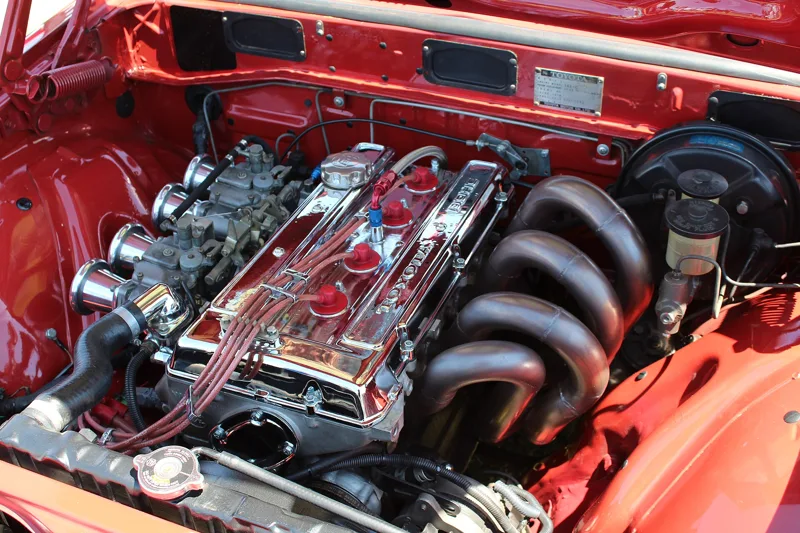
Power came from a 1,988 cc straight-six, the 3M, mounted lengthways and borrowed from the Toyota Crown (S50) saloon. Yamaha turned it into a sports engine by fitting a new DOHC head and three 2-barrel Mikuni-Solex 40 PHH carburettors. Peak torque was 175 N.m (129 lb ft) at 5,000 rpm, with 150 PS (148 bhp; 110 kW) arriving at 6,600 rpm.
Nine special MF-12 models took a different route, using a larger but less powerful SOHC 2.3-litre 2M-B engine, rated at 140 PS (138 bhp; 103 kW), reached at 5,800 rpm, plus 201 N.m (148 lb ft) of torque at 3,800 rpm.
All cars had a five-speed manual gearbox and rear-wheel drive, with a choice of three final drives. With the 4.375 axle the car was claimed to reach 135 mph (217 km/h) and return 7.59 L/100 km (31 mpg-US; 37 mpg-imp).
The chassis is what impressed engineers. A backbone frame carried coil springs and double wishbones at all four corners, and the car rode on 15-inch magnesium alloy wheels. A limited-slip differential and power-assisted disc brakes on all four wheels were standard, the discs a first for a Japanese car. It was also the first Toyota with rack and pinion steering, fitted because Toyota wanted to prove the car belonged among the world's best sports cars. A brake lever on the dashboard acted straight on the rear discs, a backup if the main system failed.
What did the 2000GT look like inside and out?
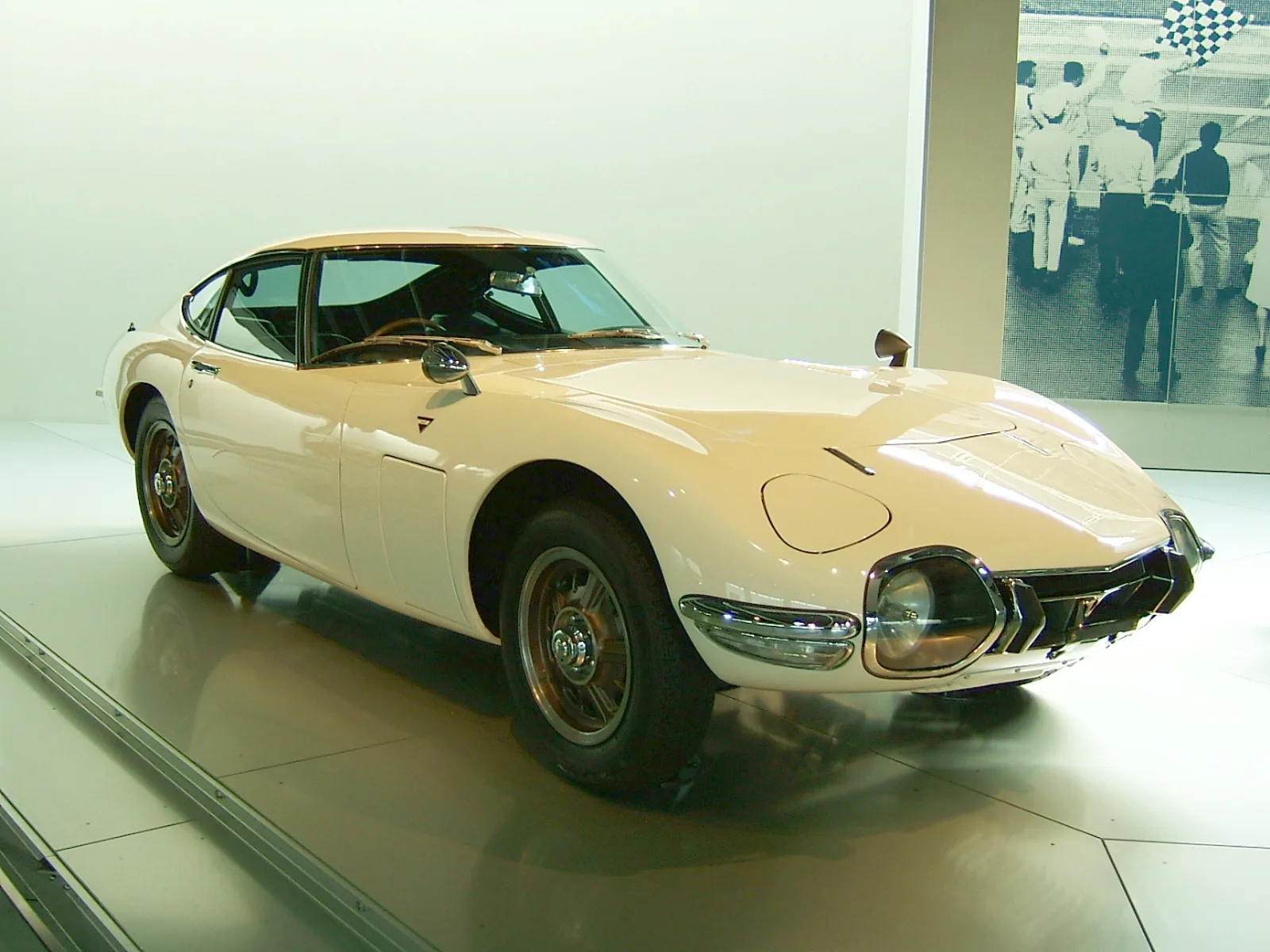
Nozaki's styling drew on the Jaguar E-Type and borrowed 1960s grand touring cues. Pop-up headlights sat above large driving lamps behind plexiglass covers on either side of the grille, a layout shared with the Sports 800. Bumpers were slim, and the car sat very low: the top of the roof stood just 116 cm (45.7 in) off the ground.
Inside, the cabin was comfortable if cramped. Walnut or rosewood veneer inlays on the dashboard came from Yamaha's musical instrument woodworking facilities, and the radio tuner could seek stations automatically. An electric clock and a stopwatch were fitted under the radio, over the climate controls. Road & Track thought the interior suited a luxurious GT and called it a car to sit in, ride in or simply admire.
Toyota reshaped the front slightly in August 1969, with smaller driving lamps and redesigned front turn signals. Rear signals grew and the interior was brought up to date. The last few cars had air conditioning, with an extra scoop under the grille feeding the unit, and automatic transmission was an option.
How did the 2000GT do in racing?
Racing at home, the car finished third at Fuji in the 1966 Japanese Grand Prix. It scored its first victory in the first running of the Suzuka 1000 Kilometres, also in 1966, and 1967 brought victories in the Fuji 1000 Kilometres and the 24 Hours of Fuji.
The record attempt grabbed more attention. During a 72-hour run in 1966 at the Yatabe High Speed Test Track, it took thirteen FIA world records covering speed and endurance. The record car was later wrecked in a pace car accident and scrapped. The records are said to have prompted Porsche to prepare a 911R specifically to beat them.
Carroll Shelby ran two 2000GTs in the CP class of SCCA's 1968 production-car racing, and built three cars including a spare. They performed well, but it was the only US season. Toyota took one back and rebuilt it as a replica of its record car, which remains in Japan, while the other two have stayed in America. A Toyota-Shelby car changed hands at auction in 2022 for US$2.5 million.
What is the 2000GT Bond car?
The 2000GT made its best-known screen appearance in 1967's You Only Live Twice, the James Bond film shot largely in Japan. Two one-off topless cars were built for it, fitted only with tonneau covers to imitate functioning roofs. The factory itself never built a convertible for sale.
It is claimed that a targa was considered to suit the tall Sean Connery, who stood 1.88 m (6 ft 2 in). That layout would have kept the fastback profile but removed the rear side windows. The story goes that his head poked above the roofline, so a roofless car was reportedly built in under two weeks. In the film only the Bond girl Aki, played by Akiko Wakabayashi, drives it. Daniel Craig, another Bond actor, picked the 2000GT as his favourite of all the Bond cars.
What did a Toyota 2000GT cost?
| Car (US list price) | Price |
|---|---|
| Jaguar E-Type | US$5,539 |
| Porsche 911S | US$6,790 |
| Toyota 2000GT (1968) | About US$7,150 ($66,197 in 2025 dollars) |
| Ferrari 365 GTB/4 | US$19,700 |
The Toyota sat moderately above the Jaguar and Porsche but far below the Ferrari. Even so, it is believed to have lost money as a halo car. Regular production came to 337 cars, a figure comparable to the elite Italian supercars of the era, and Toyota says every one was sold. Counted by model, Toyota and Yamaha data give 233 MF10, 109 MF10L and nine MF12L, though those three figures do not tie exactly to the headline total.
About 60 cars reached North America, with the rest thinly scattered around the world. Solar Red and Pegasus White dominated; the palette also included Twilight Turquoise metallic, Atlantis Green, Bellatrix Yellow and Thunder Silver metallic.
Why is the Toyota 2000GT so prized today?
Collectors treat the 2000GT as the first Japanese car worth collecting seriously. Some count it as the country's first supercar, though others give that distinction to the later Honda NSX. A car sold at auction in 2013 for as much as US$1,200,000, and in 2022 a Toyota-Shelby car reached US$2.5 million.
Scarcity explains part of the value. Add a racing record, a Bond role, Yamaha craftsmanship and four-wheel power disc brakes that were a first for a Japanese car, and the demand makes sense.
Where the 2000GT led
Low sales led to its cancellation in 1970, but it inspired Toyota to launch the performance-minded sporty coupes of the 1970s. Toyota and Yamaha also collaborated on a cheaper car, the Toyota 1600GT, which used a Toyota engine block with a Yamaha-developed DOHC head in a 1967 Corona two-door hardtop coupe. When 2000GT production ended, the Celica arrived exclusively at Toyota Corolla Store locations as a top model with a 2.0-litre DOHC engine and manual gearbox, priced more affordably.
Lessons learned by Toyota and Yamaha fed into the Toyota 7, designed mainly for FIA Group 7 competition and Toyota's first purpose-built racing car.
For surviving cars, Toyota is remaking parts from the original sources and supplying them to registered owners under its GR Heritage Parts Program.