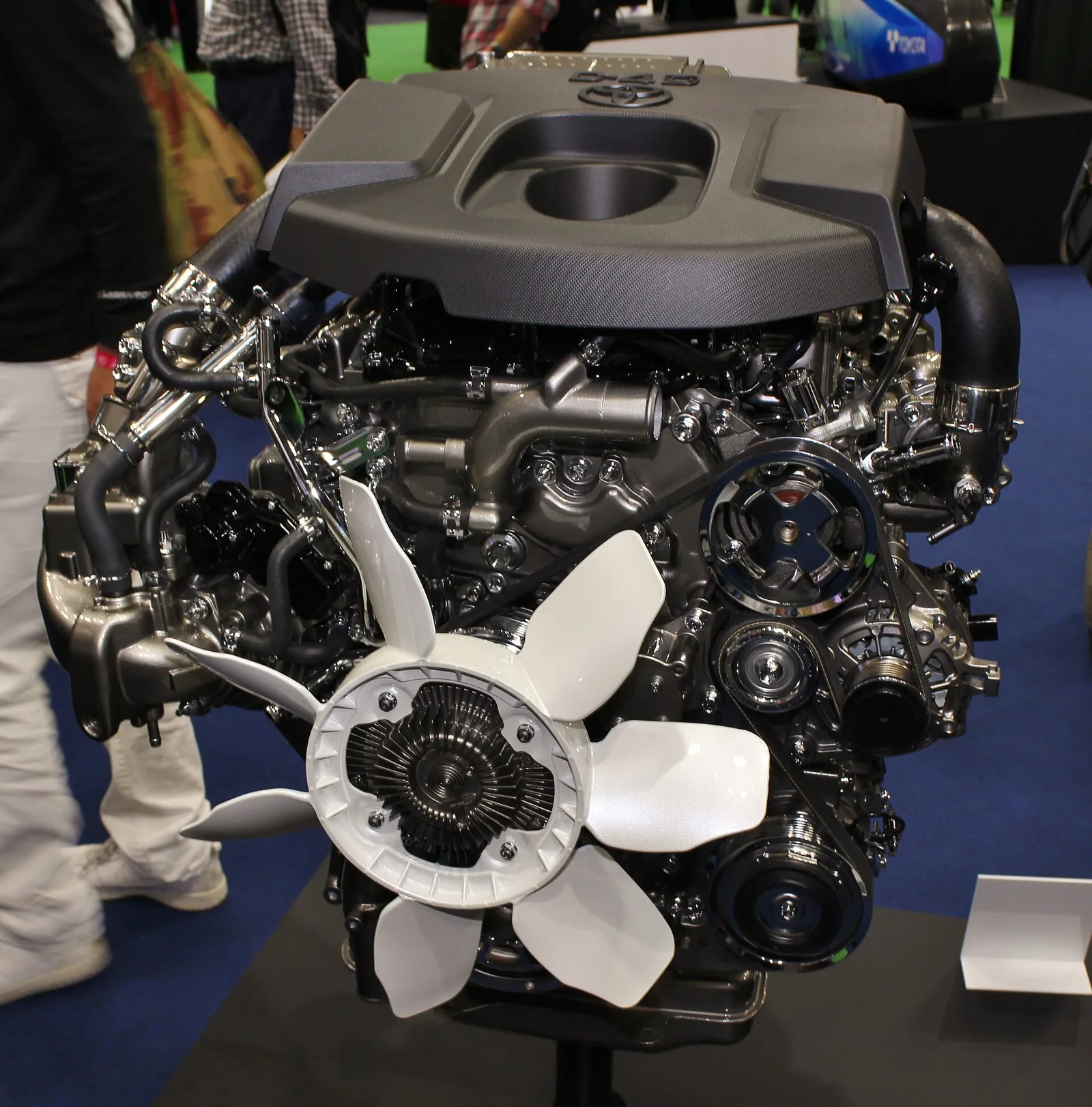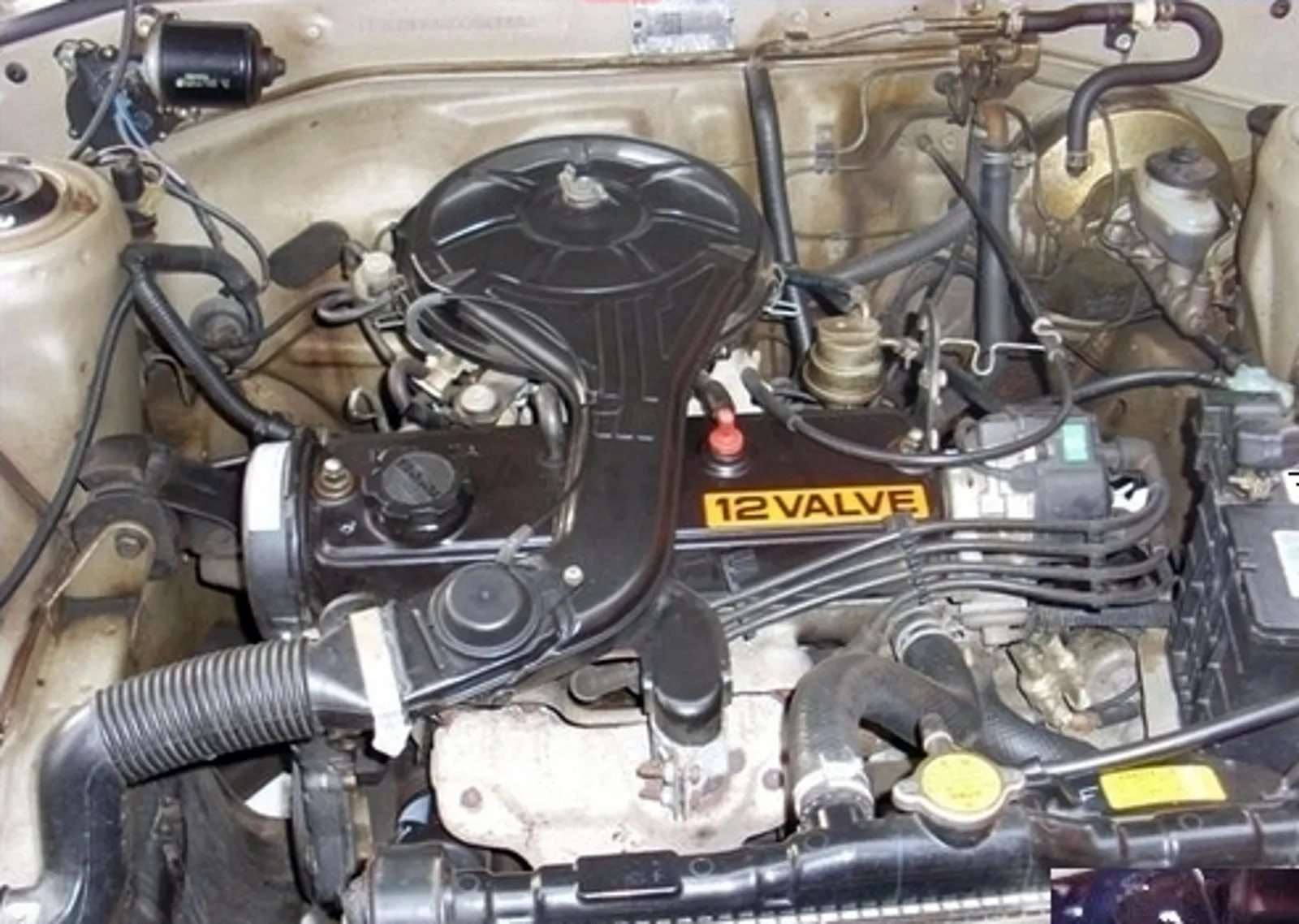
From the 4T-GTE that took Toyota rallying to the 4E-FTE Starlet turbo, and the B and C diesels behind the Land Cruiser and Corolla.
Toyota's T engines were inline-fours from 1970 to 1985, including the 4T-GTE rally turbo. The E series was a family of economy fours from 1985 to 1999. The B and C families were diesel inline-fours, from Land Cruiser trucks to Corolla and Camry passenger cars.
Toyota's 4T-GTE was a 1.8-litre road engine that Toyota stretched to 2.1 litres for rallying, and the engine let Toyota become the first Japanese manufacturer to enter the World Rally Championship, in the early 1980s. The same company built a diesel that powered Land Cruisers and military Mega Cruisers, small petrol fours that put economy ahead of speed, and a rugged diesel family that ended with Toyota stopping diesel passenger cars in Japan.
Four engine families, labelled T, E, B and C, tell most of that story. Here is how each one was built, which cars carried it, and where the big moments came.
What is the Toyota T engine?
The Toyota T series is a family of four-cylinder petrol engines in a row, made from 1970 to 1985. It began as a pushrod overhead-valve design, and twin-cam performance variants were added later. Toyota built a solid reputation on their reliability.
Chains rather than belts drive every T engine's camshaft. The block is cast iron, the head alloy with hardened valve seats, and the combustion chamber hemispherical. They are carburetted unless the code carries an E for electronic fuel injection, and they have two valves per cylinder unless the code includes a G for the twin-cam performance head. The 12T and 13T have a small sub-cylinder directly behind the spark plug leading to a smaller chamber, which is there for emission reasons.
- T: 1.4 litres (1,407 cc), built from 1970 to 1979, with an 80 mm bore and 70 mm stroke. It made 86 hp (64 kW; 87 PS) at 6,000 rpm and went into the Carina, Celica and Corolla.
- 2T: 1.6 litres (1,588 cc), from 1970 to 1984, with an 85 mm bore. The later single-carburettor engine made 75 hp (56 kW; 76 PS), and the 2T-J commercial version 93 PS.
- 12T: also 1.6 litres, from 1970 to 1983, rated at 88 hp (66 kW; 89 PS) at 5,600 rpm. Toyota introduced it with the lean-burn TTC-L system in response to Honda's CVCC.
- 3T: 1.8 litres (1,770 cc), from 1973 to 1985. Output spanned 70 to 105 hp (52 to 78 kW; 71 to 106 PS) depending on market and fuelling.
- 13T-U: the same capacity, built from 1977 to 1982, with a twin-barrel carburettor and 95 PS (70 kW; 94 hp) at 5,400 rpm.
Toyota's 4T-GTE made it the first Japanese manufacturer in the World Rally Championship.
What is the Toyota 2T-G?
The 2T-G was a chain-driven, eight-valve double-overhead-cam version of the 2T, produced from 1970 to 1983. It made 110 to 125 hp (82 to 93 kW; 112 to 127 PS) and was considered the flagship engine of Toyota's 1600 class until the 4A-GE replaced it in most applications.
The 2T-G sat in the Corolla Levin and Sprinter Trueno, the Celica and the Carina. Non-injected versions used twin sidedraft 40 mm Mikuni-Solex PHH carburettors, and every cylinder head was cast by Yamaha, though not all are marked as such. Variants included the air-injected 2T-GR, the Japan-spec 2T-GU and the fuel-injected 2T-GEU. It remains popular for conversions into classic Celicas and Corollas and for classic and formula racing.
On the track its reach was wide. Bore the 2T and 2T-G out to 89 mm and add a 3T crankshaft, and capacity climbs to almost 2.0 litres. The racing 2T-G, known as the NOVA, measured 87 mm across with an 84 mm stroke, giving 1,997 cc, and made around 170 PS (125 kW; 168 hp) at 6,000 rpm with 12.0:1 compression. It served in Formula 3 cars in Europe and Japan, where it dominated, and in Formula Pacific. The plain 2T was also common in Australian Formula Two during the 1970s and 1980s, making 180 to 200 hp (149 kW; 203 PS), and a Toyota 2T-powered Cheetah Mk6 won the 1979 championship.
What is the Toyota 3T-GTE?
The 3T-GTE is the turbocharged, twin-cam performance version of the 1.8-litre 3T, first released in September 1982. It was the first turbocharged twin-cam engine built in Japan. Rated output was 160 PS (118 kW; 158 hp), with 206 N.m (152 lb.ft) of torque at 4,800 rpm.
It has a hemispherical-chamber eight-valve twin-cam head, two spark plugs per cylinder and swirl inlet ports for better efficiency, and its fuel injection brought in knock control. The turbo is Toyota's CT20, the same unit used on the 2L-T diesel, and cars built after May 1983 had a water-cooled turbocharger. Toyota over-engineered it for durability, doubling the cam roller chains among other things, because it was meant to form the basis of the 4T-GT competition engines. It came with a W55 five-speed manual, with a larger 225 mm (8.9 in) clutch and a lighter 8 kg (18 lb) flywheel, or an A43D four-speed automatic.
The cars were the 1982 to 1985 Celica TA63 and Carina TA63 and the 1982 to 1985 Corona TT142, badged GT-T or GT-TR.
How did the Toyota 4T-GTE go rallying?
The 4T-GTE is the version of the T family that drove Toyota's Group B and World Rally Championship cars. Toyota introduced the homologation engine in November 1982 with a bore 0.5 mm larger than the 3T's, giving 1.8 litres (1,791 cc). The FIA applied a 1.4 multiplication factor to turbocharged engines, which turned that into 2.5 litres (2,507 cc) and placed the Celica in the 2.5 to 3.0-litre class.
That sounds like a penalty, but it was an opportunity. The smaller 3T would have fitted under the 2.5-litre limit, yet being in the bigger class allowed Toyota to stretch the 4T-GT to 2.1 litres (2,090 cc), using an 89 mm bore and 84 mm stroke, which converted to 2.9 litres (2,926 cc). That suited the comparatively heavy Celica better.
In race trim the engine used a Toyota or KKK/K27 turbocharger, electronic fuel injection and twin-spark ignition, and made 360 to 600 PS (265 to 441 kW; 355 to 592 hp) depending on the tune. The Group B rally version of 1984 gave 326 PS (240 kW; 322 hp) at 8,000 rpm. For the road, the 4T-GTEU was rated at 180 PS (132 kW; 178 hp); 200 were built, and 228 engines in all counting modified ones. It was also fitted to the Celica Turbo IMSA GTO, the Supra in JGTC, and sports prototypes including the TOM's 83C and 84C, the Dome 85C and 86C, the Eagle Mk I and the LM 06C.
What is the Toyota E engine?
The Toyota E engine series is a family of straight-four engines made from 1985 to 1999. They have a cast iron block, an aluminium head and timing belts, and range from 1.0 to 1.5 litres. They replaced the K engines in most applications, and many parts are interchangeable within the family.
The E series was among the first Toyota engines designed for fuel economy, practicality and everyday use rather than performance, so power and torque arrive in the low-to-mid rev range. They are lighter than earlier Toyota engines thanks to a hollow crankshaft, a thinner block casting and fewer auxiliaries. The carburetted versions use a newly designed variable-venturi carburettor, and all of these changes improved fuel economy and emissions.
The valve gear is unusual. SOHC E engines have three valves per cylinder for 12 valves in total, where most single-cam fours have two per cylinder and eight overall. DOHC engines have four valves per cylinder, 16 in total, with narrow valve angles. They use Toyota's High-Mecha Twin Cam, also called the slave-cam system: one timing belt drives the exhaust camshaft, and that cam drives the inlet cam through scissor gears.
The E sizes
- 1E: 1.0 litre (999 cc), 1985 to 1994, up to about 55 hp (41 kW) at 6,000 rpm. A fuel-injected DOHC 1E-FE also existed. It powered the Starlet EP70 and EP80.
- 2E: 1.3 litres (1,295 cc), 1985 to 1998, 65 to 88 hp (48 to 66 kW; 66 to 89 PS). The 2E-TE turbo of 1986 made 100 PS (74 kW; 99 hp) and the later 2E-TELU 110 PS (81 kW; 108 hp). It fitted the Corolla, Sprinter, Starlet and Tercel, and the Conquest and Tazz in South Africa.
- 3E: 1.5 litres (1,456 cc), 1986 to 1994, 79 to 88 PS (58 to 65 kW; 78 to 87 hp). The 3E-TE turbo produced 115 PS (85 kW; 113 hp).
- 4E: 1.3 litres (1,331 cc), DOHC, 1989 to 1998, from 74 hp (55 kW; 75 PS) to 99 hp (74 kW; 100 PS). It went into the Starlet, Tercel, Corolla, Paseo and Cynos.
- 5E: 1.5 litres (1,497 cc), DOHC, 1990 to 1998, 94 PS (69 kW; 93 hp) to 110 PS (81 kW; 108 hp). All 5E engines were fuel-injected.
The 4E-FTE, the E family's fast one
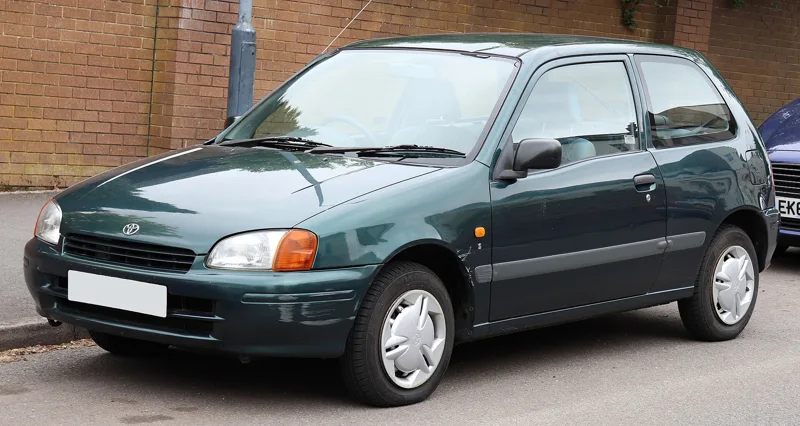
The 4E-FTE was the most powerful E engine ever produced. A turbocharged development of the first-generation 4E-FE from 1989, it was rated at 135 PS (99 kW; 133 hp), reached at 6,400 rpm, and delivered 157 N.m (116 lb.ft) of torque by 4,800 rpm. It was built only for the Toyota Starlet GT Turbo and its successor, the Glanza V, though enthusiasts also dropped it into the Corolla, Tercel, Paseo and Sera using standard Toyota parts.
Inside it has stronger connecting rods, a stronger crankshaft, a harmonic damper and lower-compression pistons, down from 9.6:1 to 8.5:1. The inlet cam has higher lift and the valve springs are stiffer. Toyota's own CT9 turbo has an internal wastegate and two boost modes, a low 0.4 bar (5.8 psi) and a high 0.65 bar (9.4 psi). A solenoid valve and the ECU control the low mode, and an actuator on the turbo controls the high one. A top-mounted, air-cooled intercooler cools the charge.
The 3E and its weak points
The 3E engines are considered slightly less reliable than other Toyota engines, despite being among the easiest to service. The usual problems are early failure of the nitrile rubber valve stem seals, carbon on the intake valves and collapse of the piston's oil control ring. Rough idling, stalling and fouled spark plugs can result, so the cause needs careful diagnosis. The valve stem seals can at least be replaced with silicone or Viton-based ones that last far longer.
The 5E-FHE
The 5E-FHE took the harmonic damper from the 4E-FTE and added more aggressive, higher-lift cams, high-compression pistons, cast 4-2-1 exhaust headers and a forged crankshaft and connecting rods. Maximum power rose to 110 PS (81 kW; 108 hp), and engine speed to 7,200 rpm in the first generation and 7,900 rpm in the second. Some versions, though not the Sera's, have an ACIS intake manifold claimed to lift power to 130 PS (96 kW; 128 hp).
What is the Toyota B engine?
The Toyota B engine family is a series of inline-four diesel engines, built in five generations, with sizes from 3.0 to 4.1 litres. It powered the Land Cruiser, Dyna, Coaster and Mega Cruiser. An unrelated 3.4-litre (3389 cc) inline-six petrol engine, also called B, was built from 1937 to 1947 for early Toyota cars, trucks and the first Land Cruiser, then known as the BJ Jeep.
Toyota's letters and numbers are a code. A 1 before the model number means direct injection, otherwise injection is indirect. F after the B means multivalve, which on an inline-four means 16 valves. T means turbocharged, and E means an electronic control unit. A 15B-FTE is therefore the fifth generation, with 16 valves, a turbo, direct injection and an ECU.
In August 1988 Toyota redesigned the B, 3B and 11B. The block became a monoblock with no cylinder liners, a gear-driven vacuum pump replaced the alternator-driven one, the camshafts got larger bearing journals and roller lifters replaced solid lifters. The pushrod inspection galleries disappeared to make the block more solid and the flywheel changed from six bolts to eight. Toyota did not rename the engines, but users call the post-1988 3B the 3B-II.
From the B to the 14B
- B: 3.0 litres, eight-valve OHV, 21:1 compression, 80 PS (59 kW) at 3,600 rpm and 191 N.m (141 lb.ft). It went into the Land Cruiser 40 and the Dyna.
- 2B: 3.2 litres, 93 PS (68 kW), in the Land Cruiser BJ41 and BJ44 and the Coaster.
- 3B: 3.4 litres, 90 hp (67 kW) at 3,500 rpm, in the Dyna, Toyoace, Land Cruiser 40, 60 and 70 and Coaster.
- 4B: 3.7 litres, indirect injection, sold only in Japan. It was released in 1999, when the 3B stopped, much later than the direct-injection 14B of 1988.
- 11B and 13B: the direct-injection versions of the B and 3B, from 1985, with the 13B-T turbo at 120 hp (89 kW), later 130 PS (96 kW) in LASRE form. The 13B ended in 1989.
- 14B: 3.7 litres (3661 cc), launched in 1988, with 18:1 compression and 98 hp (72 kW) at 3,400 rpm. The 14B-T turbo makes 140 PS (103 kW), and Yamaha adapted it for marine use as the 165 hp (123 kW) ME372.
The 15B family
The 15B is a 4.1-litre (4104 cc) four with a bore of 108 mm and a stroke of 112 mm. The 15B-T went only to the Japanese Armed Forces and is presumed to be a bored-out 14B-T. It sat in the earliest BXD-10 Mega Cruisers before the 15B-FT arrived in 1995.
The 15B-F has 16 valves and direct injection, making 86 kW (115 hp) at 3,200 rpm and 290 N.m (214 ft.lbf), in the Coaster 4x4 and Dyna. The intercooled turbo 15B-FT makes 101 kW (136 hp). The electronic 15B-FTE has a 17.8:1 compression ratio and makes 114 kW (153 hp) at 3,200 rpm and 382 N.m (282 ft.lbf) at 1,800 rpm, and it served in the Mega Cruiser, the Coaster and the Hino Dutro from 1999 to 2011. A spark-ignited LPG sibling, the 1BZ-FPE, has been fitted since 2002 to LPG-fuelled Dyna and Coaster models in selected Asian markets.
What is the Toyota C diesel engine?
The Toyota C engines are a line of four-cylinder diesels. From 1979 until 1988, Japanese-market Toyota diesels were sold exclusively through Toyota Diesel Shop dealerships. The C family covers the original C of 1958 and the later 1C, 2C and 3C, which began with the 1C in 1982.
Toyota used the name before. There was a petrol Type C in 1940, modified from the Type A and fitted to the Toyota AE, and a separate diesel C in the 1959 Crown CS20. None of these designs is related to the others.
The first C diesel debuted on 11 October 1958 in a prototype Crown Diesel (CS20) at the 5th Tokyo Motor Show, and sales began a year later. It came from the R-series petrol engine, displaced 1,491 cc and made just 40 PS (29 kW). It was underpowered, and the R-series block was not strong enough to make it durable. When the new 3R engine needed a redesigned block, Toyota cancelled the C instead of re-engineering it. Production ended in March 1961, and Toyota focused on the more powerful J engine of 1964.
1C, 2C and 3C
The 1C debuted in the seventh-generation Corona on 26 January 1982, and in May 1983 appeared as the 1C-L in the front-wheel-drive fifth-generation Corolla. It displaced 1,839 cc from an 83 mm by 85 mm bore and stroke, with 22.5:1 compression, a precombustion chamber and 63 PS (46 kW; 62 hp) in Japanese spec. Its direct-drive overhead-cam mechanism was later adopted by the L series. A turbocharged 1C-TL arrived on 18 August 1983 in the V10 Camry and Vista, and the European version, shown at the 1983 Frankfurt Motor Show, made 73 PS (54 kW).
The 2C ran for a long time. The turbo 2C-T provided 65 kW, and the more economical 3C-TE replaced it from 1999. Variants included the higher-compression 2C-II, the injected 2C-E and the 2C-TE, which made 90 PS (66 kW; 89 hp) in the Avensis sold in Europe.
The 3C was larger than the 2C-T but both more economical and more powerful, at 100 PS. In Europe the CD series took over from the C engines, and in Japan the 3C-TE was the last engine Toyota used in non-commercial diesel models. The 3C-TE made 94 to 100 PS, and the intercooled version in the Carina, Corona and Caldina of 1998 to 2001 delivered 105 PS (77 kW; 104 hp) at 4200 rpm with 226 N.m at 2600 rpm.
How do the Toyota T, E, B and C engines compare?
| Family | Fuel and layout | Years | Sizes | Best-known uses |
|---|---|---|---|---|
| T | Petrol inline-four, OHV and DOHC | 1970 to 1985 | 1.4, 1.6 and 1.8 litres | Corolla Levin, Celica, Group B rally cars |
| E | Petrol inline-four, 12 or 16 valves | 1985 to 1999 | 1.0 to 1.5 litres | Starlet, Corolla, Glanza V |
| B | Diesel inline-four, OHV | Five generations, 1985 onwards for the 11B | 3.0 to 4.1 litres | Land Cruiser, Dyna, Coaster, Mega Cruiser |
| C | Diesel inline-four | 1958 original, 1982 onwards for 1C, 2C and 3C | 1,491 cc for the original, 1,839 cc for the 1C | Crown Diesel, Corolla, Camry, LiteAce |
Where did these Toyota engine families end?
The T series ended in 1985 and the E series in 1999. Diesel passenger models ended in Japan with the 3C-TE, while the heavy-duty 15B-FTE kept going in the Hino Dutro to 2011.
The LPG 1BZ-FPE has been used in selected Asian markets since 2002, and the 5E also gave Toyota a Series Hybrid Coaster. Within the B family, the 13B ended in 1989 and the 3B stopped in 1999, when the 4B was released.