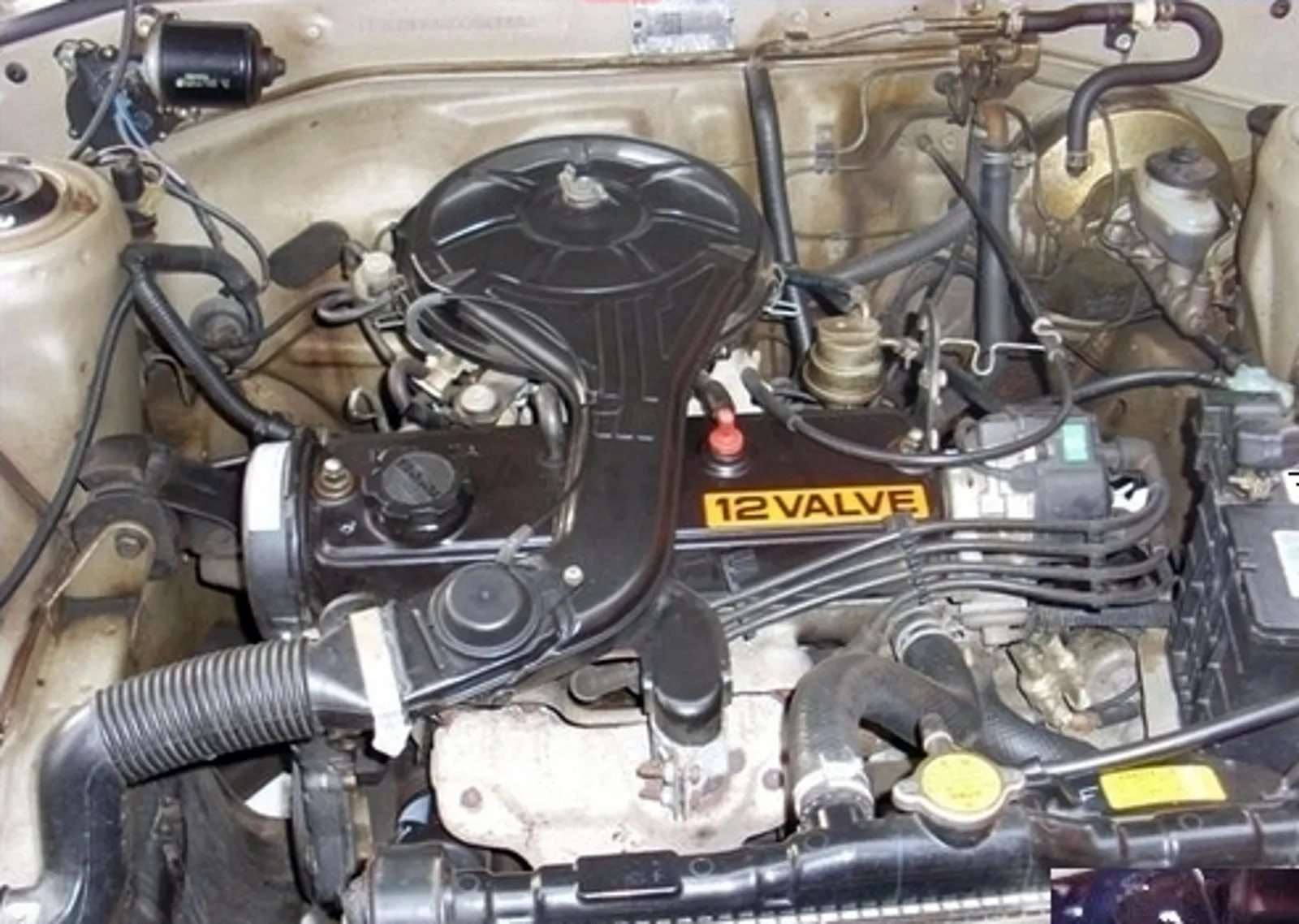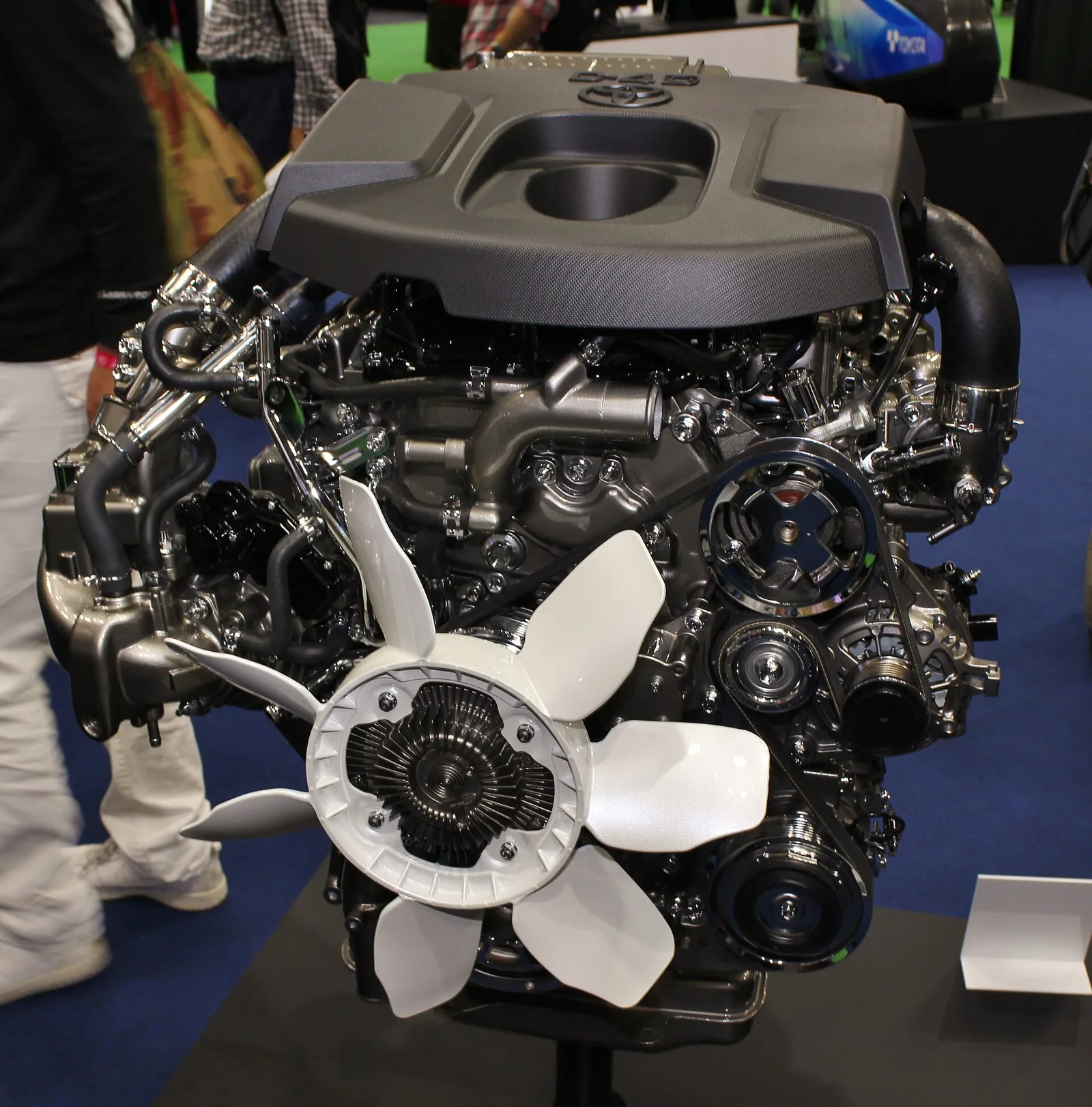
One 2.8-litre diesel from a Dyna truck to a Hilux GR Sport, a European common rail family, and a petrol four with hybrid and turbo branches.
Toyota's GD engines are diesel fours introduced in 2015 for body-on-frame vehicles such as the Hilux, the AD engines are European common rail diesels made around 2005 to 2016, and the AR is an aluminium petrol four first used in the 2008 RAV4. Each splits into several sizes and tunes.
The same 2.8-litre Toyota diesel makes 106 kW (142 hp) in a Dyna truck, 165 kW (221 hp) in a Hilux GR Sport, and up to 250 hp when a boat builder takes it to sea. Few engine families stretch across so many jobs, and the GD diesel is only one of three Toyota engine families that cover a huge amount of ground between them.
Toyota's GD diesels were built for body-on-frame pick-ups, vans and SUVs. The AD diesels went into European family cars. The AR petrol four powered the RAV4, the Camry and the Lexus NX. All three share a four-cylinder layout and a long list of variants, and the differences between the variants say a lot about who each engine was made for.
The Toyota GD engine series
The GD series is a family of diesel engines that appeared in 2015 and replaced the KD series. It is aimed mainly at body-on-frame vehicles, and it uses a package Toyota calls Economy with Superior Thermal Efficient Combustion, or ESTEC. According to Toyota, the engines reach a maximum thermal efficiency of 44 percent, which it described as top class at launch.
Production is spread over three countries. Japan builds them, as does Toyota Industries Engine India in Bangalore, and Siam Toyota Manufacturing in Chonburi, Thailand.
The same 2.8-litre diesel makes 106 kW in a Dyna truck and 165 kW in a Hilux GR Sport.
Toyota 1GD-FTV: the 2.8-litre workhorse
The 1GD-FTV displaces 2,755 cc (2.8 L) and is a straight-four common rail diesel with a variable nozzle turbocharger, chain drive and an intercooler. Its head is DOHC with 16 valves, the compression ratio is 15.6:1, and the cylinders measure 92 mm by 103.6 mm (3.62 in by 4.08 in).
At launch a six-speed automatic version delivered 180 PS (178 hp; 132 kW) at 3,400 rpm, with 450 N.m (332 lb ft) of torque on tap between 1,600 and 2,400 rpm. A manual version managed 177 PS (175 hp; 130 kW), with torque of 420 N.m (310 lb ft). From 2020 some models were uprated to 150 kW (201 hp; 204 PS), identical for both gearboxes, and 500 N.m (370 lb ft) in automatics only, over a wider 1,600 to 2,800 rpm band. Manuals stayed at 420 N.m. On Japan's JC08 test the average fuel consumption is 11.2 km/L (8.9 L/100 km).
One engine, many states of tune
Toyota changes the tune to suit the vehicle. The H200 HiAce gets a detuned 150 PS (148 hp; 110 kW), with 300 N.m (221 lb ft) from 1000 rpm. The second-generation Innova's automatic makes 174 PS (172 hp; 128 kW) with 360 N.m (266 lb ft), while its five- and six-speed manuals make 170 PS (168 hp; 125 kW), plus 343 N.m (253 lb ft). The Dyna and the Hino Dutro, sold abroad as the Hino 200, are limited to 106 kW (142 hp; 144 PS).
The top of the range is the Hilux and Fortuner GR-S and GR Sport, which are uprated to 165 kW (221 hp; 224 PS) and 550 N.m (410 lb ft). A 48-volt mild hybrid version was introduced in August 2023. The marine Yanmar 4LV is a marinised 1GD-FTV that produces as much as 250 hp (253 PS; 186 kW).
Where the 1GD-FTV is used
The applications list is long: the Hilux (AN120/AN130 from 2015, and AN220/AN230 from 2025, both with optional mild hybrid), the Fortuner (AN150 from 2015), the Innova (AN140 from 2016), the Land Cruiser Prado (J150, 2015 to 2023) and its successor the J250, the J70 Land Cruiser from 2023, the HiAce H200 and H300, the GranAce and Majesty, and the Coaster, which is also sold as the Hino Liesse II. A vehicle called the Thairung Transformer II uses it too.
Toyota 2GD-FTV and 3GD-FTV
The 2GD-FTV is the smaller sibling, a 2,393 cc (2.4 L) four with 92 mm by 90 mm (3.62 in by 3.54 in) cylinders, 16 valves and the same 15.6:1 compression. It produces 150 PS (148 hp; 110 kW) at 3400 rpm, and its 400 N.m (295 lb ft) is available from 1600 to 2000 rpm, with either gearbox depending on target market and emissions rules. In the second-generation Innova the numbers drop to 149 PS (147 hp) with a 360 N.m (265 lb ft) automatic and 342 N.m (252 lb ft) manual. It is used in the Hilux, Innova and Fortuner and in the Hilux Champ from 2023.
The 3GD-FTV goes the other way: 2,999 cc (3.0 L), a long 112.8 mm stroke and a higher 16.3:1 compression ratio. Its output ranges from 144 to 167 PS (106 to 123 kW), with torque between 300 and 452 N.m, and it appears in the 2026 Dyna and Hino Dutro and in the Coaster and Hino Liesse II.
GD engines compared
| Engine | Displacement | Bore x stroke | Compression ratio | Output |
|---|---|---|---|---|
| 1GD-FTV | 2,755 cc (2.8 L) | 92 mm x 103.6 mm | 15.6:1 | 106 to 165 kW depending on application |
| 2GD-FTV | 2,393 cc (2.4 L) | 92 mm x 90 mm | 15.6:1 | 110 kW (150 PS) and 400 N.m |
| 3GD-FTV | 2,999 cc (3.0 L) | 92 mm x 112.8 mm | 16.3:1 | 106 to 123 kW (144 to 167 PS) |
The Toyota AD diesel family
The AD series is a family of 16-valve DOHC inline-four turbo diesels with electronic common rail direct injection. They have an aluminium head and an aluminium block with cast iron liners, and they are derived from the petrol AZ engine. Offered in 2.0 and 2.2 litre sizes, they were made mainly for Europe, with a few exported to places such as India and New Zealand.
1AD-FTV: the 2.0 litre
The first 1AD-FTV used a 170 MPa common rail with nine-hole solenoid injectors and pilot injection, a timing chain, EGR with a cooler and an oxidation catalyst, and a 16.8:1 compression ratio to meet Euro IV. In Europe it delivered 126 PS (93 kW; 124 hp) at 3600 rpm, with 300 N.m (221 lb ft) spread from 2000 to 3200 rpm. Combined fuel economy was 49.6 to 51.4 mpg imperial and CO2 was 146 g/km. It went into the second-generation Avensis, the first Auris, the E140 Corolla and the third-generation Corolla Verso, all badged 2.0 D-4D.
Toyota later refreshed the AD series for Euro V under the name Toyota Optimal Drive. The injection system moved up to 200 MPa with ten-hole piezoelectric injectors and five-stage pilot injection, compression fell to 15.8:1, and some models gained a diesel particulate filter. Torque rose to 310 N.m, available from 1800 to 2400 rpm, combined economy improved to 54.3 to 61.4 mpg imperial, and CO2 fell to 119 to 138 g/km. The updated engine was used in the third-generation Avensis, the first Verso, the second-generation Auris, the E170 Corolla and the fourth-generation RAV4, with a version making 124 PS (91 kW).
2AD-FTV and 2AD-FHV: the 2.2 litre
The 2.2 litre 2AD-FTV used the same early injection system and 16.8:1 ratio, and made 136 PS (100 kW; 134 hp) in Europe, with 310 N.m. It powered the third-generation RAV4, the Avensis and the Corolla Verso. The Euro V update dropped the compression ratio to 15.7:1 and lifted output to 150 PS (110 kW; 148 hp), with 340 N.m (251 lb ft) coming between 2000 and 2800 rpm. It also powered the first Lexus IS 200d from 2010 to 2013, and the fourth-generation RAV4 in Europe, Australia and Russia.
The strongest AD is the 2AD-FHV, sold with the D-CAT label. Its injection runs at 180 MPa, and its exhaust treatment includes a four-way DPNR catalyst and exhaust port injection. In Europe it makes 177 PS (130 kW; 175 hp) at 4000 rpm and a hefty 400 N.m (295 lb ft), peaking from 2000 to 2600 rpm, on a 15.8:1 compression ratio. The Euro IV version went into the Avensis, RAV4, Auris and Corolla Verso, and into the second-generation Lexus IS 220d from 2006 to 2010. The Euro V update raised output to 179 PS (132 kW; 177 hp) in the third-generation Avensis and the first Auris.
The Toyota AR engine family
The AR is an inline-four petrol family first introduced in 2008 for the RAV4, and later used in the Highlander, Venza, Camry and Scion tC. Every one has timing chains rather than belts. The series replaced the AZ engine and inherits many of its technologies, with a die-cast aluminium block and an aluminium DOHC head.
On top of that foundation sit several efficiency measures. Dual VVT-i varies the timing of both camshafts, and the friction-cutting list covers an offset crankshaft, roller rockers, a variable oil pump with three stages, lighter-tension piston rings and an auxiliary belt drive. An Acoustic Control Induction System alters the intake tract length in two steps, chosen by rpm and throttle angle, to keep torque strong across the rev range. Tumble control valves aid combustion on a cold engine and bring the catalytic converters to working temperature fast, and 12-hole high-atomising injectors reduce fuel clinging to the intake ports.
The block is an open-deck, midi-skirt design with cast-in iron liners under a die-cast aluminium lower crankcase. The forged steel crankshaft has eight counterweights and five main bearings, and a helical gear on the third counterweight drives twin contra-rotating balance shafts.
AR variants: 2.7, 2.5 and 2.0 litres
The 1AR-FE is a 2.7 L engine that arrived in the Venza and Highlander in late 2008. It most likely ended production in 2020, though Toyota made no official statement. No new cars used it after that year, and the A25A-FKS replaced it. The Highlander's version made 190 PS (140 kW; 187 hp) at 5800 rpm.
The 2AR-FE is a 2.5 L engine first sold in the RAV4 in the United States and Canada in 2008. It took over from the 2AZ-FE in the Camry there in early 2009, which gave 11% better fuel economy. With oil and coolant filled, it has a service mass of 324 lb (147 kg). Toyota quotes the RAV4 version at 181 PS (133 kW; 179 hp) at 6000 rpm, and the engine is sold from Japan and the United States to Australia, Malaysia and the Middle East. The 5AR-FE is a 2.5 L version first used in the RAV4 in China in 2013.
Hybrid and direct-injection versions
The 2AR-FXE runs an Atkinson cycle, derived from the 2AR-FE but with unique cams and pistons and a geometric compression ratio of 12.5:1. Its large valve overlap trims cylinder charge, so torque and power fall while efficiency rises, which suits hybrids, where the electric motor and battery cover peak demands. In the Camry Hybrid it makes 154 hp (115 kW), and it also serves the Avalon Hybrid, Harrier Hybrid, RAV4 Hybrid and Lexus NX 300h and ES 300h.
The 2AR-FSE adds D4-S direct and port injection, reaching a maximum thermal efficiency of about 38.5% and an expansion ratio of 13.0 to 1. In the Crown hybrid it contributes to a combined 164 kW (220 hp). The 6AR-FSE is a 1998cc engine with D4-S and VVT-iW that can run in the Otto cycle or a modified Atkinson cycle. Introduced in the Camry in December 2014 for China and March 2015 for Thailand, it makes 123 kW (165 bhp). The 6AR-FBS followed in 2018 in the Thai Camry.
The 8AR-FTS is a turbocharged 2.0 L that can switch between Otto and modified Atkinson cycles. It debuted in the Lexus NX 200t, rated at 175 kW (235 hp), and uses ESTEC D-4ST injection with separate direct and port injectors. Some applications, including the Lexus IS 200t, GS 200t and RC 200t, are bumped by 5 kW to 180 kW (242 hp). It also powers the Tatuus FT-60 Formula Regional Oceania race car, uprated to 198 kW (266 hp).
Where the AR engines are built
In Japan, the Kamigo plant and Toyota Industries Corporation build them. Toyota Motor Manufacturing Alabama began making the 2.5 L and 2.7 L engines in mid-2011, GAC Toyota Engine in China announced the start of the same engines in November 2011, and Toyota Australia opened a new engine plant in Melbourne producing petrol and hybrid variants.
Where this goes next
The GD series keeps moving. The 3GD-FTV appears in the 2026 Dyna, Hino Dutro, Coaster and Hino Liesse II, a new Hilux generation (AN220/AN230) with optional mild hybrid arrived in 2025, and the J250 Land Cruiser Prado has mild hybrid as an option. On the petrol side, the 1AR-FE has been replaced by the A25A-FKS.