Fangio stepping aside for Moss, a pre-race deal at Melbourne and a radio message at Hockenheim: how one of the sport's oldest tactics was banned and then dropped.
Team orders are instructions telling a driver to hold position or let a teammate pass. Formula One banned those affecting a race result after 2002, following Austria, but the 2010 German Grand Prix showed the ban was ignored and the rule had gone from the sporting regulations by 2011.
Moments after Felipe Massa's engineer told him that Fernando was faster than he was and asked him to confirm he understood, Massa eased off and Fernando Alonso swept past to win the 2010 German Grand Prix. Race stewards fined Ferrari US$100,000. Formula One's rule against team orders had been sidestepped with a single sentence, and by the end of the year the FIA conceded it was not working.
Team orders are as old as the championship itself, and the way the sport has treated them says a great deal about what it wants racing to be.
What are team orders in Formula One?
Team orders are instructions telling drivers to deviate from racing each other the way they would race another team's drivers. A team can set a pecking order in advance, or tell a driver on the day to let a teammate pass or to hold position without risking a collision.
The classic case is a driver who is trailing on the day but leading the season standings. The team then asks its cars to rearrange themselves so the points leader scores more. Orders may also come when several cars are far ahead of the field and almost sure of the win, to conserve fuel, lower the chance of mechanical failure and avoid a collision. They have been issued countless times, and they can leave the driver who loses out bitter, while the press weighs in.
Team orders were banned after Austria in 2002 and gone from the regulations by 2011.
How were team orders used early in Formula One?
For much of the sport's history team orders were both legal and accepted. In the early years of the World Championship a driver could even hand his car over to the team leader during a race if the leader's own car had broken down.
In 1955 Mercedes wanted Stirling Moss to win in front of his home crowd at Aintree, and Juan Manuel Fangio obliged, refusing to attack in the closing stages and finishing less than a second behind. In the 1964 Mexican Grand Prix Lorenzo Bandini moved over for John Surtees, whose points beat Graham Hill to the championship. At Williams in 1979, Clay Regazzoni was told not to challenge Alan Jones for the lead of the German Grand Prix even though Regazzoni led the standings. Jones kept the number one role until 1981, when Carlos Reutemann ignored orders at the Brazilian Grand Prix and refused to let him by. The feud that followed ended with Jones retiring at the season's end, and Reutemann losing the title by a single point.
Not every order was needed. At Renault in 1982, Rene Arnoux angered his team by refusing to give way to Alain Prost, who led him in the championship, yet those points mattered little because Prost finished fourth in the standings, ten points behind Keke Rosberg. In South Africa in 1983 Brabham-BMW asked Riccardo Patrese to hand the win to Nelson Piquet if it helped Piquet to the title. It did not come to that: Patrese won, and Piquet's third place was enough. Patrese was in a similar spot in 1992, when he waved Williams teammate Nigel Mansell past at the French Grand Prix, and Mansell won with Patrese second.
Why did the media turn against team orders?
Public reaction turned negative in the late 1990s, when incidents began to be reported more prominently and the more blatant examples drew anger. Reaction to the more blatant cases was extremely negative.
At the 1997 European Grand Prix, Jacques Villeneuve, whose title was already secure, got a radio request from his engineer to wave the McLarens by, since they had been very helpful. In the 1997 Japanese Grand Prix, a more sophisticated approach appeared: Eddie Irvine started light on fuel to get ahead of the Williams cars and hold them up for his Ferrari teammate Michael Schumacher.
The 1998 Belgian Grand Prix put the Jordans of Damon Hill and Ralf Schumacher into an unexpected lead after Michael Schumacher and David Coulthard collided. Ralf was told not to overtake Hill, to guarantee Jordan a one-two. His brother, furious, bought out Ralf's contract for 2 million pounds and warned Eddie Jordan that his brother would not drive for the team again. In 1999, Mika Salo was leading the German Grand Prix in a Ferrari, standing in for the injured Michael Schumacher, when he was told to let Irvine through. Salo did as he was told, and so lost what would have been the only win of a 109-race career. Irvine lost the title to Mika Hakkinen anyway.
How did the 1998 Australian Grand Prix test the rules?
At the 1998 Australian Grand Prix, McLaren's Mika Hakkinen won ahead of David Coulthard after Coulthard let him pass near the end, honouring a pre-race agreement. The result drew heavy criticism, and the case was sent to the World Motorsport Council.
The race, held at Albert Park in Melbourne on 8 March 1998, opened the season and was dominated by McLaren-Mercedes. Michael Schumacher's Ferrari retired on lap 6, and every car other than the two McLarens was lapped. On lap 36 Hakkinen dived into the pit lane without warning, apparently after mishearing a radio message, drove through without stopping and rejoined behind his teammate, losing the lead to Coulthard. In 2007 Ron Dennis suggested an outsider had broken into the team's radio channel and ordered Hakkinen to pit. In 2023 Hakkinen recalled being confused by what the team said.
Coulthard led by 12 seconds with 16 laps to go, but by lap 55 of 58 the gap was only two seconds. A few laps from the end, he let Hakkinen go by on the front straight. The two had agreed before the race, because of McLaren's reliability worries, that whoever led into the first corner would win if he was in a position to do so. Coulthard and the team were criticised heavily. The World Motorsport Council ruled that any similar act harming the interests of competition in future should face severe punishment under article 151c of the International Sporting Code. Ron Walker, chairman of the Australian Grand Prix Corporation, lodged an official complaint with the FIA over how the team's actions had decided the race. It was also the first win for the tyre maker Bridgestone, and the first race since the 1991 Canadian Grand Prix that a Goodyear-shod car did not win.
Austria 2002 and the ban on team orders
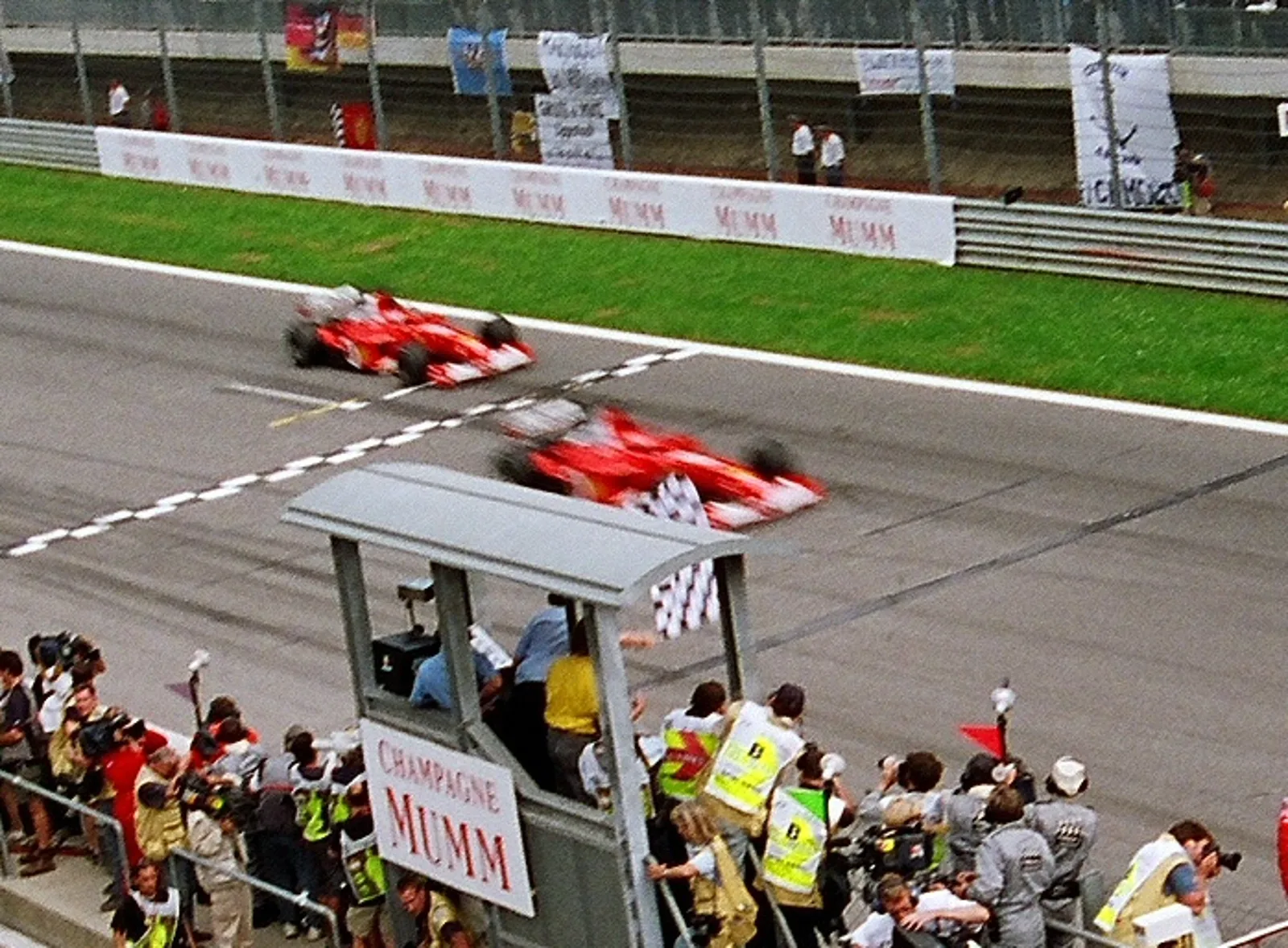
The breaking point was the 2002 Austrian Grand Prix, where Rubens Barrichello was ordered to let his Ferrari teammate Michael Schumacher pass for the win. The order came shortly before the cars crossed the finish line, and both drivers were unhappy. Schumacher would not stand on the top step of the podium, nor sit in the winner's centre seat at the press conference, and Ferrari was punished for breaking podium protocol.
At the United States Grand Prix that year Schumacher appeared to return the favour, giving Barrichello the win by a record-smallest 0.011 seconds, although it is assumed he was trying to trigger a dead heat. Another 2002 episode shows how far orders can go: Arrows, in financial trouble and without a deal with its sponsors, told Heinz-Harald Frentzen and Enrique Bernoldi to miss qualifying by being slower than the 107% limit at the French Grand Prix.
Following the 2002 season the FIA banned team orders capable of influencing a race result. They continued, though, in more discreet forms, such as an engineer telling a slower driver over the radio that his teammate was quicker. The most notorious case of a team using orders during the ban was Crashgate, the 2008 Singapore Grand Prix, where Renault told Nelson Piquet Jr to crash deliberately early in the race to bring out the safety car and help teammate Alonso, who was proven to know nothing of the scheme. A following investigation led to a two-year suspended disqualification for Renault, which expired in 2011, and bans for Flavio Briatore and Pat Symonds that were later appealed and reversed under a settlement keeping them away from FIA-sanctioned events for a time.
What happened at the 2010 German Grand Prix?
At Hockenheim on 25 July 2010, Ferrari invoked team orders on Felipe Massa to let Fernando Alonso past for the lead of the 11th round of the championship. Alonso won the 67-lap race from second on the grid, ahead of Massa, with Sebastian Vettel third. The stewards fined Ferrari US$100,000.
Vettel took pole, with Alonso alongside, but Massa passed both at the start. The pair traded fast laps until the pit stops, and Alonso pressed Massa on the 21st lap without getting by. Then traffic slowed Massa and the gap shrank. Ferrari's order came with Massa's race engineer Rob Smedley saying that Fernando was faster and asking Massa to confirm he understood. Massa eased back and Alonso went through, taking the 23rd win of his career.
The context explains the choice. Alonso had won the opening race of the season, but he arrived in Germany 47 points behind Lewis Hamilton, who led the championship with 145 points, after scoring four points in the previous two races, with safety cars hurting him at Valencia and Silverstone. Tony Dodgins, a journalist, wrote that Ferrari had concluded it must put Alonso first, ahead of Massa, by this point. The win lifted Alonso to within 13 points of Vettel in the championship. The World Motor Sport Council, meeting in September 2010, imposed no further punishment on Ferrari.
| Race | The order | Outcome |
|---|---|---|
| 1955, Aintree | Fangio told to let Moss win at Aintree | Moss won, Fangio less than a second behind |
| 1998 Australian Grand Prix | Coulthard lets Hakkinen by under a pre-race deal | Hakkinen won; Council warned of severe punishment for future acts |
| 2002 Austrian Grand Prix | Barrichello told to let Schumacher win | Ferrari punished for podium breach; ban followed |
| 2010 German Grand Prix | Massa told Alonso was faster | US$100,000 fine; rule dropped by 2011 |
| 2024 Hungarian Grand Prix | Norris told to give up the lead to Piastri | Piastri won first Grand Prix |
Are team orders legal in F1 now?
Team orders are no longer prohibited in Formula One. At the end of 2010 the FIA conceded that the rule was not working and needed review, and as of 2011 it no longer appeared in the sporting regulations. The ban that followed the 2002 Austrian race was effectively reversed after the 2010 German race.
Orders did not become quiet. At the 2012 US race Ferrari broke the FIA seal on Massa's gearbox to trigger a five-place grid penalty, shifting him behind Alonso and putting both cars on the cleaner side of the new Circuit of the Americas. In the 2013 Malaysian Grand Prix Vettel was criticised for passing teammate Mark Webber to win despite an instruction to hold position. In Hungary in 2017 Mercedes told Valtteri Bottas to let Lewis Hamilton, who had a better chance of attacking Kimi Raikkonen, take third place; when Hamilton could not pass Raikkonen he returned the place at the last corner, which cost Bottas three points. Hamilton won the title by 46 points. In 2018, James Vowles told Bottas to hold position behind Hamilton in Germany after a safety car, and in Russia Bottas, on pole and leading, was ordered to yield to Hamilton, who led the championship.
Ferrari ordered Charles Leclerc to hold station behind Vettel in Australia in 2019, and two races later in China team principal Mattia Binotto told him to let Vettel pass, later saying it was the right choice because Vettel finished third and Leclerc fifth. Red Bull told Sergio Perez, at the 2022 Spanish Grand Prix, to give up the lead to Max Verstappen, and in Sao Paulo that year Verstappen refused to give a place back to Perez, saying he had his reasons.
McLaren produced the latest controversies. At the 2024 Hungarian Grand Prix Lando Norris was told to give the lead to teammate Oscar Piastri after the team's pit stop strategy let Norris undercut him. With three laps to go and after much convincing from his engineer, Norris complied, and Piastri won his first Grand Prix. Opinion split on whether Piastri earned it or Norris, a championship contender, was robbed. McLaren swapped the two again in the 2024 Sao Paulo sprint, on lap 22, to maximise points against Max Verstappen, and ordered another swap at the 2025 Italian Grand Prix after a slow stop for Norris put him behind Piastri. Piastri was unhappy but complied.