A circuit built in eight months, a track nicknamed Monaco without the barriers and the wins, titles and accidents it has seen since 1986.
The Hungarian Grand Prix has been a Formula One fixture at the Hungaroring since 1986, the first F1 race behind the Iron Curtain. The 4.381 km circuit near Budapest was built in eight months, is twisty and dusty, and is notoriously hard to pass on. Its contract runs to 2032.
Bernie Ecclestone wanted to take Formula One to the Soviet Union. A Hungarian friend suggested Budapest instead, and the result was a circuit put up in eight months, less time than any other Formula One circuit, and the first Grand Prix behind the Iron Curtain.
The Hungaroring has since become a summer fixture: hot, dusty, twisty and famously hard to pass on, yet the setting for titles, first wins and some of the sport's most ingenious strategy.
How did Formula One come to Hungary?
Hungary's motor racing story begins earlier than Formula One. Hungary's first Grand Prix took place on 21 June 1936, over a 5 km (3.1 mile) track laid out in Budapest's Nepliget park. Mercedes-Benz, Auto Union and Ferrari running Alfa Romeos each sent three cars, and a very large crowd turned out. Then politics and war halted Grand Prix racing in the country for fifty years.
The modern race was a coup for Ecclestone. He wanted a Soviet race, was pointed to Budapest, and the plan was for a Monaco-style street circuit through the Nepliget, the city's largest park. The government decided instead to build a new track just outside the city beside a major highway. Work started on 1 October 1985, and the first Formula One race there in 1986 drew 200,000 spectators, although tickets were expensive at the time.
Monaco without the barriers, built in eight months near a Hungarian highway.
Where is the Hungaroring and what is it like?
The Hungaroring is a 4.381 km (2.722 mi) circuit in Mogyorod, Pest County, on the northeastern outskirts of Budapest, and it holds an FIA Grade 1 licence. Mogyorod ranks third among Hungarian tourist destinations, behind the Danube Bend and Lake Balaton but ahead of Budapest itself. The race has traditionally run between mid-July and late August.
Summers there are usually extremely hot and dry, and because the circuit is little used the rest of the year, and the soil is sandy, the surface is dusty. The track sits in a valley, so from any spot you can see about 80 percent of it.
Dust changes the usual rhythm of a race weekend. A quiet circuit normally gets quicker as rubber builds up, but the Hungaroring rarely does, because the dust returns so fast. It tends to improve during qualifying itself, so competitors try to leave their best lap as late as possible.
| Turn | Named after | Link to the circuit |
|---|---|---|
| 1 | Nelson Piquet Sr. | Fought duels with Senna here |
| 2 | Lewis Hamilton | A record eight victories |
| 4 | Nigel Mansell | He lost a wheel there in 1987 |
| 11 | Jean Alesi | A massive crash in qualifying for the 1995 race |
| 12 | Michael Schumacher | Four wins and two second places at the circuit |
| 13 | Ayrton Senna | The other half of those Piquet duels, and a driver who says he loves the track |
Why is overtaking so hard at the Hungaroring?
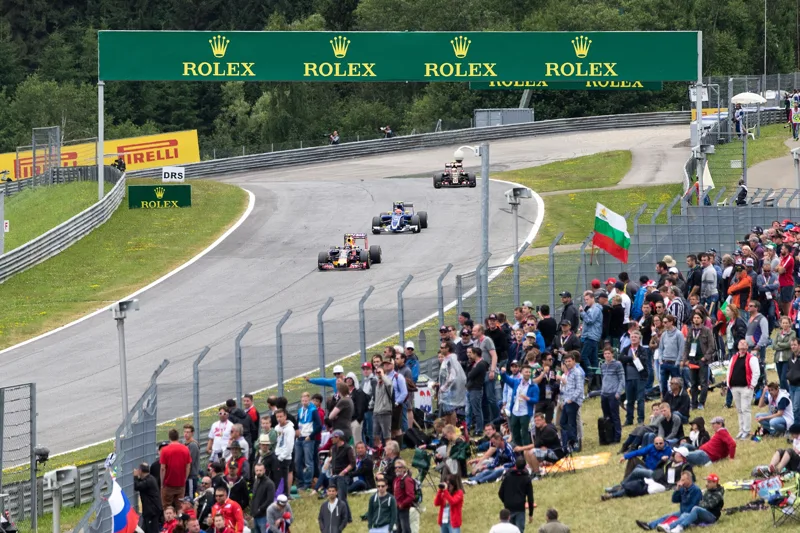
Overtaking is very difficult in dry conditions because the circuit is narrow, twisty and bumpy, and it has been nicknamed "Monaco without the barriers" for that reason. Races are often processional, with cars following one another in trains and no room to pass.
Thierry Boutsen proved the point in 1990 by keeping his slower Williams ahead of championship leader Ayrton Senna for lap after lap. So pit strategy matters. In 1998 Michael Schumacher's Ferrari changed his plan midway through, and he built a winning margin over the McLarens of Hakkinen and Coulthard once all the stops had been made.
The exception was 1989, when Nigel Mansell started his Ferrari 12th, passed car after car and took the lead when Senna was baulked by a slower runner. Opinions of the track differ: Senna, Mansell, Schumacher, Hamilton, Verstappen and Alonso have said they love it, while many other drivers find it too slow, hot and demanding.
How has the Hungaroring layout changed?
The first alteration came in 1989, when a chicane after turn three was removed by culverting a stream. It had been a temporary measure during construction, because a spring was discovered where the direct route was meant to run.
In 2003 the circuit was modified in an attempt to allow more passing. The main straight grew by roughly 200 m (660 ft), reaching 908 m (2,979 ft), the hairpin at its end was tightened, and so was turn 12. The lap grew from 3.975 km (2.470 mi) to 4.381 km (2.722 mi). Early 2016 brought a complete resurfacing, the first in its history.
Which Hungarian Grands Prix stand out?
Several first-time winners have emerged in Budapest: Hill (1993), Alonso (2003), Button (2006), Kovalainen (2008), Ocon (2021) and Piastri (2024). Alonso was the first Grand Prix winner from Spain and the youngest ever at the time, and he named the Hungaroring his favourite track. Kovalainen's victory made him the 100th different winner of a World Championship race.
The 2006 race was the first wet Hungarian Grand Prix. Button won from 14th on the grid, giving the reborn Honda team its first win, while title rivals Alonso and Schumacher both retired. In 1997 Hill nearly won in a technically inferior Arrows-Yamaha, only for his car to lose drive on the last lap and leave him coasting home second.
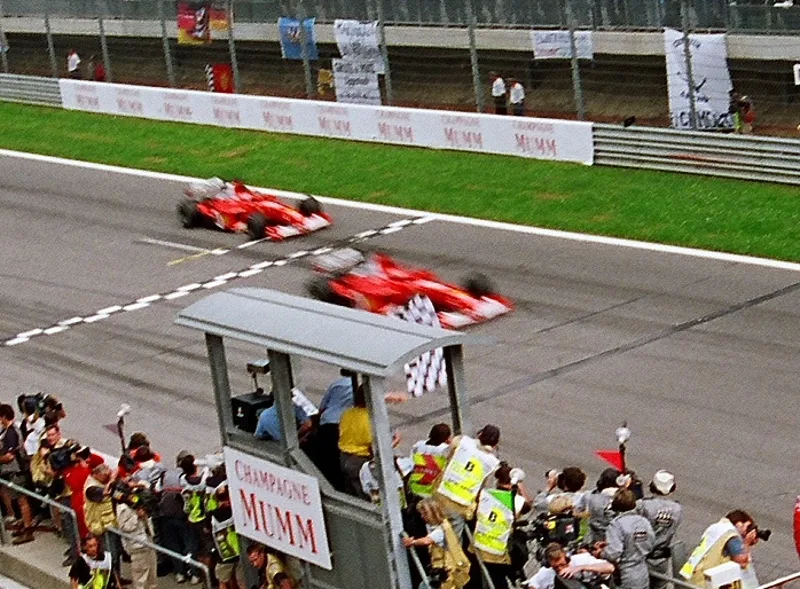
The circuit has also decided championships. Michael Schumacher equalled Alain Prost's record of 51 wins here in 2001, a drive that clinched his fourth title, and Nigel Mansell had sealed the 1992 title in Hungary. Constructors' crowns were secured by Williams in 1996 and by Ferrari in 2001, 2002 and 2004. Schumacher won in Hungary in 1994, 1998, 2001 and 2004, and was second in 2000 and 2002. Zsolt Baumgartner of Hungary and Poland's Robert Kubica both made their debuts at the track as the first F1 drivers from their countries.
In 2014 Daniel Ricciardo won after charging from sixth on the grid, with Lewis Hamilton third, six seconds behind, after starting from the pit lane. Hamilton made a late pass on Max Verstappen to win in 2019, and in 2020 took an eighth Hungarian victory, the most any driver has won the same Grand Prix, a record he shares with Schumacher's eight at the French Grand Prix.
The 2021 race was memorable. Valtteri Bottas triggered a first-lap incident in wet conditions that took out several cars, including Verstappen, Lando Norris, Lance Stroll and Sergio Perez, plus Charles Leclerc and Daniel Ricciardo; only Ricciardo and Verstappen managed to finish. After the red flag, leader Hamilton stayed on intermediate tyres and was the only car to start from the grid on them, while the others pitted for dry tyres. Ocon led most of the race and took the Enstone team's first win since 2013, with Hamilton second after Sebastian Vettel was disqualified over an insufficient fuel sample. Verstappen won in 2022.
Two corners carry the names of drivers who suffered there. Mansell lost a wheel at turn 4 in 1987, and Alesi crashed heavily at turn 11 in qualifying for the 1995 race.
What happened to Felipe Massa in 2009?
Qualifying on Saturday 25 July 2009 turned frightening for Ferrari's Felipe Massa, hit on the head during the second session by a spring that had come off Rubens Barrichello's Brawn GP car as he travelled at 261 km/h (162 mph). Replays showed debris hitting his helmet 1 inch above the left eye. Unconscious, he ran head-first into a tyre barrier.
He was flown to the military hospital in Budapest, where surgeons operated around his left eye. His condition was first described as life-threatening but stable and improved rapidly; he was discharged a week later and went home to Brazil, and tests later led to a titanium plate being fitted in his skull before he raced again. Hamilton won the race, his first as champion, ahead of Kimi Raikkonen, and it was the first time that season Brawn GP failed to score with both cars.
Who watches the Hungarian Grand Prix?
Most foreign fans come from Germany and Austria, with a large contingent of Finns. Locals make up about ten percent of the crowd. Schumacher's winning streak in the 1990s pulled in tens of thousands of Germans every year, a trend that began in 1992 and ran until his retirement in 2006. Poles came in large numbers from 2006 to 2010 to see Kubica, and when Austria lost its Grand Prix in 2003 Budapest was left as the nearest Formula One race for fans across Central Europe, until Austria's event came back in 2014.
The winners' trophies are as much a feature as the racing. Each is handmade by the Herend porcelain manufacturer, takes about six months to produce and costs 40,000 euros.
What else has raced at the Hungaroring?
Feeder series have been regulars: International Formula 3000 from 1998 to 2004, the GP2 Series from 2005 to 2016, GP3 from 2010 to 2018 and World Series Formula V8 3.5 from 2007 to 2016. Touring cars have come in force too, with the FIA GT Championship from 1998, the World Touring Car Championship as the Race of Hungary from 2011 to 2017, WTCR from 2018 to 2022, and DTM in 2014 and from 2016 to 2018.
Two wheels have had their turn. The Superbike World Championship visited from 1988 to 1990, the Hungarian motorcycle Grand Prix was held in 1990 and 1992, and sidecars raced in 1990, 1997, 2005 and 2012. Other visitors include the Cup of Peace and Friendship in 1986 and 1987, the 12 Hours of Hungary, the European Truck Racing Championship, the W Series in 2021 and 2022 and the electric ETCR series in the same two years.
What does the future hold for the Hungaroring?
At the 2013 race it was confirmed that Hungary would host Formula One until 2021. The deal was extended for five years, until 2026, after the 2016 resurfacing, and at the 2023 race the contract was extended again to 2032. Profits from tobacco advertising have been out of the equation since the ban in 2007.
The circuit is also the home of Hungarian motorsport. In July it hosts the Formula 2 and Formula 3 championships, the Porsche Supercup and International GT Open alongside the Grand Prix, and it has been home to DTM, the FIA GT Championship and, from 2011 to 2022, WTCC and WTCR rounds. Future entries for 2027 include GT World Challenge Europe, the GT2 European Series and the GT3 Revival Series.