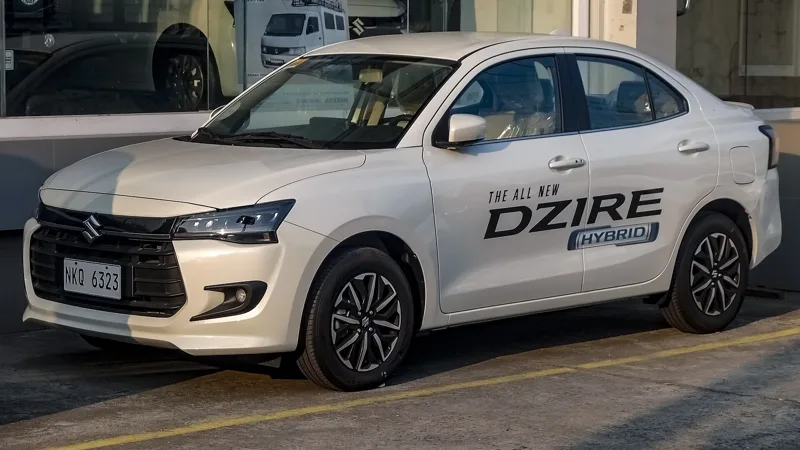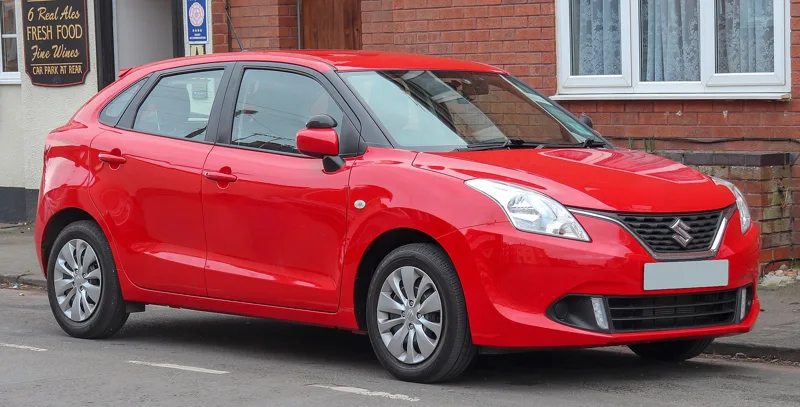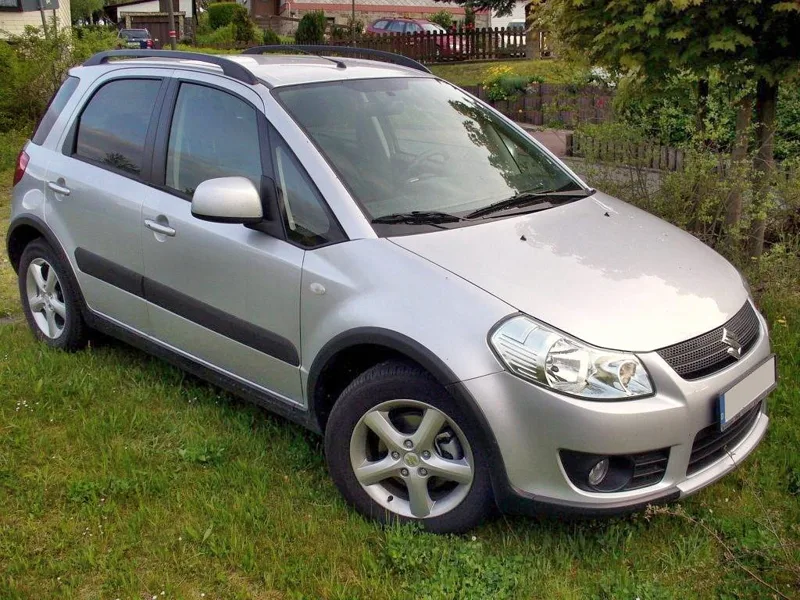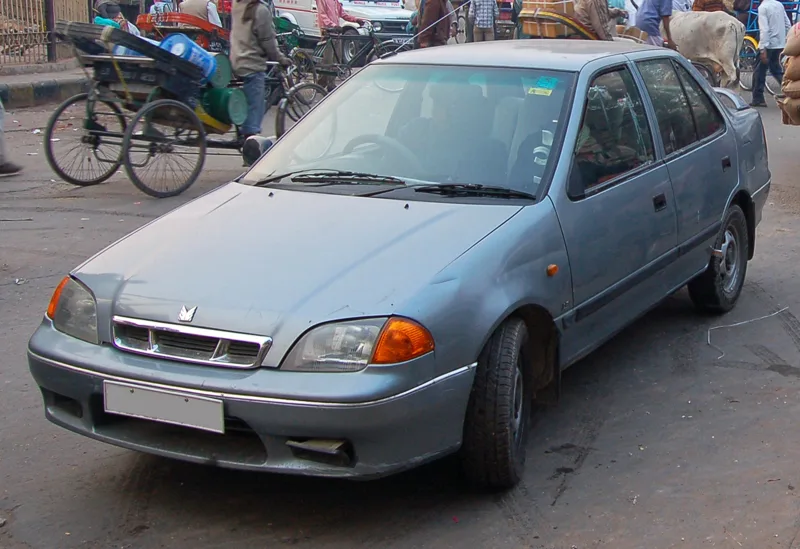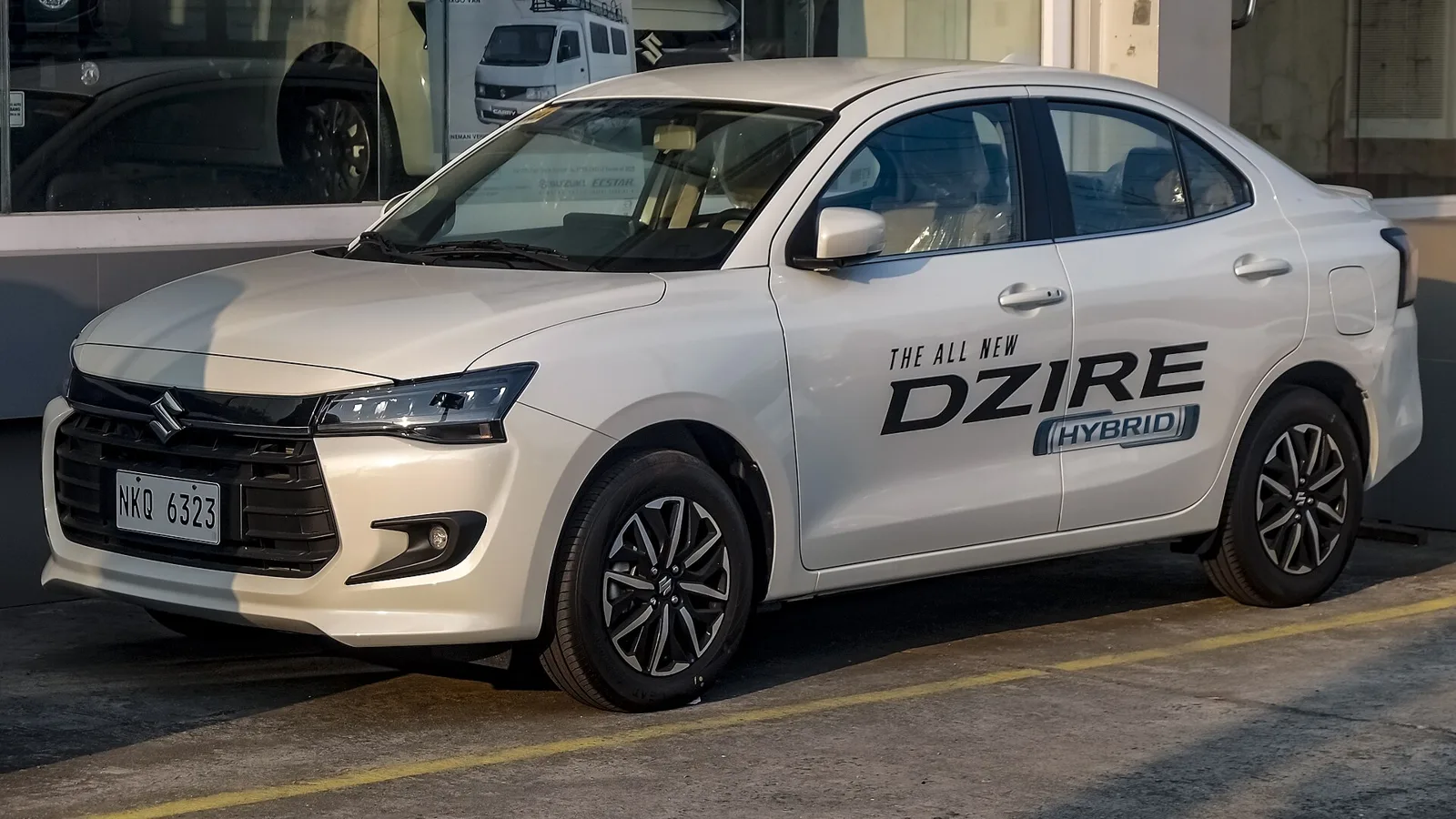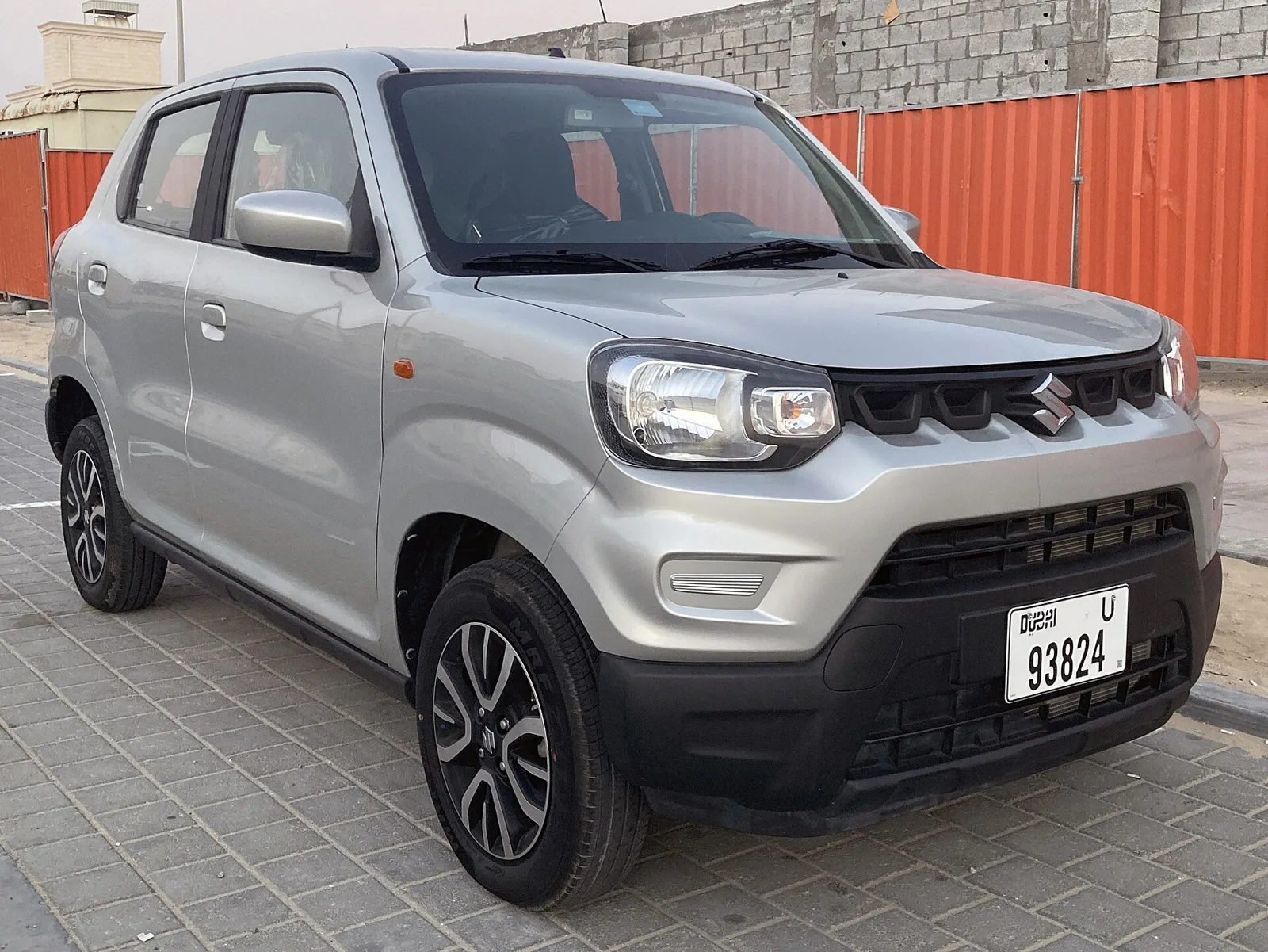
A recession-hit mid-size sedan, a subcompact sold under half a dozen names and a micro SUV with a rough crash-test record, set side by side.
The Suzuki Kizashi was a mid-size car sold from 2009 to 2015, the Cultus Crescent a subcompact built from 1995 and sold as the Esteem or Baleno, and the S-Presso a micro SUV made in India since 2019 with 180 mm of ground clearance.
Between 2009 and 2015 Suzuki sold 3,379 Kizashis in Japan, and a quarter of them went to the National Police Agency. That leaves about 30 cars a month for the public, in a country where the Suzuki badge meant kei cars. The Kizashi is one of three very different Suzukis worth putting side by side, along with the subcompact Cultus Crescent of the 1990s and the S-Presso micro SUV built in India today.
Suzuki Kizashi: a mid-size car launched into a recession
The Suzuki Kizashi is a mid-size car, unveiled in the United States on 30 July 2009. It reached Japan on 21 October 2009 and North America on 1 December 2009, followed on 11 May 2010 by Australia and New Zealand, where it was the first mid-size Suzuki the market had seen. India got it in February 2011, and it was sold in European markets too.
The name is a Japanese word meaning something great is coming, as well as omen, sign or warning. The car did not live up to the first reading. In December 2013 Suzuki said it would phase the Kizashi out gradually, with no successor. Despite a good technical record, sales suffered from the Great Recession and from Suzuki pulling out of the American market in 2013 and the Canadian one in 2014. The last cars left the Sagara plant in December 2015.
Of 3,379 Kizashis sold in Japan, a quarter went to the National Police Agency.
Suzuki Kizashi review: trims, engine and equipment
The Kizashi is a family sedan sized between compact and mid-size, offered in base, SE, Sport GTS and Sport SLS trims. Every car has a 2.4-litre four-cylinder engine making 185 hp (138 kW; 188 PS) and 170 lb ft (230 N m), with front-wheel drive as standard. It is a more powerful take on the engine used in the Grand Vitara, known as the Escudo in Japan.
Keyless entry, keyless start, automatic dual-zone climate control and projector headlamps came as standard. Buyers could pick a 6-speed manual, available with front-wheel drive only, or a continuously variable transmission. All-wheel drive, taken from the i-AWD system in the SX4, was offered on every model except the base S and lets the driver switch back to front-wheel drive to save fuel. Other details include 17 and 18-inch alloy wheels, Akebono brakes, cloth or leather seats and a 425-watt Rockford Fosgate stereo that takes an iPod and, on most models, Bluetooth.
Safety equipment was generous. Antilock brakes, traction control and stability control were fitted, along with side airbags front and rear and curtain airbags that run the full length of the cabin; all-wheel-drive cars add an enhanced stability system. ANCAP gave it five stars.
Kizashi awards and recalls
American owners were happy with it. The Kizashi won AutoPacific's Vehicle Satisfaction Award for midsize cars in both 2010 and 2011, and Consumers Digest named it a Best Buy in 2011. In December 2010 it took two New Zealand awards: overall winner of the AA Motoring Excellence Awards and the New Zealand Herald's Car of the Year. Judges singled out its attention to detail, refinement and comfort.
There were two recalls. On 28 June 2010 Suzuki recalled 5,107 model year 2010 cars because a glove box door could open in a crash, failing the FMVSS 201 interior impact standard. In July 2014 an undisclosed number of 2010-2013 cars were recalled after spiders were found weaving webs into the evaporative canister. A blocked canister can create excessive negative pressure in the fuel tank, which could crack it and raise the risk of fire.
Why the Suzuki Kizashi struggled in Japan, India and Pakistan
In Japan the Kizashi came in a single version with a CVT and optional four-wheel drive, built to order. Heavy taxation on its engine of over 2 litres and its width worked against it, and the brand's association with kei cars did the rest. Suzuki stopped taking orders in September 2015.
India's Maruti Kizashi launched on 2 February 2011. It came in as a Completely Built Unit, which carried a 105% import duty, and was priced at around 16 to 17.5 lakh rupees. Maruti Suzuki, 54.2% owned by Suzuki Motor Corporation, sold few. The J24B engine displaces 2,393 cc and makes 185 hp (138 kW; 188 PS) at 6,500 rpm with the manual or 180 hp (134 kW; 182 PS) at 6,000 rpm with the CVT, plus 170 lb ft (230 N m) at 4,000 rpm. The car returns 9 km/L in the city and 12 km/L on the highway from a 63 L tank. Being petrol only and expensive limited its appeal.
Pakistan was the final market. Pak Suzuki Motors launched the car at the Pearl Continental Hotel in Lahore on 11 February 2015, again as an imported Completely Built Unit with an ex-factory price of PKR 5.0 million at launch and no plan to build it locally.
Suzuki Kizashi concepts and the hybrid that never came
Three concepts preceded the car. The first, shown at the 2007 Frankfurt Motor Show, had a 2.0-litre turbo diesel, a sequential 6-speed gearbox, 21-inch wheels and all-wheel drive. The second, at the 2007 Tokyo Motor Show, was a five-door crossover sport wagon with a 3.6-litre (3,564 cc) V6, a 6-speed automatic, i-AWD and 265/45ZR22 tyres. The third, at the 2008 New York show, kept the V6 and added a rating of 300 hp (224 kW; 304 PS), 21-inch wheels and 255/30ZR21 tyres.
At New York in 2011 Suzuki showed the Apex, a performance concept with a new turbocharged engine producing roughly 205 to 224 kW (275 to 300 hp). The EcoCharge was a hybrid in which a 2.0-litre petrol engine was helped by a 15 kW belt-driven electric motor for 144 hp (107 kW; 146 PS), with 127 lb ft (172 N m) of torque, together with a six-speed automatic, low-rolling-resistance tyres, regenerative braking and stop-start. Steve Younan of American Suzuki said the company was planning such a product and claimed a 25 % real-world fuel economy gain. A Kizashi hybrid never entered production.
Suzuki Cultus Crescent: one subcompact, many names
The Suzuki Cultus Crescent is a subcompact built in Japan from 1995 to 2002, with South Asian production running until 2007. It reached Japan in January 1995 and was Suzuki's first attempt at the competitive compact segment. In North America it replaced the Cultus (Swift) sedan on a slightly stretched version of the smaller car's platform, giving more cabin room while sharing most internal parts.
The badge changed with the market. It was the Suzuki Esteem in North America, the Philippines and Thailand, the Suzuki Baleno across Asia, Australasia, Europe and Latin America, the Maruti Suzuki Baleno in India and, in the Philippines after a facelift, the Chevrolet Cassia. In Japan it became the plain Cultus in mid-1998 after the previous Cultus was dropped. A yellow Esteem with one red door became Jimmy McGill's car in the AMC series Better Call Saul.
At launch there was a three-door hatchback and a four-door sedan, with 1.3 and 1.5-litre belt-driven G-family engines making 85 to 97 PS (84 to 96 hp; 63 to 71 kW). February 1996 added four-wheel drive with a 1.6-litre engine of 115 PS (113 hp; 85 kW), a 1.8-litre DOHC J18A of 135 PS (133 hp; 99 kW), and the Cultus Crescent Wagon GT, Suzuki's first station wagon outside the kei class. Europe never had the 1.5-litre engine; its 1.8-litre went only into the sporty GTX at 121 PS (119 hp; 89 kW), and a high-roof van was sold in several countries.
Cultus Crescent around the world: Baleno, Esteem and Cassia
Local builds multiplied. In 1995 GM Colmotores assembled the car in Colombia as the Chevrolet Esteem, as a sedan with 1.3 and 1.6-litre engines. Indonesia began local production in July 1996, replacing the old Cultus sedan with the Baleno, a sedan with a 118 PS (116 hp; 87 kW) 1.6-litre engine and a 5-speed manual; when the government raised tax on engines above 1.5 litres, the Baleno received a 1.5 in 1999, and a 4-speed automatic followed in 2000.
The Philippines took the Esteem from 1996 to 2000 as a wagon only, then Suzuki swapped it for the Chevrolet Cassia as a sedan to compete with popular Japanese saloons. Its only engine was a 1.6-litre unit of 97 PS (96 hp; 71 kW), and it carried fewer features than rivals such as the Ford Lynx, Toyota Corolla, Honda Civic, Nissan Sentra and Mitsubishi Lancer, it did not sell, and production ended in 2002, two years after its introduction. The Chevrolet Optra replaced it.
India and Pakistan began building the Baleno in mid-1998. Pakistan kept the pre-facelift nose until 2002 and made only the sedan with 1.3 and 1.6-litre petrol engines. India built the wagon as well, selling it as the Baleno Altura. North America changed over with the 1999 model year, adding the chain-driven J18A engine, and the 1.8-litre Esteem wagon took over completely from the 1.6. In Europe some hatchbacks with the 1.8 became the limited-edition Baleno GSR, and a turbodiesel appeared using a 75 PS (55 kW; 74 hp) XUD9 engine supplied by Peugeot. A small grille change followed in 2001, reaching India around 2006.
The Aerio/Liana, launched in 2001, replaced the car in most markets. The Japanese sedan ended in November 2001 and the wagon in August 2002, while Europe and North America lost the whole range in 2002. The car carried on in India and Southeast Asia until 2007, when the Maruti line gave way to the SX4 sedan.
Suzuki Baleno rally record and Pikes Peak failure
The Baleno regularly finished in the top five of the A6 class, mostly at Rally New Zealand from 1997 to 2001, and gained a cult following among rally enthusiasts in India. In 2000 Suzuki entered a heavily modified Cultus sedan at the Pikes Peak International Hill Climb. It used two turbocharged J20A inline-four engines for a combined 800 PS (588 kW; 789 hp) and 90 kg m (883 N m; 651 lb ft) of torque. Nobuhiro "Monster" Tajima, the previous year's runner-up, drove it, but an accident wrecked the car and it did not finish.
Suzuki S-Presso: a micro SUV above the Alto
The Suzuki S-Presso is a city car made by Maruti Suzuki in India since 2019, slotting above the Alto and below the Wagon R. Marketed as a micro SUV or mini crossover, it offers 180 mm (7.1 in) of ground clearance. Underneath is the HEARTECT platform, a development of the one under Suzuki's kei cars, with 40% high tensile steel in its structure. Exports go to emerging markets across Africa, South Asia, Southeast Asia, Latin America and the Middle East.
The Future S concept appeared at Auto Expo in February 2018, and the production model was announced on 30 September 2019. In India it rivals the Renault Kwid and Datsun redi-Go, in Standard, LXi, VXi and VXi+ grades. A CNG variant was announced in June 2020 for the LXi and VXi grades. The July 2022 update brought the K10C Dualjet engine, which is 14 to 17% more efficient depending on the gearbox, plus ESP with hill-hold assist for AGS models, electric mirrors and a cabin air filter, and made dual airbags standard. The CNG versions were dropped, then returned in October 2022 with the new engine.
Where the Suzuki S-Presso is sold
In Indonesia the S-Presso arrived on 11 August 2022 at the 29th Gaikindo show alongside the second-generation Baleno, as an indirect successor to the Karimun Wagon R. It came in one grade based on the pre-update Indian VXi+, and unlike the Wagon R it falls outside the Low Cost Green Car programme. A February 2023 update at the 30th Indonesia International Motor Show added the Dualjet engine, start-stop, ESP, ISOFIX, a 7-inch screen and wireless phone linkage.
The Philippines unveiled it on 14 March 2020 with the XL7, initially with a 5-speed manual only; a special edition followed in July 2022 and an AGS version in May 2023. Brunei received it in March 2020 as a GL with AGS and a May 2023 update brought the 1.0-litre K10C Dualjet and 14-inch dual-tone alloys. In South Africa, launched on 19 March 2020, the GL+ gained a 7-inch touchscreen in a December 2022 update and the S-Edition a reversing camera and a 9-inch screen. Nigeria's distributor, CFAO Motors, unveiled it on 4 June 2021, and in Tunisia it is marketed as the cheapest micro SUV. In Latin America it reached Chile and Colombia in March 2020 and Peru in June 2020; Suzuki discontinued it in Colombia in January 2025, giving priority to the Swift.
Suzuki S-Presso safety ratings
The Indian car scored zero stars for adults and two for children in Global NCAP's 2020 test, with the passenger's neck at unacceptable risk, the footwell rupturing, a two-point lap belt in the rear centre and no ISOFIX anchorages. A January 2022 rule then required two frontal airbags on all Indian cars. Under a tougher protocol that includes side impacts, the Indian S-Presso scored 1 star for adults and 0 for toddlers in the second half of 2022. A South African car tested in the first half of 2022 earned 3 stars for adults and 2 for children, with two airbags and pretensioners. Cars sold in Southeast Asia and Latin America had not been independently crash-tested by ASEAN NCAP or Latin NCAP as of July 2022.
Suzuki Kizashi, Cultus Crescent and S-Presso side by side
| Detail | Kizashi | Cultus Crescent | S-Presso |
|---|---|---|---|
| Segment | Mid-size car | Subcompact | Micro SUV |
| Built | 2009 to December 2015 | 1995 to 2002, South Asia to 2007 | Since 2019 |
| Other names | Maruti Kizashi in India | Esteem, Baleno, Cassia | S-Presso |
| Engine | 2.4-litre four, 185 hp | 1.3 to 1.8 litres at launch | 1.0-litre K10C Dualjet |
| Standout record | Five stars from ANCAP; AutoPacific satisfaction awards | Top-five class finishes at Rally New Zealand | Exported to emerging markets across Africa, Asia and Latin America |