A quiet flathead eight that stayed on sale while its V8 successor waited, and a Jeep four-cylinder designed around the tooling for a six.
The Pontiac straight-eight was a flathead inline eight built from 1933 to 1954, the cheapest American eight of its day, replaced by the 287 V8 in 1955. The AMC straight-four was a 2.5 L overhead-valve engine built from 1984 to 2002 for AMC, Jeep and Dodge, designed around the existing six-cylinder tooling.
Pontiac had a modern V8 ready in 1953, and it spent the next two years on the shelf, held back by sister divisions at Buick and Oldsmobile, while a flathead straight-eight from the 1930s kept going in the cars. Years later American Motors had the opposite problem: it needed a new four-cylinder and wanted one that could be built on the machines already making its six. Both engines made unusual choices, and both choices had reasons.
Pontiac straight-eight engine: America's cheapest eight
The Pontiac straight-eight ran from 1933 to 1954. Pontiac introduced it in the autumn of 1932 for the 1933 Pontiac 8. It was the most powerful engine Pontiac had built at that point and the least expensive eight-cylinder from any American maker. Its displacement grew twice over 21 years, each time as the cars got bigger.
Saginaw Metal Casting Operations made the castings, Tonawanda assembled the engines and Pontiac Assembly fitted them. Inside the company it was known as the Silver Streak. It was optional in the cheaper models, and the pitch was a likeable car with enough power for the job at an affordable price.
The buyers were conservative and lower middle class. Pontiac sat between the popular Chevrolet and the pricier Oldsmobile and Buick, and over the engine's run it went into a long list of cars:
- the Special and Deluxe, from 1936 to 1940
- the Torpedo, from 1940 into the late 1940s
- the Streamliner, from 1942 to 1952
- the Chieftain, for its first six years from 1949
- the Star Chief in its first year, 1954
Pontiac's modern V8 was ready in 1953 and waited two more years while a 1930s flathead kept going.
How a flathead straight-eight works
Pontiac's eight was typical of American engines of its time. It was a side-valve L-head, usually called a flathead, with the valves in the block beside the cylinders instead of in the head above them, and a chain-driven camshaft. A Carter W-series downdraft carburettor, with either one barrel or two, fed it.
Keeping the valve gear inside the iron block makes for a quiet engine, because there are fewer exposed moving parts clattering about up top. The compression ratio started at 5.7:1, rose to 6.2:1 in 1934 and to 6.5:1 in 1940. From 1952 to 1954 there were two settings, 6.8:1 with the manual gearbox and 7.7:1 with the Hydramatic automatic.
Idle speed was strikingly low. The engine ticked over at 450 rpm with a manual gearbox, and at 375 rpm in drive with the automatic, whereas a modern engine is set to idle at 600 to 700 rpm at the least. The electrical system was 6-volt with a negative earth and a conventional mechanical ignition. Pontiac used full-pressure oiling and full bearing inserts, which its Chevrolet cousin did not.
Why build a straight eight at all?
A straight eight without a balance shaft has very little vibration built in, and pairing it with side valves made it very quiet next to overhead-valve rivals such as Buick's engines. In the 1930s a smooth, silent engine counted as a sign of quality, which suited a car sold on affordable luxury.
The shape pushed designers towards long strokes. To keep eight cylinders in a row from becoming too long to fit, the bores had to be small, and larger capacity then had to come from stroke. Engineers call that layout undersquare, with the piston travelling further than the bore is wide. Undersquare engines pull well at low revs and can idle slowly, which helped drivability as well as quietness. Chrysler built similar engines, but they were not aimed at the low price band that General Motors' manufacturing skill and volumes allowed.
What killed the Pontiac straight-eight
The drawbacks were weight and breathing. An iron-block straight engine is much heavier than a V layout of the same size, because the crankshaft and crankcase need more material, and the car around it gets heavier by a still greater proportion. The long crankshaft also tends to twist and flex in torsional vibrations under high power, rather like a long thin bar twisted from one end. And a flathead tangles up the flow of intake and exhaust gas, which holds back power.
None of that mattered until the horsepower race of the early 1950s. Then powerful overhead-valve V8s from Cadillac, Buick and Oldsmobile, and new ones from Ford and Chrysler, made the cheap, smooth, quiet Silver Streak all but obsolete.
The red Special-8 and the V8 that waited
By 1953 Pontiac's 287 cu in (4.7 L) Strato Streak V8 was ready, with chassis and steering already adapted to take it. The Buick and Oldsmobile divisions protested, and it was held back. The engine that eventually arrived in 1955, known as the 287, became the base for every Pontiac V8 that followed.
The wait left a curiosity. At the 1954 General Motors Motorama, Pontiac showed the Bonneville Special, a concept from head designer Harley J. Earl. It carried the "Special"-8, a 268 cu in (4.4 L) straight-eight painted bright red and finished in chrome. A high-lift cam, higher compression and four Carter YH side-draft one-barrel carburettors, the type used on the 1953 Corvette, sat under open-mesh breathers. It was rated at 230 bhp (172 kW), the most any eight ever made, though some estimated more than 300 bhp (224 kW). Only two Specials were built.
Pontiac's new V8 was considered for the Special, but General Motors marketing insisted on the straight-eight so the V8 stayed secret for one more year. In the fall of 1956 Bunkie Knudsen began pushing Pontiac towards a performance image. He brought in Pete Estes from Oldsmobile as chief engineer and John DeLorean, a former Packard and Chrysler engineer, as director of advanced engineering.
AMC straight-four engine: built to use the six's tooling
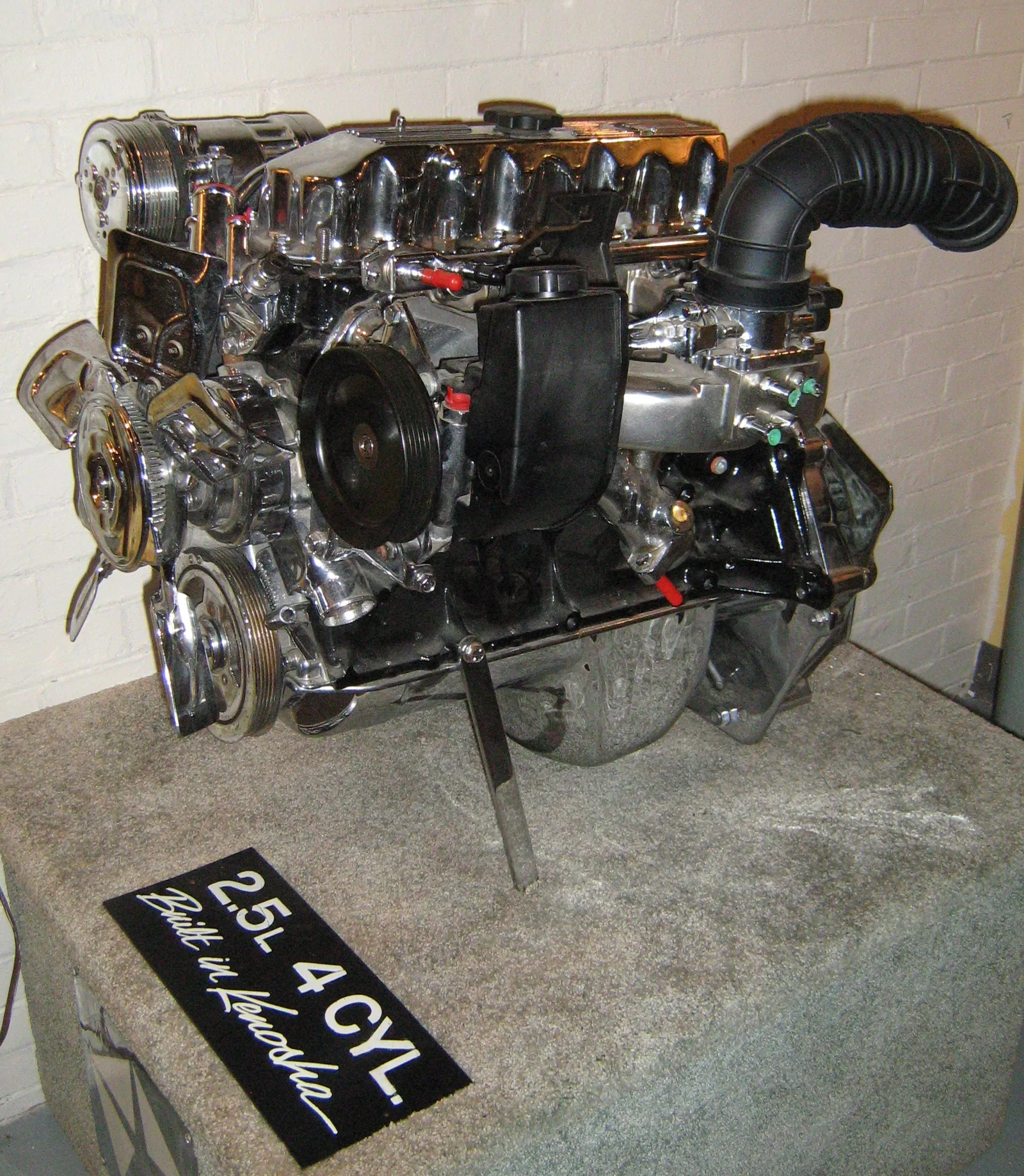
The AMC straight-four is a 2.5 L engine that American Motors developed for its own and Jeep vehicles, and which Dodge later used as well. It was built from 1984 to 2002. It shares design ideas and some internal parts with AMC's 4.0 L straight-six, which arrived for the 1987 model year.
American Motors spent three years developing it. The engine kept the existing spacing between cylinder bores, so the tooling stayed the same, and the distributor, oil filter and starter sat where the machine tools for the straight-six expected them. Think of building a bigger house on foundations that are already poured: the width of each room is fixed, and you can only change the height.
Roy Lunn, Jeep's chief engineer, described the engine as designed from the start for Jeep vehicles and the Eagle rather than adapted from a passenger-car engine, with performance and durability at the top of the list. It was not simply a six with two cylinders removed. Some parts were common with the 258 cu in (4.2 L) six, including the water pump, front housing and connecting rods, but the four had its own electronics, a shorter stroke and larger bore, bigger valves and new pistons. With bore centres fixed, Lunn said, stroke was the one dimension the engineers could change, so they chose the largest bore and stroke that gave 2.5 L.
General Motors' Iron Duke four preceded it in some AMC vehicles, yet has nothing in common with it. The same goes for Chrysler's later 2.5 L, which belongs to a successor family aimed at cleaner emissions and better economy.
Inside the AMC 2.5: a squish head and a tough valvetrain
The bore and stroke were 98.43 mm by 80.96 mm, for 2,458.06 cc. The new cylinder head had a double-quench combustion chamber, a shape that leaves only narrow gaps at either end as the piston nears the top of its stroke. Those gaps squeeze mixture out and throw it into the middle of the chamber, a push known as squish. The air and fuel mix more evenly, and the flame spreads faster. The same chamber and port design was later used on the 4.0 L.
The valvetrain was simple: eight overhead valves, hydraulic lifters, pushrods and rocker arms, on a block with five main bearings. A super-duty double-roller timing chain with an automatic tensioner drove it. The exhaust valve seats were hardened inserts of a kind normally reserved for aluminium heads, and a thinner wall between those seats and the water jacket helped heat escape. These changes helped the engine through AMC's 1,000-hour torture tests.
The engine control was clever for its day. Knock sensors on each cylinder let the computer advance the spark by up to 6 degrees when the engine ran cleanly, or retard it in steps of 2 degrees, by as much as 12, to cope with poor fuel. Fuelling began with a one-barrel carburettor in 1984 and 1985. From 1986 throttle-body injection took over, made by Renix from mid-1986 until August 1990, with a revised spark curve and new starters. The starters were lighter, falling from 17 lb to 8 lb (8 kg to 4 kg), and gave 10% higher cranking speeds. For 1987, plastic quick-connect vacuum fittings with hoses attached cut assembly errors and made leak checks easy.
Even the bolt pattern had a history. Its gearbox bolt pattern came from General Motors' small V6 and four-cylinder engines, because it replaced fours AMC had bought from GM, and because AMC kept buying GM's 2.8 L V6 until the 4.0 L six arrived in 1987. The 2.5 L and the GM V6 therefore shared drivetrain parts in Jeeps, whereas the 4.0 L needed stronger transmissions. The oil filter thread matched the GM 2.8 through 1986, then changed to one shared with Renault engines until 1991.
Power, economy and the 300,000-mile claim
The early throttle-body engine was rated at 105 hp (78 kW; 106 PS), with 132 ft lb (179 N m) of torque. By the final year, with sequential multi-port injection, it made 121 hp (90 kW; 123 PS) at 5400 rpm and peak torque of 145 ft lb (197 N m) came at 3250 rpm. The 258 six in its last year, with a computer-controlled carburettor, managed 112 hp (84 kW; 114 PS) at 3200 rpm, but its torque peaked at 210 ft lb (280 N m), down at 2000 rpm. The four won on power. The six had far more torque, and delivered it lower down.
| Feature | Pontiac straight-eight | AMC straight-four |
|---|---|---|
| Built | 1933 to 1954 | 1984 to 2002 |
| Layout | Eight cylinders in line, side valves | Four cylinders in line, overhead valves |
| Valve gear | L-head flathead with chain-driven cam | Hydraulic lifters, pushrods, rocker arms |
| Fuelling | Carter W one- or two-barrel carburettor | Carburettor, then throttle-body injection from 1986, then multi-port |
| Compression ratio | 5.7:1 up to 7.7:1 | 9.2:1 quoted for Cherokee and Comanche |
| Output | 230 bhp (172 kW) in the two Special-8 show cars | 105 hp (78 kW; 106 PS) rising to 121 hp (90 kW; 123 PS) |
| Replaced by | Pontiac V8, 1955 | Chrysler 2.5 L, a separate design |
Fuel economy was never its selling point. The newly downsized 1984 Jeep XJ, with its carburettor and five-speed manual, gave 15.3 mpg-US (15.4 L/100 km; 18.4 mpg-imp) over its first tankful. In a stock Wrangler, Motor Trend found almost no economy difference between the 2.5 L four and the 4.0 L six, though the six drove better on and off road. The final multi-port versions are regarded as the best for emissions and economy.
Durability is the engine's reputation. Owners say these engines last well beyond 200,000 miles, and some report 300,000 miles, helped by a torque curve that is almost flat. Among Jeep's four-cylinders, the 2.5 L is rated as one of the best.
Where the AMC straight-four was used
- Jeep DJ-5M and AMC Eagle, 1983 to 1984
- Jeep CJ-7, 1984 to 1986
- Jeep Cherokee (XJ), 1984 to 2000
- Jeep Comanche (MJ), 1986 to 1992
- Jeep Wrangler (YJ and TJ), 1987 to 2002
- Eagle Premier, 1988 to 1989
- Dodge Dakota, 1996 to 2002, where it was the standard engine in regular-cab, rear-wheel-drive trucks
The PowerTech I4 name was used from 1997 until 2002. The Wrangler version was detuned for several years. For the Cherokee and Comanche from at least 1992 to 1995 the quoted figures are 130 hp (97 kW; 132 PS), 149 ft lb (202 N m) and a 9.2:1 compression ratio.
China had its own version. AMC's joint venture, Beijing Jeep Corporation, made the engine as the C498QA from 1984 for the locally built Cherokee, the Beijing Jeep BJ213. A stroked 2.7 L version, the C498QA3, arrived around 2003 with 2,744 cc and 96 kW (131 PS; 129 hp) at 4800 rpm, and went into the Jeep 2700. Beijing had tried the engine in the old Beijing Jeep as early as 1986, but the first old-model derivative to use it was the facelifted BJ 2020 V of 1999. Three BJ 752 prototype sedans were built in 1987 and 1988 with the Cherokee engine.
What this means for someone driving one
A straight-eight Pontiac idles far lower than a modern engine, at 450 rpm or 375 rpm in drive with the automatic, and that is normal for the design. The electrics are 6-volt.
For an AMC four, the year matters. The oil filter thread changed in 1987, and output varies by year and by vehicle. A Wrangler was detuned for several years, and early engines used a carburettor where later ones have fuel injection. The knock sensors let later engines compensate for lower-quality fuel.
What became of the Pontiac eight and the AMC four?
The Pontiac straight-eight was superseded by the 287 V8 in 1955. Pontiac's performance image grew from there, and every later Pontiac V8 traced back to that engine.
American Motors' four lasted until 2002. In China, the engine went into the Cherokee-based BJ2025 Leichi SUV from 2004 to 2008, and Beijing Jeep's joint venture was dissolved in 2009.