A police-option code became a muscle car, the Cutlass line became America's best seller, the Aurora tried to rescue the brand and the Silhouette gave it a minivan.
The Oldsmobile 442 was a muscle car sold from 1964 to 1987, while the Cutlass Supreme was the premium mid-size Cutlass from 1966 to 1997. The Aurora was a luxury sedan built from 1994 to 2003, and the Silhouette was a minivan sold from 1990 to 2004. General Motors closed the brand in 2004.
The first Oldsmobile 4-4-2 existed on paper as the "B09 Police Apprehender Pursuit" option, a code that sounds more like a squad car than the muscle car it became. Oldsmobile's hasty reply to the Pontiac GTO in 1964 was the start of a line of names that ran through a muscle car, a best-selling mid-size coupe, a luxury sedan meant to save the company and a minivan.
The Oldsmobile 442, the Cutlass Supreme, the Aurora and the Silhouette sat in very different corners of the range between 1964 and 2004, the year General Motors closed the Oldsmobile brand.
What does Oldsmobile 442 stand for?
The name described the first car's hardware: a four-barrel carburettor, a four-speed manual gearbox and dual exhausts. In 1965 the standard gearbox became a three-speed, so Oldsmobile restated the figures as 400 cubic inches, four barrels and two exhausts. Badges lost their hyphens in 1968, though brochures kept writing 4-4-2.
Oldsmobile's answer to the GTO was officially a police option code.
How the Oldsmobile 442 began in 1964
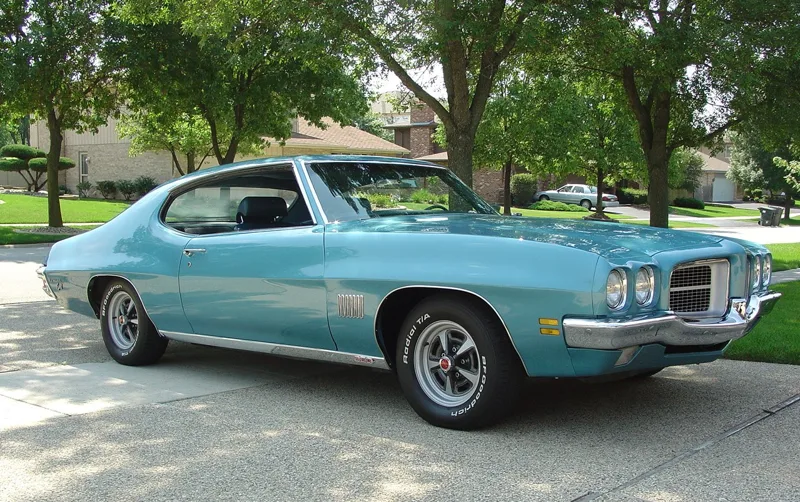
The GTO had proved an unexpected hit midway through 1964, and Oldsmobile answered by beefing up the popular Cutlass. A team under engineer John Beltz, who later worked on the Toronado, got the job, helped by Dale Smith and chief engineer Bob Dorshimer. The result was conservative beside the 389-powered GTO. It used the four-barrel 330 cu in (5.4 L) V8, known as L79, with a high-lift camshaft and stronger internals, rated at 310 hp (231.3 kW) at 5,200 rpm.
Handling got attention: springs rated 30% stiffer, shocks with 50% more restriction, thicker sway bars, a quicker 20:1 manual steering ratio and a 3.36:1 rear axle. The car did not come with power brakes or power steering unless the buyer added them, and its frame was not special. It could be ordered on any F-85 or Cutlass except the wagon, though almost all were hardtop coupes. The package cost $136 on top of $2,663 for the coupe or $2,773 for the hardtop, and 2,999 were sold. Motor Trend timed a 3,440 lb (1,560 kg) example from 0-60 mph in 7.5 seconds, with a quarter mile of 15.5 seconds at 90 mph (145 km/h) and a top speed of 116 mph (187 km/h).
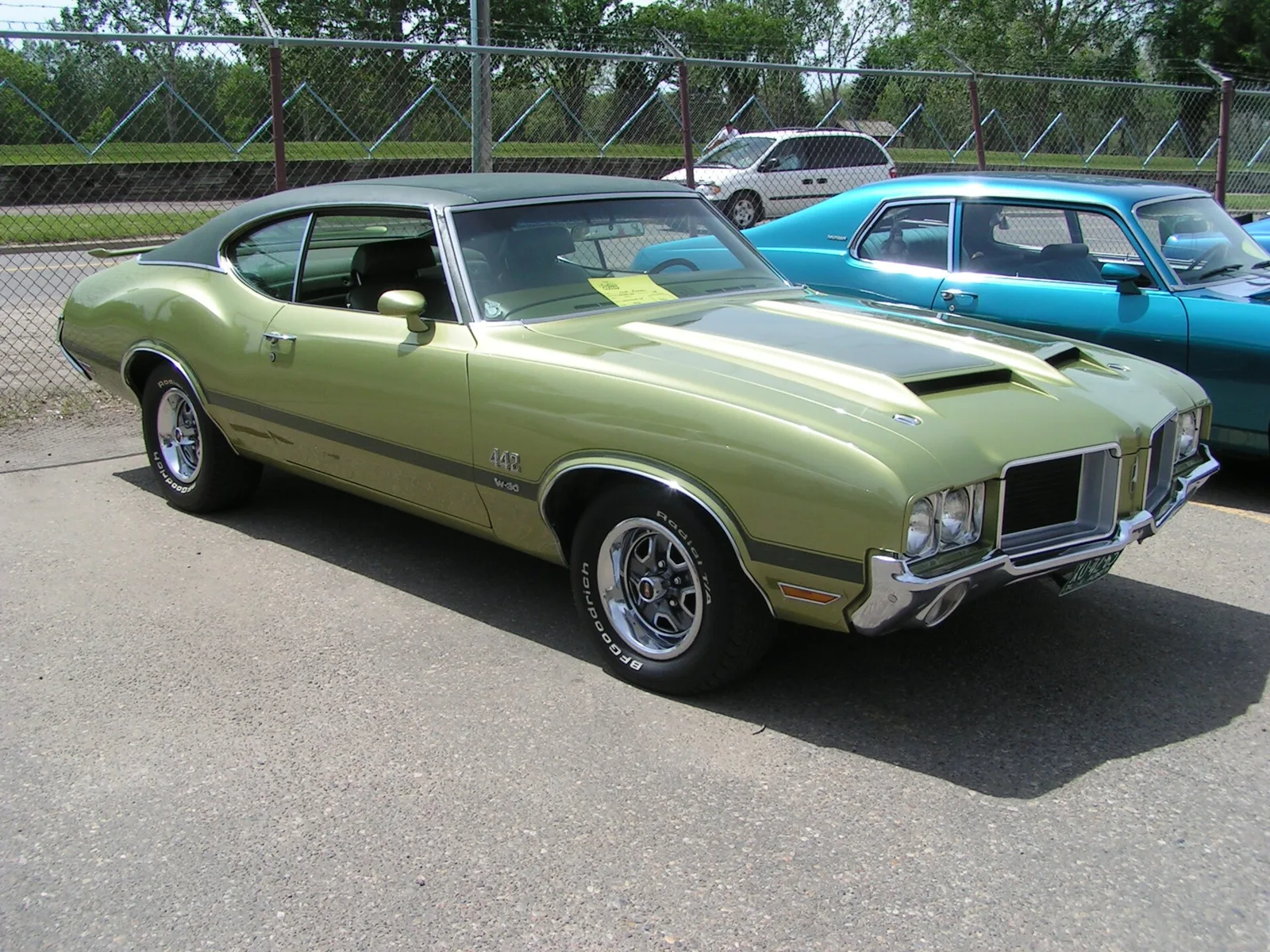
For 1965, with General Motors approving the big 389 for the GTO, Oldsmobile fitted its new 400 cu in (6.5 L) V8. It made 345 hp (257 kW) and 440 lb-ft (597 N-m), and sales rose to 25,003, including 3,468 convertibles. The 1966 car added a 350 hp (261 kW) L78, an L69 option with three two-barrel carburettors at 360 hp (268 kW), and the rare W30. The W30 added an outside-air induction system that carried cool air from the grille to the carburettors, which meant moving the battery to the boot and made it impossible on convertibles. Only 54 were built at the factory, plus 97 for dealer installation.
In 1967 General Motors banned multiple carburettors on everything but the Corvette and Corvair, which killed the L69. The W30 survived with a Quadrajet four-barrel, and 502 factory engines were built to meet NHRA rules. A tested W30 with a 4.33 rear axle ran the quarter mile in 14.1 seconds at 103 mph (166 km/h). The 442 package that year moved onto the top-line Cutlass Supreme.
Oldsmobile 442 year by year
| Year | Standard engine | Power | Built |
|---|---|---|---|
| 1964 | 330 cu in V8 | 310 hp (231.3 kW) | 2,999 |
| 1965 | 400 cu in V8 | 345 hp (257 kW) | 25,003 |
| 1966 | 400 cu in V8 | 350 hp (261 kW) | 21,997 |
| 1967 | 400 cu in V8 | 350 hp (261 kW) | 24,833 |
| 1968 | 400 cu in V8 | 350 hp (261 kW), 325 hp (242 kW) automatic | Over 33,000 |
In 1968 the 442 became its own model, on a 112 in (2,845 mm) wheelbase, and it kept that status through 1971. The 400 engine now shared the 4.25-inch stroke of the new 455. That year Oldsmobile also teamed with Hurst Performance Research Corporation to build the Hurst/Olds, 515 of them in Peruvian silver, each with a 455 rated at 390 hp (291 kW) and a Hurst dual-gate shifter. The 442 then fell back to an option through the mid-1970s, returned in the 1980s on the rear-drive Cutlass Supreme, and in the early 1990s was an option on the front-drive Cutlass Calais.
Oldsmobile Cutlass Supreme, from trim package to best seller
The Cutlass Supreme began in 1966 as a plusher version of the new four-door hardtop, called the Holiday Sedan, with a bench seat with armrest and "CS" emblems on the rear pillars. By 1967 it was a full series with coupe, sedan and convertible bodies, powered as standard by a 320 hp (239 kW) 330 cu in V8.
The 1968 restyle shortened the coupes to a 112 in (2,845 mm) wheelbase and stretched sedans and wagons to 116 in (2,946 mm), with the glass-roof Vista Cruiser wagon on a 121 in (3,100 mm) wheelbase. The Supreme was now the top-line intermediate, and the 442 had moved to the cheaper Cutlass S.
Then, for 1970, the name was repositioned. Oldsmobile used it for its answer to the downsized Pontiac Grand Prix, an entry in the growing market for smaller personal-luxury cars. Unlike the Grand Prix and the Chevrolet Monte Carlo, which had separate bodies, the Supreme shared front and rear body parts and its 112 in wheelbase with the ordinary two-door Cutlass. An SX option package for 1970 and 1971 brought the 455 Rocket V8 from the 442. The last convertible until 1990 came in 1972, when 11,571 sold, or 16% of the market, more than the Eldorado or Corvette. Only 77 Supreme notchback hardtops were built that year with the L75 455 and a four-speed.
The 1973 Colonnade body replaced the pillarless hardtops, a change driven by worries over proposed rollover standards. It proved hugely successful. By 1974 the Cutlass line made up 43% of Oldsmobile's volume, and in 1976 it was America's best-selling car, helping Oldsmobile become the only marque outside Ford and Chevrolet to sell a million cars. The oil embargo brought smaller engines in 1975, and a Buick-built 231 V6 became the base unit in 1977.
The 1978 downsizing took 9.5 inches off the length, four inches off the wheelbase and more than 500 pounds from the weight, yet interior volume rose. The Calais replaced the Salon as the touring flagship, and the base engine became a 105 hp V6. In 1988 Oldsmobile replaced the rear-drive car with a downsized front-drive model on the W platform. Production ended in 1997 with no direct successor, although the Intrigue of 1998 was sized and priced to stand in for all the Cutlass models.
Oldsmobile Aurora, the sedan meant to rescue the brand
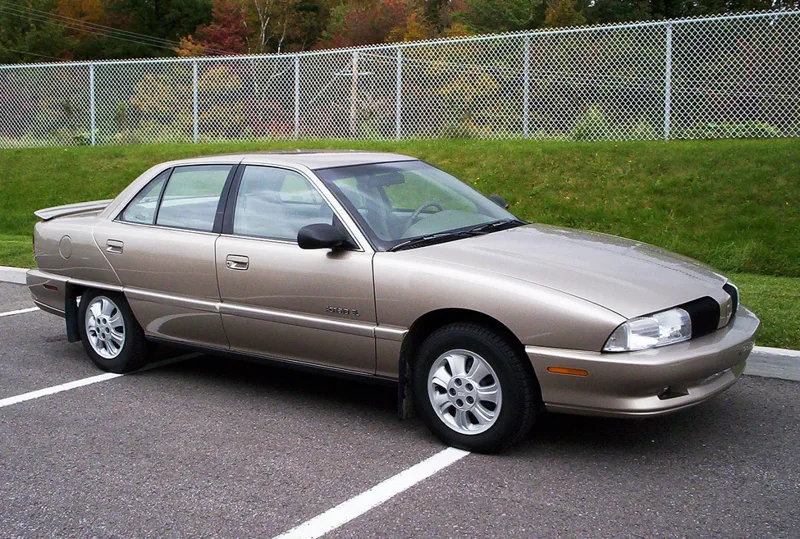
Oldsmobile sales had slipped from a record 1,066,122 in 1985 to 402,936 in 1993. Acura, Infiniti and Lexus had better reputations for reliability, and the "not your father's Oldsmobile" slogan alienated many loyal customers. General Motors built the Aurora to reverse the slide. Its roots lay in the 1989 Tube Car concept by Bud Chandler, which previewed a full-width tail lamp, a wraparound rear window and frameless doors, and the final design was approved in July 1989.
The car carried almost no Oldsmobile badging, only on the radio and engine cover, because focus groups were put off by the name. Division head John Rock proposed using Aurora to replace the Oldsmobile brand outright, in the manner of the new Saturn division, but higher management vetoed it. The prototype was nearly written off in 1993 when a four-foot log fell from a Michigan Department of Natural Resources truck; Governor John Engler, a lifelong Oldsmobile customer, bought one afterwards.
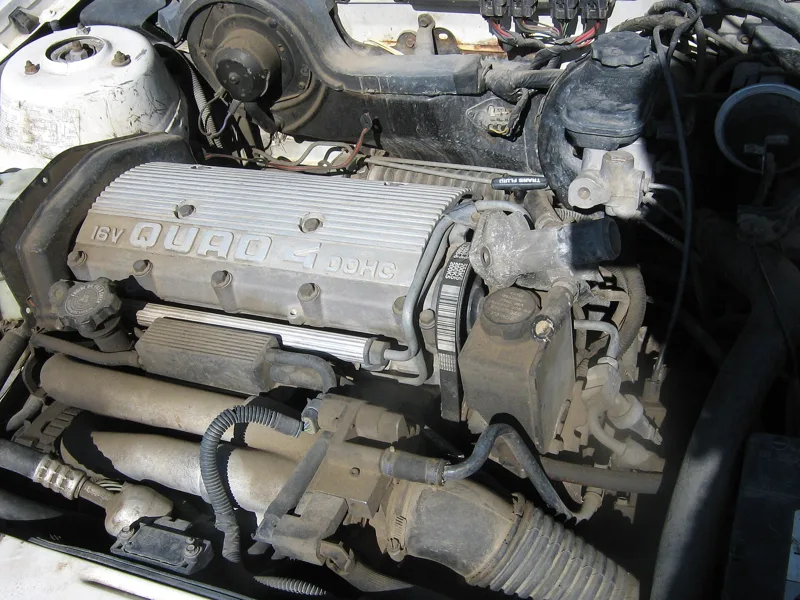
Production began on 24 January 1994 for the 1995 model year. A 4.0 L (3,995 cc) DOHC V8, derived from Cadillac's Northstar, made 250 hp (186 kW) at 5600 rpm and 260 lb-ft (353 N-m) at 4400 rpm through a four-speed automatic with normal and power modes. Its body was so rigid that, in a crush-to-failure test, the Aurora broke General Motors' testing machine, and a frame-crusher normally used on truck frames had to take over. A 650 hp (485 kW) version of the engine powered the Aurora GTS-1 racing programme. The car was pace car for the 1997 and 2000 Indianapolis 500, the ninth and tenth times an Oldsmobile had led the field.
The first generation ended on 25 June 1999. The second, sold for 2001 to 2003, began as a planned replacement for the Eighty-Eight called the Antares, but Buick dropped its Riviera plans just as Oldsmobile ran into money trouble, so engineers rebuilt it as an Aurora in a hurry. It was about six inches shorter than before and offered a 3.5 L V6 with 215 hp (160 kW) for 2001 and 2002. Sales suffered after General Motors announced in December 2000 that the Oldsmobile marque would be phased out. The last 500 cars, built on 28 March 2003, wore Dark Cherry Metallic paint, chrome wheels and "Final 500" badges. In total, 68,552 second-generation cars were made, split 53,640, 10,865 and 4,047 across the three years.
Oldsmobile Silhouette, the premium minivan nicknamed the dustbuster
General Motors' first minivan attempt, the Chevrolet Astro and GMC Safari, was rear-drive and truck-based, and it failed to dent Chrysler. The answer was the U-body family built from the 1986 Pontiac Trans Sport concept. Chevrolet got the value-minded Lumina APV, Pontiac the sporty Trans Sport, and Oldsmobile the premium Silhouette, aimed at the Chrysler Town and Country.
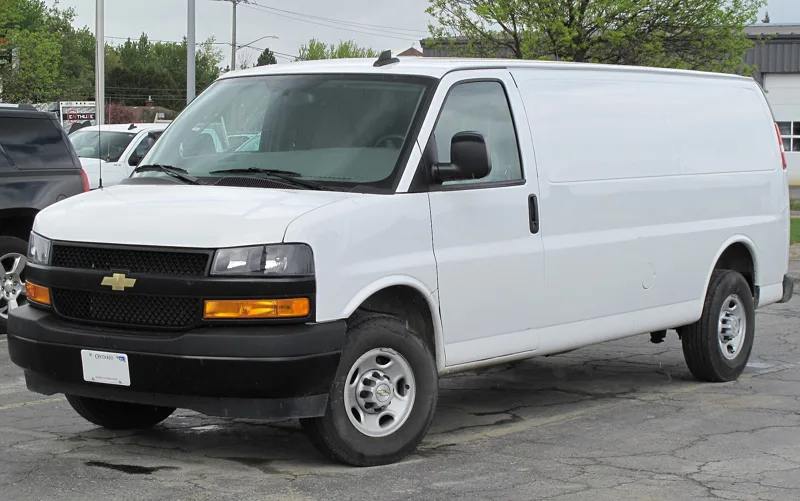
The first 1990 model was made on 1 August 1989 at North Tarrytown. A galvanised steel space frame wore composite plastic panels that resisted rust and small dents, a technique developed on the Pontiac Fiero and used on Saturn. It seated seven, and each of the five rear seats weighed 34 lb (15 kg) and could be removed. A level-ride package used a compressor to hold the van's height, and it came with an air hose kit for pumping up tyres, air mattresses and sports equipment. Built-in child seats and a remote-controlled sliding door arrived in 1994. In Europe the Silhouette was sold as the Pontiac Trans Sport, whose successors included the Opel Sintra, called the Vauxhall Sintra in Britain. The first generation was never sold in Canada.
Magazines called these vans "dustbusters" after the household appliance, and the long, sloped windshield disconcerted drivers at first. The original 3.1 L V6 made only 120 hp (89 kW), but the 3800 V6 added in 1992, with 170 hp (127 kW), made them the most powerful minivans then in production. The final first-generation van left the Tarrytown plant, open since 1900, on 26 June 1996.
The 1997 replacement, built at Doraville, was as conservative as the old one was radical, with a steel unibody and a narrower body that GM hoped would suit Europe as well as North America. A 3.4 L V6 was the only engine, and trims ran from GL and GLS to the Premiere, which from 1998 offered a DVD player with an overhead retractable screen. Canadian sales began with the 1998 model. Safety was its weakness: in the Insurance Institute for Highway Safety's 40 mph (64 km/h) moderate overlap test, the closely related 1997 Pontiac Trans Sport earned a "Poor" rating and was named the worst-performing vehicle, a result that also applied to the Silhouette because it shared the chassis and body. The related Sintra scored 2.5 stars in Euro NCAP's frontal test. The National Highway Traffic Safety Administration gave it 4 stars for driver protection and 3 for passengers in a 35 mph (56 km/h) frontal test.
Rare Oldsmobiles by the numbers
Production figures pick out the scarce ones. The 1964 442 carried no option code on its data plate and sat on a frame found under ordinary manual-gearbox F-85s. Oldsmobile built 54 W30 cars at the factory in 1966, and 502 W30 engines in 1967. Only 77 Cutlass Supreme notchback hardtops left the factory in 1972 with the 455 and four-speed. The Aurora V6 existed only for 2001 and 2002, and the V8 became standard in 2003.
How the Oldsmobile line-up ended
General Motors announced in December 2000 that the marque would be phased out. The Silhouette ended in 2004 when the brand was discontinued, and General Motors carried on the U-body minivans as the Saturn Relay and the Buick Terraza from 2005 to 2007. The Cutlass Supreme had gone in 1997, and the Aurora went in 2003.