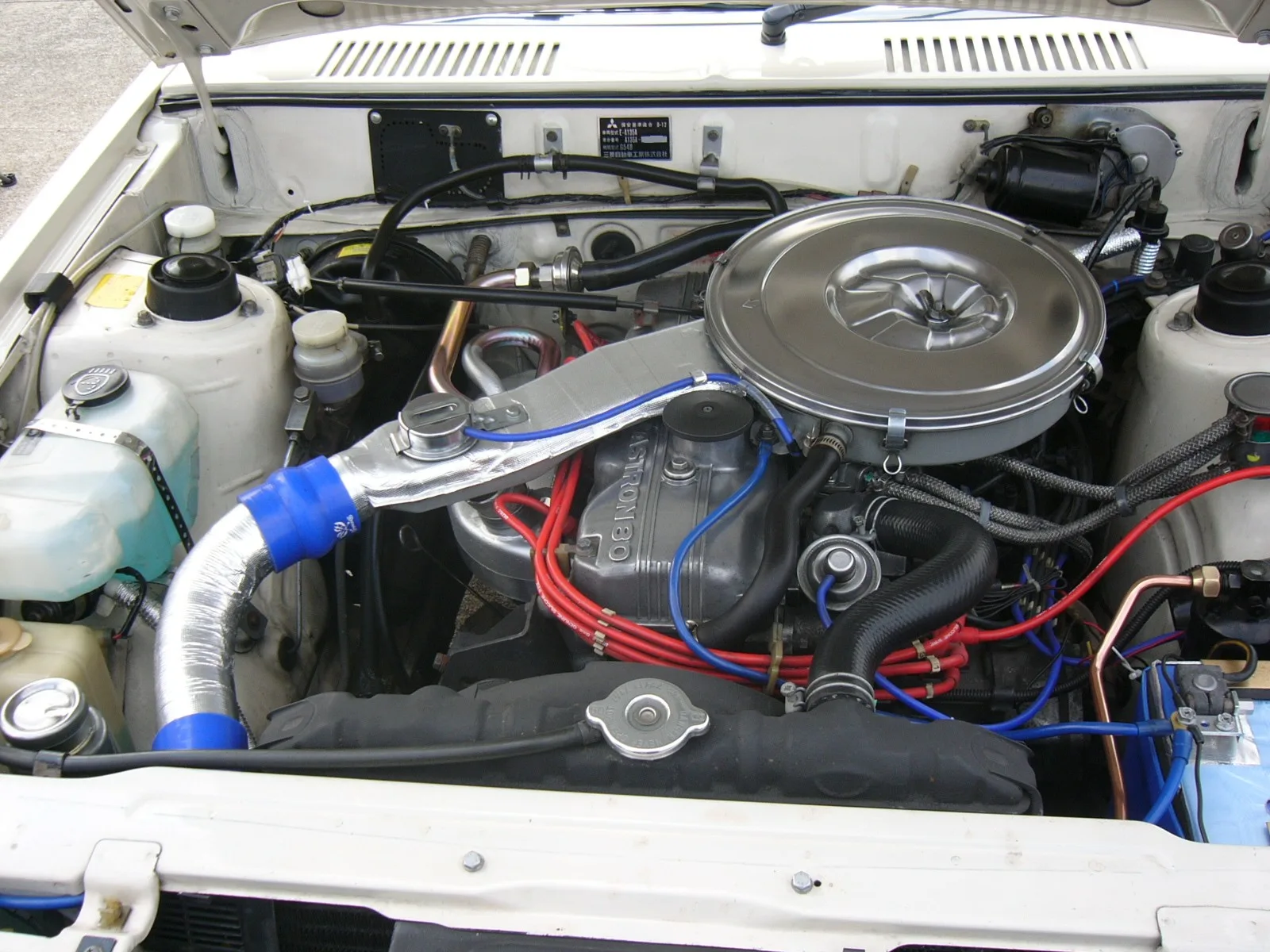
Three families of Mitsubishi fours cover lean-burn heads, twin balance shafts, a pioneering turbodiesel and a turbocharged Evolution engine.
Astron, Orion and 4B1 are three families of Mitsubishi four-cylinder engines. The Astron began in 1972 with sizes from 1.8 to 2.6 litres and the Jet Valve. The Orion followed around 1977 in 1.2 to 1.6 litres. The 4B1, built in Shiga with Chrysler and Hyundai, brought MIVEC and the Lancer Evolution X's 4B11T.
In 1975 a Mitsubishi four-cylinder brought twin balance shafts to a modern engine for the first time, under the name Silent Shaft. The idea went back to Frederick Lanchester, whose original patents Mitsubishi had acquired, and Fiat and Lancia, Saab and Porsche all ended up licensing it. The engine was the Astron, and it opens a family history that runs from the 1970s to the Lancer Evolution X.
What are the Mitsubishi Astron, Orion and 4B1 engines?
The Astron, coded 4G5 for petrol and 4D5 for diesel, is a straight-four family Mitsubishi first built in 1972, in sizes from 1.8 to 2.6 litres. The Orion, or 4G1, is a smaller inline-four of 1.2 to 1.6 litres. The 4B1 is an all-alloy straight-four built in Shiga, Japan, for an alliance with Chrysler and Hyundai.
Size set the Astron apart. In its day it counted among the largest four-cylinder engines made. The Orion arrived around 1977, alongside the Astron, Sirius and Saturn engines, and went first into the Colt and Colt-derived models in 1978. It replaced the Neptune and kept that engine's crossflow design, but where the Neptune was close to square, the Orion had a long stroke.
The 4B1 belongs to a later era. It comes out of the Global Engine Manufacturing Alliance, known as GEMA, and although the basic design is shared, each partner has its own specification.
The Jet Valve was a small second intake valve fitted to Astron engines for the United States.
What was the Jet Valve on the Mitsubishi Astron engine?
The Jet Valve was a small second intake valve fitted to Astron engines for the United States. It set the incoming charge swirling, which let the engine burn a leaner mixture of fuel and air and so meet tougher emissions rules.
The packaging was neat. The valve came as a cartridge holding its own spring and seat, and it screwed into a threaded hole in the cylinder head much as a spark plug does, though it sat beneath the cam cover. Rocker arms on the main intake valve were widened to reach it, and the cartridge used a very soft spring so that it would not wear the camshaft's intake lobe. Because it removed the need for a three-valve-per-cylinder head, changes to the head stayed modest.
The Orion carried the same lean-burn thinking. Its 4G11 used Mitsubishi's MCA-Jet technology, with a tiny second inlet valve to create swirl, and the US-market 4G54 head also had additional jet valves.
How did Silent Shaft work?
Silent Shaft used a pair of balance shafts, spinning weights arranged to cancel the shake a four-cylinder engine produces. It debuted on the Astron 80 in 1975 and proved influential across the industry.
Mitsubishi followed designs by Lanchester, whose original patents it held, and the licensing deals with Fiat and Lancia, Saab and Porsche are the measure of how influential the system proved. The Australian-built 4G54, sold as the Astron II, carried Balance Shaft technology that was later licensed to Porsche and other makers.
Which engines made up the Mitsubishi Astron petrol range?
Four petrol sizes cover the range: the 1.9-litre 4G51, the 2.0-litre 4G52, the 2.4-litre 4G53 and the 2.6-litre 4G54, with a 2.3-litre 4G55 listed alongside. They were used in everything from cars to buses and forklifts.
The 4G51 displaced 1,850 cc and went into the 1977 to 1979 Chrysler Sigma. The 4G52, at 1,995 cc, produced 100 PS (74 kW) in a 1975 Canter, and as much as 125 PS (92 kW) in the twin-carburettor form fitted to the Galant GTO GSR and Galant GS-II. Its bore and stroke were 84 mm x 90 mm (3.31 in x 3.54 in), and in Australia it appeared in the Sigma, Scorpion and L200.
The 4G53 stepped up to 2,384 cc with an 88 mm x 98 mm bore and stroke. It gave 110 PS (81 kW) at 5,000 rpm in the Rosa bus and the Canter cabover truck, and its dimensions match those of the Fuso 4DR1 diesel of the same period. Rated at 46 PS (34 kW), it also drove the FG30 3-ton forklift.
What is the Mitsubishi 4G54 engine?
The 4G54, sometimes called the G54B, is a 2.6-litre (2,555 cc) single-overhead-cam, eight-valve four with a 91.1 mm x 98 mm bore and stroke. Mitsubishi fitted it to various models from 1978 to 1997, and Chrysler used it in its K-cars and their derivatives from 1981 to 1987.
Most installations were longitudinal, in rear- and all-wheel-drive layouts, but the engine also went across the nose of the front-drive Mitsubishi Magna and the Chrysler K platform. Chrysler commonly marketed it as a Hemi. The original carried a Mikuni two-barrel carburettor with a secondary vacuum actuator, and later versions took electronic fuel injection.
Transmissions differed by market. Chrysler usually paired the engine with its A470 three-speed automatic, while in Australia Mitsubishi adapted a five-speed manual and its four-speed ELC automatic, which had electronic overdrive. In the end Chrysler replaced the 4G54 with its own 2.5-litre engine, and Mitsubishi chose a 2.4-litre unit coded 4G64.
The fuel-injected ECI-Multi version delivered 98 kW (131 hp) on 91 RON petrol and 102 kW (137 hp) on 95 RON, both at 4,750 rpm, with a compression ratio of 9.2:1. Peak torque was 212 Nm (156 lb ft) at 3,750 rpm on the lower grade and 220 Nm (162 lb ft) at 4,000 rpm on the higher. The carburettor engine managed 85 kW (114 hp) at 5,000 rpm and 198 Nm (146 lb ft) at 3,000 rpm, with a lower 8.8:1 compression ratio.
How did the Astron diesel become the Mitsubishi 4D56?
The 4D5 diesel arrived in 1980 in the fifth-generation Galant. It was the first turbodiesel offered in a Japanese passenger car, and it did well in the SUV and minivan markets where Mitsubishi was strong, until the 4M4 range replaced it in 1993.
The 4D56 version kept going through the 1990s as a cheaper alternative, and it remains in production, updated with a common rail direct injection system. Hyundai also builds the engine in South Korea, which is why some Kia products use it, under the codes D4BA, D4BX, D4BF and D4BH.
The earlier 4D55, at 2.3 litres (2,346 cc), ran at a compression ratio of 21.0:1. Its non-turbo form gave 55 kW (75 PS) on the Japanese test and powered the Pajero from 1982 to 1986, the first-generation L200 and the 1985 to 1987 Ford Ranger. The wastegated turbo version raised output to 70 kW (95 PS) and went into the Galant, Pajero, Ford Ranger and the 1983 to 1985 Dodge Ram 50.
The 4D56 grew to 2.5 litres (2,477 cc), measuring 91.1 mm x 95 mm across bore and stroke. Its development ran from a distribution-pump engine with 21.0:1 compression to a 16-valve common rail unit, and the top-spec water-cooled TD04 version used a roller-follower rocker arm, a swirl-type combustion chamber and a top-mounted aluminium air-to-air intercooler.
Mitsubishi 4D56 power and torque by generation
| Version | Power | Torque | Compression |
|---|---|---|---|
| Non-turbo | 74 hp (55 kW) | 142 Nm (105 lb ft) | 21.0:1 |
| Non-intercooled turbo | 84 PS (62 kW) | 201 Nm (148 lb ft) | - |
| Intercooled turbo (TD04) | 90 hp (67 kW) | 197 Nm (145 lb ft) | 21.0:1 |
| Intercooled water-cooled turbo (TD04) | 99 hp (74 kW) | 240 Nm (177 lb ft) | 21.0:1 |
| First-generation DI-D | 114 PS (84 kW) | 247 Nm (182 lb ft) | 17.0:1 |
| Second-generation DI-D | 136 PS (100 kW) | 320 Nm (236 lb ft) | 17.0:1 |
| Third-generation DI-D, variable geometry turbo | 178 PS (131 kW) | 400 Nm (295 lb ft) manual; 350 Nm (258 lb ft) automatic | 16.5:1 |
What is the Mitsubishi Orion engine?
The Orion is a family of inline-fours from 1.2 to 1.6 litres, introduced around 1977 for the Colt and Lancer. Its codes run from 4G11 to 4G19, and some of them are still being built in China.
The 4G11, at 1,244 cc, had a bore and stroke of 69.5 mm x 82 mm and led with the MCA-Jet lean-burn system. It went into the Colt and Mirage, the Lancer, Lancer Van and Lancer EX. Next in line was the 1.4-litre 4G12 (1,410 cc), the first engine to use Mitsubishi's MD technology. MD stood for modulated displacement, a form of variable displacement that shut off two cylinders at light load and low speed. It was never offered with fuel injection, and it later looked dated beside its successors.
The turbocharged 4G12T used a small Mitsubishi Heavy Industries TC-04 turbo with 49 mm blades, spinning at 90,000 rpm to supply 0.53 bar (7.7 psi) of boost. That lifted power by about 30 percent and torque by about 25 percent. The Japanese-market version made 152 Nm (112 lb ft) at 3,000 rpm, with 105 PS (77 kW) arriving at 5,500 rpm.
Further sizes followed. The 4G13 (1,298 cc) produced 75 to 85 PS (55-63 kW) and has been built in Harbin, China, since September 1998. The 4G16 (1,198 cc) was aimed mainly at European buyers, since it fitted local tax rules. The 4G17 (1,343 cc) made 78 PS (57 kW; 77 hp), and its run in the Indonesian Colt T120SS ended because Euro 2 required direct injection, an engine control unit and a catalytic converter.
The 4G19, a 1.3-litre DOHC MIVEC four introduced in 2002 in the then-new Colt, made 90 PS (66 kW; 89 hp) at 5,600 rpm.
How long has the Mitsubishi 4G15 been in production?
The 4G15 is a 1.5-litre four of 1,468 cc that Mitsubishi has made in many forms, and new variants are still built for Chinese cars today. It ranks among the longest-lived Japanese engines.
Its early SOHC eight-valve version, with a carburettor, advertised 77 PS (57 kW; 76 hp) and a compression ratio of 9.4:1. A twelve-valve form entered production in 1989 for the third-generation Mirage and Lancer, in carburettor or injected form, with 85 or 100 PS (63 or 74 kW) in Japanese trim. A natural-gas version followed, and in 1991 a lean-burn system called Mitsubishi Vertical Vortex arrived.
Later engines pushed further. A multi-point injected 4G15 gave about 94 hp (69 kW) in a 1993 Mirage, the DOHC edition 109 hp (81 kW), and a DOHC direct-injection version 100 hp (74 kW). The DOHC MIVEC turbo 4G15T serves in the Colt and delivers 165 hp (121 kW) in the Colt Version-R, while the Colt CZT Ralliart, a special model in Switzerland, reaches a total of 197 hp (147 kW).
Durability is part of the legend. One 1998 Mitsubishi Mirage sedan is recorded as exceeding 997,000 mi (1,604,516 km). In China, Harbin is home to Dongan Mitsubishi Motors Engine Manufacturing, which builds the engine, and GAC Mitsubishi Motors in Hunan province has done so since April 2017. The Geely Emgrand EC7 held the longest run with it, 13 years from 2009 to 2022, before Volvo-sourced engines took over from 2023.
What is the Mitsubishi 4B1 engine?
The 4B1 is a range of all-alloy straight-fours built at Mitsubishi's World Engine plant in Shiga. Every member has an aluminium block and head, four valves per cylinder, twin overhead cams and MIVEC variable valve timing.
The partners jointly developed the block and other basic structure, but Mitsubishi independently handled the intake and exhaust manifolds, the ports in the cylinder head and the other parts that decide how an engine is tuned. All variants share one block with a 96 mm bore pitch, so different displacements come from changing bore and stroke.
It was also the first family to apply continuously variable valve timing to the exhaust valves as well as the intake. Intake and exhaust cam timing are controlled continuously and independently, which provides four optimised operating modes.
The family has four main members. The 4B10 is a 1.8-litre naturally aspirated engine used in the 2007 to 2017 Lancer, the 2010 RVR in Japan and the 2010 to 2015 Proton Inspira. The 4B11 is the 2.0-litre, the 4B11T its turbocharged sibling and the 4B12 a 2.4-litre naturally aspirated unit.
What makes the Mitsubishi 4B11 different?
The 2.0-litre 4B11 has a square layout, with bore and stroke both 86 mm (3.39 in). According to Mitsubishi, the dimensions give a free-revving character, with maximum power at 6,500 rpm, linear power delivery and a wide torque curve.
Its applications are broad: the 2007 to 2017 Lancer and Galant Fortis, the Outlander, Outlander Sport and ASX, the Delica from 2007 to the present and the Eclipse Cross from 2018.
Mitsubishi swapped the belt for a timing chain, citing reliability, and fitted iridium plugs that cut emissions and stretch major service intervals. To save weight, plastic is used for the cam cover and intake manifold, with double-layer stainless steel for the exhaust manifold. The exhaust manifold moved to the rear of the transverse engine, which improves emissions performance. To reduce vibration, the engine hangs on a four-point inertial axis system with hydraulic mounts, a squeeze-cast aluminium bracket on the right and a steel plate bracket on the left to cut noise.
The Outlander PHEV uses a modified 4B11. MIVEC is on the intake side only, a balancer shaft derived from the 4B12 replaces the standard oil pump, and the engine is limited to 4,500 rpm so that overspeeding cannot damage the electric motors and generator.
How did the 4B11T change the Lancer Evolution?
The 4B11T was the first Lancer Evolution engine with a die-cast aluminium block, where the 4G63 before it had used cast iron. Even with a timing chain and MIVEC on both camshafts added, it weighs 12 kg (26 lb) less.
It powered the Lancer Evolution X from 2007 to 2016, while a detuned version with a smaller turbocharger went into the Lancer and Galant Fortis Ralliart from 2008 to 2015. Peak figures for Japanese Evolution models are 280 PS (276 bhp; 206 kW) and 422 Nm (311 lb ft), and for US models 295 PS (291 bhp; 217 kW) and 407 Nm (300 lb ft).
The revised turbocharger responds up to 20 percent faster at lower engine speeds, and the 4B11T makes more torque than the 4G63 at every engine speed, helped by its square bore and stroke. Redline marks begin at 7,000 rpm, with a fuel cutout at 7,600 rpm to protect the engine.
Strength comes from a semi-closed deck, a ladder frame built into the block and main bearing caps with four bolts each, and unlike the 4G63 it needs no balancer shaft. Pistons are now fully floating, the camshafts are built-up hollow items, and a direct-acting valvetrain does away with the roller rocker arms of the old engine. The internals were reinforced for high boost.
What did Mitsubishi change in the 4B12?
The 2.4-litre 4B12 was built for efficiency. Mitsubishi cut friction with elastic grinding of the valve stems, a plastic impeller in the water pump and low-viscosity 0W-20 oil, and it improved combustion with optimised ports, MIVEC on both valve sets and injectors that spray an ultra micro droplet fuel mist.
The cylinder block is die-cast aluminium, the cylinder head cover and intake manifold are plastic, and the exhaust manifold is stainless steel. A balance shaft module that is compact and carries the oil pump, plus a silent chain driving the camshafts, keep vibration and noise low.
Which of these engines are still built
Several of these engines are still working. The 4D56 remains in production in common rail form, the 4G15 continues in Chinese cars, and the 4B11 is listed in the Delica and Eclipse Cross as a current application. In the Emgrand EC7 the 4G15 was replaced from 2023 by Volvo-sourced engines.