An American opera singer in Staines, a Le Mans win, W. O. Bentley's V12 and the 1976 saloon whose dashboard cost four times the whole car's budget.
Lagonda is a British luxury marque founded in 1906 and owned by Aston Martin since 1947. Its best-known car is the Aston Martin Lagonda, a wedge-shaped four-door saloon designed by William Towns and built from the 1970s to 1990, 645 in all, with a pioneering digital dashboard that was famously unreliable.
The Aston Martin Lagonda was the first production car to wear a digital instrument panel, and the electronics alone ate four times what had been set aside for the entire car. It looked like a folded sheet of paper, cost more than a Ferrari, and was named on lists of the ugliest and worst cars ever made.
Behind that wedge-shaped saloon sits a Lagonda marque that goes back to 1906, won Le Mans, lured W. O. Bentley from Rolls-Royce and then disappeared into Aston Martin. The two stories explain each other.
Who founded Lagonda?
Wilbur Gunn had been an opera singer in America before he took British nationality in 1891 and settled in Staines, Middlesex, to engineer speedboats and motorcycles. There in 1906 he started the Lagonda company, borrowing the name of a Shawnee settlement in his hometown, Springfield, Ohio.
Gunn had been making motorcycles in small numbers in his garden, and one of them won the 1905 London-Edinburgh trial. A car followed in 1907, the Torpedo, a 20 hp six-cylinder that took the 1910 Moscow-St. Petersburg trial and, with it, a healthy flow of export orders from Russia until 1914. In 1913 came something more advanced, a small car called the 11.1 with a 1,099 cc four. By 1914 it also boasted panhard rod suspension, a riveted unibody shell and the very first fly-off handbrake. Wartime meant artillery shells.
The Lagonda was the first production car with a digital instrument panel, and the electronics alone cost four times what had been budgeted for the entire car.
How did Lagonda grow between the wars?
After the war the 11.1 carried on, first as the 11.9 with a 1.4-litre engine and electric lighting as standard, which lasted until 1923, and then as the 12 until 1926. Gunn died in 1920 and Colin Parbury led the three remaining directors. Lagonda's first sports car, the 14/60 of 1925, had a twin-cam 1,954 cc four with hemispherical combustion chambers; Arthur Davidson, newly arrived from Lea-Francis, drew it. The two-litre Speed model of 1927 offered more power and could be had supercharged from 1930. From 1926 to 1930 a lengthened chassis, the 16/65, took a 2.4-litre six. The decade closed with the three-litre, a 2,931 cc six that grew to 3,181 cc in 1933 and, as the Selector Special, could be ordered with an elaborate eight-speed Maybach gearbox.
In 1933 the 16-80 arrived with a two-litre Crossley engine, adding a preselector gearbox the next year. The little Rapier of 1934 had a 1,104 cc engine and the same kind of gearbox; Lagonda stopped making it in 1935, but D. Napier and Son of Hammersmith kept building more through 1938. At the opposite extreme stood the M45, good for nearly 100 mph (161 km/h) from a Meadows six of 4,453 cc (271.7 cu in). Tune that engine, shorten the chassis and the result was the M45R Rapide, which took a disputed victory at Le Mans in 1935.
How did W. O. Bentley end up at Lagonda?
Finances were shaky, and in 1935 a receiver took over. Alan P. Good bought the firm, narrowly beating Rolls-Royce to it, and lured W. O. Bentley away from Rolls-Royce as designer, bringing a number of his racing staff along. The 4.5-litre range turned into the LG45, lower but heavier in the body, with an LG45R Rapide as well. Three Sanction versions followed, each carrying more of Bentley's touches in the engine. For 1938 the LG6 arrived, a revised LG45 with torsion-bar independent front suspension and hydraulic brakes.
Alongside former Rolls-Royce men Stuart Tresillian and Charles Sewell and the design specialist Frank Feeley, Bentley swallowed his dislike of the primitive factory and started on what would be his masterpiece, the Lagonda V12 of 1937. Its 4,480 cc produced 180 bhp (134 kW) and, it was claimed, pulled from 7 to 105 mph (11 to 169 km/h) in top gear and spun to 5,000 rpm. A V12 Lagonda went on show in New York in 1939, where the Rapide was tagged at $8,900, the dearest car in the hall, and a report credited the twelve-cylinder with 200 horsepower, more than the 180 bhp quoted elsewhere.
Richard Watney, a production specialist who had been managing director since 1935, ran wartime Lagonda. He set up and controlled one of Britain's biggest gun-making plants, plus factories producing 50,000 25 lb shells a day, and he developed the Crocodile and Wasp flame-throwers for armoured vehicles.
What happened to Lagonda under Aston Martin?
In 1947 David Brown, who had also bought Aston Martin, took over Lagonda and installed it alongside Aston Martin at Feltham. The old works at Staines went to Petters Limited. The 1948 Lagonda 2.6-Litre, the last prototype Bentley had drawn, restarted production on a new chassis with fully independent suspension, and its twin-overhead-cam straight-six became the foundation for Aston Martin's engines of the 1950s. A 3 litre Lagonda engine took over in 1953 and stayed on offer until 1958.
Many thought the marque had gone. Then in 1961 the Rapide name came back on a four-door saloon built from the contemporary DB4, with Carrozzeria Touring of Milan providing the aluminium bodywork and a 3,995 cc engine capable of 125 mph (201 km/h). The company, now Aston Martin-Lagonda, worked from Newport Pagnell in Buckinghamshire. The Rapide ran until 1965.
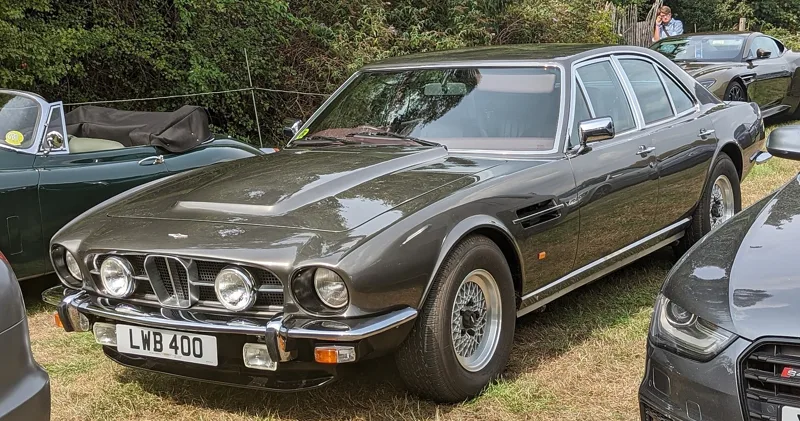
A four-door prototype of the new Aston Martin DBS carried the Lagonda name in 1969. Chassis MP230/1 stayed with the factory until 1972 as Sir David Brown's personal car, registered JPP 5G. Its prototype five-litre V8 was soon swapped for a 5.3-litre production quad-carb engine of early type. Seven four-door saloons were built from 1974 to 1976 on the same basis, with a single headlight and a horseshoe-shaped Lagonda grille instead of the prototype's twin-headlamp face.
What was the 1976 Aston Martin Lagonda?
By the middle of the 1970s Aston Martin was under financial pressure and needed cash. It had traditionally built 2+2 sports cars, so a four-door saloon was a departure, but the Lagonda drew hundreds of deposits as soon as it was introduced and helped replenish the company's reserves.
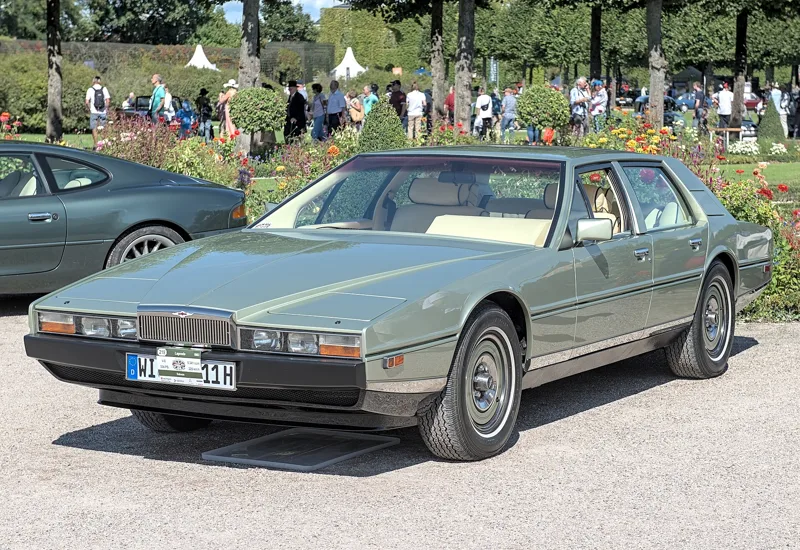
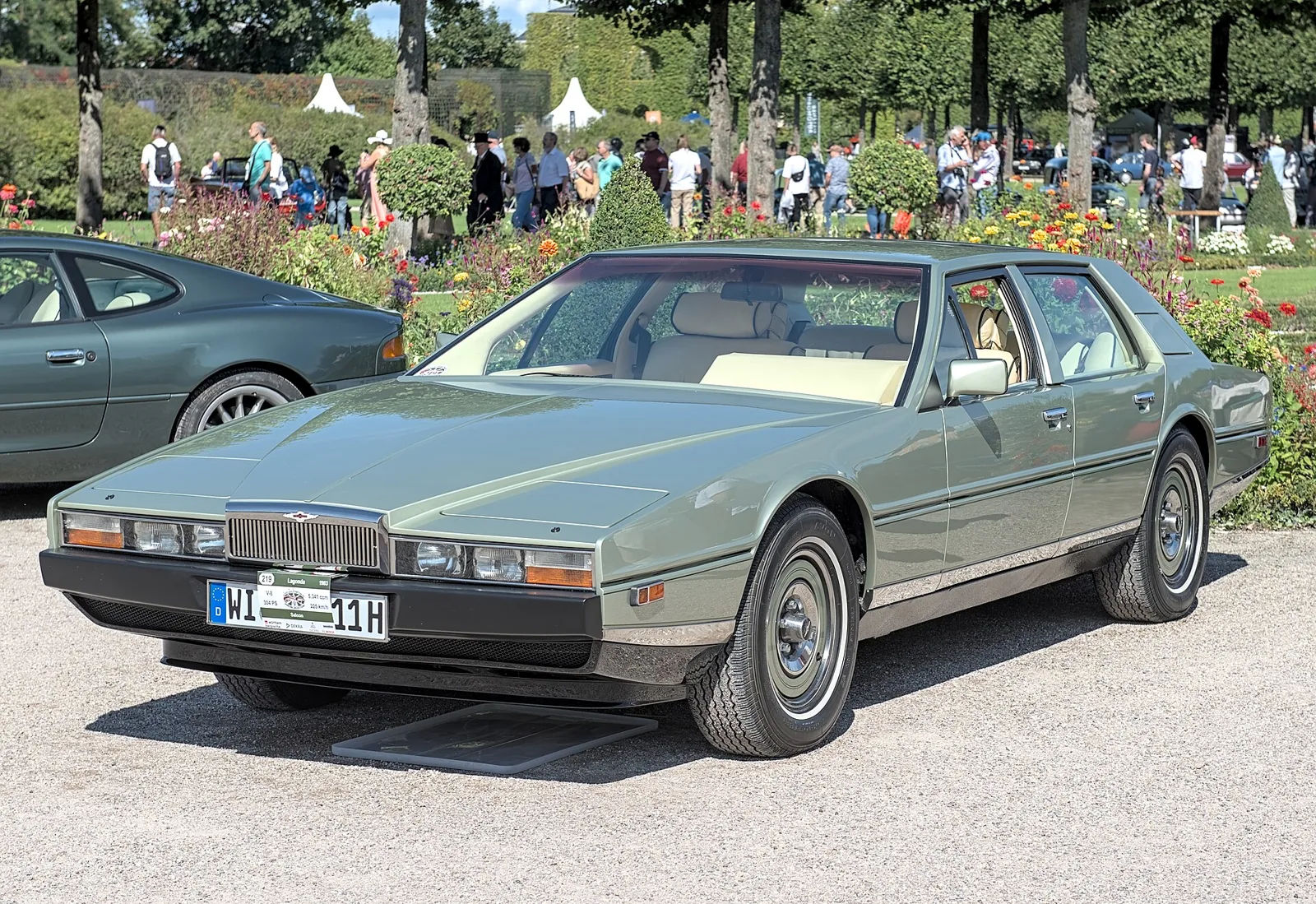
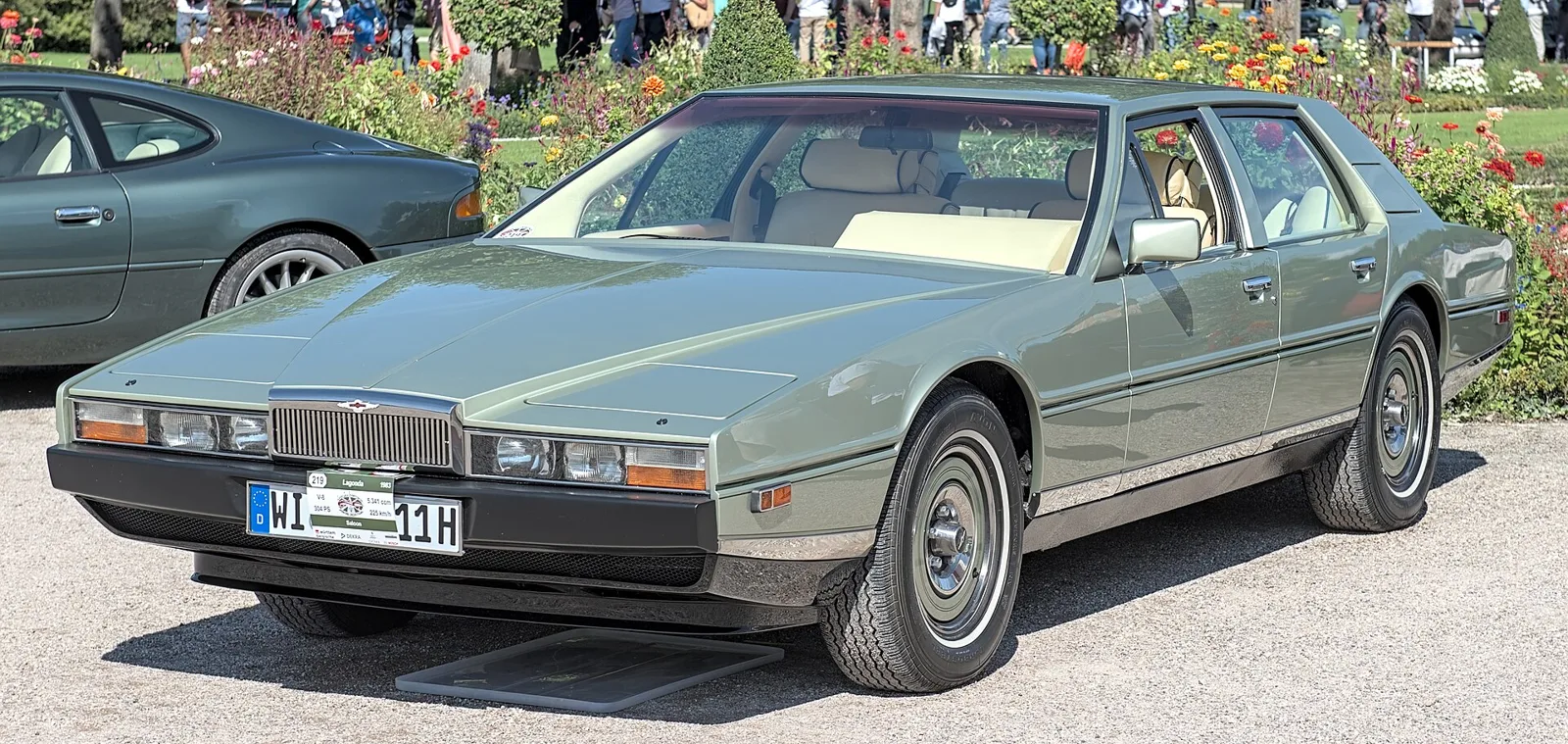
William Towns designed the 1976 car from the ground up as an extreme take on the folded-paper look of the 1970s. Set among famous contemporaries, the Countach, the Esprit and the DeLorean, it is often named as one of the most striking wedge shapes of the era. It paired that shape with a premium leather interior, advanced instrumentation for the day, a Chrysler three-speed TorqueFlite automatic and a four-cam carburettor V8 that returned between 12.4 and 12.5 mpg in contemporary road tests, a figure fuel injection barely improved.
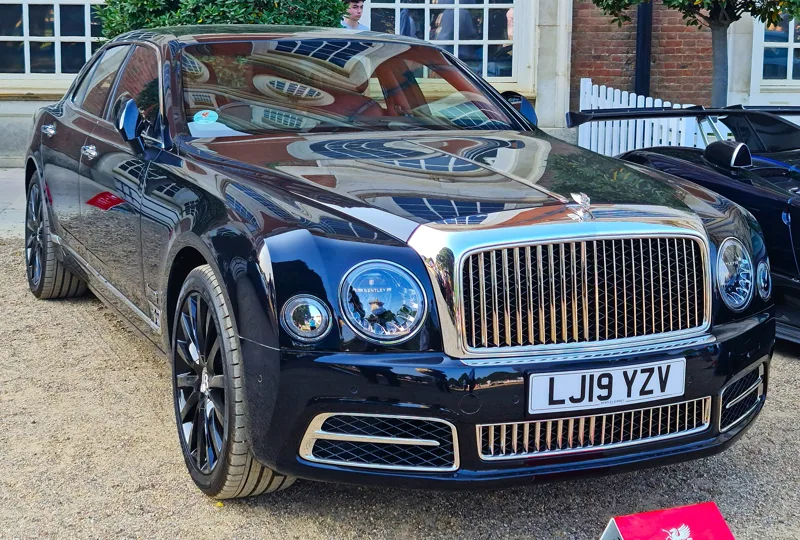
Built by hand, it ranked throughout its life among the priciest luxury cars anywhere. Only the Rolls-Royce Silver Spirit and Silver Spur and the Bentley Mulsanne came close on price. The Lagonda was also the first production car to carry a digital instrument panel, and the electronics cost four times the budget for the entire car. The Series 3 switched to cathode-ray tubes, which proved even less reliable than the original display.
Critics have been unkind. Bloomberg Businessweek placed it on a list of the 50 ugliest cars in 50 years, and Time ranked it among the worst cars ever, calling it a mechanical catastrophe whose electronics would impress if they ever worked.
How did the original and the wedge compare?
| Specification | Series 1 (1974-1975) | Series 2 (1976-1985) |
|---|---|---|
| Engine | 5,340 cc DOHC V8 | 5,340 cc DOHC V8 |
| Power | 320 hp (239 kW; 324 PS), estimated | 280 hp (209 kW; 284 PS) at 5,000 rpm |
| Torque | 350 lb-ft (475 N-m), estimated | 360 lb-ft (488 N-m) at 3,000 rpm |
| Top speed | 240 km/h (149 mph) | 238 km/h (148 mph) |
| 0-97 km/h (0-60 mph) | 6.2 seconds | 7.9 seconds official; 8.9 seconds in a 1982 Road and Track test |
| Length | 4,928 mm (194.0 in) | 5,281 mm (207.9 in) |
| Wheelbase | 2,910 mm (114.6 in) | 2,916 mm (114.8 in) |
| Width | 1,829 mm (72.0 in) | 1,791 mm (70.5 in) |
| Height | 1,323 mm (52.1 in) | 1,302 mm (51.3 in) |
| Weight | 2,000 kg (4,409 lb) | 2,023 kg (4,460 lb) |
How did the four series differ?
The 1974 London Motor Show saw the Series 1, a stretched four-door take on the Aston Martin V8, built on the DBS. No car had carried the Lagonda name since the 1961 Rapide. Buyers could specify a five-speed manual or an automatic gearbox, though only seven were sold. R.S. Williams of Cobham later took at least two of them, chassis 12003 and 12005, up to 7.0 litres, giving 440 to 480 hp (328 to 358 kW) on unleaded petrol.
The wedge-shaped Series 2 made its debut at the 1976 London Motor Show, sharing only an engine with its predecessor. Deliveries did not start until 1979. Early cars had a digital dashboard and touch-button controls, both dropped in 1980. In that year it retailed at GBP 49,933, a good deal above a Ferrari 400 or Maserati Kyalami and under a Rolls-Royce Corniche. Sales in the United States began in 1982 after small changes to the front bumper and airdam. In its 1982 test Road and Track recorded 24.8 seconds from 0 to 161 km/h (100 mph).
The Series 3, from 1986 to 1987, lasted a year and 75 were built, all with fuel-injected engines. Its cathode-ray tube instruments were later replaced by a vacuum fluorescent display, and its styling matched the Series 2. Geneva in March 1987 saw the Series 4, comprehensively restyled by the original designer, William Towns. He rounded off the sharp edges, replaced the pop-up headlamps with a triple set either side of the grille, deleted the side character line and added 16-inch wheels. At roughly one car a week, 105 were made up to January 1990, 72 of them left-hand drive.
In all, 645 were built from 1974 to 1990. Special variants were few: five Tickford Lagondas with a bodykit in 1983, four long-wheelbase Tickford limousines in 1984 at GBP 110,000 each with split rear door windows, a single two-door short-wheelbase Rapide with the Series 4 triple headlights, and a one-off shooting brake by Roos Engineering, built in 1998 on a 1987 car. In 2022, 113 were still registered in the United Kingdom, 82 of them declared SORN, meaning not in routine road use.
What did Lagonda build after the wedge?
A Lagonda Vignale concept car was Aston Martin's contribution to Geneva in 1993. Across 1993-94 the company built nine four-door Lagonda saloons and seven shooting brakes, badged Les Vacances on the rear door or tailgate, all on a stretched Virage. They remained its only factory shooting brakes until the 2018 Vanquish Zagato. Six went to a foreign royal family, and customers chose between a 310 hp 5.3-litre V8 and a 500 hp 6.3-litre. The Lagonda trade name then fell dormant from 1995 to 2008.
Is the Lagonda name still in use?
On 1 September 2008 Aston Martin said it would relaunch Lagonda to expand into markets such as luxury saloons and to celebrate a centenary in 2009. Chief executive Ulrich Bez said the brand would let the company make cars with a different character from a sports car. Spokeswoman Janette Green added that Lagonda models would be usable all year in markets like Russia, where a specialist sports car could be driven for only three or four months of it.
Geneva in 2009 brought a four-wheel-drive, four-seat SUV with a V12 engine and 22-inch wheels, unveiled to mark a century since the first Lagonda car. The Rapide name returned in 2010 on the Aston Martin Rapide saloon. On 9 March 2011 the company confirmed the Lagonda revival, with a range of mainly high-end SUVs. In 2014 it announced a large, low saloon instead, the Taraf, priced at GBP 1 million with a naturally aspirated V12 making 565 hp, with 465 lb-ft of torque on offer. The Taraf was first meant only for the Middle East, sold by invitation, but it ended up on sale in the UK, Europe and South Africa too, capped at 200 cars. The name has been dormant from 2010 to 2013 and again since 2016.
Where has a Lagonda appeared on screen?
In a 1960 episode of The Twilight Zone, A Thing About Machines, a 1939 Lagonda LG6 Rapide Drophead Coupe has a role. Cary Grant drives one in Alfred Hitchcock's 1941 film Suspicion, Lord Peter drives one in Dorothy Sayers's Whose Body?, and Captain Hastings in the Poirot detective series is a Lagonda driver. The first episode of the 2026 Netflix production The Seven Dials has Lady Eileen, known as Bundle, behind the wheel of a Lagonda.