From aero engines in the First World War to five Le Mans wins in the 1920s, W. O. Bentley built a marque, lost it to Rolls-Royce and then designed engines for other makers until he retired.
W. O. Bentley, an English engineer, founded Bentley Motors in 1919 and led it to multiple Le Mans victories. Once Rolls-Royce had acquired the firm in 1931, he moved between Lagonda, Aston Martin and Armstrong Siddeley as a designer before retiring.
W. O. Bentley was an English engineer who founded Bentley Motors in London in 1919 and built it into a leading luxury and performance car maker. The company's cars won at Le Mans five times between 1924 and 1930. After Rolls-Royce bought the business in 1931, he spent the rest of his career designing engines for other makers.
Who was W. O. Bentley?
Walter Owen Bentley came into the world on 16 September 1888 in Hampstead, London, the youngest of nine children. He trained as an engineer, raced motorcycles as a young man and made his name designing aircraft and automobile engines before setting up his own firm.
His father was a retired businessman, and his mother was born in Adelaide, Australia. He attended Clifton College in Bristol between 1902 and 1905, leaving at 16 to begin an engineering apprenticeship.
An engineer who wanted a good car, a fast car and the best in its class, and who built a marque that won Le Mans five times.
How did his apprenticeship shape him?
Bentley joined the Great Northern Railway's Doncaster Works as a premium apprentice. The five-year course cost his father 75 pounds and taught him to design complex railway machinery, as well as the casting and manufacturing methods that went with it. He completed it in the summer of 1910.
On the footplate he served as a second fireman on express trains. He remembered one 400-mile day running from London to Leeds and back, with about seven tons of coal to be shovelled by hand. That practical grounding stayed with him in the engines he later designed.
Motorcycle racing came early. In 1909 and 1910 he rode Quadrant, Rex and Indian machines, and both of his Isle of Man attempts, in 1909 and 1910, ended without a finish. In 1910, a burst rear tyre ended his Indian's race on the second lap.
What did Bentley contribute to aero engines in the First World War?
Bentley realised that aluminium alloy pistons, which he had first used in DFP cars sold by his brother's company, would help military aero engines produce more power and run cooler. He passed the idea to manufacturers through the Navy and was commissioned into the Royal Naval Air Service.
After his consultation, Rolls-Royce's first aero engine, the Eagle, was designed with aluminium pistons. He then visited Sunbeam, and the same innovation was adopted across their aero engines. Bentley also liaised with Gwynnes, whose Chiswick factory built French Clerget engines under licence.
When Gwynnes declined to act on his larger suggestions, the Navy gave him a team at the Humber factory in Coventry to design his own engine. The BR1 rotary, a prototype of which ran in the early summer of 1916, was followed by the bigger BR2 in early 1918. Bentley received the MBE for this work.
How did Bentley Motors begin?
Early in 1919 Bentley set up shop in modest London premises alongside Frank Burgess and Harry Varley. Clive Gallop joined as an engine designer to help develop the 3,000 cubic centimetre straight-four. Road tests of the first complete car started in January 1920, and customers received the first production model in September 1921.
Its goal was a car that was good, quick and the best of its kind. The marque competed in hill climbs and at Brooklands, and one lone 3 Litre came 13th at Indianapolis in 1922, averaging 74.95 mph.
In the 1922 Tourist Trophy Bentley entered a team of modified 3 Litres, driving one of them himself. The team was the only one to finish, which earned it the team award and launched the marque's reputation for durability. The first 3 Litre's own stamina had already won widespread praise, and the 1922 result added to it.
How did Bentley cars win at Le Mans?
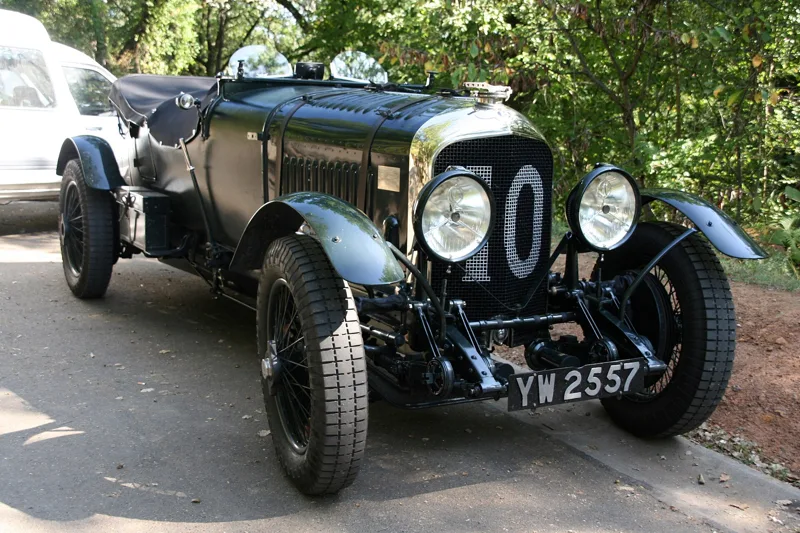
A Bentley 3 Litre won the 1924 Le Mans 24 Hours, and further victories followed in 1927, 1928, 1929 and 1930. Bentley had been sceptical about the race until he attended the inaugural event in 1923, where he watched a private Bentley entry finish fourth.
The drivers who raced for the company became known as the Bentley Boys. Ettore Bugatti is said to have described Bentley's cars as the fastest lorries in the world. In 1925 neither Bentley entered at Le Mans finished, but the marque returned to winning form in 1927.
The six-cylinder Speed Six, introduced as a road car in 1928, became the most successful competition Bentley. Its racing version won at Le Mans in 1929 and 1930, and Bentley's design work continued under the company's new chairman.
That chairman was Woolf Barnato, the heir of the Kimberley diamond magnate Barney Barnato, who bought the company's assets when it ran into difficulty. Barnato raced Bentleys with distinction and remained the only driver to win at Le Mans all three times he entered.
What went wrong at Bentley Motors?
The company's finances collapsed as the Great Depression took hold. Barnato's backing had faded by July 1931, when the firm entered voluntary liquidation. The business had accumulated losses of 136,220 pounds, and a receiver was appointed on 10 July.
The 8 Litre, launched in October 1930 as a grand car for the very wealthy, sold about a hundred examples. The supercharged Blower version of the 4 1/2 Litre, built away from Bentley in Welwyn Garden City, was less successful. Bentley had feared its durability, and the car failed on the track.
Napier and Son had entered negotiations to buy the company out of liquidation, but Rolls-Royce moved first. The purchase was announced on 20 November 1931, and Bentley's old name became part of the Rolls-Royce family.
Why did Rolls-Royce take over Bentley?
Rolls-Royce was disturbed by the 8 Litre encroaching on the market for its own Phantom II. To prevent Bentley from remaining a competitor, its agents made an offer under a different name and topped Napier's bid at the last minute. The purchase was completed on that basis.
Cricklewood was closed during 1932, and production moved to Rolls-Royce's premises in Derby. After the war, production continued at Crewe. Rolls-Royce acquired the Bentley showrooms, the service station and the factory, and only a few 8 Litre chassis were kept at Derby.
Bentley thought Barnato had quietly built up a large stake in Rolls-Royce before withdrawing his backing during a trip to New York. Apart from some 8 Litre chassis, the stock went, and the name was to be kept for a cheaper car; that prototype turned out to be as intricate and expensive as the big Rolls-Royces, so work stopped.
His contract with Rolls-Royce ran from May 1932 until April 1935. He was largely kept away from the design team, and his role was mainly liaison with customers and testing vehicles on long runs across the Continent and the Alps.
What did he design after leaving Rolls-Royce?
Rolls-Royce marketed the new Bentleys as the Silent Sports Car, and Bentley departed in April 1935 feeling liberated. He then joined the board of LG Motors at Staines as technical director in 1935, after the Lagonda company was saved from receivership. He brought Stewart Tresilian and other former Rolls-Royce staff with him, and Tresilian became chief designer of a 4,480 cc V12 engine launched in 1937.
Through the war years he turned Lagonda's workshops to armaments, and toward the end he started a 2.6-litre straight-six with twin overhead cams. The 2 1/2-litre Lagonda project that followed was cancelled in August 1947 owing to production difficulties and the double purchase tax. David Brown bought the specification the next month and fitted the engine to the Aston Martin DB2.
Brown had bought Lagonda largely to gain Bentley's engineering expertise. The straight-six remained in use in Lagonda and Aston Martin cars until 1959. Bentley also observed that key design details passed on to the V8 that came later.
How did his career end at Armstrong Siddeley?
After Lagonda, Bentley worked for Armstrong Siddeley, designing a second twin-overhead-cam engine of 3 litres before he stepped back. Donald Bastow was part of his team, which also looked at the Sapphire project's chassis as well as its engine.
The team's work ended in 1949, and Bentley retired soon after. His engine was rejected as too expensive for production, yet his involvement earned the finished Sapphire admiration from contemporaries.
What were the key milestones of his career?
| Year | Milestone | Detail |
|---|---|---|
| 1912 | Enters the car trade | Joins his brother Horace selling DFP cars |
| 1916 | BR1 rotary engine prototype | Designed at the Humber factory in Coventry |
| 1919 | Bentley Motors founded | Set up in London with Frank Burgess and Harry Varley |
| 1921 | First production 3 Litre | Delivered in September, made at Cricklewood |
| 1924 | First Le Mans win | 3 Litre victory at the 24 Hours |
| 1929 | Speed Six Le Mans win | Repeated in 1930 |
| 1931 | Rolls-Royce takeover | Announced 20 November 1931 |
| 1935 | Technical director at Lagonda | Joined after leaving Rolls-Royce in April 1935 |
| 1947 | Lagonda straight-six cancelled | David Brown buys the specification |
| 1971 | Death | Woking, Surrey, 13 August |
What is his legacy?
He was recognised in 1995 with a place in the Automotive Hall of Fame. He had been patron of The Bentley Drivers' Club since 1947, and the club, founded in 1936, now has nearly 4,000 members across the United Kingdom, Europe, the United States and other countries.
The old company built 3,040 cars, and the club's archive records the history of many of them. Its website keeps photographs and documents for individual cars. A former colleague who worked for him for six years praised his modesty, his honesty and his constant interest in improving the car. His own memoir, My Life and My Cars, appeared in 1969. He died at Woking, Surrey, shortly before his 83rd birthday.