A four-cylinder British sports car from the late 1920s, built in 720 examples, that won Le Mans and gave birth to the supercharged Blower Bentley.
The Bentley 4.5 Litre was a four-cylinder British sports car built from 1927 to 1931 in 720 examples. A 1928 Le Mans win and the supercharged Blower version made it one of the defining cars of the Bentley Boys era.
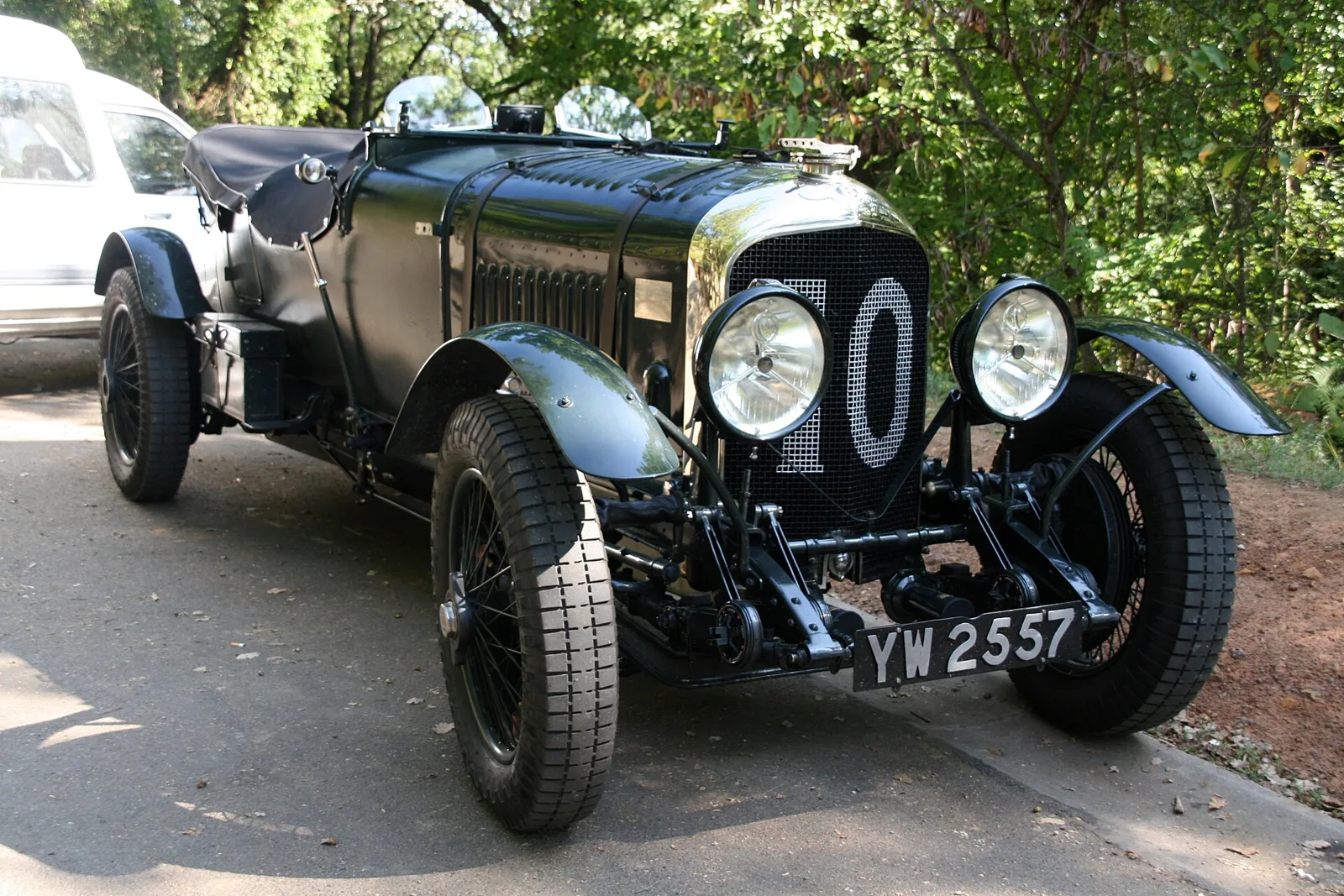
The Bentley 4.5 Litre was a British car built by Bentley Motors from 1927, based on a rolling chassis that carried a four-cylinder engine displaced to 4.4 litres. A racing variant with a supercharger became known as the Blower Bentley, and the car is remembered for winning Le Mans and for the publicity its race programme brought the marque.
A total of 720 cars were produced between 1927 and 1931, including 55 supercharged examples. The standard car was used by private owners for personal transport, with a range of bodies from saloons to tourers, while the racing versions carried the marque's reputation across Europe.
Why did Bentley replace the 3 Litre?
W. O. Bentley wanted a more powerful car than the 3 Litre, which by 1927 was seen as outdated and under-powered. The six-and-a-half-litre was available but its image had been tarnished by poor tyre performance, so the company looked for a car that would fill the gap.
The answer was the 4.5 Litre, which took two cylinders out of the six-and-a-half-litre model and reduced the displacement to 4.4 litres. The change gave the company a smaller and more capable car at a time when the Le Mans race was becoming the most important test of a manufacturer's reputation.
A four-cylinder British sports car that won Le Mans in 1928 and gave the world the supercharged Blower, one of the rarest and dearest cars of its era.
Why did Le Mans matter so much to Bentley?
The 24 Hours of Le Mans began in 1923 on the Circuit de la Sarthe, and it attracted many French drivers. Early foreign entries were scarce, and the race offered a quick route to reputation for any car maker that could win it.
After two years without success, Bentley gathered a group of wealthy British drivers and mechanics who became known as the Bentley Boys. They drove Bentley cars to victory in several races between 1927 and 1931, including four consecutive wins at Le Mans, which forged the brand's reputation.
The Boys were a group of wild and fabulously wealthy enthusiasts who valued insouciance, elegant tailoring and speed. Their success on the track gave Bentley a sporting image that outlasted the decade in which it was earned.
What was the basic 4.5 Litre engine?
The engine was a cast iron inline-four with a displacement of 4,398 cc, from a 100 mm bore and a 140 mm stroke. It was described as resolutely modern for its time, with a single overhead camshaft driving four valves per cylinder inclined at 30 degrees.
The engine had two SU carburettors and dual ignition using Bosch magnetos. It produced 110 hp (82 kW) in touring form and 130 hp (97 kW) in racing form, and its speed was limited to 4,000 rpm. Few other cars of the time used four valves per cylinder, which made the design unusually advanced.
A vertical shaft at the front of the engine carried bevel gears that turned the camshaft, the same arrangement the 3 Litre used. The tanks for radiator, oil and petrol had quick release filler caps, which saved time during pit stops.
How did the 4.5 Litre handle?
The car weighed 1,625 kg (3,583 lb) and measured 4,380 mm (172 in) in length with a 3,302 mm (130.0 in) wheelbase. Despite its size, it was well balanced and steered nimbly, although the four gears were unsynchronised and needed skill to shift.
The chassis was a steel lattice reinforced with ties, which supported the heavy cast iron engine. Semi-elliptic leaf springs were used at front and rear, and the brakes were 17-inch (430 mm) drums finned for cooling and operated by rod.
The steering wheel measured about 45 cm (18 in) across and was wrapped in braided rope for grip. The touring body came with a canvas top stretched over a lightweight Weymann body, and the hood structure was light but caught plenty of wind.
Who invented the Blower Bentley?
Sir Henry Birkin, known as Tim, was one of the Bentley Boys and called by W. O. Bentley the greatest British driver of his day. He refused to accept the company's view that a larger engine was always better than forced induction, and he set out to build supercharged cars for Le Mans.
Birkin commissioned a series of supercharged models, with an early 3 Litre supercharged at the Cricklewood factory in the winter of 1926 and 1927 as proof of concept. The first supercharged Bentley was officially presented in 1929 at the British International Motor Show at Olympia.
Financing came from the horse racing enthusiast Dorothy Paget, and Woolf Barnato, the chairman and majority shareholder, approved the project. Development was carried out in a workshop at Welwyn Garden City by Amherst Villiers, who also supplied the superchargers.
How did the Blower differ from the standard car?
The supercharger was a Roots-type unit added by Amherst Villiers, and it was placed at the end of the crankshaft in front of the radiator. That gave the Blower its easily recognised appearance and added weight at the front, which increased understeer.
W. O. Bentley disliked the idea and refused to modify the engine to take the supercharger, so the Blower had its own crankshaft, pistons and lubrication system. It made 175 hp (130 kW) at 3,500 rpm in touring form and 240 hp (180 kW) at 4,200 rpm in racing form, more than the six-and-a-half-litre developed.
A guard protected the two carburettors at the compressor intake, and the fuel tank at the rear was protected because a flying stone had punctured the 3 Litre of Frank Clement and John Duff at the first Le Mans race. Those details show how closely the design was tailored to competition.
What was the 4.5 Litre's competition record?
The first race was the Old Mother Gun at the 1927 Le Mans, driven as a pre-production prototype. It was favoured to win but crashed and did not finish, though its performance was enough to convince Bentley to start production that same year.
In 1928 the 4.5 Litre of Woolf Barnato and Bernard Rubin raced neck and neck with a Stutz, setting an average speed of 111.12 km/h (69 mph). The car won the 1928 Le Mans, and in 1929 three 4.5 Litres finished second, third and fourth behind the six-cylinder Speed Six.
The naturally aspirated car was reliable, but the supercharged Blowers were not. Both Blowers entered in the 1930 Le Mans, by Dorothy Paget and one co-driven by Birkin, did not finish. In 1930 Birkin finished second in the French Grand Prix at Pau behind a Bugatti Type 35.
Ettore Bugatti, irritated by Bentley's pace, dismissed the 4.5 Litre as the fastest lorry in the world. He had a point about the Type 35's lightness and economy, but the Bentley's speed was real enough to matter.
How fast was the Blower Monoposto?
Mildred Bruce, a British racer, set a 24-hour distance record at Montlhery in a Blower, averaging 89.4 mph (143.9 km/h). A Daily Herald trophy for Brooklands' fastest driver was introduced in 1930, and Kaye Don took the first award at 137.58 mph (221.41 km/h).
In 1932 Birkin won the trophy in his red Blower Monoposto, clocking 137.96 mph (222.03 km/h). The record stood as the highest speed set in a Blower Bentley, even though the car had never won a major race.
How did production of the 4.5 Litre end?
In November 1931 Bentley had sold 720 copies of the 4.5 Litre, 655 naturally aspirated and 55 supercharged, in three models: the Tourer, the Drophead Coupe and the Sporting Four Seater. The company was then forced to sell to Rolls-Royce for 125,175 pounds, a casualty of the recession that followed the 1929 Wall Street crash.
The sale ended the independent Bentley company that had built its name on the Le Mans wins, and the 4.5 Litre became one of the last cars to be made under the original management.
What are 4.5 Litre Bentleys worth today?
As of 2013, surviving 4.5 Litre cars from the inter-war period sold for around 1,000,000 euros. Blowers could fetch more than 7 million euros, even though they never won a single race, which makes them among the most sought-after collector cars of their era.
Enthusiasts often describe the 4.5 Litre as the Spitfire of the car world, a machine that defined its age and still carries an emotional pull for those who value the era.
Why is the Bentley 4.5 Litre in Bond films?
James Bond drives a 1930 Blower Bentley in Ian Fleming's first three novels, Casino Royale, Live and Let Die and Moonraker. In the books he drives one of the last Blower Bentleys, a battleship grey convertible coupe with French Marchal headlamps.
The car's presence in Fleming's novels helped keep the Blower in the public eye long after the Bentley Boys had gone, and it made the 4.5 Litre part of popular culture as well as motor sport history.
Was the Blower built again?
Bentley scanned all 630 components of the Blower in 2019 and 2020 so that the car could be recreated digitally, and it planned 12 new models from that work. In December 2020 the company presented Bentley Blower Car Zero, the first example of the Blower Continuation Series.
The new car was built in Crewe to the historic specifications and based on the production methods of the period, which allowed a modern continuation of a car that had been out of production for almost a century.
What are the Bentley 4.5 Litre specifications?
| Model | Engine | Output | Notes |
|---|---|---|---|
| 4.5 Litre touring | 4,398 cc inline-four, two SU carburettors | 110 hp (82 kW) | Speed limited to 4,000 rpm |
| 4.5 Litre racing | 4,398 cc inline-four | 130 hp (97 kW) | Racing version of the same engine |
| Blower touring | Roots supercharger by Amherst Villiers | 175 hp (130 kW) at 3,500 rpm | Supercharger in front of the radiator |
| Blower racing | Roots supercharger, special crankshaft | 240 hp (180 kW) at 4,200 rpm | Used at Le Mans and Brooklands |
| Chassis and body | Lattice steel chassis, 17-inch drum brakes | Weight 1,625 kg (3,583 lb) | Length 4,380 mm; wheelbase 3,302 mm |