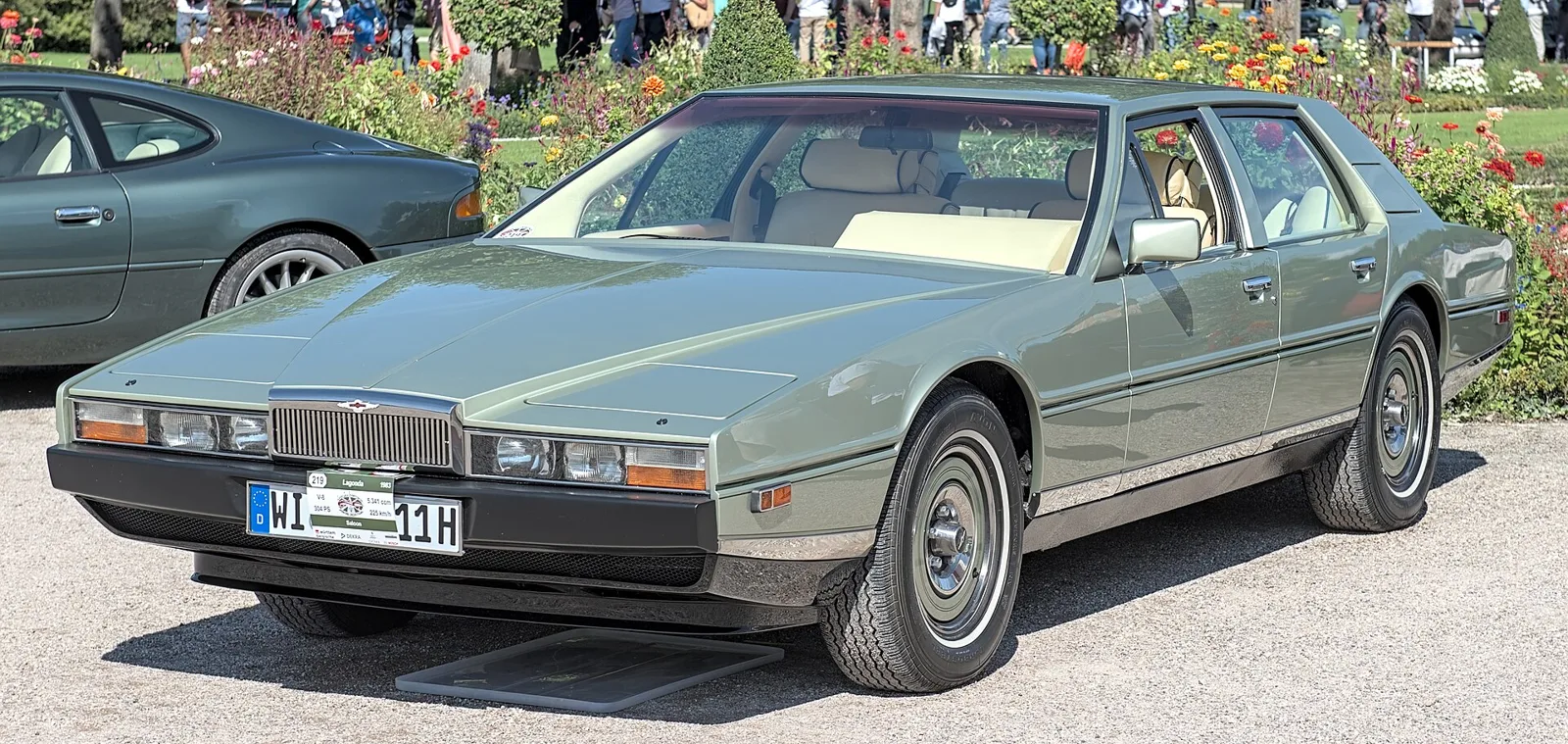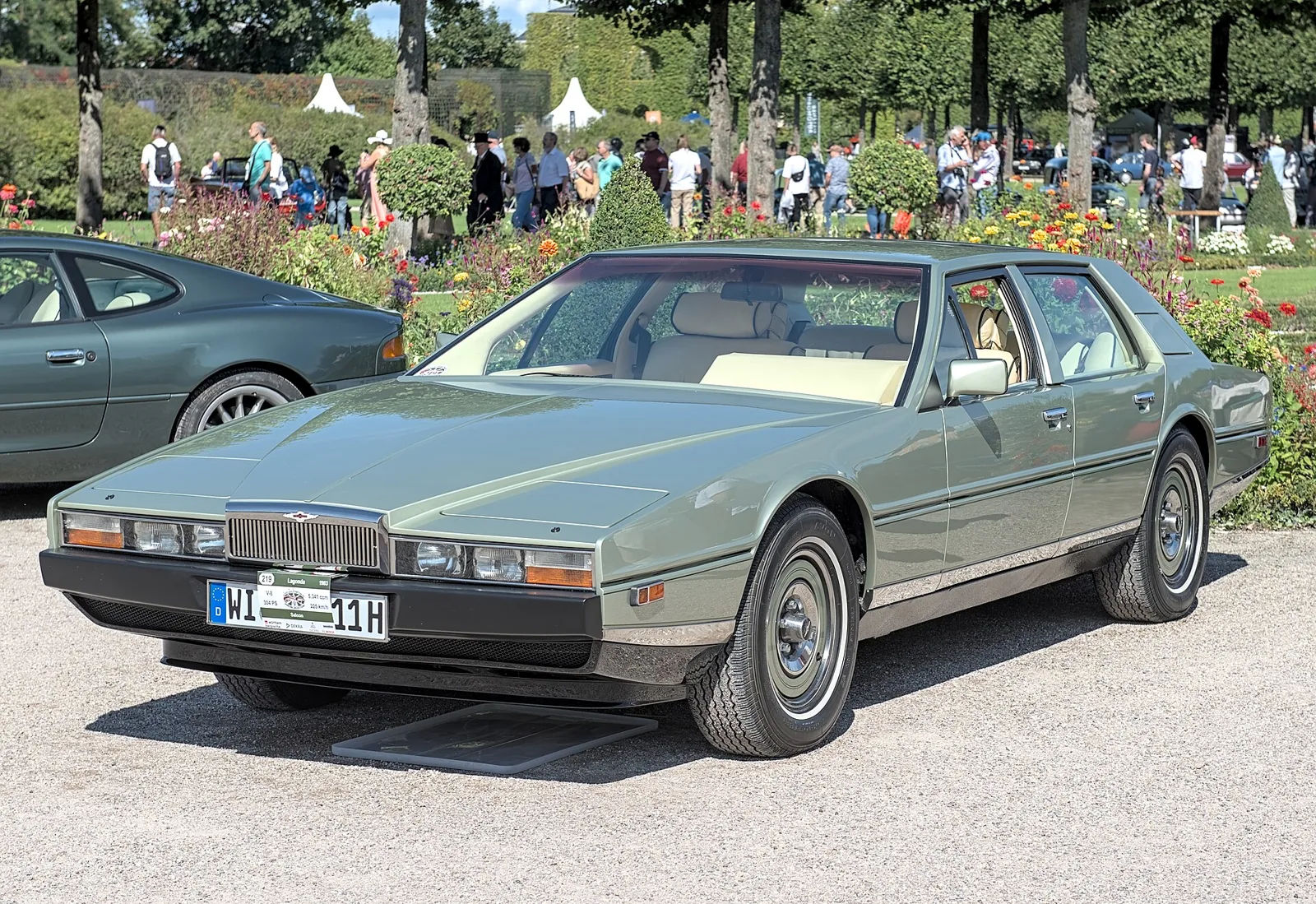
Wedge styling, a digital dashboard and a 5.3 litre V8 made the Lagonda an expensive gamble that kept Aston Martin afloat through the 1980s.
The Lagonda Series 2-4 was a wedge-styled Aston Martin saloon sold in three series between 1978 and 1989. Its 5.3 litre V8 and electronic dashboard made it costly and troubled, but it helped save the company.
The Aston Martin Lagonda Series 2-4 was a wedge-shaped four-door saloon that Aston Martin made from autumn 1978 until summer 1989, in three series. It was unveiled in 1976 with an interior dominated by electronics, and it was called an absolute sensation while also polarising opinion.
Where did the Lagonda name come from?
Lagonda was a sports car maker that David Brown took over in 1947 and folded into Aston Martin. The name lapsed for a decade before Aston Martin revived it in 1974, first on a four-door saloon that was simply called an Aston Martin Lagonda.
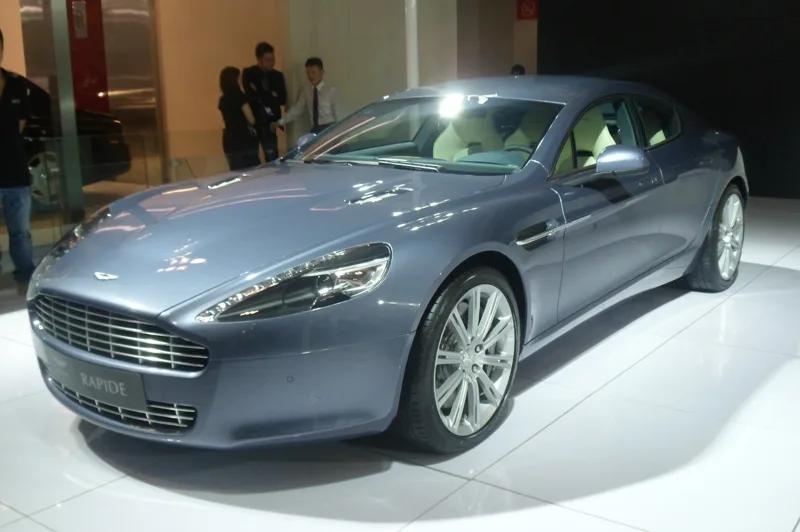
The earlier Lagonda lines were the 2.6 Litre (1948-1953), the 3 Litre (1953-1958) and the Rapide (1961-1964). In that period Aston Martin handled sports and racing cars, while Lagonda covered the market for sporting saloons.
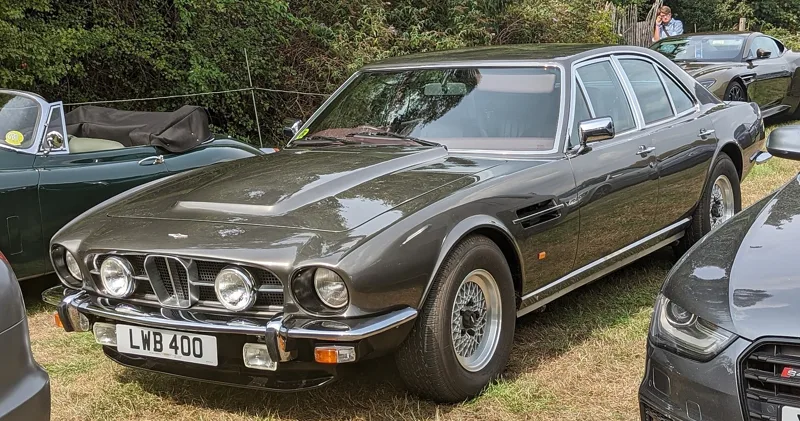
The revived saloon, later designated Series 1, was a four-door version of the Aston Martin DBS. Sales stalled, and only seven had been built by 1975. Economic crisis at the company led to insolvency in early 1975.
Aston Martin built not a single car in the first six months of 1975. In June that year a consortium of British and Canadian businessmen took over and formed Aston Martin Lagonda (1975) Ltd. Only 21 cars were built in 1975, two of them Lagondas.
The new management kept building the V8 Saloon but dropped the Series 1, which it did not consider attractive enough. It commissioned a completely new saloon as an eye-catcher that would show what the company could still do.
Observers considered it the most advanced car of its time, despite early electronic faults.
Who designed the wedge-shaped Lagonda?
William Towns designed the body and interior, and Mike Loasby led the engineering from 1976. Towns drew the outer form in only a month, and a 1:4 scale clay model existed by January 1976. A full-size wooden model followed two months later.
The brief was to show that the old British firm could still act decisively after its hard years. The car had to draw eyes, and nothing about its outside was to hint at the Aston Martin V8 underneath.
The car had a low, wedge-shaped body and an elaborate electronic system for its controls and instruments. Development ran much longer and cost far more than planned. The original budget was 75,000 GBP, but the bill had reached 1.25 million GBP before the car was ready for the showroom.
How did the body look and what were its quirks?
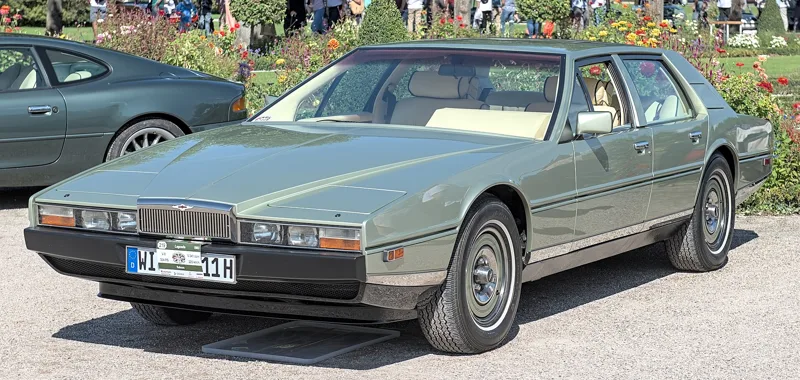
The body was very flat and wedge-shaped, with smooth surfaces and angles, and at 1,300 mm (51.2 in) it was the lowest four-door of its time. That low profile brought quirks, including rear windows that stayed fixed until the third series.
The front end sloped sharply forwards, and the first two versions had pop-up headlights. The rear lights were four narrow strips built into the tailgate. British traffic authorities judged them not sufficiently visible to following vehicles when the tailgate was open, so extra lights were fitted on the inside of the tailgate.
The Moon Roof over the rear seats could be raised, but the roll bar built into it stopped it sliding fully open. Some observers found the door handles of the Ford Cortina cheap-looking beside the elaborate overall concept.
What engine and transmission did the Lagonda use?
The Lagonda used the 5.3 litre (323 cu in) eight-cylinder from the DBS V8 of 1970, which produced 280 bhp (209 kW; 284 PS) in its first version. It drove through a three-speed automatic from Chrysler, and Aston Martin's own manual five-speed gearbox was not offered.
In basic form the engine did not fit under the low bonnet, even though it was set considerably further back than in the V8. The lubrication system had to be changed and the air intake reduced to make it fit.
Electronic petrol injection from Marelli replaced the carburettors in 1986, and output rose to about 221 kW (300 PS) or 223 kW (304 PS), depending on the figure quoted. It was reduced to 289 PS with the fourth series.
Aston Martin tried to raise output further. Fitting the Vantage V8, with about 380 PS, failed early because its carburettors did not fit under the low bonnet. A twin-turbo V8 built in 1980 roughly matched the Vantage's output, but the turbocharger could not be synchronised reliably with the carburettors, so it never reached production. That prototype was scrapped in 1982.
How did the digital dashboard work?
The Lagonda had no analogue dials. Speed and rev count appeared on a light-emitting diode display in the instrument carrier, and most functions were run from touch-sensitive keys. Early software proved unreliable, and the system was rebuilt by a Dallas firm from September 1977.
The first software came from the Cranford Institute of Technology in Britain and caused several total failures. Test prototypes that went to journalists in 1977 had analogue instruments fitted to keep them working, and the software faults were the main reason series production missed its May 1977 start.
The sensor control of many functions was dropped, and gas plasma displays were replaced by light-emitting diodes. From 1984 a speech computer announced information and faults in English, Arabic, French and German.
Other luxury makers tried similar digital systems in the following years, but none took one to series production. Despite its problems, the digital instrumentation was a milestone. The factory service has offered a complete software restructuring since 2006.
When did series production start and what did it cost?
Series production began in autumn 1978, after a planned May 1977 start slipped because of faults in the on-board electronics. Prices climbed steadily, from 25,570 GBP quoted in October 1977 to 75,000 GBP in 1985, roughly quadrupling over the life of the model.
The first series cars were priced at 49,333 GBP on delivery. Aston Martin asked 53,500 GBP in March 1981 and 56,600 GBP in February 1982, and a year and a half later the price stood at 59,900 GBP.
The Series 3 raised the price to 79,500 GBP. The Series 4 was introduced at 95,000 GBP, and the price later rose to 99,500 GBP.
How many were built and in which series?
The Aston Martin Lagonda was built in three series from autumn 1978 to summer 1989, and 645 vehicles were made in that time. The series were named Series 2, Series 3 and Series 4. The Series 4 accounted for 100 cars.
Series 2
The first series was named Series 2, out of consideration for the V8-based predecessor. It was built until 1985 and changed in several ways over time.
Series 3
Presented in 1986, the Series 3 changed mainly the drivetrain. The eight-cylinder received petrol injection developed by Weber and Marelli, which raised output to 221 kW (300 PS). The interior was reworked with new displays and a head-up display that reflected the speed onto the windscreen.
These cars used cathode-ray tubes for the instruments, which proved even less reliable than the LED displays they replaced.
Series 4
Presented in 1987, the Series 4 had a largely redesigned body that kept the layout William Towns had drawn ten years earlier. The pop-up headlights gave way to six rectangular lights around a narrow grille, and the indicators moved into the bumper.
The fuel filler moved below the rear window and the rear lights became one continuous unit, no longer built into the tailgate. The car also received Avon 255/60 VR 16 tyres and a modified final drive, with slightly more torque.
How did the Lagonda compare on price?
The Lagonda was among the most expensive saloons in the world for its whole production run. The Rolls-Royce Silver Spirit, at about 250,000 Deutsche Mark (DM) in 1983, sat in a similar price range, while the near-twin Bentley Mulsanne and the Maserati Quattroporte were cheaper to buy.
The Lagonda never followed the tradition of understatement. In 2003 the British magazine Thoroughbred & Classic Cars placed it close to vehicles of doubtful standing.
What special versions were built?
The factory and some independent makers built special versions of the Lagonda. Among them were the Tickford cars, which were built to individual customer requests from 1984. The Tickford name was borrowed from a traditional coachbuilder, although the two companies had no organisational or legal connection.
Tickford
Under the Tickford name, Aston Martin ran a department for special constructions in the early 1980s. The name recalled the coachbuilder Tickford, which David Brown had taken over in 1955.
From 1984 Tickford built lavishly equipped Lagondas. Buyers got skirts at front and side, usually in body colour, plus a pair of televisions that worked separately. The Tickford Lagonda cost 85,000 GBP and five were sold.
A longer version was also offered, with its wheelbase stretched by 254 mm and all of the extra length given to the passenger compartment. A minibar, a record player and several car telephones could be fitted, and the price was 110,000 GBP. Aston Martin sold three of these.
Two-door
In 1988 a two-door Lagonda on a shorter wheelbase was made, though sources disagree on whether one or two were built. One of them served at the factory as a test vehicle for the chassis of the future Virage.
Shooting brake
The factory never planned an estate version, and William Towns drew no designs for one. Roos Engineering in Switzerland produced a five-door shooting brake between 1998 and 2000. It stayed a single example, combining a Series 3 body with a Series 4 interior.
A Dutch collector later built another estate with a much wider D-pillar, known as the Kielstra Lagonda after its builder.
Why does the Lagonda still matter?
Observers thought it the most advanced car of its time, and it secured Aston Martin's economic survival through the 1980s despite serious electronic problems. Its digital instrumentation was a milestone, even though rival makers never brought similar systems to production.
The name returned in 2014 with the Taraf, a further attempt to revive the brand.