A production-based class that turned into a field of racing prototypes, and the Nissan that finished third, fifth, sixth and tenth at Le Mans in 1998.
Group GT1 was an FIA grand touring class from 1993 to 2012, born in the BPR series. It required road-going versions of race cars, which makers met by building one or a few, as with the Nissan R390 GT1, whose four 1998 Le Mans entries all finished in the top ten.
To go racing at Le Mans, Nissan built exactly one road car. It was never meant to be sold, though Nissan did offer to build more at a value of US$1 million, and it exists because the grand touring rules said a race car had to have a road-going twin.
That rule is the thread running through Group GT1. It was a category meant to be production-based, and within a few years it was occupied by thinly disguised prototypes. The Nissan R390 GT1 was one of them, and at the 1998 Le Mans 24 Hours all four of its cars finished in the top ten.
What was Group GT1?
Group GT1, or simply GT1, was a set of grand touring regulations maintained by the FIA. The class was created in 1993, with a place on the Le Mans entry list, and became the top division of the BPR Global GT Series. After the BPR series came under FIA control in 1997 it became the FIA GT Championship, and the category was wound up as 2012 began.
The ACO first ran the class at Le Mans in 1993 under the name Group GT, and the FIA defined it in its Appendix J regulations that same year. Its life divides into four eras: 1993 to 1996, 1997 to 1998, the long GTS stretch from 1999 to 2009, and 2010 to 2012.
Nissan built one road car so that it could go racing, and offered more at US$1 million.
Where did the BPR series come from?
The FIA World Sportscar Championship collapsed in 1992, and in 1994 the BPR Global GT series was founded for privateers, with endurance races of four hours. The name came from its three founders: Jurgen Barth, Patrick Peter and Stephane Ratel. Barth was an ex-Le Mans winner who managed customer competitions at Porsche, Peter was a respected race promoter, and Ratel was an executive and investor in the Venturi GT1 project.
There were four categories, GT1 to GT4, where each lower number meant more freedom in the technical rules. By 1996 the grids had grown, thanks to cars including the McLaren F1 GTR and the Porsche 911 GT2 Evolution, built on the 993 platform, which took over from the 964-based Carrera RSRs. Professional teams were also arriving in a championship meant for privateers, and costs rose dramatically.
How did GT1 become a home for homologation specials?
The turning point was Porsche, which entered a works team in several rounds with the 911 GT1. Most of the paddock felt it broke the spirit of the rules: it was a Porsche 962 sharing only the front of its chassis with the 993 911, and the road version existed simply to satisfy homologation. The trick was not new. In 1994 Porsche and Dauer Sportwagen had raced the Dauer 962 Le Mans when only one road car existed at the time of homologation, and it scored the last Le Mans victory for the 962 series.
| Car | Year | Link to a road car |
|---|---|---|
| Dauer 962 Le Mans | 1994 | Only one road car existed when it was homologated |
| Toyota SARD MC8-R | 1995 | Toyota MR2 heavily modified for the race |
| Porsche 911 GT1 | 1996 | A 962 with a 993 front section; street variant to meet homologation |
| Mercedes-AMG CLK GTR | 1997 | No street-legal version built by 1999; shared only instruments, grille and four headlamps with the CLK |
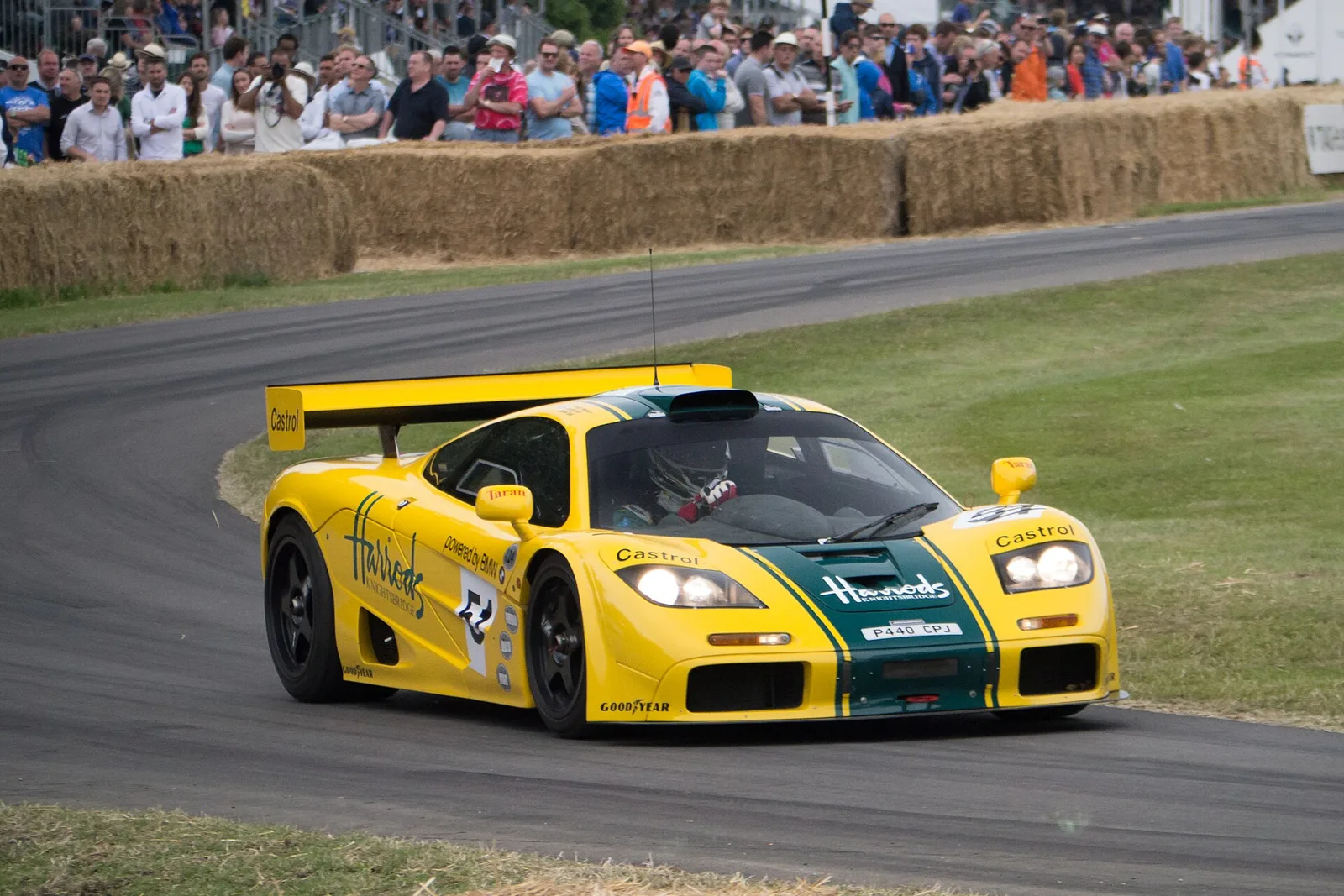
| McLaren F1 GT | 1997 | Three road cars built after the racing bodywork was updated |
| Nissan R390 GT1 | 1997 | One road car built, stored by Nissan |
Others took the same path. Toyota turned a heavily reworked MR2 into the SARD MC8-R for 1995, and the field that year also held a more road-derived Supra, the Nissan Skyline GT-R and the Honda NSX. The Supra and the GT-R also raced in Japan's JGTC with identical specifications.
What happened to GT1 in 1997 and 1998?
After Patrick Peter left, the BPR Organisation became the Stephane Ratel Organisation (SRO), which co-organised the championship with the FIA. The GT1 grid now consisted entirely of professional teams. In 1997 the Mercedes-AMG Team arrived with the CLK GTR, another homologation special that was a racing version of a grand tourer in name only.
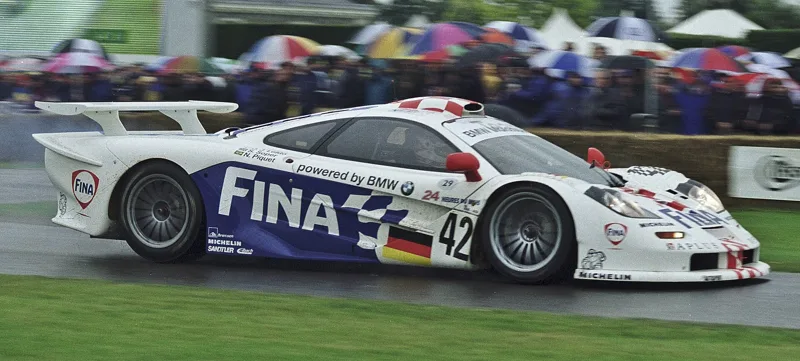
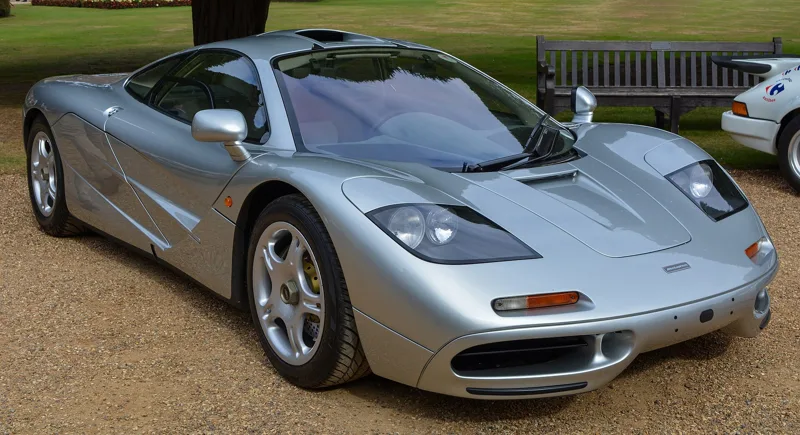
McLaren saw that the F1 GTR could not compete with such cars and updated its bodywork so much that it had to build a road car to match, the F1 GT, of which three were made. In 1998, with the CLK LM and the Porsche 911 GT1-98 arriving, the F1 GTR was beaten again. McLaren withdrew backing for the programme, as BMW had done in 1997, though Parabolica Motorsports and Davidoff Classic still entered two cars.
Mercedes-AMG won every race in the 1998 championship with the CLK GTR and CLK LM. The following year no GT1 teams entered apart from Mercedes-AMG, so the FIA ran its 1999 championship with just the GT2 class.
What came after GT1?
For 1999 the FIA GT Championship was restructured. The old GT2 class became the top class under the name GT, with a new N-GT class below it, and the ACO equivalents were GTS and GT. In 2005 the two classes were renamed GT1 and GT2. The Maserati MC12 dominated that era, taking team titles in the FIA GT Championship for the Vitaphone Racing Team from 2006 to 2009.
Why did Nissan build the R390 GT1?
Nismo, Nissan's motorsport arm, returned to sports car racing in 1995 and enjoyed some success with the Skyline GT-R LM in the GT1 class. But new manufacturers were using loopholes to build racers that looked little like road cars, such as the Mercedes-Benz CLK GTR and Porsche 911 GT1, and the GT-R was quickly outpaced. It needed replacing with a purpose-built racing car.
Nismo turned to Tom Walkinshaw Racing (TWR) to develop the R390 GT1, a name that continued the tradition begun by Nissan's R380 in the 1960s. The R390 was built in Atsugi, Japan, and was designed to qualify for Le Mans in 1997 and 1998 under rules that demanded a homologated road version. So it was conceived as a road car first, with the racing version developed afterwards.
The first decision was the engine. The Skyline GT-R LM ran the dependable RB26DETT straight-six, an ageing design whose iron block added weight and raised the centre of gravity. Nismo instead revived the VRH35Z from the Group C Nissan R89C, a 3.5 L (3,495 cc) V8 with an aluminium block, a lower centre of gravity and a better ability to work as a stressed member. Modified and designated VRH35L, it produced approximately 650 PS (478 kW; 641 hp) at 7,000 rpm in racing form, and the road version was detuned to 558 PS (410 kW; 550 hp).
Ian Callum of TWR led the styling, while Tony Southgate of TWR and Yutaka Hagiwara of Nismo led the mechanical and aerodynamic design. Southgate had designed the Le Mans-winning Jaguar XJR-9, and the R390 shares a resemblance with the Jaguar XJR-15, which TWR also developed. In fact it used the cockpit tub, greenhouse and roof line from the same tooling as the XJR-15, though the front and rear ends and suspension were new, and the R390 was lower and wider but slightly shorter.
Using an existing engine meant the car came together in a short time. A red prototype went through wind tunnel testing in England, while the finished car was assembled and tested at Atsugi.
How did the R390 GT1 do at Le Mans?
The three cars for 1997 were painted black and red. At their first outing, in May's pre-qualifying, Martin Brundle posted the quickest time overall. The best car, number 22, qualified fourth overall and second in class behind a Porsche 911 GT1, while the others started 12th and 21st.
First, though, all three cars failed scrutineering and had to be modified, which led to gearbox overheating. By about the midpoint of the race, numbers 21 and 22 had both been retired with mechanical failure. The third survived, with two complete gearbox changes, to finish 12th overall and fifth in class, many laps behind the winners.
For 1998 the car was reworked. The rear bodywork was extended to create more "luggage space" and satisfy the ACO, a new rear wing was fitted to the race cars, and a rear diffuser added downforce. Nissan came back with four cars. They were comfortably outqualified by the CLK-LM from Mercedes-Benz, Toyota's GT-One, the Porsche 911 GT1-98 and BMW's V12 LM, and started 10th, 13th, 14th and 19th. But all the Mercedes and BMWs retired early, and all four R390s finished in the top ten, in third, fifth, sixth and tenth, beaten only by two Porsche 911 GT1s.
After the race the GT rules changed to end the loopholes, and for 1999 a closed-cockpit prototype class, LMGTP, was introduced. Mercedes and Toyota were improving already faster cars, so Nissan had to modify the R390 into a prototype or abandon it, as Porsche abandoned the GT1. It chose open-cockpit LMP rules instead and developed the R391 with European collaboration. Results were mixed, including a win over Toyota at Fuji, and Nissan ended its Le Mans-type racing as 1999 closed. Eight R390 GT1 race chassis were built in the two years.
What is the R390 GT1 road car like?
Nissan built only one road car, as a prototype for developing the racers, and kept it. It is stored in Nissan's collection with the number 32 R390 GT1 race car from 1998. It uses the same 3.5 L twin-turbocharged VRH35L V8 as the race car, detuned so that peak torque is 470 lb ft (637 N m) at 4,400 rpm and peak power 558 PS (410 kW; 550 hp) at 6,800 rpm, though Nissan's own claim was lower, more than 350 PS (257 kW; 345 hp) at 5,200rpm and more than 490 N m (361 lbf ft) at 4,000 rpm.
All the power goes to the rear wheels through a six-speed sequential manual gearbox. The car accelerates from 0 to 97 km/h (0-60 mph) in 3.9 seconds and covers the quarter-mile in 11.9 seconds. Nissan rates its top speed at 354 km/h (220 mph), but none of the road tests has been run to measure top speed, so the claim has never been proven.
The car was first built in 1997 in red, and given the UK registration "P835 GUD" while it was shown at Le Mans that year. In 1998 it was rebuilt wearing a new nose and side vents, a stretched tail and a ducktail spoiler in place of a wing, in blue paint. That car became known as the long-tail version, and a fake registration, "R390 NIS", was used for photos and magazine features. The race cars received the same changes, with a fixed rear wing instead of a spoiler.
A second R390 was later registered for road use by Erik Comas, who bought chassis VIN780009 from Nissan. Andrea Chiavenuto led a two-year restoration and street conversion, adding door panels, a glass windscreen, a cooling system and upholstery to satisfy road regulations; the car is claimed to retain 95% of its original racing parts. Both the race and road versions appear in video games including Gran Turismo, Forza, GRID, Project Gotham Racing and Asphalt Legends.