A public-road giant, a flat purpose-built circuit with copied corners, and a plateau track with blue run-offs. What sets Reims-Gueux, Magny-Cours and Paul Ricard apart.
Reims-Gueux was a fast public-road circuit used from 1926 and closed in 1972. Paul Ricard, opened in 1970, hosted the French Grand Prix on 14 occasions to 1990 and again from 2018. Magny-Cours, opened in 1960, held the race from 1991 to 2008.
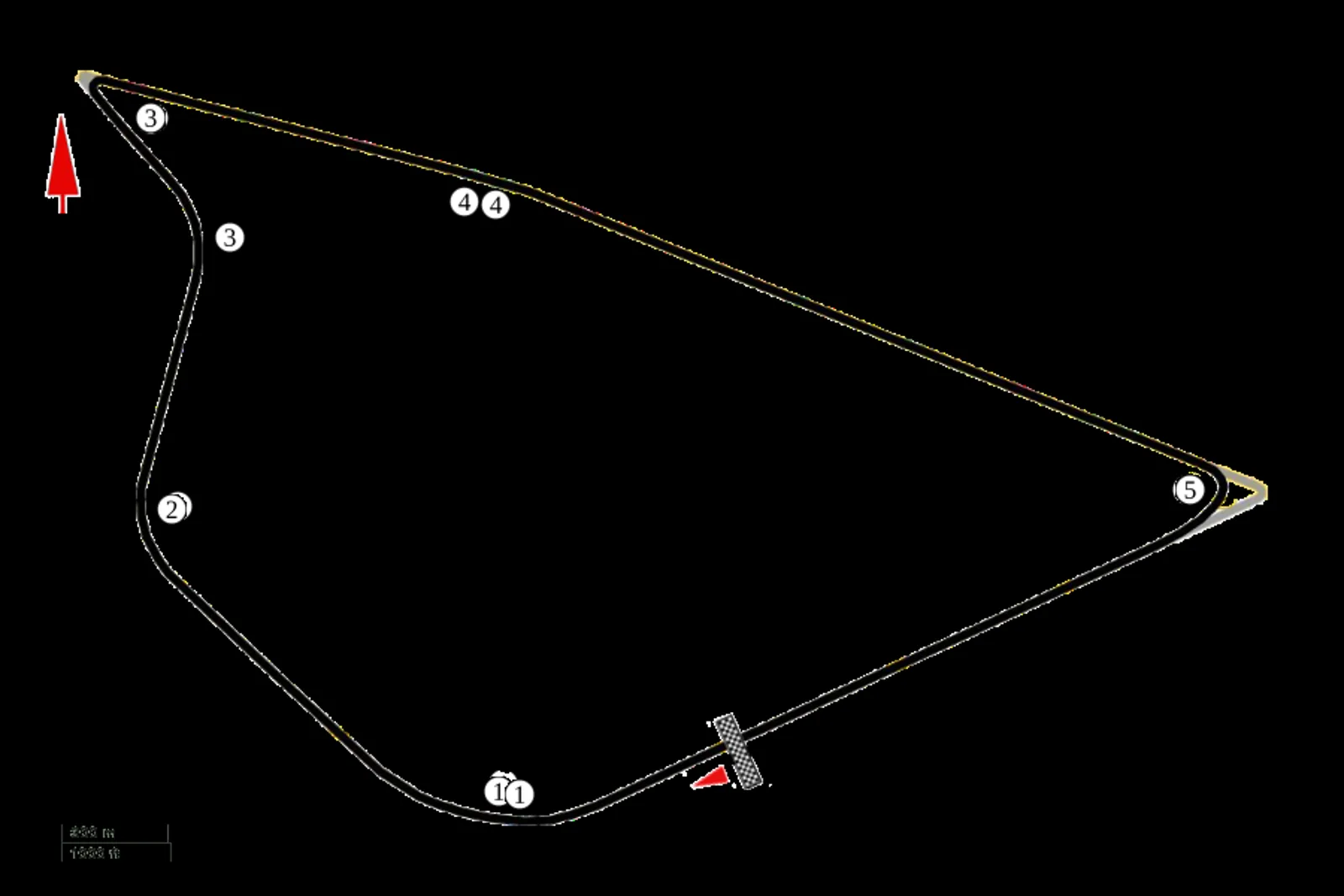
At Paul Ricard in 1985, Keke Rosberg's pole lap in a Williams-Honda took 1:32.462. In 1990, Nigel Mansell's pole in a Ferrari took 1:04.402. Same circuit, same Grand Prix, a pole time more than 28 seconds shorter, because in between the Grand Prix layout had been cut from 5.809 km (3.610 mi) to 3.812 km (2.369 mi).
That kind of change runs through the story of the French Grand Prix circuits. Reims-Gueux, Magny-Cours and Circuit Paul Ricard each hosted the race at different times, and each is very different from the others.
What was Reims-Gueux?
Reims-Gueux was a circuit of rural public roads in the village of Gueux, in France's Champagne region and 8 km (5.0 mi) to the west of Reims. It was set up in 1926 as the second home of the Grand Prix de la Marne. Its triangle of public roads ran between the villages of Thillois and Gueux, crossing the Route nationale 31 at the La Garenne and Gueux intersection. It became known as one of the fastest circuits of its era because of two long straights, each about 2.2 km long, which led to many famous slipstream battles.
The race had moved there in 1926 from a square-shaped 22 km (14 mi) circuit at Beine-Nauroy, east of Reims. The first Reims-Gueux layout measured 7.816 km (4.857 mi), with the start/finish line on road D27 about 1.6 km (0.99 mi) east of Gueux village. Built of long straights, flat-out kinks, two tight angular corners and a sharp hairpin, it was hard on engines, brakes and fuel.
The same track produced a pole lap of 1:32.462 in 1985 and 1:04.402 in 1990, because in between it was cut from 5.809 km to 3.812 km.
How did Reims-Gueux change over the years?
Widening of some sections before the 1932 Grand Prix de France brought a published length of 7.826 km (4.863 mi), and the layout stayed essentially the same until 1937. Before 1938, organisers extensively widened the Thillois-Gueux straight, reportedly felling trees and demolishing structures to make it faster. That ended the pre-war Grand Prix era, with the 1938 and 1939 editions of the French Grand Prix.
Racing resumed in 1947 with the sixteenth Grand Prix de Reims, which effectively ended the Grand Prix de la Marne except for a last edition in 1952. The first Formula 1 cars came in 1948 and 1949 for non-championship rounds, and in 1950 it staged the sixth race of the very first World Drivers' Championship. After that it was clear that it needed extensive renovation to keep pace with Formula 1 technology.
For 1952 the track was rerouted to bypass Gueux using the new D26, shortening the lap from 7.826 km to 7.152 km (4.444 mi), and renamed Circuit de Reims. In 1953, the first year of the 12 Hours of Reims, a D26 extension from the Hovette corner, also called the Annie Bousquet corner, reached a new intersection at the Muizon corner, taking the lap to 8.372 km (5.202 mi). Before 1954 the Muizon and Thillois corners were reshaped to larger, faster radii, giving a final length of 8.302 km (5.159 mi). With three fast sweepers added and the main straight extended, the circuit was faster by about 4-5 mph a lap.
What happened to Reims-Gueux?
The last Formula 1 race there came in 1966, the final sports car competitions in 1969, and motorcycle racing continued for another three years. Financial difficulties closed Reims-Gueux permanently in 1972. A historic race planned for 1997 was cancelled for technical reasons months beforehand, and by 2002 bulldozers were tearing down parts of the circuit.
Some of it can still be seen: around the pit lane, at the D26 and D27 roundabout, and along part of the D26 extension from the Hovette corner towards the old Muizon hairpin. The former straight on the RN31 linking Muizon and Thillois has become a broader dual carriageway, still on the line of the original two-lane road. It is possible to drive a lap of roughly the 1926 version through Gueux and of the 1952 variant, except for the old La Garenne junction, which was demolished in the RN31 modernisation. The 1953 layout cannot be driven, since the surface linking Bretelle Nord with Muizon has been lifted. A non-profit group, Les Amis du Circuit de Gueux, is working to preserve the pit building, grandstands and other remains and supports historic meetings on the 1952 Circuit d'Essais.
What is Circuit Paul Ricard?
It is a motorsport track at Le Castellet in the Var, near Marseille, built in 1969 with money from the pastis magnate Paul Ricard, who wanted to take on the challenge of building a racetrack. It opened on 19 April 1970. Its facilities were so innovative that it was among the safest circuits in the world at the time, with three layout permutations, an industrial park and an airstrip. Mild winters and that airstrip made it popular with teams for off-season testing.
Its Formula One French Grand Prix dates were scattered between 1971 and 2022, and the French motorcycle Grand Prix visited on and off from 1973 to 1999. The Bol d'Or motorcycle race has been based there since 2015, and the European Le Mans Series and the GT World Challenge Europe Endurance Cup also call in.
Why did Paul Ricard's original layout end?
The first layout centred on the Mistral Straight, 1.8 km (1.1 mi) long and ending at the quick right-hander of Signes. With long spells at full revs, the layout was hard on engines and failures were common. In the 1985 French Grand Prix Ayrton Senna's Lotus lost its Renault engine and spun backwards at Signes on his own oil, escaping with light bruising. Nigel Mansell crashed at the same corner in practice, a slow puncture having caused his left rear tyre to burst at over 320 km/h (200 mph) and torn off the rear wing of his Williams FW10. He suffered a concussion and missed the race.
Speeds that year show how far apart cars were. In qualifying Marc Surer pushed his turbocharged Brabham-BMW, with 1,000 bhp (746 kW; 1,014 PS), to 335 km/h (208 mph) on the Mistral, the highest then recorded by a Formula One car there. Stefan Bellof's naturally aspirated Tyrrell-Ford V8, with 550 bhp (410 kW; 558 PS), managed 277 km/h (172 mph), 9 seconds off Surer and 12 seconds off pole. Rosberg, Mansell's team-mate, set the original circuit's race lap record, 1:39.914, in the Honda-powered FW10.
In 1986 Elio de Angelis died in a testing crash at the quick first corner, when the rear wing of his Brabham BT55 came off. The circuit was not the cause, but it was modified for safety. The Mistral Straight was reduced from 1.8 km to just over 1.0 km (0.62 mi), and the sweeping Verrerie curves where de Angelis crashed were bypassed: after the start, cars braked hard for a sharp right into a short link joining the pit straight to the Mistral. That produced the 3.812 km Grand Prix lap and the sharp drop in times.
Which French Grand Prix races did Paul Ricard host?
Ricard staged the French Grand Prix fourteen times from 1971 to 1990, using the Long Circuit from 1971 to 1985 and the Club Circuit from 1986 to 1990. In six of those years (1971, 1975, 1976, 1978, 1980 and 1989) the man who won at Ricard also became champion, and only Ronnie Peterson (1973 and 1974) and Rene Arnoux (1982) among its winners never won the championship. Alain Prost, a four-time champion, won there in 1983, 1988, 1989 and 1990. A 2-litre sports car race opened the circuit.
The Grand Prix then moved to Magny-Cours, which held its first race in 1991. During the 1990s Ricard saw only motorcycle racing and French domestic events, notably the Bol d'Or 24-hour motorcycle race until 1999, and was home to the Oreca F3000 team. After Paul Ricard's death the track was sold in 1999 to Excelis, which belonged to the Formula One promoter Bernie Ecclestone, rebuilt as an advanced test track and for a time called the Paul Ricard High Tech Test Track.
An announcement on 5 December 2016 brought the French Grand Prix back for 2018 at Paul Ricard: the first edition since 2008, and the first at the circuit since 1990. It stayed on the calendar until the 2022 season, after which it dropped off again.
Why does Paul Ricard have blue lines and run-offs?
The track is known for black and blue run-off areas called the Blue Zone. The surface is a mixture of asphalt and tungsten and replaces the gravel traps seen elsewhere. A second, deeper run-off, the Red Zone, has a more abrasive surface that maximises tyre grip and so cuts braking distance, although it causes extreme tyre wear. The last line of defence is Tecpro barriers, a modern take on the tyre wall. The track is built on a plateau and is very flat, with its elevation ranging from 408 to 441 m (1,339 to 1,447 ft).
Work between 2000 and 2005 left the circuit able to run in 247 different configurations, the shortest 0.828 km (0.514 mi) and the full lap 5.858 km (3.640 mi). In 2019 the pit lane entry moved between the last two corners, turns 14 and 15, after safety concerns. Paul Ricard has 3-star FIA Environmental Accreditation, and a 2021 report placed it second among the world's most sustainable tracks, tied with Barcelona-Catalunya and behind only Mugello. Sebastian Vettel holds the official record for the current F1 layout, 1:32.740, set in the 2019 French Grand Prix; the unofficial all-time best is Lewis Hamilton's 1:28.319 in final qualifying for that race.
What is Magny-Cours?
Circuit de Nevers Magny-Cours lies in central France close to the towns of Magny-Cours and Nevers, about 240 km (150 mi) from Lyon and 250 km (160 mi) from Paris. The lap is 4.411 km (2.741 mi). Jean Bernigaud built it, and it opened on 7 August 1960. It housed the Winfield racing school, which produced Francois Cevert, Jacques Laffite and Didier Pironi. In the 1980s it fell into disrepair and saw no international racing until the Conseil Departemental de la Nievre bought it in 1986. In the 1990s Ligier, then Prost, were based there and did much of their testing.
It staged the French Grand Prix from 1991 to 2008 and the Bol d'Or from 2000 to 2014. The Superbike World Championship has visited since 1991 and annually since 2003, and the circuit also hosted the French motorcycle Grand Prix in 1992. A campus of the engineering college Institut superieur de l'automobile et des transports sits on site, along with the museum Conservatoire de la monoplace francaise.
What is the Magny-Cours circuit like?
It is a smooth, flat track with negligible elevation change, just a shallow dip at the Estoril corner and a gentle rise by the Lycee corner. Unusually, many corners copy famous turns from other circuits and carry their names: the fast Estoril corner at turn 3, the Adelaide hairpin at turn 5 and the Nurburgring and Imola chicanes at turns 7 and 12. The best chance to pass comes at the Adelaide hairpin, taken in first gear at the end of a long, fast straight.
Even so, passing is rare. A redesign for the 2003 French Grand Prix changed the final corner and chicane to encourage overtaking, with little effect, and races there are commonly seen as processional, with most passing done in pit stop sequences. Rain changes things. In 1999 a downpour interrupted the race, and after the restart most leading contenders hit trouble, giving Heinz-Harald Frentzen a surprising win in his Jordan. The area has an oceanic climate with over 800 mm (31 in) of rain a year, though in the Formula One era the Grand Prix often dodged it.
Michael Schumacher won the 2004 race with an unprecedented four-stop strategy, and in 2006 became the first driver to win one Grand Prix eight times at the same circuit. His 1:15.377 in the 2004 race is the official lap record, and Fernando Alonso set the unofficial all-time record of 1:13.698 in qualifying for the same race.
Why did the French Grand Prix leave Magny-Cours?
Bernie Ecclestone first said F1 would not return in 2008, mentioning an alternative location perhaps in Paris, then reversed when the July 2007 calendar listed Magny-Cours. In May 2008 he confirmed the race would end there after 2008, again suggesting Paris streets. Attendances were weak: the site is remote, hard to reach and short of places to stay. A provisional 2009 calendar still listed a French Grand Prix at Magny-Cours on 28 June, but in October 2008 it was cancelled after the French Motorsports Federation withdrew financing.
The circuit moved on to other events: its first Superleague Formula race in 2009, a second in 2010, a stage of the 2014 Paris-Nice cycling race finishing on the front straight. The Bol d'Or, held at Magny-Cours for several years, returned to the more popular Paul Ricard in 2015.
Reims-Gueux, Magny-Cours and Paul Ricard side by side
| Detail | Reims-Gueux | Magny-Cours | Paul Ricard |
|---|---|---|---|
| Start | 1926, public roads | 7 August 1960 | 19 April 1970 |
| Location | Gueux, west of Reims | Near Nevers, central France | Le Castellet, near Marseille |
| Lap length | 8.302 km (5.159 mi) in its final form | 4.411 km (2.741 mi) | 5.858 km (3.640 mi) full; 3.812 km (2.369 mi) GP short |
| Character | Two straights of about 2.2 km, slipstream racing | Flat, corners copied from other circuits | Plateau, Mistral Straight, Blue Zone |
| Last Formula 1 use | 1966 | 2008 | 2022 |
| Status | Closed 1972, remains preserved in part | Active, motorcycles and touring cars | Active, endurance racing and testing |
What does this mean for a visitor?
The three circuits are three kinds of visit. At Reims-Gueux you can drive parts of the old public-road lap and see the surviving pit building. Magny-Cours is a working circuit with a museum, the Conservatoire de la monoplace francaise, on site. Paul Ricard runs a busy calendar, from the Ferrari Challenge Europe in March to the Bol d'Or in September and the Asian Le Mans Series round in November.