From a 1965 Transit V4 to a Taurus V6 and a Festiva that ran 12.9 seconds over a quarter mile, four Ford engines with four different origins.
The Essex V4 was a 1.7 and 2.0-litre Ford V4 made from 1965 to 1977. The DOHC four was Ford's first in-house twin-cam, built from 1989 to 2006. The DLD is a diesel family developed with PSA, and the SHO V6, developed with Yamaha, powered the Taurus SHO from 1989 to 1995.
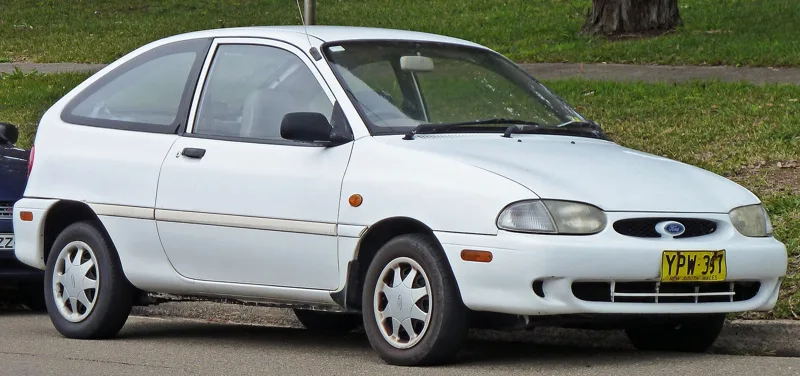
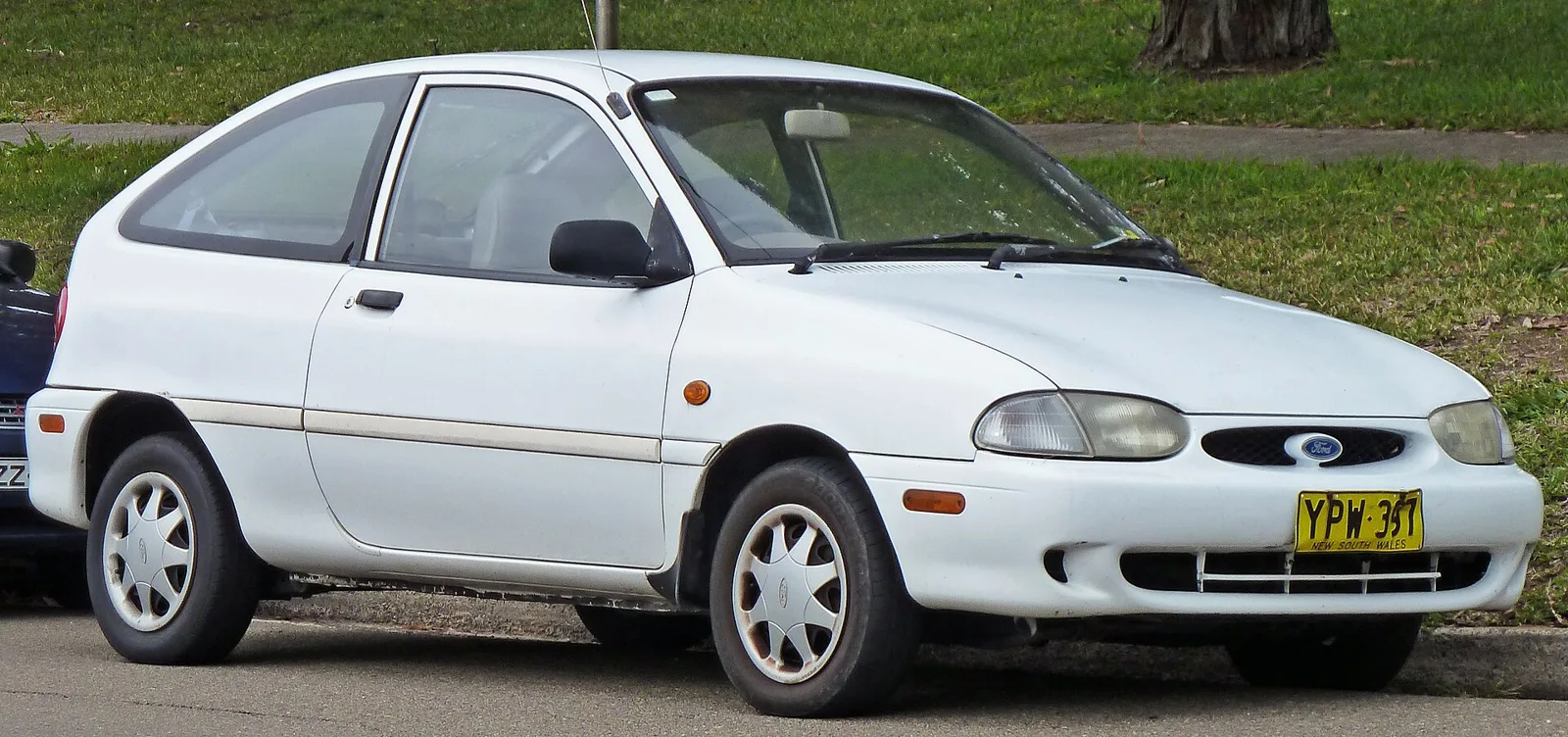
In 1990, seven Ford Festivas were rebuilt by Rick Titus and Chuck Beck of Special Editions, each with a 3.0-litre SHO V6 bolted behind the front seats. The result covered a quarter mile in 12.9 seconds at 100.9 mph (162.4 km/h). The engine came from the Ford Taurus SHO, one of four very different Ford engine families.
What are the Ford Essex V4, DOHC four, DLD and SHO V6 engines?
They are four unrelated Ford engines. The Essex V4 was a 1.7 and 2.0-litre petrol engine made from 1965 to 1977, the DOHC four a twin-cam petrol engine from 1989 to 2006, the DLD a diesel family built with PSA, and the SHO V6 a Yamaha-developed unit for the Taurus SHO.
Each served a different purpose. The Essex V4 was designed for Transit vans and family saloons, the DOHC gave Ford its own twin-cam for the mass market, the DLD was a joint effort for small diesel cars, and the SHO was a high-revving performance engine.
In 1990, seven Ford Festivas were rebuilt by Rick Titus and Chuck Beck of Special Editions, each with a 3.0-litre SHO V6 bolted behind the front seats.
What was the Ford Essex V4 engine?
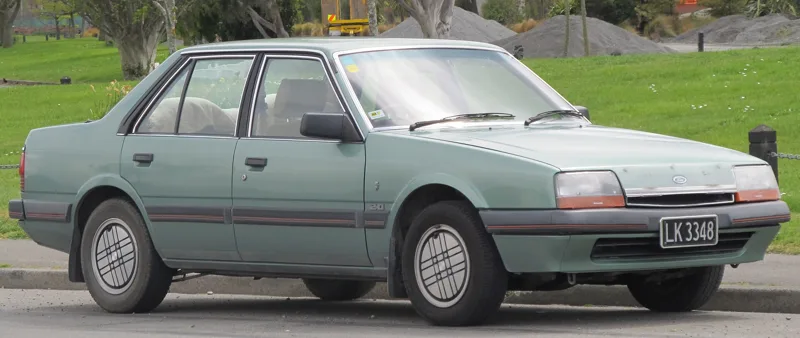
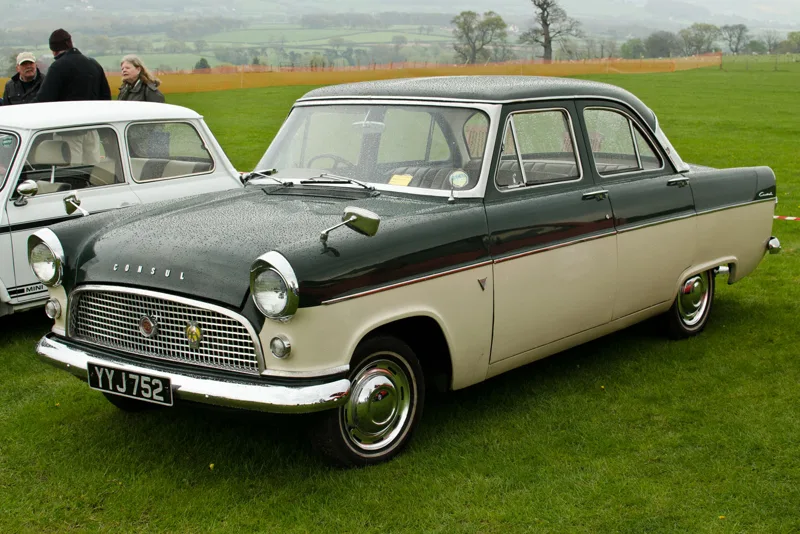
The Essex V4 was a 60-degree V4 petrol engine that Ford of Britain designed and built at Dagenham from 1965 to 1977, in 1.7 and 2.0-litre sizes. It powered the Corsair, the first Capri, the Zephyr Mk IV, the Consul and Granada Mk I and the first Transit van.
Development began in 1961 under engine design director Alan Worters, with Alan Aitken, John Pask and George Soule, while product planners including Terence Beckett shaped the brief. The aim was one engine for saloons and work vans alike, with boats and industry also in mind and a diesel planned from the start. Planners studied the market-leading Volkswagen Transporter and, rather than copy its rear engine, proposed a V4 in front of the driver to open up cargo room.
Ford approved both a V4 and a V6, sharing a 60-degree angle between the banks, an oversquare bore and stroke ratio, and many parts including pistons, valves and spark plugs. Meanwhile Ford of Germany was designing its own Transit around the Taunus V4. Management settled on a single body and chassis with separate engines for England and Germany, and 14 million pounds went into renovating the Dagenham plant.
How was the Essex V4 built?
The Essex V4 had a cast iron block and heads, and the block was only 20 in (510 mm) long. Crossflow heads carried two overhead valves per cylinder, driven by pushrods and rocker arms from a single camshaft in the block.
Both sizes shared a 93.66 mm (3.69 in) bore. The 1.7 had a 60.35 mm (2.38 in) stroke and the 2.0 a 72.42 mm (2.85 in) stroke, so Ford kept the connecting rods identical and changed only the crankshaft throws and piston heights. Compression ratios ranged from 7.7:1 in the Transit to 9.1:1 in 1.7-litre cars, and output from 73 hp (54.4 kW) to 93 hp (69.4 kW). With its Heron head design and bowl-in-crown pistons, the cylinder head itself set the compression, with shallow chambers for low compression and flat heads for high.
A 60-degree V4 shakes, so Ford added a balance shaft that the V6 did not need. Even so, reviewers often remarked on its lack of smoothness, despite Ford promoting the V4 Corsair as quiet.
The 1967 Corsair 2000E received bigger ports, a new camshaft and a two-barrel Weber carburettor in place of a single-barrel Zenith Stromberg, lifting output to 97 hp (72.3 kW) at 5,000 rpm from 88 hp (65.6 kW). Between 1971 and 1972 the engine gained a new camshaft, D-shaped inlet ports and a compression increase from 8.9:1 to 9.0:1.
What went wrong with the Essex V4?
Its best-known weakness was the timing gear. Originally made of fibre composite, it could break at high revs or with age, and because the V4 was an interference engine the pistons could then strike open valves and cause serious damage.
Ford changed the camshaft drive gear to steel with fibre teeth in 1971 to 1972. A second weakness was the oil pump drive: the camshaft turned the distributor through a skew gear, which drove a hexagonal shaft to the pump, and if that shaft rounded off the pump stopped and the engine ran out of oil. Early engines also suffered from weeping head gaskets, tired balance shaft bearings and failures of big-end or main bearings.
Which cars used the Essex V4?
The first Transit, released in 1965, was designed around the Essex V4, with a flat front and short bonnet. The planned diesel version never reached production, so a Perkins inline-four diesel was offered and needed a longer Bullnose bonnet.
The Corsair arrived the same year with both sizes. Crayford Engineering built a Corsair V4 GT Convertible from 1966 to 1968, and the Corsair 2000E Deluxe was the most powerful factory V4 at 103 hp (104.4 PS; 76.8 kW). The Zephyr 4 used the 2.0 until 1972, the Capri 2000GT of 1969 made 92 hp (93.3 PS; 68.6 kW), and the Mk1 Granada and Consul offered it into the early 1970s. The Capri II of 1974 replaced it with the Pinto four or the Cologne V6.
Marcos built a V4-powered 2 litre from 1969 to 1971, and when the Marcos GT returned in component form in 1982 the V4 was an option. Estimates of V4 Marcos production usually say 78 cars, though some references say as few as 40. South Africa built its own 2.0, fitting it to the Corsair, Cortina TC, 17M and Capri.
What is the Ford DOHC four?
The Ford DOHC is an inline-four with twin overhead cams, made from 1989 to 2006, first as a 2.0-litre 8-valve and later in 2.0 and 2.3-litre 16-valve forms. It was Ford's first in-house twin-cam to reach volume production.
Ford designed it to replace the 2.0-litre OHC Pinto, which by the late 1980s lagged behind rivals in power, efficiency and refinement. Apart from layout and size it shares nothing with the Pinto, and it is described as a clean-sheet design built at the Dagenham Engine Plant. It launched in late 1989 in the rear-drive Sierra, Sierra Sapphire and Scorpio with a five-speed manual or a four-speed automatic, and reviews were mixed: an improvement on the Pinto, but not the leap expected.
The Escort RS2000 gave it a second life. Debuting in 1991 with the DOHC mounted across the engine bay in a front-drive car, the RS2000 16V produced 150 PS (110 kW; 148 bhp). The Sierra ended in 1993 and the RS2000 in 1996, but the engine went on in the Galaxy MPV from 1995, joined by a 2.3-litre 16-valve version that also appeared in the Scorpio and Transit. It ended in 2006 with the Galaxy's redesign.
Each uses a cast iron block under an aluminium head, with a cast aluminium sump that stiffens the engine and five main bearings. A timing chain drives the two camshafts, and the valves work through hydraulic tappets. The 2.3 added two balance shafts, a joint effort of FEV Motorentechnik, Cosworth Engineering and Ford of Europe, which cut interior noise by 6 decibels.
Ford DOHC four versions compared
| Code | Size and valves | Power | Torque |
|---|---|---|---|
| N8A/N8B | 2.0 L, 8-valve, carburettor | 79 kW (106 hp) at 5,600 rpm | At 3,000 rpm, 171 Nm (126 lb ft) |
| N8C/N8D | 2.0 L, 8-valve, carburettor, catalyst | 75 kW (101 hp) at 5,500 rpm | At 3,000 rpm, 166 Nm (122 lb ft) |
| N9A/N9B | 2.0 L, 8-valve, injection | 90 kW (121 hp) at 5,500 rpm | 171 Nm (126 lb ft) at 2,500 rpm |
| N7A | 2.0 L, 16-valve | 150 hp (112 kW) at 6,000 rpm | 190 Nm (140 lb ft) at 4,500 rpm |
| N3A | 2.0 L, 16-valve | 136 hp (101 kW) at 6,300 rpm | 175 Nm (129 lb ft) at 4,200 rpm |
| Y5A/Y5B | 2.3 L (2,295 cc), 16-valve | 145 hp (108 kW) at 5,600 rpm | 210 Nm (155 lb ft) at 4,500 rpm |
What problems does the Ford DOHC four have?
The engine is reported to suffer certain weaknesses, though not whether they come from design flaws or poor maintenance. Timing chains that stretch or break head the list.
The other reported problems are electrical faults, leaks from seals and gaskets, a blocked oil spray bar, plugs that seize in the head, worn hydraulic tappets, a cracked head, and a blocked cooling system that can lead to overheating and head gasket failure.
What is the Ford DLD diesel engine?
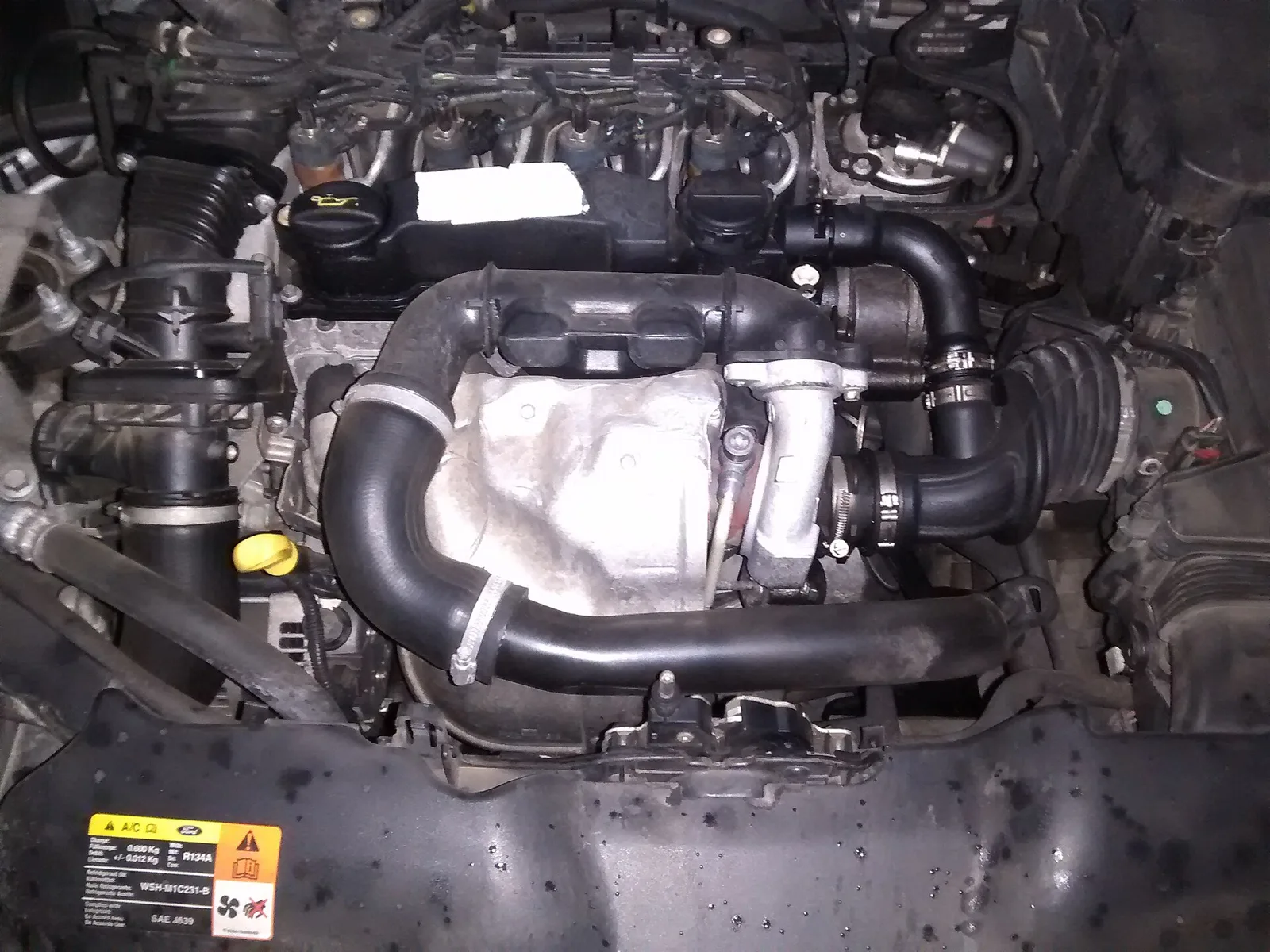
The DLD is a family of compact inline-four diesels that Ford of Britain developed with PSA, the maker of Peugeot and Citroen. The joint venture was announced in September 1998, and Ford sells the engines as DuraTorq TDCi, while Citroen and Peugeot call them HDi.
Half of the engines are built at Ford of Britain's plant in Dagenham and at Ford's Chennai plant in India, and the other half at PSA's plant in Tremery, France. Mazda also uses the Ford-built engine in the Mazda2 and Mazda 3, as the MZ-CD or CiTD.
The 1.4-litre DLD-414, also called DV4, displaces 1398 cc and made 68 PS (50 kW; 67 hp) with 160 Nm (118 lb ft). One version has a single-cam 8-valve head and a turbocharger without an intercooler, the same turbo as the Renault K9K diesel, and it gained a particulate filter from 2006 to reach Euro 4. A second version had a 16-valve double-cam head and an intercooled variable-geometry turbo, but it was dropped from 2006 because it could not meet Euro 4. In the 2005 to 2008 Citroen C1, Peugeot 107 and Toyota Aygo, PSA lowered output to suit the weaker five-speed gearbox.
The 1.5-litre DLD-415 (1499 cc) arrived in 2012, derived from the 1.6, and offers 75 PS (55 kW; 74 hp) to 130 PS (96 kW; 128 hp) with 230 Nm (170 lb ft) to 300 Nm (221 lb ft). The 1.6-litre DLD-416, or DV6 (1560 cc), is built in the UK and supplied to Ford, Volvo, PSA, Mini and Mazda, meeting Euro 5, with an 8-valve single-cam form called DV-6C and DV-6D from 2011.
Is the Ford DLD-418 really a DLD?
Only by name. The 1.8-litre (1753 cc) DLD-418 is completely unrelated to the 1.4 and 1.6 units and derives from Ford's own 1.8 8v Endura-D, which served through the 1980s and 1990s, though Ford counts it in the DLD family.
Ford heavily updated the Endura-D with a variable-vane turbo and Delphi high-pressure common rail and relaunched it in 2001 as the DuraTorq TDCi, rebadging the original as TDDi. The 2001 unit made 115 PS (85 kW; 113 hp) and 250 Nm (184 lb ft). A reduced-power 99 PS (73 kW; 98 hp) version appeared in the Focus in August 2002, and early in 2005 the stronger unit's torque rose to 280 Nm (207 lb ft).
The latest DLD-418 engines came with the 2007 Mondeo, in 99 PS (73 kW; 98 hp) and 125 PS (92 kW; 123 hp) forms, the latter with 320 Nm (236 lb ft). That 125 PS engine was the first production car engine with a wet belt, a timing belt running in an oil bath, an idea better known from PSA's PureTech and Ford's EcoBoost engines.
What is the Ford SHO V6 engine?
Ford fitted the SHO V6 family of twin-cam V6 engines to the Taurus SHO between 1989 and 1995, SHO standing for Super High Output. In 1984 Yamaha Motor Corporation signed a contract to develop, produce and supply a compact 60-degree DOHC V6 based on Ford's Vulcan engine.
The 3.0-litre, which debuted in 1988, displaced 2,986 cc and had an iron block, closed deck, aluminium head, 24 valves and a variable-length intake manifold. With an 89 mm x 80 mm (3.50 in x 3.15 in) bore and stroke it made 220 bhp (164 kW; 223 PS) at 6,200 rpm and 271 Nm (200 lb ft) at 4,800 rpm. Redline was 7,000 rpm and fuel cut-off came at 7,300, and it was offered only with the Ford MTX-IV manual.
From 1993 to 1995 a 3.2-litre (3,191 cc) engine joined it, paired with the AX4S automatic. It kept the 80 mm stroke but had a larger 92 mm bore, lifting torque to 292 Nm (215 lb ft) at 4,000 rpm. Power stayed at 220 bhp, now at 6,000 rpm because of a milder cam. In 1996 Ford discontinued the V6 and fitted the Taurus SHO with a SHO V8 and AX4N automatic.
The unusual intake manifold is symmetrical, so it can be rotated 180 degrees to ease a swap from transverse to longitudinal mounting, and its bell housing pattern is shared with the HSC four, Vulcan V6 and the Canadian-built 3.8 Essex V6. Enthusiasts often replace a 3.0 with a 3.2, and fitting the 3.0's cams to a 3.2 has allowed manual-transmission Taurus SHOs to run into the low 14s over a quarter mile (402 m).
What odd vehicles used the SHO V6?
In 1989 Ford Truck Public Affairs worked with Roush Racing to build a one-off Ranger called the SHO Ranger, with a 3.0-litre V6 and the T-5 manual from a Mustang GT, a project commissioned to see whether the market wanted it.
Ford Canada took a different tack in 1993, hand-building 40 Mercury Sables under its Aluminum Intensive Vehicle program, some with SHO engines, and releasing 20 to the public. With aluminium suspension elements and body panels, joined by spot welding and adhesive, they weighed 400 lb (180 kg) less against a SHO Taurus. Multimatic Motorsports then entered one in the 1995 One Lap of America, finishing 15th overall and first in the Mid-Price class.
The SHOGun Festiva remains the best known. Beck and Titus added fibreglass wheel arches and redesigned the suspension, and the cars reached up to 1.04 g of lateral acceleration. Jay Leno owns the silver car, number 003, while the purple number 005 was modified for SCCA competition with a rollcage and five-point restraints. One was destroyed in the 2021 to 2022 Boulder County fires, and others have copied the idea with their own transplants.
Where these Ford engines stand now
Production dates tell much of the story. The Essex V4 ended in 1977, the SHO V6 in 1995 and the DOHC four in 2006. For the DLD, Ford added the 1.5-litre in 2012, after the 1.6 gained a single-cam 8-valve form in 2011, and the DLD-418 reached its latest forms with the 2007 Mondeo.