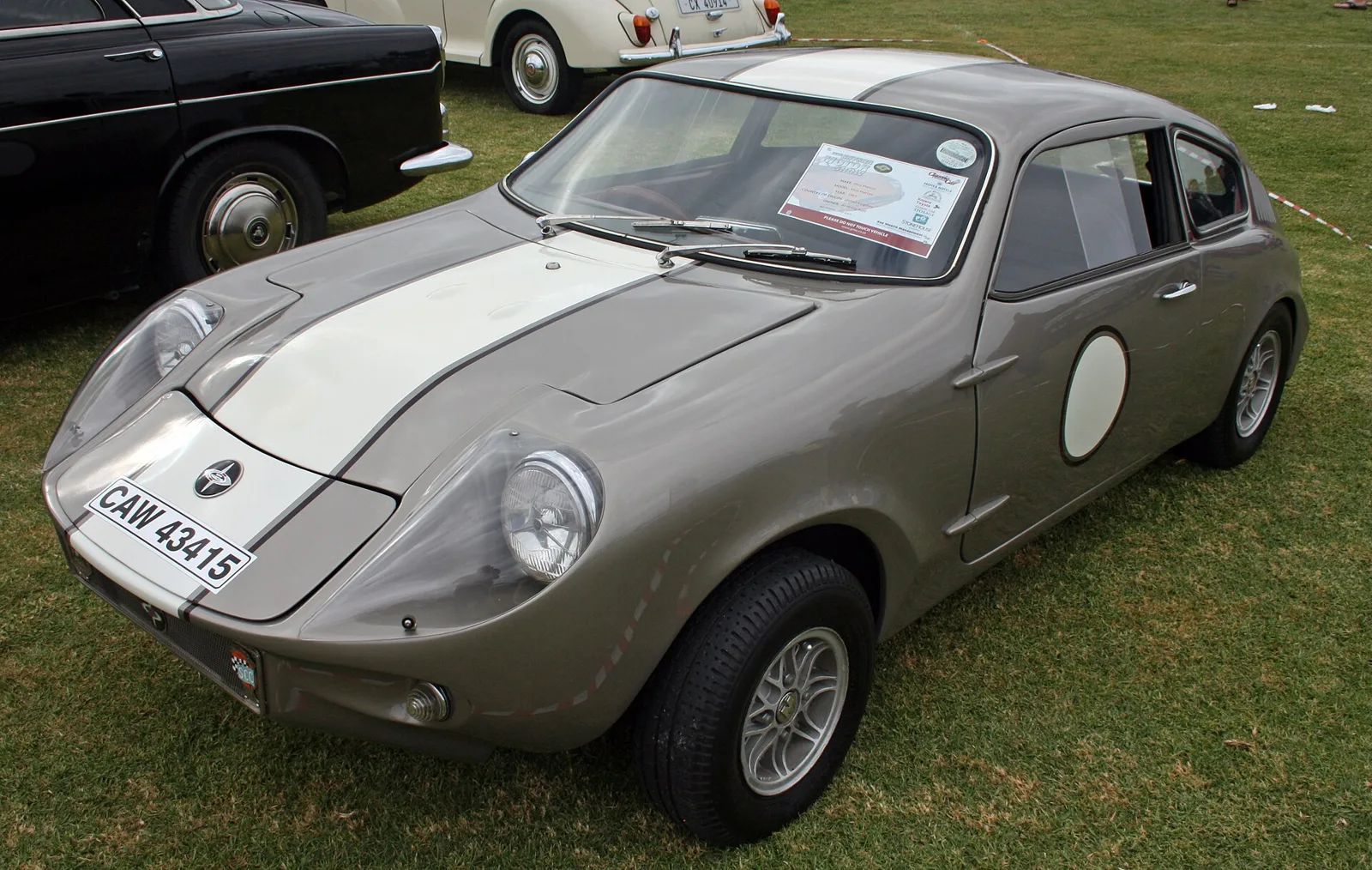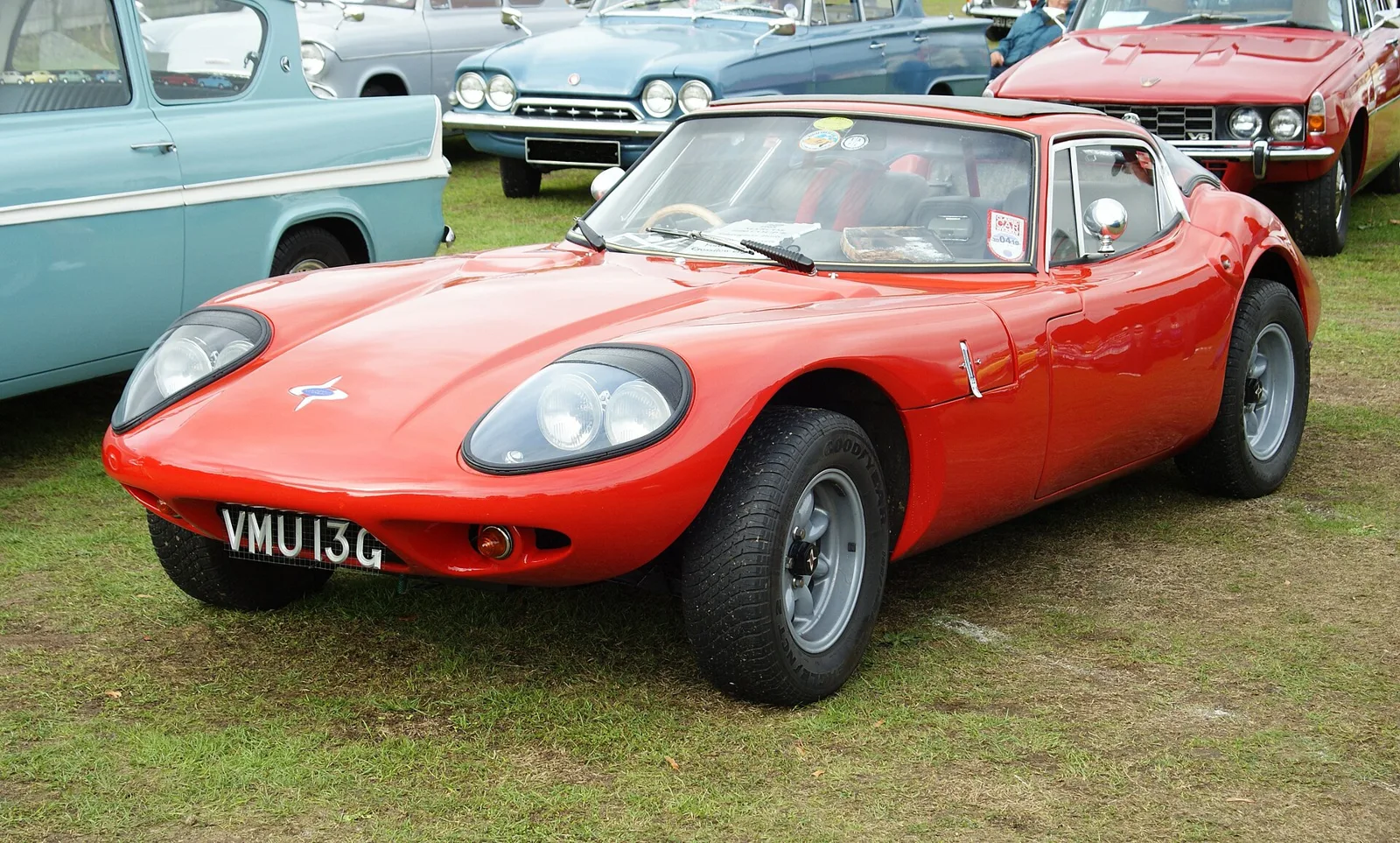
A very low coupe from 1964 with a plywood chassis, a Volvo heart, Ford engines in its middle years and a racing afterlife that lasted decades.
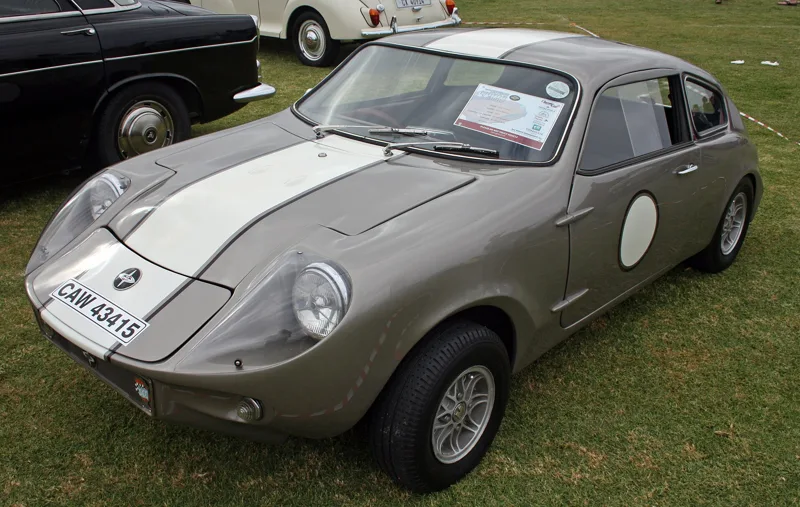
The Marcos GT is the name Marcos Engineering used for its cars until 1970, most commonly describing a very low coupe designed by Dennis and Peter Adams. Launched as the 1800 in 1964, it had a glassfibre body, a wooden chassis and a Volvo engine.
The Marcos GT is the coupe that gave its name to a British sports car maker's output until 1970. It was first shown as the Marcos 1800 in 1964, built from glassfibre over a wooden chassis, and it moved from a Volvo engine to Ford power as the company tried to lower costs.
What is the Marcos GT?
The Marcos GT is a very low coupe from the British firm Marcos Engineering, most commonly associated with the design work of brothers Dennis and Peter Adams. It was introduced as the Marcos 1800 in 1964, and the name covered all of the company's cars until the Mantis appeared in 1970.
Most GTs were built in the factory until 1972, although some were supplied as kits. Production stopped between 1972 and 1981, when small-scale component car production restarted under Jem Marsh.
A very low glassfibre coupe built around a plywood chassis, first shown in 1964 with a Volvo heart.
How did the Marcos 1800 reach the market?
The 1800 arrived in 1964 with a glassfibre body and a cast-iron Volvo 1778 cc B18 four-cylinder engine. The B18 unit came with an overdrive gearbox and a De Dion rear axle, and the car caused a sensation at the 1964 Racing Car Show.
The Volvo engine produced 96 hp (72 kW), which was enough for a top speed of 116 mph (187 km/h) and a 0-60 mph time of 8.2 seconds. Some period figures give 108 hp (81 kW) SAE, so the output is not fully settled.
The car was expensive and sold very slowly. The price came down from GBP 1500 to GBP 1340, yet the car still failed to turn a profit, and its rear end changed from de Dion to a live Ford axle after the early cars.
What was the Marcos 1800 chassis made of?
The first chassis was a plywood structure glued together from 386 separate pieces. It was light, strong and cheap to set up.
Drivers lay almost flat in fixed seats set below the floor. A knob on the dashboard slid the pedal set forward or back, and booster pillows could be fitted for shorter drivers.
The nose was long and tapered, swinging up from a front hinge and held shut by latches set behind the wheel wells. The seats stayed fixed right up to the end of production in late 2007.
Why did Marcos switch to Ford engines?
In 1966 the GT changed to a pushrod Ford Kent inline-four of 1500 cc, a move made to lower costs after the 1800 proved too expensive to market. The Ford cars were slower than the 1800, yet they sold far better.
The complex dash was replaced with a flat polished wood unit, and the rocker covers were replaced with Marcos parts. Jem Marsh also switched from Weber to Stromberg carburettors, so the common Ford engine was less obvious to buyers.
The 1500 Kent produced 85 hp (63 kW), while the Lawrencetune version reached 120 hp (89 kW) but was fragile.
How did the 1650 and 1600 Crossflow cars differ?
An overbored Lawrencetune version of 1650 cc was offered in 1967, with 32 cars built. The 1600 Crossflow became the most popular model in the range, with 192 cars built in total.
The 1600 weighed 740 kg (1,631 lb) and had standard front disc brakes, with power assist available as an optional extra. Its engine produced about 100 hp (75 kW), using a number of official Ford Performance Center parts.
Production of the 1600 ended in October 1969. A few steel-chassis 1600 cars were built in late 1971 and early 1972 as a low-priced entry version, with stripped interiors, no bumpers and steel wheels.
What were the six-cylinder Marcos cars?
The six-cylinder line began with the Marcos 3 litre, shown at the October 1968 London Show. It used a Ford Essex V6 with 140 bhp (104 kW), and the car is most easily recognised by the large central bonnet bulge needed to clear the bigger engine.
The 3 litre used a four-speed manual gearbox with a Laycock-de-Normanville overdrive for third and fourth gears. Ford V6 cars achieved more than 120 mph (190 km/h) on test.
A twin-carburettor Volvo B30 straight-six arrived in December 1969. In 1971, eleven or twelve cars took Triumph's 2.5-litre straight-six, rated at 150 bhp (112 kW), and were badged 2.5 litre.
Why did Marcos leave the US market?
Cars for North America had tubular steel space frames and a higher ride height, all changes made to meet US road rules. Marcos sold through the New York-based importer Marcos International Inc.
In 1970, US Customs impounded 27 exported cars on the grounds that they broke federal rules. The impounding caused Marcos to withdraw entirely from the US market, and the company then faced the costs of the Mantis project and the arrival of VAT on kit cars.
About sixty US market cars were built. Some of them were brought back after the market dried up in 1970 and converted to right-hand drive for sale at home, while Volvo 3 litre cars kept coming off the line for every other market.
How did the company change hands in the 1970s?
After Marcos ran out of money, the company was sold to Hebron and Medlock Bath Engineering in mid-1971. The firm did not last long, and the factory then passed to the Rob Walker Garage Group, which sold off everything the factory held.
Among the stock sold off were six Mark 2 1600s. The sale marked the end of the company's first run.
Jem Marsh bought the moulds in 1976 and resurrected the brand in 1981. The earlier GT cars were offered as kits only.
What changed in the chassis and suspension?
Earlier cars used a Triumph Herald front suspension, while later cars had a Ford MacPherson strut setup. The wooden chassis still carried its front suspension on a steel subframe.
Early cars, the first 33 by most counts (some say 52), had de Dion rear suspension, and later cars used a live Ford axle. An independent rear suspension was introduced for the Mantula in 1986.
The plywood chassis was used until 1969, when square-section steel frames took over. Early steel-framed cars needed a lower sill panel and different rear bumpers, and small interior changes were made at the same time.
Did the Marcos GT return after 1972?
Yes. Jem Marsh revived the brand in 1981 and offered the earlier GT cars as kits, in four stages of completion. Engine choices included the Ford 3.0 Essex V6, the 2.0 litre V4 and the 1600 Crossflow.
Further options included the Cologne V6 and the Pinto inline-four. The Mantula, introduced in 1983 with a Rover V8, was lighter and more powerful than the GT and became the main model in the later years.
A front spoiler was added in 1984 to reduce high-speed lift. About 130 Marcos Coupe kits were sold up to 1990, when the firm chose to concentrate on fully assembled Mantula models.
Did the Marcos GT race?
Yes, the GT was built with competition in mind, and early Marcos cars still compete in FIA and HSCC historic racing. The 1800 is the only Marcos eligible for historic racing, and that status sets it apart from the later cars.
The LM600 of 1994 competed in the 1995 Le Mans 24-hour race. The racing focus had faded by then and did not return for another thirteen years, when the LM series appeared.
Some of the last cars built had 2-litre Volvo B20 engines, as did some of the racing versions.
What are the Marcos GT specifications?
| Specification | Detail |
|---|---|
| Introduced | 1964 as the Marcos 1800 |
| Original engine | 1,778 cc Volvo B18 four with overdrive, 96 hp (72 kW) |
| Ford 1500 engine | Kent inline-four, 85 hp (63 kW); Lawrencetune 120 hp (89 kW) |
| Ford 1600 engine | Crossflow four, about 100 hp (75 kW) |
| 3 litre V6 | Ford Essex V6, 140 bhp (104 kW) |
| Top speed (1800) | 116 mph (187 km/h) |
| 0-60 mph (1800) | 8.2 seconds |
| Weight (1600) | 740 kg (1,631 lb) |
| Chassis | Plywood from 386 pieces until 1969; square-section steel after |
| Cars built | 1800: 106 (or 99); 1600: 192; 3 litre V6: 100 or 119 wooden-chassis cars |
| Production end | Late 2007 for the fixed-seat design |