A win from 15th on the grid, a wall at turn 17 and a team that told the FIA it would not fight the charges: the 2008 Singapore scandal and its aftermath.
In Crashgate, Renault's Nelson Piquet Jr hit the wall on lap 15 of the 2008 Singapore Grand Prix, allegedly on the team's orders, which gave Fernando Alonso the win. Renault did not contest the FIA's 2009 charge. Flavio Briatore was banned indefinitely and Pat Symonds for five years, until a French court overturned both bans.
Renault won the 2008 Singapore Grand Prix from 15th on the grid, and a year later it told the FIA it would not contest the charge that the victory had been manufactured by a deliberate crash. The scandal that followed became known as Crashgate.
It ended with a disqualification that never took effect, two of the sport's best-known figures banned and then freed by a French court, and a driver who said he had been asked to hit the wall.
What was Crashgate?
Crashgate was the sporting scandal that began when Renault driver Nelson Piquet Jr. crashed deliberately at the 2008 Singapore Grand Prix to help his teammate Fernando Alonso. The crash brought out the safety car, and Alonso went on to win. The FIA charged Renault with conspiracy, and the team did not contest it.
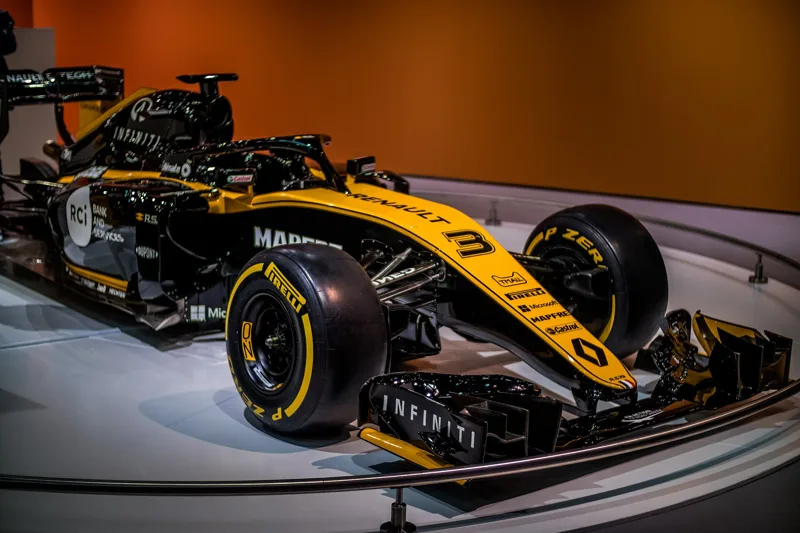
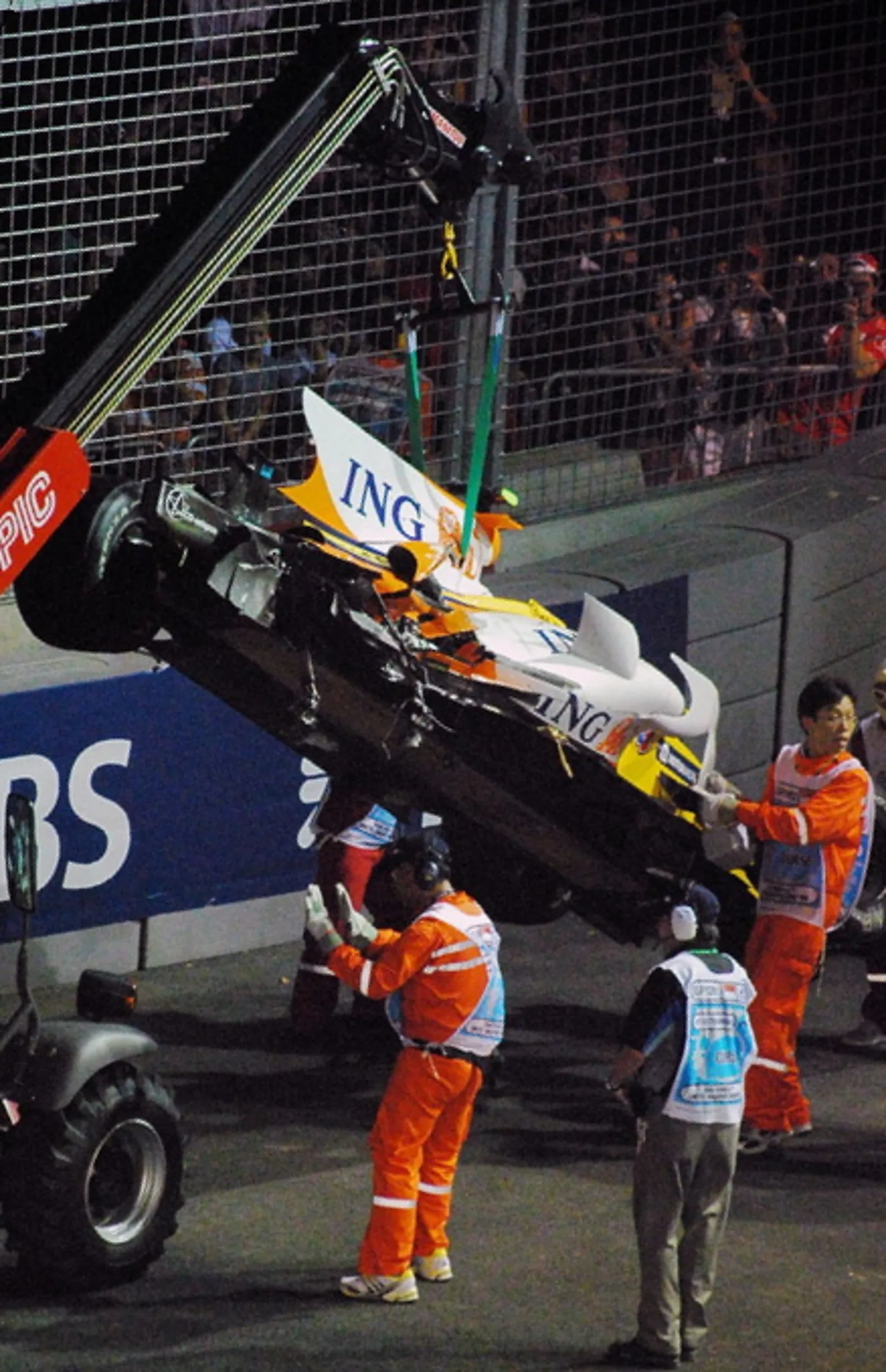
The word is the media's, not an official name. What is on record is that Piquet crashed his Renault R28 into the wall at turn 17 on 28 September 2008, on lap 15, close to the expected pit window for everyone. At the time he called it a simple mistake and blamed the difficulty of driving with a heavy fuel load.
Renault won from 15th on the grid in Singapore, then told the FIA it would not contest the charge.
What happened at the 2008 Singapore Grand Prix?
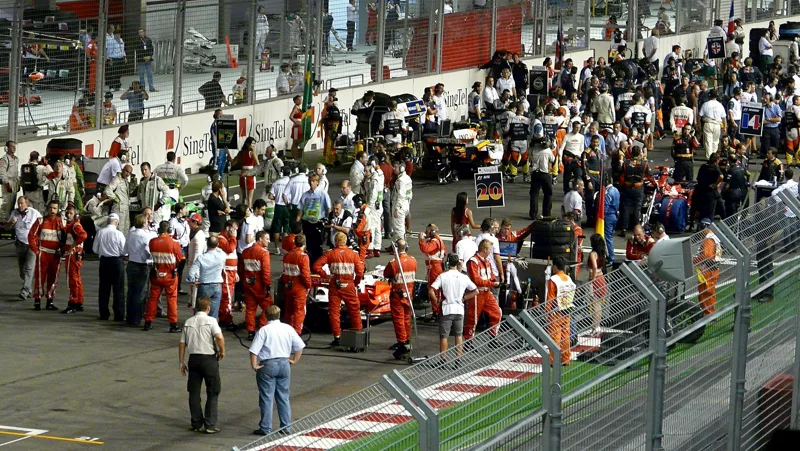
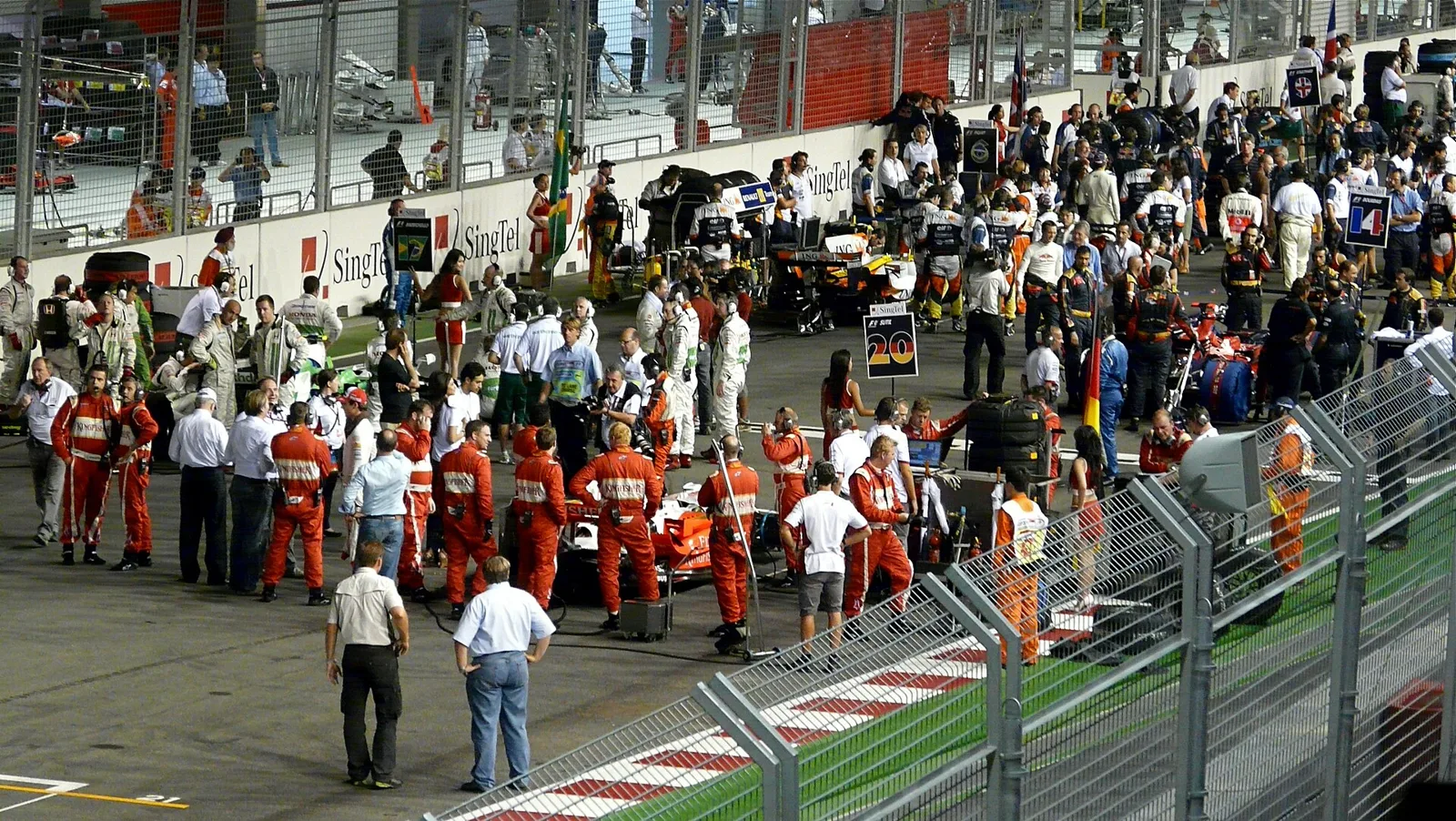
Renault had a poor qualifying session. Alonso started 15th after a mechanical failure ended his running, with Piquet alongside him in 16th. It was the first night race in the sport's history, and Renault had not won a Grand Prix for almost two years, since Japan on 8 October 2006. The team was said to be close to quitting Formula One.
Alonso made the first routine stop on lap 12, rejoining at the back with a light fuel load. That was unusual: drivers who qualify low normally go heavy to skip a stop. Piquet had spun at the same corner on the warm-up lap but kept going. Three laps after Alonso pitted he hit the wall at turn 17, a corner with no crane nearby, and the safety car came out.
The 2008 safety car rules closed the pit lane until all the cars had bunched up behind the safety car, so leaders who stopped lost their advantage and rejoined at the back. Drivers who needed fuel and pitted while the lane was closed were penalised. Alonso had pitted just before the safety car appeared, so he gained a huge advantage. Most leading cars were stuck behind him and behind slower runners on the narrow circuit, and those ahead of him were running light and still needed to stop. Alonso took the lead late in the race, in its final third, and won.
Felipe Massa had been leading when Piquet crashed. He finished 13th and went on to lose the 2008 world title to Lewis Hamilton by a single point. According to Brazilian broadcaster Rede Globo, Massa quizzed Briatore over the crash at the time, but FIA president Max Mosley said the sport could not act on speculation. Renault described Alonso's drive as a brilliant tactical drive, while Briatore and Symonds put the safety car down to good luck. The journalist Joe Saward noted that cynics were asking questions but said he preferred to think no team could be so desperate as to order a driver into a wall.
Who ran Renault's team in 2008?
Renault returned to Formula One in 2000 by buying the Benetton team, and Briatore, who had been Benetton's managing director until 1997, came back as managing director and team principal in place of Rocco Benetton. The team raced as Benetton-Renault in 2001 and as Renault F1 from 2002. Briatore also had interests outside racing: from 2007 to 2011 he was part-owner and chairman of the football club Queens Park Rangers.
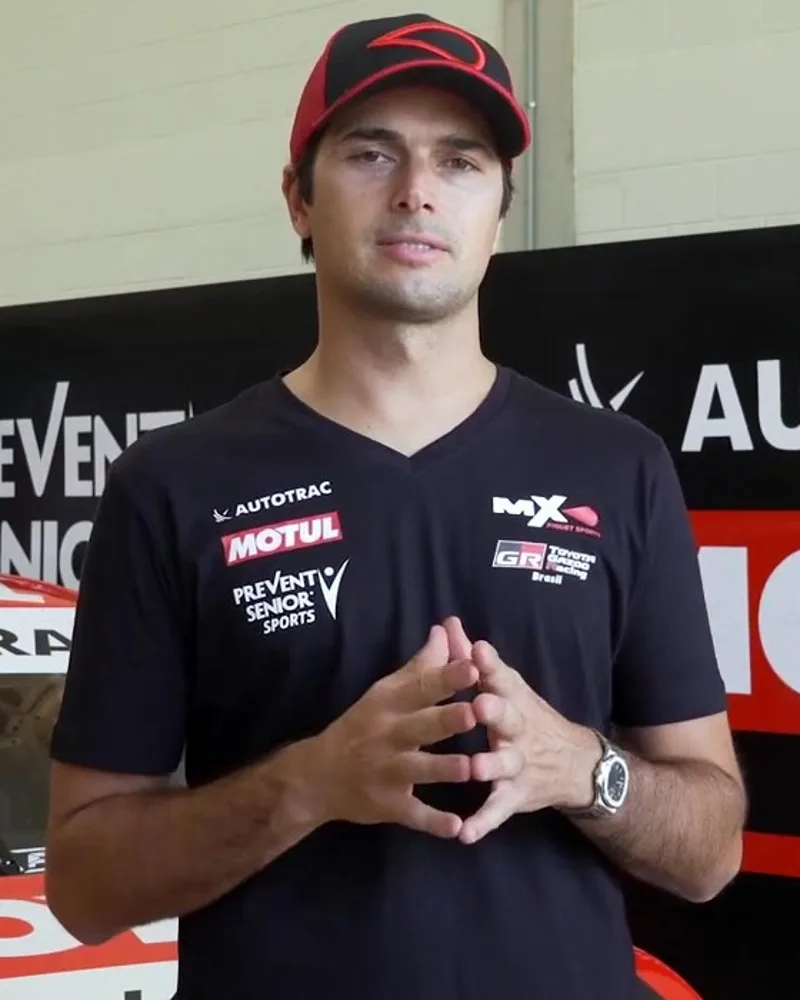
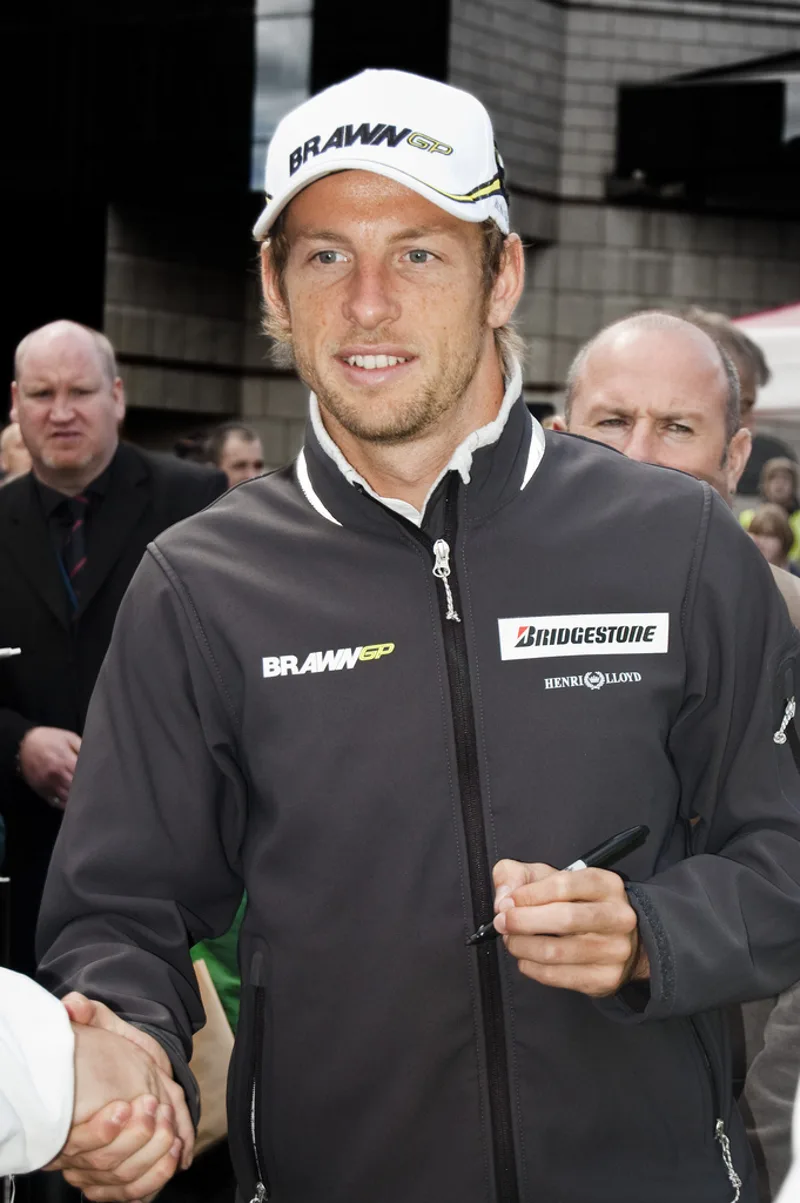
His style with drivers was blunt. In 2003 he dropped Jenson Button to make room for Alonso, promising that time would tell if he was wrong, and he later sacked Jarno Trulli in the same year that Trulli won the 2004 Monaco Grand Prix. Alonso won the 2005 and 2006 titles with the team, spent 2007 at McLaren, and came back for 2008. Piquet Jr., the son of the three-time champion Nelson Piquet, had been Renault's reserve and test driver in 2007 and became Alonso's teammate in 2008. Since October 2006 he had also been personally contracted to Briatore's management company, FFBB.
Symonds had joined Toleman in 1979 and stayed through its transformation into Benetton and then Renault. He was race engineer to Teo Fabi and Derek Warwick in 1982, Bruno Giacomelli in 1983 and a rookie Ayrton Senna in 1984, and in the mid-1990s he engineered Michael Schumacher to two titles. He became technical director in 1997 and executive director of engineering in 2001, the post he held in Singapore.
How did the Renault crash controversy come to light?
Piquet was dropped by Renault in August 2009 after the Hungarian Grand Prix, and then alleged that the team had asked him to crash on purpose. On 30 August 2009 Rede Globo reported the claim, and the FIA said straight away that it was looking into alleged incidents at an earlier race.
Piquet had ended 2008 with 19 points, twelfth in the standings, against Alonso's 61. Renault re-signed him for 2009, but by the tenth race he had no points while Alonso had 13. On 3 August 2009 he confirmed that he had been dropped. The parting was acrimonious, with Piquet criticising the team and Briatore. Romain Grosjean replaced him.
| Date | Event |
|---|---|
| 28 September 2008 | Piquet crashes in Singapore; Alonso wins |
| 3 August 2009 | Piquet confirms Renault has dropped him |
| 30 August 2009 | Rede Globo reports the allegation; FIA begins investigating |
| 4 September 2009 | FIA charges Renault with conspiracy |
| 16 September 2009 | Renault will not contest; Briatore and Symonds leave |
| 21 September 2009 | World Motor Sport Council hearing in Paris |
| 5 January 2010 | French court overturns Symonds's ban |
What did the FIA charge Renault with?
On 4 September 2009 the FIA formally accused Renault of having interfered with the result of the 2008 Singapore race and of conspiring with Piquet. The charge cited article 151c of the International Sporting Code and alleged that the team had plotted with its driver to cause a deliberate crash, bringing out the safety car to Alonso's benefit.
The team was summoned to a hearing of the World Motor Sport Council in Paris on 21 September, days before the 2009 Singapore race. Renault said it would make no comment until then.
In the meantime the evidence came out in public. On 10 September Piquet gave the FIA the second of his two statements, and the same day the transcript of his first, given in Paris on 30 July, appeared on F1SA.com. Mosley said he had seen nothing he believed to be a forgery. In the transcript Piquet said Briatore and Symonds asked him to crash at a specific corner. Alonso said he had never imagined such a thing, and the FIA absolved him of any blame during the investigation. Piquet questioned whether Alonso could have been unaware, pointing to what he called a senseless race strategy of a low fuel load and an early stop on lap 12.
On 11 September Mosley confirmed that Piquet would face no action over his statements, even if Renault were cleared. The same day Renault said it had started criminal proceedings in France against Piquet and his father over what it called false allegations and an attempt to blackmail the team into keeping Piquet in the car for 2009. Piquet answered that he had nothing to fear because he was telling the truth. On 14 September Symonds was reported to have been offered immunity if he gave the FIA details, and to have told investigators that the crash idea originated with Piquet. The next day The Times published extracts of radio conversations between Renault staff, including Piquet, Alonso, Symonds and Briatore, from before and after the race.
Why were Flavio Briatore and Pat Symonds banned?
On 16 September 2009 Renault said it would not contest the charges, and announced that managing director Flavio Briatore and engineering chief Pat Symonds had left the team. On 21 September the World Motor Sport Council handed Renault a disqualification from Formula One, suspended for two years pending any comparable infringement.
Briatore was banned indefinitely from all Formula One and FIA-sanctioned events, and Symonds received a five-year ban. Symonds accepted that he took part in the conspiracy and expressed "eternal regret and shame" to the council. The length of his ban is given variously: five years in most tellings, and three years of exclusion from operational roles, with consulting still allowed, in another. A French court, the Tribunal de Grande Instance, overturned Symonds's ban on 5 January 2010 and he was paid 5,000 euros in compensation. Briatore's ban was overturned too. An out-of-court settlement with the FIA followed in April 2010 under which they undertook to stay out of Formula One and FIA events for a set period.
What happened to Flavio Briatore after Crashgate?
Briatore was out of Formula One for years but returned. He came back in 2022 as an ambassador, in 2024 as an adviser to Team Enstone, and in 2025 as team principal. He is now Alpine's executive adviser, effectively its team principal, the team that grew out of Benetton and Renault.
He had come to Formula One through Benetton, where he became managing director and by 1991 had full control of the team. He left in 1997, and returned as managing director when Renault bought the Benetton team in 2000. Under his leadership the Enstone team won three constructors' titles and four drivers' titles. Earlier in his career he faced cheating allegations, among them the 1994 Launch Control row and the 2007 Spygate affair, though his teams escaped penalties in both cases. Piquet, who was personally contracted to Briatore's management company, later called him his executioner.
What happened to Pat Symonds after Crashgate?
Symonds came back to Formula One in 2011 as a consultant to Virgin Racing, later Marussia, while his ban restricted him to that kind of role. In July 2013 he became chief technical officer at Williams, where he stayed until the end of 2016. From March 2017 until May 2024 he was Formula One's own chief technical officer, helping to shape the 2022 regulations that brought back ground effect cars.
Before the scandal he had spent three decades inside the Enstone team, from its days as Toleman to Benetton and Renault, as race engineer to Michael Schumacher in the mid-1990s and as the engineer who helped Alonso to the 2005 and 2006 championships. Teams that involved him won four drivers' titles, three constructors' titles and 42 Grands Prix. In May 2024 he signed on as executive engineering consultant to the Cadillac Formula One team, in time for its planned 2026 entry.
For Renault, the disqualification stayed suspended for two years from September 2009.