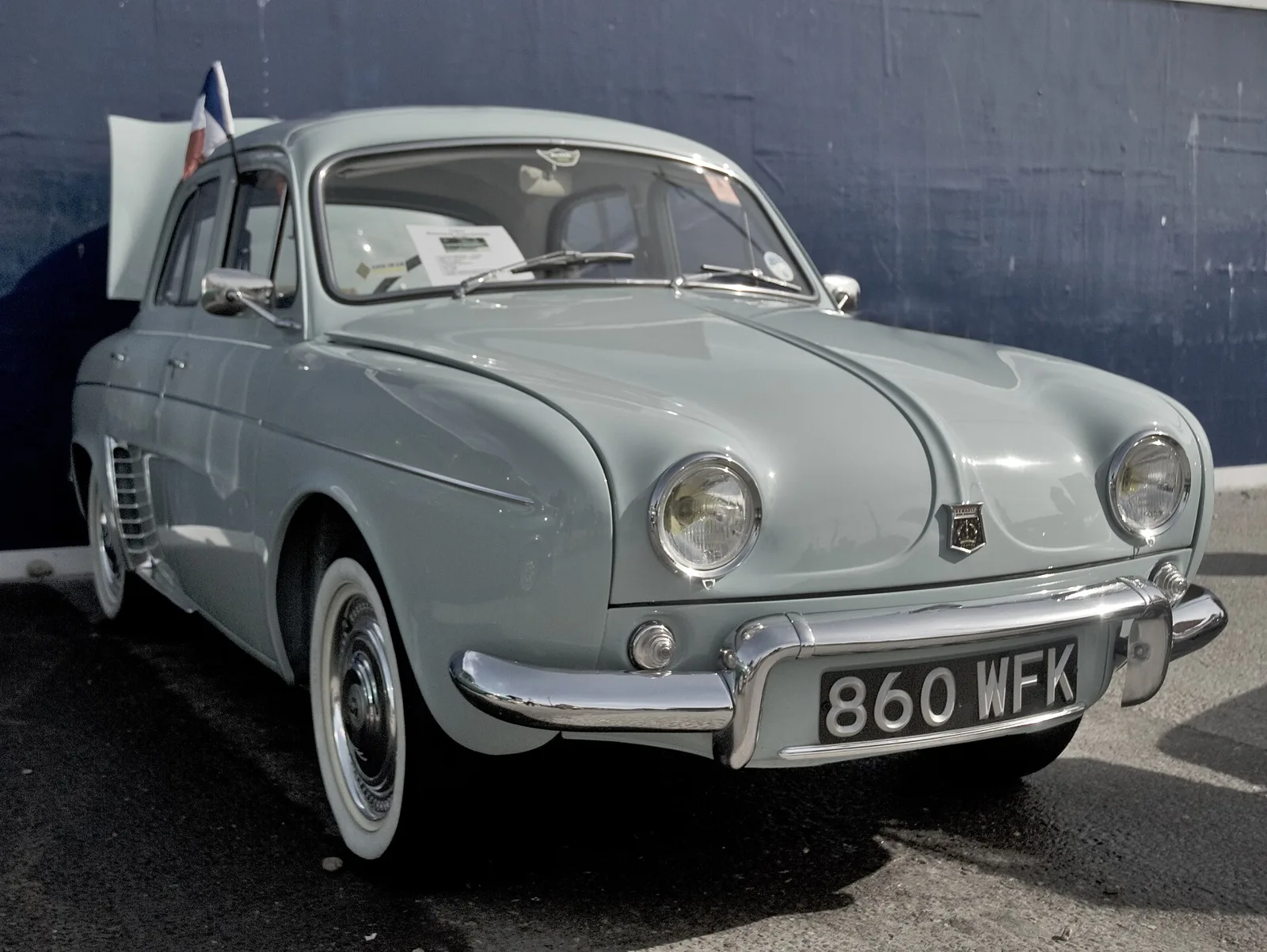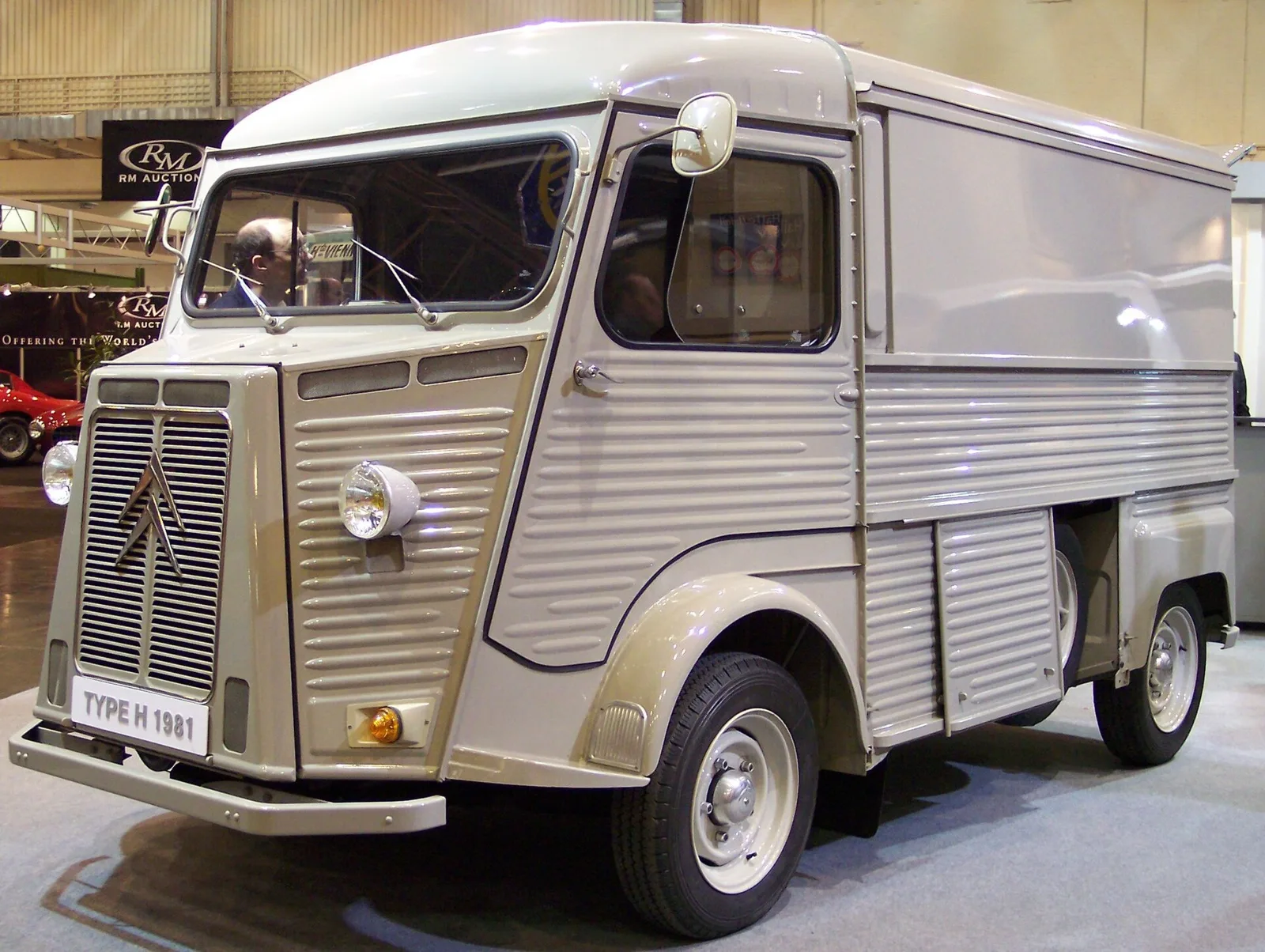
One was built from corrugated steel on a frameless body, the other grew from a rule book Citroen ignored; both put the engine and drive at the front.
The Citroen H Van, most often the HY, was a French front-wheel-drive panel van with a corrugated, frameless body, built from 1947 to 1981. The Renault Estafette, launched in June 1959, was Renault's front-drive answer, sold in van, pickup, minibus and chassis-cab forms until 1980.
The welded floor of a Citroen H Van was strong enough to support a horse. The French maker built the van for 34 years, from 1947 to 1981, and Renault's answer, the Estafette, followed in 1959 with the same front-wheel-drive idea and a very different body. Between them they supplied a generation of French shopkeepers and tradesmen.
What was the Citroen H Van?
The H Van, usually seen as the HY, was Citroen's range of panel vans and light trucks, in production from 1947 to 1981. They are notable for industrial design built on corrugated metal outer panels, chosen to save material, weight and cost. In all, 473,289 were made in factories in France and Belgium.
Early models were simply called the Type H, but they soon took a second letter drawn from the end of the alphabet, giving the HW, HX, HY and HZ, with the HP reserved for flat-bed pickups. Most were sold as the HY. For a time they were also marketed as the 1600, and when the police used them they were nicknamed a "panier a salade", a salad basket.
Behind the letter lies a simple history. Citroen's teams worked on eight projects after the war, and only the last was developed. It gave the van its name, H.
The H Van's welded floor was strong enough to support a horse.
How was the Citroen HY van built?
The H followed the Traction Avant of 1934 in having a unitary body without a separate frame, independent front suspension and driven front wheels. For a commercial vehicle that meant a flat load floor sitting low to the road, with room to stand at 180 cm (6 ft). The philosophy was the same as that of the 2CV: simple, cheap and sensible.
Loading happened through an upward-hinged tailgate over lower double half-doors at the back, with a sliding side door as an option. There were short- and long-wheelbase models, with a choice of short or longer rear overhang, and the sides of the vans received varying treatments.
The corrugated panels owe something to the aircraft maker Junkers, which used the method from the First World War into the 1930s, the three-engined Ju 52 being the last aircraft to use it. Henry Ford applied the same construction to his Tri-Motor airliner. Ribbing gave strength at no cost in weight, and the press tools to form it were simple and cheap. Inside, box sections shaped like top hats, set at right angles to the ribs, braced the flat panels.
What engines did the Citroen HY use?
The HY used a derated Traction Avant four-cylinder engine with a three-speed gearbox, in which first gear had no synchromesh. Top speed was just under 100 km/h. The engine and gearbox were nearly identical to those of the Traction Avant and later the DS, though the engine sat ahead of the gearbox.
Many smaller parts came from other Citroens. The headlights were the same as the 2CV's, while speedometers were borrowed first from the Traction Avant and later the Ami 6.
Pace was modest, but roadholding was good for a van of the era, especially in the short-wheelbase version. The chassis was low-slung with very little overhang, and the suspension was independent at all four wheels, using double torsion bars at the front instead of coil springs. The initial cast-iron-head 1.9-litre 11D engine gave 35 hp (26 kW), which was more useful power than the rival 1950 Volkswagen Type 2 could draw from its 1.2-litre engine. Output crept up through the 1950s as petrol and raw materials improved, and period brochures quote 50 hp (37 kW) for the same engine.
In late 1963 the 1.9-litre unit gave way to a downsleeved type 72, with an alloy crossflow head and the bore cut from 78 to 72 mm (3.1 to 2.8 in). It made 45 hp SAE (33 kW) at 4,200 rpm, allowed a higher top speed, reduced the tax burden to 9CV and improved fuel economy by 15 to 20 percent. Late 1966 brought the 1.9-litre back for the HY 78 and HZ 78, this time wearing the type 72's alloy head and making 58 hp (43 kW) at 4,200 rpm.
Diesels were offered too. Perkins supplied them from 1961, and Indenor engines took over in March 1964. The Perkins 4/99 in the HYDI and HZDI gave 42 hp (31 kW), rising to 50 hp (37 kW) with the 1.8-litre Indenor TMD, and in December 1966 a larger bore lifted the Indenor to 1.95 litres and 57 hp (42 kW).
How did the Citroen H Van change from 1947 to 1981?
Over more than three decades the basic design barely moved. Only three bodies left the Citroen factory: the standard closed van, a pickup, and a bare shell that outside coachbuilders finished as cattle trucks and other variants.
The standard van measured 4.26 metres (14 ft 0 in) overall, and a long-wheelbase version reached 5.24 metres (17 ft 2 in). Changes tended to be small, and the main ones fell in the 1960s.
- September 1963: the tall, narrow rear window with rounded corners was replaced by a square one, equally tall but wider, with sides of 45 cm (18 in). Two rectangular intakes appeared low on the bonnet: one fed the heater, and the other was a dummy added for balance.
- Early 1964: a one-piece windscreen took over from the split screen fitted since 1947. Later that year the narrow aluminium chevrons of the grille, like those on the Traction Avant, gave way to shorter pointed ones of the style used on most Citroens for decades.
- November 1969: the little parking lights disappeared, front indicators sank into the wings, and the rear wings were reshaped from half-round to square.
Cab doors hinged at the rear, the so-called suicide type, stayed until the end in 1981. Dutch buyers could have conventionally hinged doors from 1968.
Where was the Citroen H Van sold?
France, Belgium and the Netherlands took most H Vans. At its Slough Trading Estate plant, open from 1926 to 1966, Citroen UK assembled a very small number with right-hand drive. Germany was supplied by competitors, notably the Volkswagen Type 2 and the front-drive DKW Schnellaster minivan.
After 1964 the H Van, like the Volkswagen, could not compete in the United States, thanks to the Chicken tax, which put a tariff of 25 percent on commercial vehicles.
Old H vans are still a familiar sight across Europe and in big cosmopolitan cities elsewhere, where they work as stylish food trucks with a retro continental air. Some are sold as static displays and others are upgraded with modern engines and power steering. For the van's 70th anniversary in 2017 the Italian coachbuilder Fabrizio Caselani of FC Automobili revived the design as a body kit on the Fiat Ducato, Citroen Jumper and Ram ProMaster X290 platform, with a smaller HG version based on the Citroen Jumpy, both under licence from Citroen.
What was the Renault Estafette?
The Estafette was a light commercial front-wheel-drive van from Renault. Power came first from the water-cooled Ventoux engine and later from the Cleon-Fonte unit, across several body styles, and the Renault Trafic eventually took over from it. It launched in June 1959, and the name comes from the Italian staffetta, meaning courier.
Its arrival gave Renault a distinction. With the Estafette (engine and drive at the front), the Dauphine (engine and drive at the rear) and the Fregate (engine at the front, drive at the rear) on sale together, Renault became the only maker selling all three common drivetrain layouts. Economy and practicality mattered more than power or heavy-duty ability. Over 500,000 were sold.
Why did Renault build the Estafette?
Renault built it because Citroen was winning the small-business customer. In the summer of 1944 France's Ministry of Industrial Production, headed by Paul-Marie Pons, drew up a plan to stretch scarce resources across the postwar motor industry. The Plan Pons confined Peugeot, Renault and Chenard and Walcker to vans of 1000 to 1400 kg, and gave Citroen the small trucks of 2 and 3.5 tonnes.
Pierre-Jules Boulanger at Citroen ignored the plan and carried on with the H Van, launched in 1947. Its frameless shell rode on independent suspension at each wheel, front-wheel drive, a strong motor, generous capacity and a remarkably low loading floor, and buyers took to it at once.
Renault obeyed. Its 206 E1 followed pre-war ideas, with a fixed chassis, a bolted-on body and metal panels fitted to a wooden frame. The old-fashioned method paid off in build time and cost, since stamped panels were relatively expensive then, and it saved weight too. The van, nicknamed the 1000 kg, did well, though it never matched the H Series, which was selling to shopkeepers and tradesmen. So Renault chose to fill the gap between the 300 kg Juvaquatre and the 1000 kg 206 E1, a position held by the Colorale until it ended production in 1957, leaving two years without a successor.
A front-wheel-drive van was the obvious answer, but Renault had just committed to rear-engined cars with the 4cv and the Dauphine. The only rear-engined van, the Volkswagen Type 2, offered neither load space nor a low floor to rival Citroen. Fernand Picard, designer of the 4cv, reluctantly gave a team led by Guy Grosset-Grange the go-ahead to try something new.
Production logic meant using existing parts, which meant the engine being developed for the Dauphine. Turning it around for front drive was not simple, so the team paired it with a new gearbox, which let them pick ratios to suit a van. They also feared that the 845 cc engine could not carry a 600 kg payload, until they learned that the German Gutbrod Atlas was carrying 1000 kg from a tiny 622 cc engine. A Gutbrod went to France as a test bed, the doubts faded, and more than 2 million kilometres of testing followed.
What body styles did the Renault Estafette offer?
The Estafette was introduced in four body types, and each sold on the same promise of a low floor and a wide rear opening. The commonest was the van, with a rear door in three sections, a variation on the stable-door idea: the upper part, with its window, hinged upwards, while the lower part split into two halves that opened left and right.
Most vans also had a sliding door on the kerb side of the load area and another for the driver. The high-roof van had a translucent plastic roof, unpainted on its lower part, and was popular with firms moving bulky loads. The extra 0.8 cubic metres (28 cu ft) did not sound like much, but the added height let a man stand inside to help load.
The pickup carried a tubular frame to support its canopy, which could be pushed forward and stored behind the closed-off cab, and its tailgate could serve as a loading ramp or be removed. A minibus seated eight passengers and the driver. Early buyers could choose from only four factory colours: grey, blue, yellow or orange. The Estafette also became popular as a mobile shop, as typically French at markets as the ice cream van is English.
What about the Renault Estafette camper?
The Alouette of 1961 was a simpler minibus whose removable seats let it be converted into a camper van, and French conversion companies liked it. A chassis-cab version came later, on which an almost endless range of bodies could be fitted.
How did the Renault Estafette change from 1959 to 1980?
Three engines powered the Estafette over its life, and each generation had its own production codes.
| Model | Built | Engine | Payload |
|---|---|---|---|
| R2130/31 | May 1959 to May 1962 | 845 cc, 32 PS (24 kW), type 670 | 500 to 600 kg (1,102 to 1,323 lb) |
| R2132/33/34/35 | May 1962 to Nov 1968 | 1,108 cc, 45 PS (33 kW), type 688 | 800 kg (1,764 lb); 1,000 kg (2,205 lb) for Estafette 1000 |
| R2136/37 | Sep 1968 to Jun 1980 | 1,289 cc, 54 PS (40 kW), type 810 | 800 kg for R2136; 1,000 kg for R2137 |
In May 1962 the 800 kg (1,764 lb) Estafette became the first vehicle to receive Renault's new water-cooled "Sierra" four-cylinder, a 1,108 cc five-bearing engine that reached a passenger car the following month, when the Renault 8 arrived in June 1962.
In 1968 a series of 70 vans went to the police at the Winter Olympics in Grenoble, which brought a long-term contract, though the French telephone company PTT was Renault's biggest customer. That year the Estafette also gained the 1,289 cc engine created for the still unreleased Renault 12, which allowed a full 1000 kg load. The grille was updated in 1973 with a plainer, more modern look, and production ended in 1980 when the Trafic took over.
The R2137 was the open-bed pickup, sold as the Plateau and the Base Carrossable. In Romania, Automobile Dacia built a version for the Romanian Post between 1975 and 1978, in only 642 units.
Is there a new Renault Estafette?
Renault showed an Estafette concept at the 2024 IAA Show in Hanover. It comes from the new Flexis Group, which pairs Renault with Volvo Trucks, and is the first vehicle on the 'FlexEVan' platform, due to enter production two years after the reveal.
The new Estafette is intended to replace the Trafic. Philippe Divry, chief executive of Flexis, described it as a first look at tomorrow's electric utility vehicles.