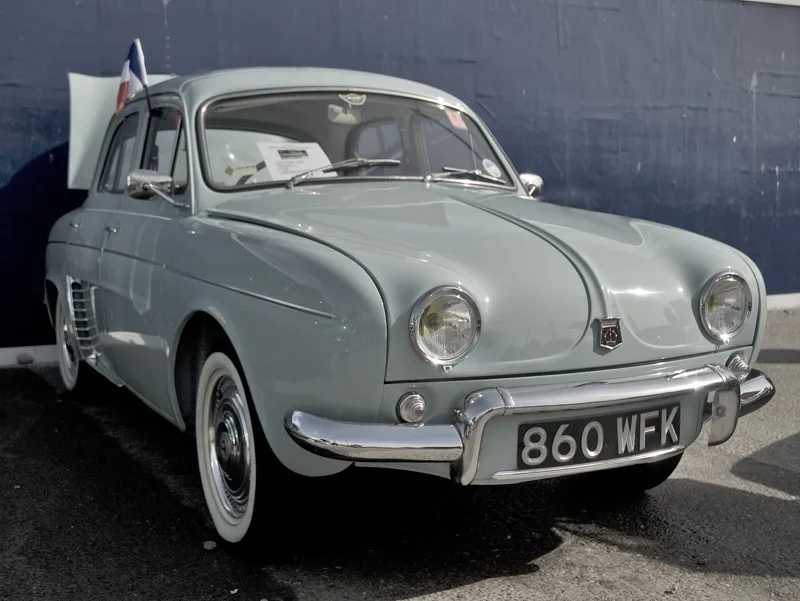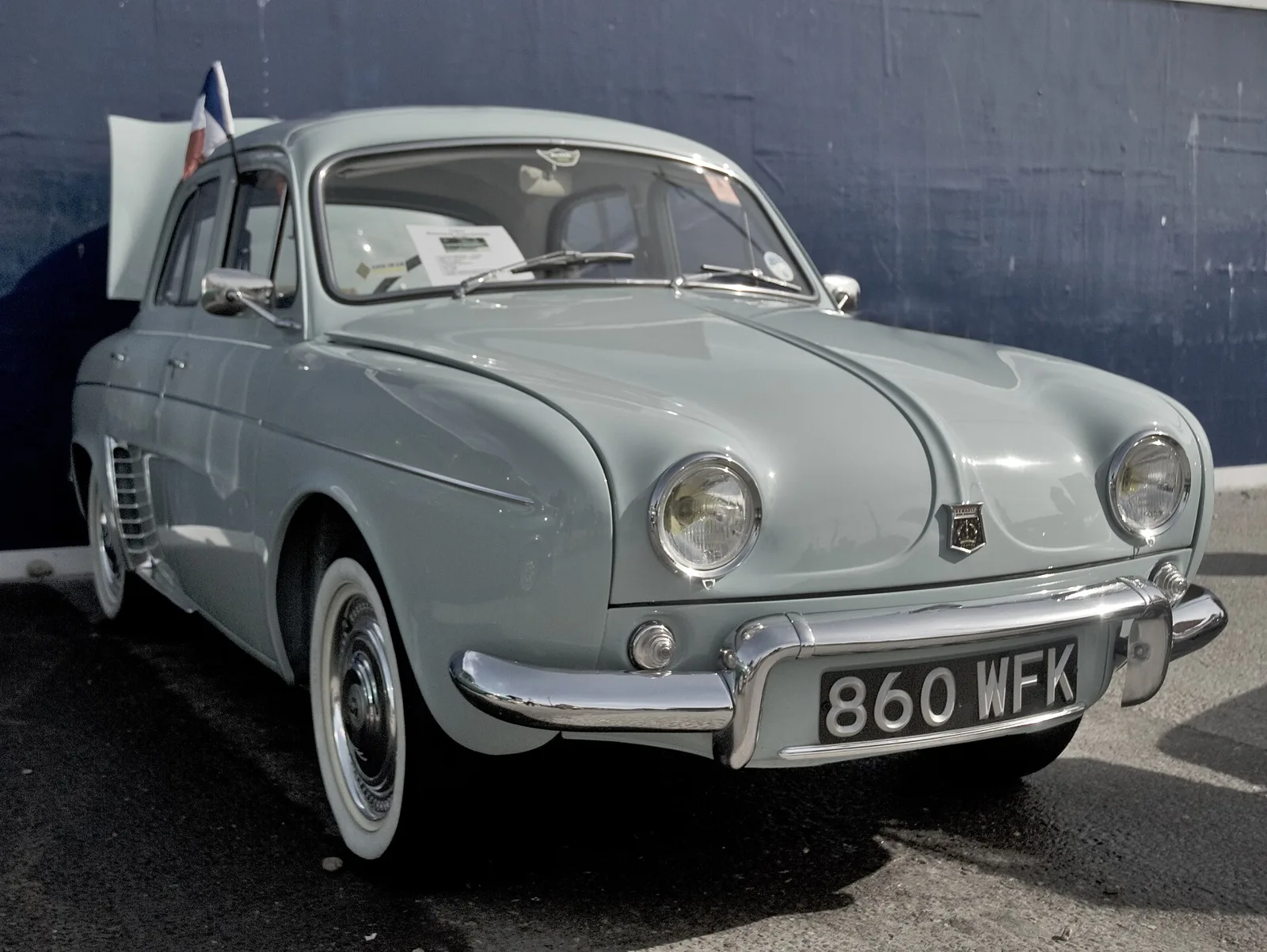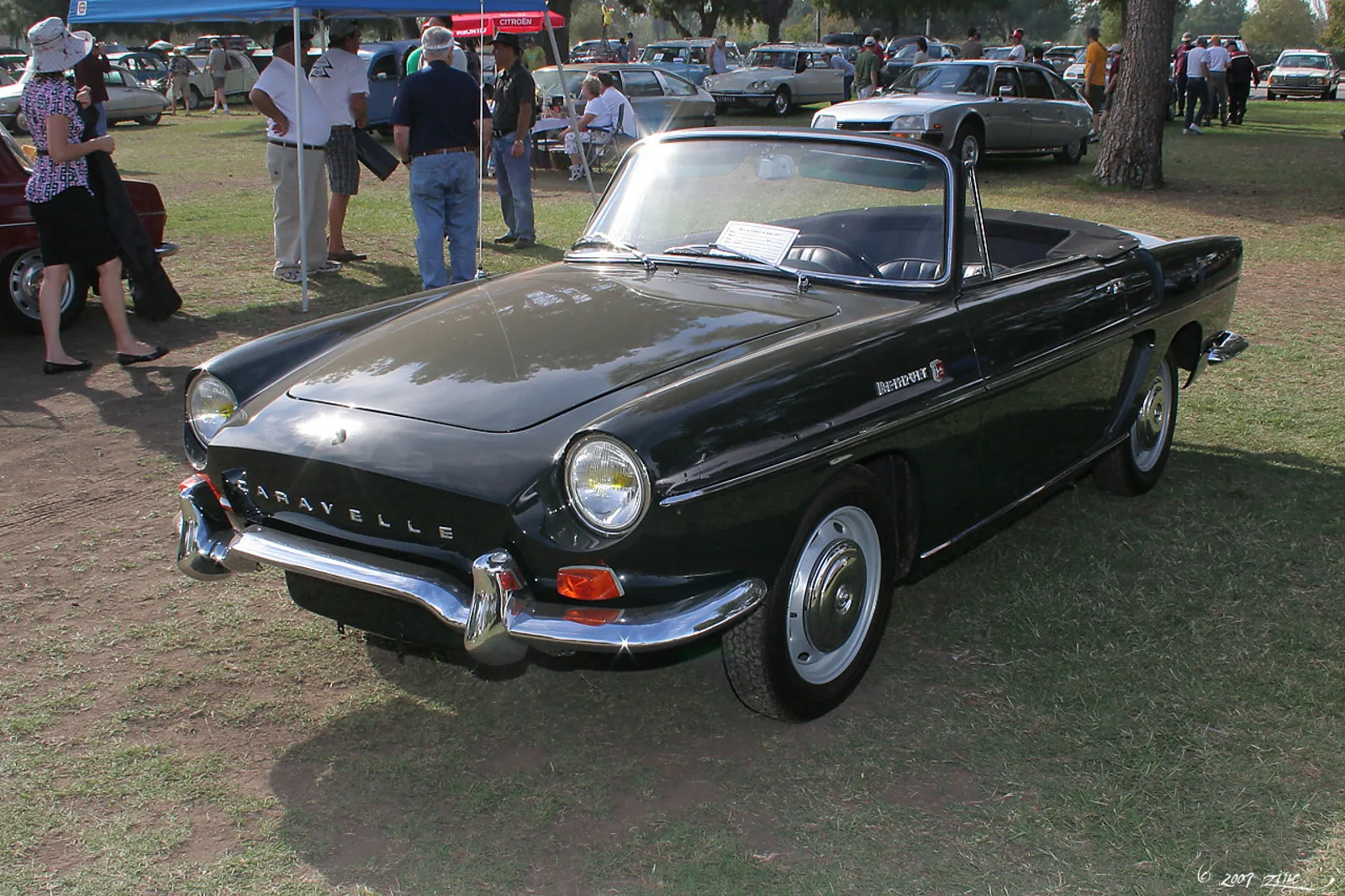
A Dauphine in an Italian suit, renamed because Floride was thought unsuitable for 49 US states, and the Renault 12 coupes that followed it.
The Renault Caravelle, sold as the Floride outside the English-speaking markets until 1962, was a Frua-styled rear-engined coupe or convertible built from 1958 to 1968 on the Dauphine floorpan. The Renault 15 and 17, made from 1971 to 1979, were coupe versions of the Renault 12.
A convention of Renault's North American distributors in Florida produced the car that became the Floride, and then the Floride name was judged unsuitable for 49 of the 50 US states. The Caravelle that went on sale instead was a Dauphine in an Italian suit, built from 1958 to 1968. Three years after it left the stage, Renault's next coupes arrived: the Renault 15 and 17.
Why was the Renault Floride renamed Caravelle?
Renault's US dealers asked for a Dauphine coupe at a convention in Florida, and the car became the Floride within the company. The name was thought unsuitable for the other states, so Caravelle was used in North America and in English-speaking markets such as the UK, and it replaced Floride everywhere from 1962.
The background was commercial. Renault had noticed the growing success of the Volkswagen Beetle in North America and was looking for a way to match it with the Dauphine. At the Florida convention its dealers asked for a coupe or cabriolet Dauphine that would lift Renault's standing in the vital American market. Chairman Pierre Dreyfus agreed. Because the idea had been born in Florida, the car was instantly the Floride inside the company, but naming it after one state could have implied disrespect to the others.
Outside North America and Britain, the Floride name stayed until 1962. In 2011 it came back on the Megane Coupe Cabriolet Floride, a special-edition convertible in ivory with a red and ivory interior, intended as a tribute to 1960s chic.
The Floride name was thought unsuitable for 49 of the 50 states of the United States.
What was the Renault Caravelle?
The Caravelle was a rear-engined, rear-drive sports car that Renault built from 1958 to 1968 in a single generation. Pietro Frua of Carrozzeria Ghia designed the coupe and convertible, which shared its floorpan and engine with the Dauphine. It was presented as the Floride at the 1958 Paris Motor Show.
The North American launch, as the Caravelle in the United States and Canada, came a year after its introduction in Europe. The car was offered as a 2+2 coupe, a 2+2 cabriolet and a convertible, which was the cabriolet with a removable hardtop. It kept the Dauphine's wheelbase of 2,265 mm (89.2 in) but had longer overhangs, which made it 320 mm (12.6 in) longer overall, slightly lower and very slightly wider.
What engine did the Renault Floride have?
At launch the Floride used the Dauphine's 845 cc water-cooled four-cylinder engine, mounted at the back. It differed in being fed by a 32 mm Solex carburettor, where the Dauphine had a 28 mm one. The cars on the 1958 Paris stand had a claimed 37 hp (28 kW) SAE.
By the time deliveries began in early summer 1959, buyers could also order a performance version engineered by Amedee Gordini. Reworking the inlet manifold and camshaft, and lifting compression from 7.6:1 to 8.0:1, produced 40 hp (30 kW) SAE.
The standard gearbox was a three-speed manual with synchromesh on the top two ratios. Buyers of the slightly heavier coupe could pay 200 New Francs more for a four-speed, and since power was limited, most did.
Who built the Renault Floride?
Frua was Italian, but the body was built near Paris by Chausson, based in Asnieres-sur-Seine and known in France for making many of the school bus bodies that carried children in country areas. Assembly was a different matter, and for that Renault went somewhere unexpected.
France had grown rapidly during the 1950s, and although demand for the 4CV had dropped and the Fregate was selling poorly, the new Dauphine was a hit, leaving Renault seriously short of capacity. The main Billancourt plant, on the Seguin island in the Seine, was ill-suited to expansion. A new plant had opened at Flins in 1952 and another near Le Havre would follow in 1964, but neither answered the question of where to assemble the Floride in 1958.
The answer was Brissonneau and Lotz, a heavy engineering company better known for railway rolling stock. In 1956 it had launched a small cabriolet on 4CV mechanicals, a tentative project that sold only around 200 cars. Renault persuaded it to give that up. Brissonneau's long experience with locomotives meant it had relevant know-how at both operational and workforce level, and Renault supplied much of the investment that turned its main Creil plant, 190,000 square metres of which 41,280 were covered, into a Floride factory during 1958 and 1959. The Floride was assembled there until it was withdrawn in 1968.
How was the Renault Caravelle improved?
The first big change came in October 1959, for the 1960 model year. The Floride and the Dauphine both received a new suspension conceived by the by now almost legendary engineer Jean-Albert Gregoire and called Suspension Aerostable by Renault. At the front, added rubber springs cut body roll. At the rear, air springs mounted inboard of the normal coils tilted the wheels slightly, giving them negative camber and more grip in corners.
March 1962 brought a new 956 cc engine, which the Renault 8 would share from June. This five-bearing "Sierra" unit shared no components with the 845 cc Dauphine engine, but was conceptually very similar, and its size was chosen to come slightly below the top of the French 5CV tax band. With it came a sealed cooling system, revised suspension at both ends, fresh steering and a new gear linkage. The radiator moved behind the engine, which gave 12 cm of extra space behind the front seat, and power climbed to 48 hp (36 kW).
The four-speed transmission, which some export markets already had at no extra cost, became standard even for French buyers, although first gear still lacked synchromesh. The upgraded cars, first shown at the 1962 Geneva Motor Show, also got disc brakes on all four wheels, making the Floride the first French volume car to have them and cutting unsprung weight by about 6 kg. In 1964 another engine from the Renault 8, of 1108 cc, joined the Caravelle with 55 hp (41 kW).
Britain's Autocar tested that model in November 1965. It reached 143 km/h (89 mph), covered 0-60 mph (97 km/h) in 17.8 seconds and returned 9.4 L/100 km (30.2 mpg imperial) overall. Performance closely matched the contemporary Triumph Spitfire 4, though the Triumph was a couple of mph quicker at the top. The Renault looked expensive next to it, with a UK recommended price of GBP 1039 against GBP 666 for the Spitfire, even allowing for the tariffs that still protected the British market.
How well did the Renault Caravelle sell?
Slowly at first, then strongly, then in decline. Only 3,777 cars were completed in 1959, but after the Aerostable upgrade Renault built 36,156 Florides in 1960. By the mid-1960s the fashionable styling was dated, and the removal of internal tariffs in the Common Market sharpened competition from inexpensive Italian sports cars.
Annual production fell from 4,880 in 1966 to 2,991 in 1967 and to 1,438 in 1968. Renault withdrew the Caravelle in the summer of that year.
What were the Renault 15 and Renault 17?
They were two versions of one coupe, designed and built by Renault from July 1971 to August 1979, and in effect coupe versions of the Renault 12. Both made their debut at the Paris Motor Show in October 1971. In Italy the 17 was sold as the R177, out of respect for heptadecaphobia.
Underneath, the chassis and most mechanical parts were Renault 12 items, yet the bodywork was all new. The differences between the pair lay mainly in the lights and the rear side windows. The 15 had two rectangular headlights, a simpler side profile and an unsplit rear side window that could still be opened, and it had no folding roof. The 17 had four round headlights, though some markets showed it with rectangular lights on TL versions. Its rear side glass came in two pieces: a retracting front section, and a hinged rear section tucked behind a louvre grille.
What engines did the Renault 15 TL and Renault 17 Gordini have?
The 15 TL used the Renault 12's 1289 cc engine with 60 PS (44 kW), while the more powerful 17 TS, later badged Gordini, launched with the 1565 cc A-Type from the Renault 16 TS with 108 PS (79 kW; 107 hp). The middle of the range shared a 90 PS version of the same engine.
| Model | Engine | Output |
|---|---|---|
| R15 TL | 1289 cc | 60 PS (44 kW) |
| R15 TS and R17 TL | 1565 cc | 90 PS (66 kW; 89 hp) |
| R17 TS, 1971 | 1565 cc, fuel injected | 108 PS (79 kW; 107 hp) |
| R17 TS and Gordini, March 1976 | 1647 cc, twin carburettors | 98 PS (72 kW; 97 hp) |
Four-speed gearboxes went into the 15 TL, 15 TS and 17 TL, while the 17 TS had five speeds. A fabric sunroof was available on the 17 TL and TS from 1973.
At the 1974 Paris Motor Show the 17 TS became the 17 Gordini, a name that stepped into the space left by the just-dropped Renault 12 Gordini. Only the badge changed. The TS and Automatic models also received a slightly larger 1605 cc engine.
A minor facelift in March 1976 replaced the 15's chrome grille surround with a body-coloured one and enlarged the headlights, which moved forward to sit roughly flush with the surround. The 17's grille also lost its chrome. The TS gained a 1647 cc engine like that of the R16 TX, but with twin carburettors instead of fuel injection, an apparent retrograde step. Top speed was around 175 km/h (109 mph). A five-speed manual with a centre shift lever was joined by an optional three-speed automatic.
How did the Renault 15 TL perform when tested?
Autocar tested a 1,289 cc Renault 15 TL in November 1972, soon after its UK debut. Top speed was 151 km/h (94 mph) and 0-60 mph (97 km/h) took 13.6 seconds, which left it near the bottom of the comparison list, but overall fuel consumption of 8.9 L/100 km (31.8 mpg imperial) was class-leading.
At GBP 1,370, it was priced slightly below a comparable Vauxhall Firenza Sport and Fiat 128 Coupe 1300, while Ford's Capri 1300L at GBP 1,123 undercut them all by a wide margin. Autocar concluded that anyone wanting more power could pick a stronger 15 or 17, and that apart from its modest output the 15 TL offered attractive styling, careful development, excellent comfort and a high level of equipment and safety.
Where were the Renault 15 and 17 sold?
The range reached Australia gradually from May 1973, starting with the 15TS and 17TL, and the 17TS promised later that year. These 1973 cars had unique features to meet local regulations (ADR), among them a stick-on mirror and sun visors borrowed from the Renault 12, and a "verandah" over the instrument panel to reduce glare, which was also fitted to North American and Scandinavian cars. Their high price made sales slow, and the 17TL was dropped in late 1974.
In August 1974 the 17TS (R1317, 1605 cc) finally arrived, and in early 1975 the 17 Gordini replaced it. Later cars added inertia reel seat belts, tinted glass, evaporative emission control and the Gordini's front suspension. In 1976 a last shipment of 1975 model year 17s was stockpiled ahead of the ADR 27A emission rules, and these, again because of the price, sold slowly through 1978.
The 17 also reached the United States, on and off until production ended in 1979, though sales stayed small. Apart from the Le Car, it was for many years Renault's sole US model. The last 17 Gordinis came only with a five-speed manual, a sliding roof and the 1647 cc engine, which gave 95 hp (71 kW) at 6250 rpm.
Did the Renault 17 Gordini go rallying?
In selected events, with one famous result. Renault, which had won the 1973 World Rally Championship, dropped plans to contest it, and instead the firm had the Alpine Competition Factory develop a high-performance 17 coupe using many A110 components for selected European events.
The engine, developed by Gordini, had a pair of twin-choke Webers, a hot cam, 11.5 compression, big valves and a tuned extractor exhaust. The body was very light, with fibreglass doors, boot and bonnet panels, plastic windows and a stripped interior, and the factory said weight was cut by more than 25 percent.
Its best-known outing was the 1974 "Press-on-Regardless" in Michigan, the American leg of the World Rally Championship. A Renault 17 Gordini driven by Jean-Luc Therier and Christian Delferier won it, and a similar car finished third.
What happened to the Renault 15 and 17?
The Renault Fuego, presented in March 1980, replaced both after production ended in August 1979. The cars were made by Chausson at Maubeuge, with final assembly and painting of the first series at Renault's Sandouville plant from 1971 to 1975. In all, Renault built 209,887 Renault 15s and 94,969 Renault 17s.
Rust and age have removed most of them from the road. In 2024 Renault unveiled a prototype electrified R17 restomod, made with Ora-Ito.