Chrysler's engineers found a normal 1930s car ran better backwards. The Airflow flopped, yet its ideas, and the slab-sided ponton body, ended up everywhere.
The Chrysler Airflow of 1934-1937 was the first full-size American production car designed around streamlining, with a unibody and engine moved forward. It sold badly, but its ideas spread. Ponton styling later folded fenders and running boards into one full-width body, the look of postwar cars such as the Mercedes-Benz Ponton.
In wind-tunnel tests at Chrysler in the early 1930s, engineers noticed something absurd: a conventional two-box car of the day was actually more aerodynamic when it was tested as if it were being driven backwards. That discovery produced the Chrysler Airflow, a car that nobody much wanted, and, indirectly, a whole way of shaping cars.
Built by Chrysler from 1934 to 1937, the Airflow was America's first full-size production car designed around streamlining. Its story runs on into the ponton body, the postwar shape in which fenders and running boards melted into a single slab-sided shell. Together they explain how the upright, fendered car gave way to a smooth, enveloping one.
Why was the Chrysler Airflow built backwards in the wind tunnel?
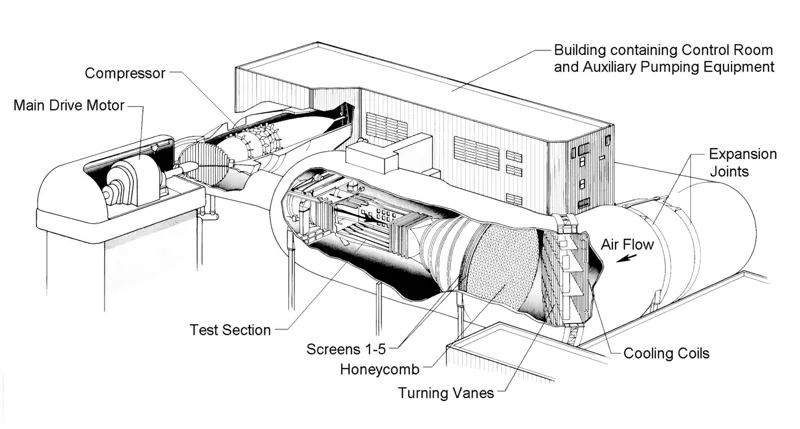
Chrysler engineer Carl Breer, together with colleagues Fred Zeder and Owen Skelton, ran wind-tunnel tests that Orville Wright helped with, looking for the shapes nature found most efficient and whether a car could use one. Chrysler built its own tunnel at Highland Park, and by April 1930 it had put 50 or more scale models through it.
The headline result was the backwards finding. Cars with upright radiators, headlamps and windscreens caught the air. With that lesson in hand the engineers turned to the structure underneath. A body that shared the load could be stiff without being heavy, so they began studying unibody construction as an alternative to a separate frame and body. A publicity reel demonstrated the strength. Chrysler's next unibody car did not come until 1960, the Forward Look designed under Virgil Exner.
Chrysler's engineers found that a conventional car of the day was actually more aerodynamic when tested as if driven backwards.
How did the Airflow change the way a car sat on its wheels?
A traditional two-box car carried about 65 percent of its weight over the rear wheels, and with passengers aboard that could rise to 75 percent or more. Handling on slippery roads suffered, and because the rear leaf springs had to be stiff to cope, the ride was harsh.
The Airflow flipped the layout. The engine moved forward over the front wheels, and the passengers moved with it, so rear-seat riders sat inside the wheelbase instead of perched on the axle. About 54 percent of the weight lay over the front wheels, evening out to nearly 50:50 once the car was loaded. That allowed more equal spring rates, better handling and a far better ride.
What did the Airflow look like?
Before the car appeared, Chrysler staged a stunt. It reversed the chassis of a conventional 1933 Chrysler Six, putting the front axle and steering gear at the back, and drove it round Detroit apparently backwards. The stunt caused near panic. Marketing hoped it would highlight how poor the aerodynamics of ordinary cars were and hint that something big was coming.
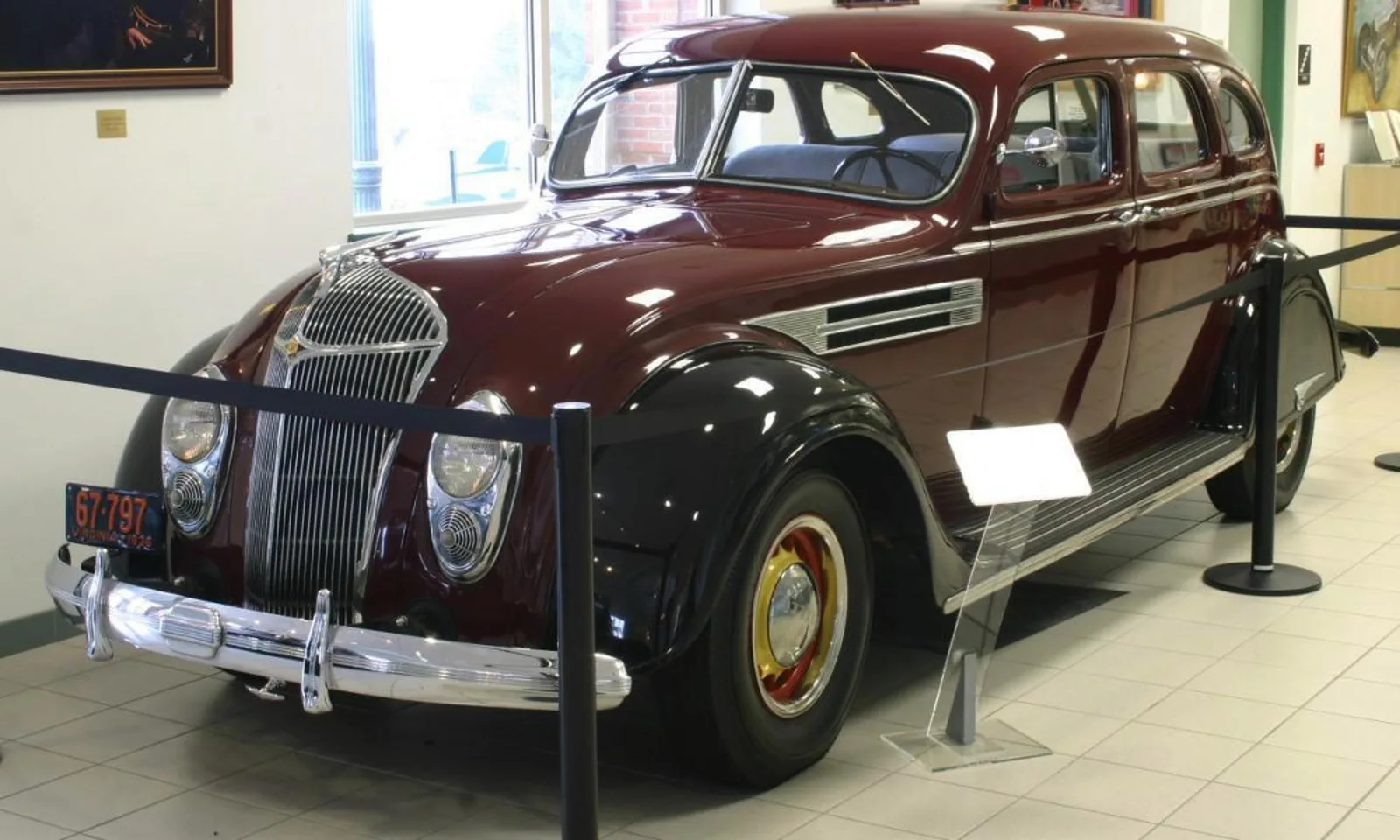
What came was like nothing else on American roads. Low and sleek, it had a grille that cascaded forward and downward in a waterfall, semi-flush headlights, front fenders that wrapped the tread of the tyre and skirts over the rear wheels. The windscreen was two sheets of glass forming a raked vee, side to side and top to bottom, and every window was safety glass. The body was all steel, at a time when General Motors, Ford and even Chrysler still used wooden framing, and it sat between the wheels instead of on top of them. The front seat was wider and the rear seat deeper than in other cars.
Why did the Chrysler Airflow fail?
It was introduced in January 1934, months before production began. Monthly output topped out at just 6,212, in May 1934, scarcely enough to give each dealer one car, because the factory had not allowed for the cost and difficulty of an unprecedented range of welding techniques. Early cars arriving in showrooms suffered from problems mostly traced to faulty manufacturing. Fred Breer, whose father Carl was the engineer, said the first 2,000 to 3,000 had major defects, among them engines breaking loose from their mounts at 80 mph (130 km/h).
Within six months the car was a sales disaster. General Motors ran an advertising campaign to discredit it, and rumours spread that the unfamiliar body was unsafe, which was largely false. A film shown in cinemas pushed an empty Airflow off a Pennsylvania cliff, more than 110 ft (34 m), then righted it and drove it away, battered but recognisable.
Most automotive historians nevertheless agree the main problem was how it looked. The hood, waterfall grille, headlamps and fenders merged into one continuous form that critics read as an anonymous lump. The car also arrived at the depth of the Great Depression and seemed too advanced for many buyers. In its first year it sold a respectable 10,839, yet Chrysler's traditional sedans and coupes outsold it by 2.5 to one. DeSoto, which had offered nothing else, fared far worse, and on its shorter wheelbase the shape looked short and stubby.
How did the Airflow decline year by year?
| Year | What changed | Airflow output |
|---|---|---|
| 1934 | Launch with waterfall grille, flathead eight and four Chrysler eight-cylinder lines | 10,839 sold in the first year |
| 1935 | Peaked grille replaces waterfall; Airflow Eight two-door sedan dropped | Below 8,000, about one for every four Airstreams |
| 1936 | Trunk added; grille more pronounced; Imperial leaves the Airflow range | 6,275, against more than 52,000 Airstreams |
| 1937 | Reduced to the Airflow Eight coupe and sedan; programme cancelled | 4,600 |
What did Chrysler do to rescue it?
Stung by the reaction, Chrysler changed the front. For 1935 a slightly peaked grille replaced the waterfall. For 1936 the Airflow gave up its smooth tail to a bolted-on trunk, and the grille grew more pronounced. Only one body style that year, the four-door Imperial sedan, broke the 1,000 mark, with 4,259 built. The Lincoln-Zephyr arrived in 1936, a streamlined V-12 car that sold much better.
The 1934 range itself was broad. The Chrysler line of eight-cylinder Airflows ran from the CU Airflow Eight on a 123.5 in (3,140 mm) wheelbase through the CV Imperial Eight and the CX Custom Imperial to the LeBaron-bodied CW Custom Imperial on 146.5 in (3,720 mm). The CW carried the industry's first one-piece curved windscreen on a production car. Chrysler of Canada built 445 Airflow Sixes in 1934 before dropping them.
A few Airflows found grand homes. One Imperial Custom Airflow CW limousine served as the official car of Manuel L. Quezon, the Philippine president, was restored in 1978 and again in 2009, and now belongs to a Presidential Car Museum inaugurated on 19 August 2018.
What did the Airflow leave behind?
The poor sales made Chrysler wary. Over four years it repeatedly toned down the grille and front end, and after the Airflow ended it went back to conventional designs, while other makers slowly took up some of its aerodynamic thinking. Writing in a 1977 history, Howard S. Irwin wrote that Ferdinand Porsche admired the engineering and began work on a smaller rear-engined design that Carl Breer had considered and set aside, citing the Volkswagen Beetle as evidence.
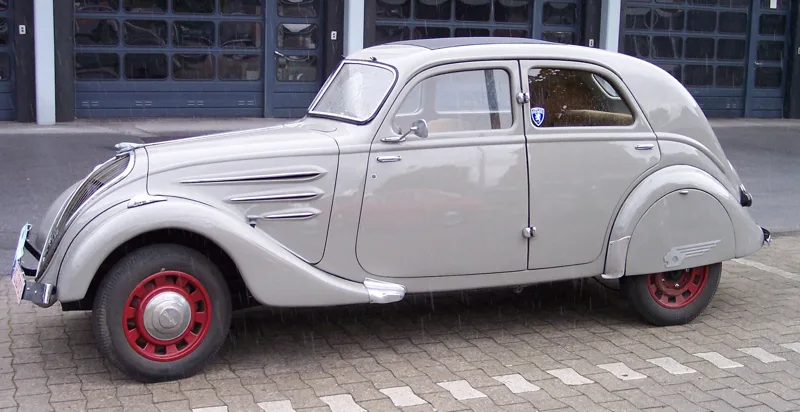
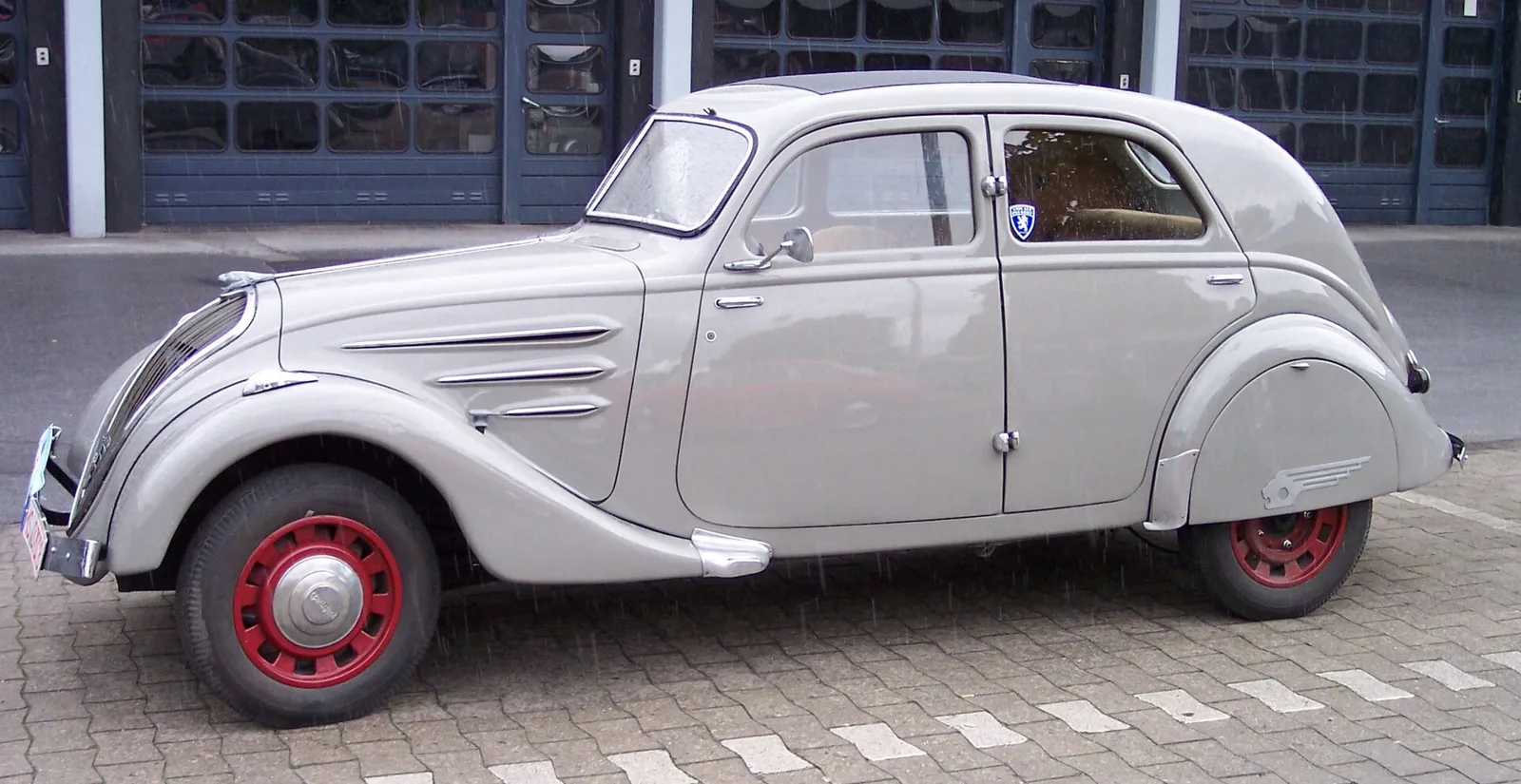
Designers around the world saw the benefits at once. American designers could not look past steel bodies, aerodynamics and moving the rear seat ahead of the axle. General Motors answered with all-steel Turret Tops and, from 1942 to 1950, a fastback coupe look across its nameplates, among them the Cadillac Series 61 Sedanette, Buick Super Sedanette, Oldsmobile 88 Club Coupe, Pontiac Streamliner and Chevrolet Fleetline. Elsewhere, where petrol cost more and practicality outweighed fashion, the imitation was more sincere. Volvo was among the first to put a smaller copy into production, Peugeot followed with the 202 and the larger 402, which became a major success, and the Airflow strongly influenced the first Toyota prototype and car, the Toyota AA.
Nearly a century on, Chrysler's retro PT Cruiser borrowed from the Airflow and the 1949 Chevrolet Advance Design. The artist Claes Oldenburg made a print and sculpture, Profile Airflow, with a lithograph of the car beneath an aquamarine resin relief; the original resin faded to olive green and the first printing was recalled.
What is streamline moderne, and what did streamlined cars of the 1930s look like?
The Airflow belonged to a wider fashion. Streamline Moderne grew out of Art Deco in the 1930s as an international design style drawing on aerodynamics. It stressed curving forms and long horizontal lines, with the occasional nautical touch, and designers used it on locomotives, telephones, buses and appliances to give everyday objects an air of speed and modernity. The French called it style paquebot, meaning ocean liner, after the liner SS Normandie. As the Depression deepened, industrial designers removed the ornament from Art Deco and kept the pure aerodynamic line.
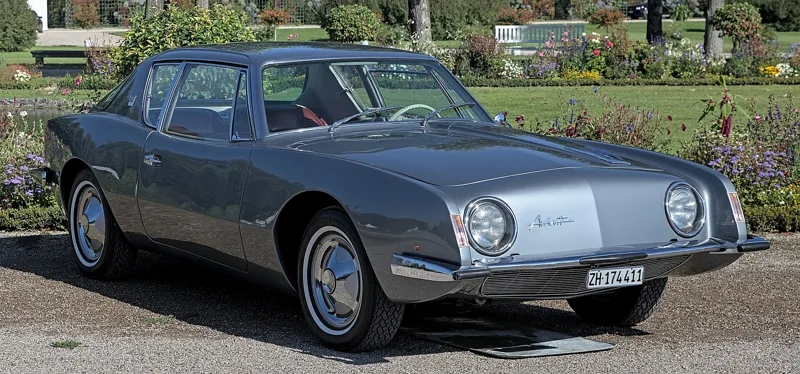
In the United States the style reached the public at the 1933-34 Chicago World's Fair. Car designers took the flowing lines of liners and airships: grilles and windscreens tilted backwards, bodies sat lower and wider, and curves and horizontal speed lines abounded. Among the examples are the Studebaker Land Cruiser and the Chrysler Airflow, both from 1934, and new materials such as bakelite, formica, stainless steel and enamel gave the interiors a feeling of newness. The Tatra 77 of the same year is credited as the first mass-market streamlined car, with the Airflow second. Later came the 1950 Nash Ambassador Airflyte and postwar Hudsons like the Commodore.
A rival school in Europe, functionalism, chased simple designs that cut production costs for the large working class.
What is a ponton car?
Ponton styling, also called pontoon or envelope styling, is a design genre that ran roughly from the 1930s to the 1960s. The body swelled out to cover the car's whole width and length in one piece, so separate running boards and fenders disappeared. The word comes from the French and German ponton, meaning pontoon. In America the most exaggerated version was sometimes called the bathtub look.
The term now sounds archaic, but it describes the bulbous, slab-sided postwar cars of Volvo, Renault, Rover, Fiat, Lancia, Borgward, DKW, Auto Union, Opel and Mercedes-Benz, plus similar designs from North America and Japan.
Where did the ponton shape come from?
The idea is older than the Airflow. In 1921 the Hungarian aerodynamicist Paul Jaray filed a patent for a streamlined car whose smooth lower body wrapped over the wheels, and a running prototype followed a year later. A ponton body also appeared on the Bugatti Type 32 Tank, which ran in the 1923 French Grand Prix at Tours. Back in 1922 the Romanian engineer Aurel Persu had patented a car with its wheels inside an aerodynamic body, claiming a drag coefficient of only 0.22. He had decided that the ideal shape was a falling water droplet, and Germany granted him the patent in 1924.
The Hanomag 2/10, designed by Fidelis Bohler and built from 1924 to 1928, was among the first production cars to have such a body. Its loaf-like shape earned the nickname Kommissbrot, after army bread. Bohler built it around two side-by-side seats and, to save weight, did without running boards and merged the fenders into the body. It sold well to cost-conscious Germans.
Italy supplied more examples. Vittorio Jano and the brothers Gino and Oscar Jankovitz built the one-off, mid-engined Alfa Romeo Aerodinamica Spider in 1935 on a 6C 2300 chassis. Pinin Farina drew a flowing ponton body for the Lancia Aprilia berlinetta aerodinamica in 1937, then an open one for the 1940 Aprilia Cabriolet. Shortly before the war Carrozzeria Touring built Superleggera bodies for the BMW 328 Touring Coupe, the 1938 Alfa Romeo 8C 2900B Le Mans Speciale and the 1939 Alfa Romeo 6C 2500 SS Berlinetta Aerodinamica.
Meanwhile the word pontoon had a different early meaning in America. It described 1930s front fenders that encased a wheel and ended in a teardrop point while staying distinct from the body, as on the Auburn Speedster, the Cord 810/812 and designs by Figoni et Falaschi. The 1938 Buick Y-Job, the industry's first concept car, integrated them further. The later and more familiar meaning came from the full-length tread armour fitted to German tanks, and British writers adopted it.
Which postwar cars defined the ponton look?
The 1946 Cisitalia 202 coupe, which Farina styled from sketches by Giovanni Savonuzzi, is the car New York's Museum of Modern Art said transformed postwar automobile design. MoMA acquired one in 1951 and noted that the hood, body, fenders and headlights flowed together in one continuous surface, a style it called the new fashion in Europe.
In America, the 1946 Frazer and Kaiser and the 1946 Crosley CC series were among the first with fresh postwar envelope bodies. The Frazer, designed by Howard Darrin, won the Fashion Academy of New York Gold Medal and was said to have inspired the 1949 Borgward Hansa 1500, the first German saloon in the ponton style. The Soviet GAZ-M20 Pobeda entered production in June 1946, within days of the first Kaiser, although only 23 were built that year and full-scale output began in mid 1947. Britain's answer, the Standard Vanguard, appeared in 1947, the year of the Studebaker Champion that Roy Cole and Virgil Exner designed. Its rear end made Americans smile and ask which way it was going, and it is sometimes wrongly credited to Raymond Loewy. In 1948 Czechoslovakia's Tatra 600 began production as a rear-engined car with an aeroplane-inspired body.
Ford and General Motors joined in from 1949. Ford's entries were the 1949 Ford in the United States, the Taunus P1 in Germany and the Zephyr in Britain. General Motors had the 1949 Chevrolet, the Vauxhall Velox in Britain after 1951 and the Opel Kapitan in Germany after 1953. Also in 1949, Nash launched cars Popular Science called the most obvious departure from previous designs, with fenderless pontoon bodies and a fastback shape that became a family look including the Nash-Healey.
The name stuck hardest to Mercedes-Benz. Models built from 1953 to 1962 are known as the Ponton, with titles such as the Ponton saloon and the 220S and SE coupes and cabriolets. A General Motors document calls the 1953 Opel Olympia Record its first Opel with a full-width body, a ponton shell. The Volkswagen Beetle kept its running boards and separate fenders, but the later Type 3 (1961-1974) was known for ponton styling, and in the Netherlands the two-door notchback was simply called the Ponton.
Where this goes next
In 2022 Chrysler said the Airflow name would return on an electric crossover SUV.