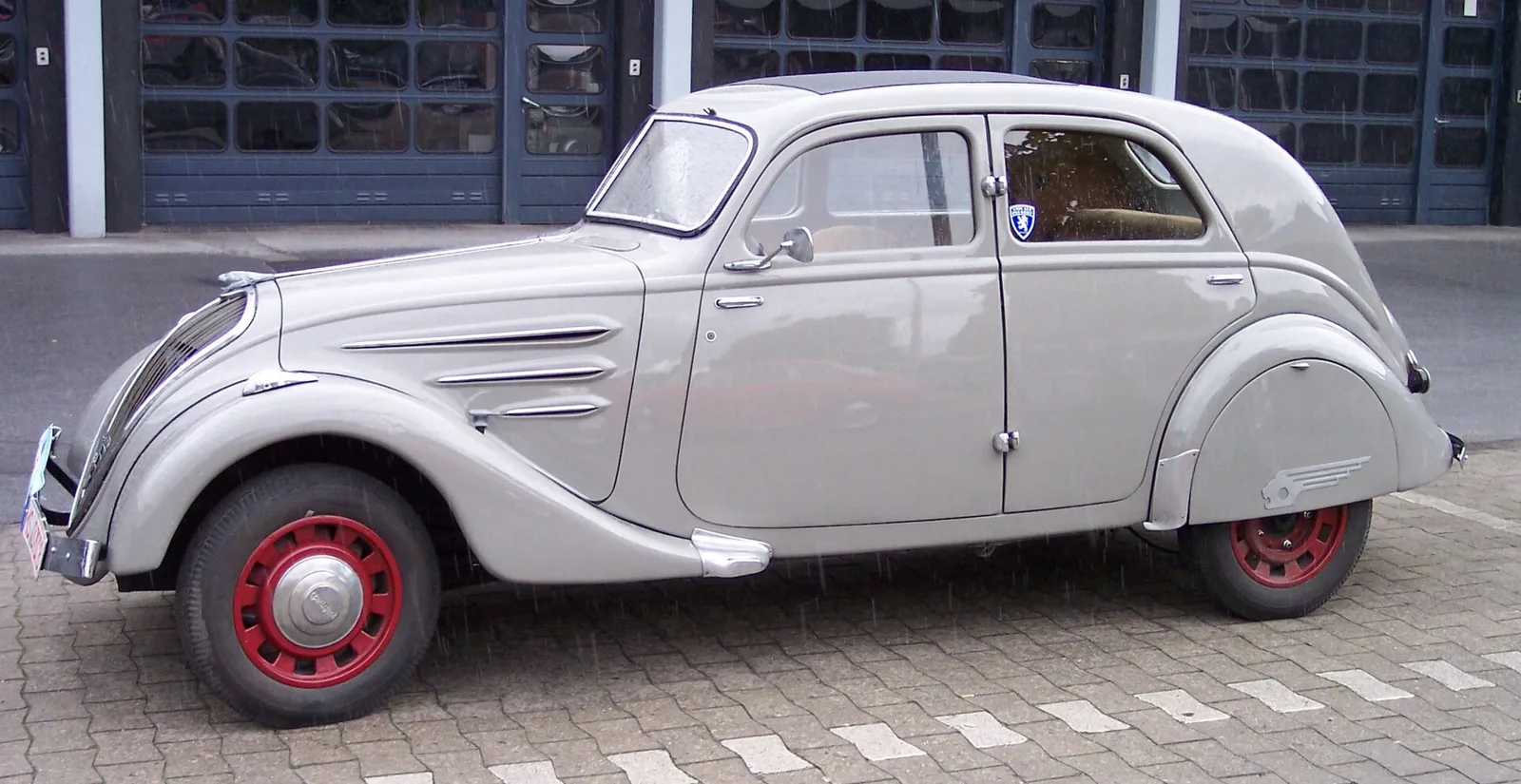
Sochaux's large 1935 saloon, styled with a nod to the Chrysler Airflow, sold in around 75,000 examples and kept running in wartime on charcoal gas.
The Peugeot 402 was a large Sochaux family car built from 1935 to 1942, replacing the 401. Its Airflow-inspired streamlined styling came in many body variants, the 1938 engine rose to 2,142 cc, and about 75,000 were built before the war ended production.
The Peugeot 402 was a large family car that Peugeot built at Sochaux, France, from 1935 to 1942. It appeared in 1935 to succeed the 401, and it became known for streamlined styling, a long list of body variants and wartime running on charcoal gas.
Where did the Peugeot 402 come from?
The 402 was shown at the Paris Motor Show in 1935 as the replacement for the Peugeot 401. Built at Sochaux, it was a large car that sat at the top of the family range, and its arrival marked a clear step forward in the company's styling.
Its shape was streamlined yet still a little Art Deco, and it owed much to the 1934 Chrysler Airflow. Peugeot pushed the idea further by moving the headlights into the centre, behind the grille, a move made sixteen years before General Motors showed its 1951 Le Sabre concept. Unlike the Airflow, the 402 was not a sales flop.
The car was followed by the 403, which arrived almost thirteen years after the 402 ended during the Second World War. The 403 was clearly meant as the 402's successor, once the market wanted smaller and cheaper cars.
A streamlined 1935 Peugeot saloon with sixteen body types, a diesel that almost reached the road, and a charcoal burner for wartime.
Why was the 402 nicknamed Fuseau Sochaux?
In France the 402 picked up the nickname Fuseau Sochaux, which loosely means the spindle or axis of the company's main plant at Sochaux. The name nodded to the car's body, which was directly modelled on the Chrysler Airflow after Peugeot bought one or two of those cars to take apart and study.
Streamlining was a fashion in French car design during the 1930s. Peugeot was one of the first volume makers to take it as far as the 402, and the smaller 202 carried the same look into a mass-market range.
Recessed safety door handles and the advertised automatic transmission and diesel options gave the car an air of innovation. Underneath, the 402 kept a conventional separate chassis, which made it simpler to fit a wide variety of bodies.
How well did the 402 sell?
Peugeot spent heavily on developing the car and on the tooling needed to build it. Measured against the standards of the time, the 402 was a popular seller, even though it occupied the high end of the car market. That spending showed how much the company wanted the car to succeed.
Advertising highlighted standard features that the company thought would tempt buyers. These included twin windscreen wipers with their own electric motor, semaphore-style trafficators, a clock on the instrument panel, twin sun visors and a fuel tank with a reserve section that could be switched on.
The 402 was also measured against Citroen's large Traction Avant, a comparison that remains hard to avoid. Citroen had been forced to hand its car business to its largest creditor, the tyre maker Michelin, in 1934.
How many body styles did the 402 have?
Even by the generous standards of the 1930s, the 402 range was large. The result was one of the most varied ranges of its day. One estimate counts sixteen body types, running from expensive steel convertibles to family saloons that were among the roomiest built in France.
All-steel bodies were costly, because the heavy presses and dies needed to stamp the panels were so expensive. The body range was therefore planned to share as many panels as possible between variants.
Several body types were priced for low-volume production, so the sharing of panels mattered even more across the range.
What were the three 402 wheelbases?
There were three standard wheelbases: 2,880 mm (113 in) for the short chassis, 3,150 mm (124 in) for the normal chassis and 3,300 mm (130 in) for the long one. The short chassis was added in 1937, borrowed from the short-lived Peugeot 302.
The normal wheelbase carried the standard saloon and most of the early body styles, while the long wheelbase took the Familiale, the taxi and several of the later variants.
What was the 402 Legere?
The 402 Legere, or light-bodied car, used the short 2,880 mm chassis from 1937. It paired the Peugeot 302's body and wheelbase with a 1991 cc engine from the 402, which lifted output from 43 hp (32 kW) to 55 hp (41 kW), both at 4,000 rpm.
That extra power changed the listed top speed from 105 km/h (65 mph) for the 302 to 125 km/h (78 mph) for the Legere. The car was built with minimal investment by reusing an existing bodyshell with an engine already in production, and about 11,000 were made.
From the outside the Legere looked almost identical to the 302. Its starting-handle hole sat below the 402 badge, because the engine was mounted slightly higher. A Cotal pre-selector gearbox was available at extra cost, with a lever placed behind the steering wheel.
Many accounts describe the Legere as a single model, but it came in at least three bodies. The four-door berline was priced at 24,900 francs in October 1937, while the two-door coach was listed at 30,900 francs and a decapotable convertible at 31,900 francs.
What body styles did the normal wheelbase offer?
The standard saloon, or berline, was first shown at the Paris Motor Show in late autumn 1935 on the 3,150 mm chassis. It was sold as a six-seater with two rows of bench seats, and the four-door version had three windows on each side. In 1936 it was the cheapest normal-wheelbase 402, at 23,900 francs.
The commerciale looked much like the berline but had a two-piece tailgate and could be converted for carrying goods. Some commerciales had a station-wagon style roofline, although most kept the saloon's silhouette.
The 1936 show also brought a Grand-luxe berline with a sliding steel sunroof, a 2-door soft-top cabriolet at 30,900 francs, a 5/6-seater coach at 29,900 francs, a roadster at 27,900 francs and the Eclipse coupe at 34,900 francs. By early 1937 three of these had been dropped from the list.
What was the Eclipse?
The Eclipse was a steel-roofed convertible whose roof folded into the boot, a clever arrangement for its period. Georges Paulin designed its retractable hardtop mechanism, and he patented it in 1931. The first application had just two seats, despite the generous 3,150 mm wheelbase.
Peugeot later built a longer steel-roofed Eclipse on the long chassis, with seating for four or five. The original 402 Eclipse decapotable was made with the Pourtout coachbuilders, and it is regarded as one of the world's first convertible hardtop production cars.
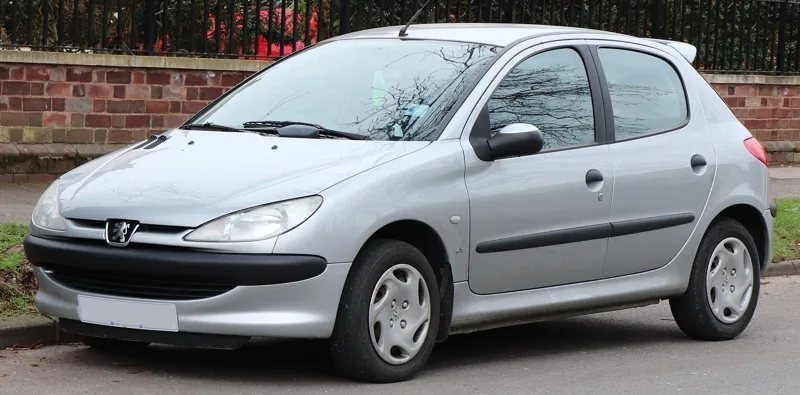
The idea returned decades later, with the 1995 Mitsubishi 3000GT Spyder and the 1996 Mercedes-Benz SLK-Class. Peugeot resumed hardtop convertibles with the 2001 206 CC.
What was the long-wheelbase 402 range?
The main long-wheelbase car in 1935 was the 402 Familiale. The long chassis was the largest of the three. It resembled the six-light berline but had extra length for a third row of fold-away seats at the back of the cabin.
By the 1937 show the commerciale had moved to the long chassis, in time for the 1938 model year. Peugeot also offered a taxi version, which it said was in service in Paris and other French cities by 1937, although the company never owned a Paris taxi business itself.
At the 1936 show a long-chassis cabriolet metallique decouvrable revived the Eclipse, with a second bench seat that was rather cramped. Light commercial and utility variants also appeared, and they grew in importance during the war years. Accounts differ on whether production ended in 1942 or ran on to 1944.
What engines did the 402 use?
The first cars used a water-cooled four-cylinder unit of 1991 cc, fitted with poppet valves. The standard body, rated at 55 hp (41 kW), reached 120 km/h (75 mph) at 4,000 rpm, and the petrol engine was the core of the range.
In 1938 the capacity rose to 2,142 cc with the 402B, whose output was 60 hp (45 kW). Other versions existed as well, and a Darl'mat performance coupe was quoted at 70 bhp (52 kW).
The diesel story is more interesting. Peugeot had made diesel engines at its Lille plant since 1928, and by 1936 it had readied the HL50 for light commercial vehicles. French rules at the time limited diesels in road cars, so Peugeot needed a special dispensation to fit one to the 402.
Several prototypes received the 2,300 cc HL50, claimed at 55 hp, by the end of 1938. In early 1939 several dozen long-bodied saloons were fitted with diesels and sold into the taxi trade, and their fuel economy was about 33 percent better than the 2.1-litre petrol car. The work fed into the 403, launched in 1959.
How did the 402 drive and stop?
The standard transmission was a three-speed manual driving the rear wheels. The Cotal three-speed automatic was offered too, but it was an elaborate system more often seen on upmarket cars from Delahaye and Delage. At 2,500 francs in 1937 it was too dear for most buyers.
Braking relied on mechanical, cable-operated drum brakes. By then the Citroen Traction Avant had hydraulic brakes, and cable systems were regarded as old technology that undercut the 402's modern image.
How did the war affect the 402?
France declared war on Germany in 1939, and the cabriolet and convertible versions vanished from the price lists. The April 1940 list showed only the standard-bodied and long-wheelbase saloons. That left the saloon as the core of the range. Peugeot's car line narrowed quickly.
The army had come to rely on Peugeot from 1938 onward. Several thousand 202s and 402s served with the armed forces in 1939 and 1940, and the long-wheelbase 402 was a favourite.
When fuel grew scarce, Peugeot adapted its engines to run on gas made by burning charcoal. Fuel restrictions shaped the car's last years, as they did for most civilian owners. A boiler holding 35 kg of charcoal sat on a platform at the back of the car, and it gave about 80 km (50 miles) before more charcoal was needed. Peugeot fitted more than 2,500 cars with the gas system during 1940 to 1944.
What was the Peugeot DK 5?
The DK 5 was a military truck that Peugeot built in the 1930s and 1940s for the French army. The Wehrmacht also used it after Germany conquered France. It rode on a dedicated truck chassis, and it combined the body of the 401 with the front of the 402 cut short to open up a large cargo bed.
It weighed about 1,790 kg (3,946 lb) and carried a payload of one and a half tonnes, powered by the 2,142 cc straight-four of the 402. About 12,500 were made, and the design led on to the later Peugeot DMA.
Where did the 402 appear on film?
Don Ameche drove a 402 taxi in the 1939 screwball comedy Midnight. It also appeared in the 1953 British film A Day to Remember, where Odile Versois drove one. Its screen career ran from 1939 to 1989, and each role leaned on its image as a taxi or a stylish period car.
The 402 appeared in several films and videos. Its later screen life included HP Baxxter's music video for Friends. Hayao Miyazaki also recreated a 402 for his 1989 film Majo no takkyubin.
What are the Peugeot 402 specifications?
| Specification | Detail |
|---|---|
| Production | 1935 to 1942, Sochaux, France |
| Engine at launch | 1991 cc four-cylinder, poppet valves, 55 hp (41 kW) |
| 402B engine | 2,142 cc, 60 hp (45 kW), from 1938 |
| Darl'mat performance coupe | 70 bhp (52 kW) |
| Diesel HL50 | 2,300 cc, 55 hp, prototypes and taxis, 1938 to 1939 |
| Top speed, standard | 120 km/h (75 mph) at 4,000 rpm |
| Legere top speed | 125 km/h (78 mph) against 105 km/h (65 mph) for the 302 |
| Wheelbases | 2,880 mm (113 in), 3,150 mm (124 in), 3,300 mm (130 in) |
| Legere output | 55 hp (41 kW) against 43 hp (32 kW) for the 302 |
| Transmission | Three-speed manual; optional Cotal three-speed automatic |
| Brakes | Cable-operated mechanical drums |
| Total built | About 75,000 cars |
| Legere built | About 11,000 cars |
| Gasifier conversions | More than 2,500, 1940 to 1944 |
| DK 5 truck | About 12,500 built, one-and-a-half-tonne payload, 2,142 cc |
The rows cover the petrol cars, the diesel prototypes and the military derivatives separately, so the figures stay tied to the versions they describe.