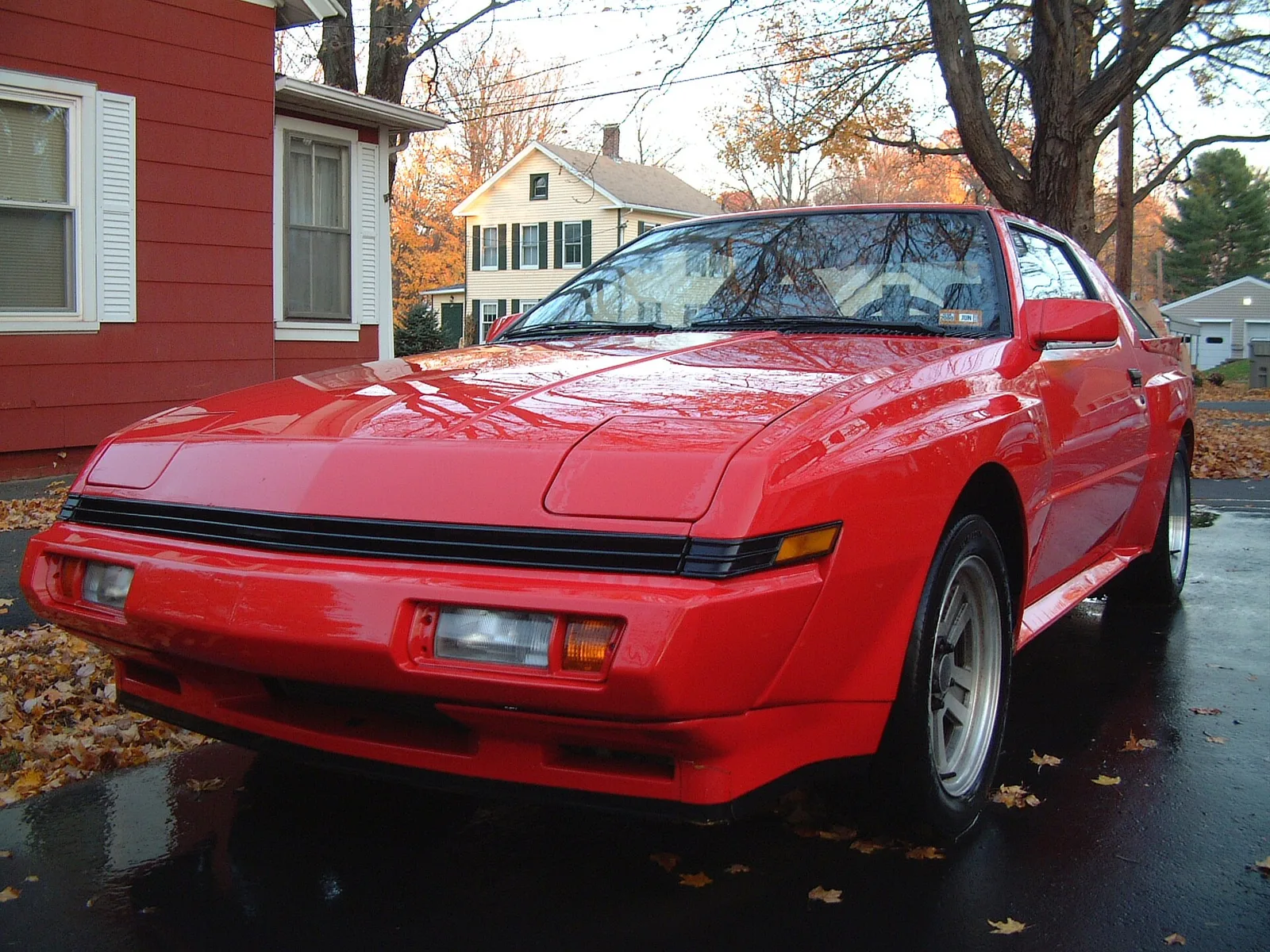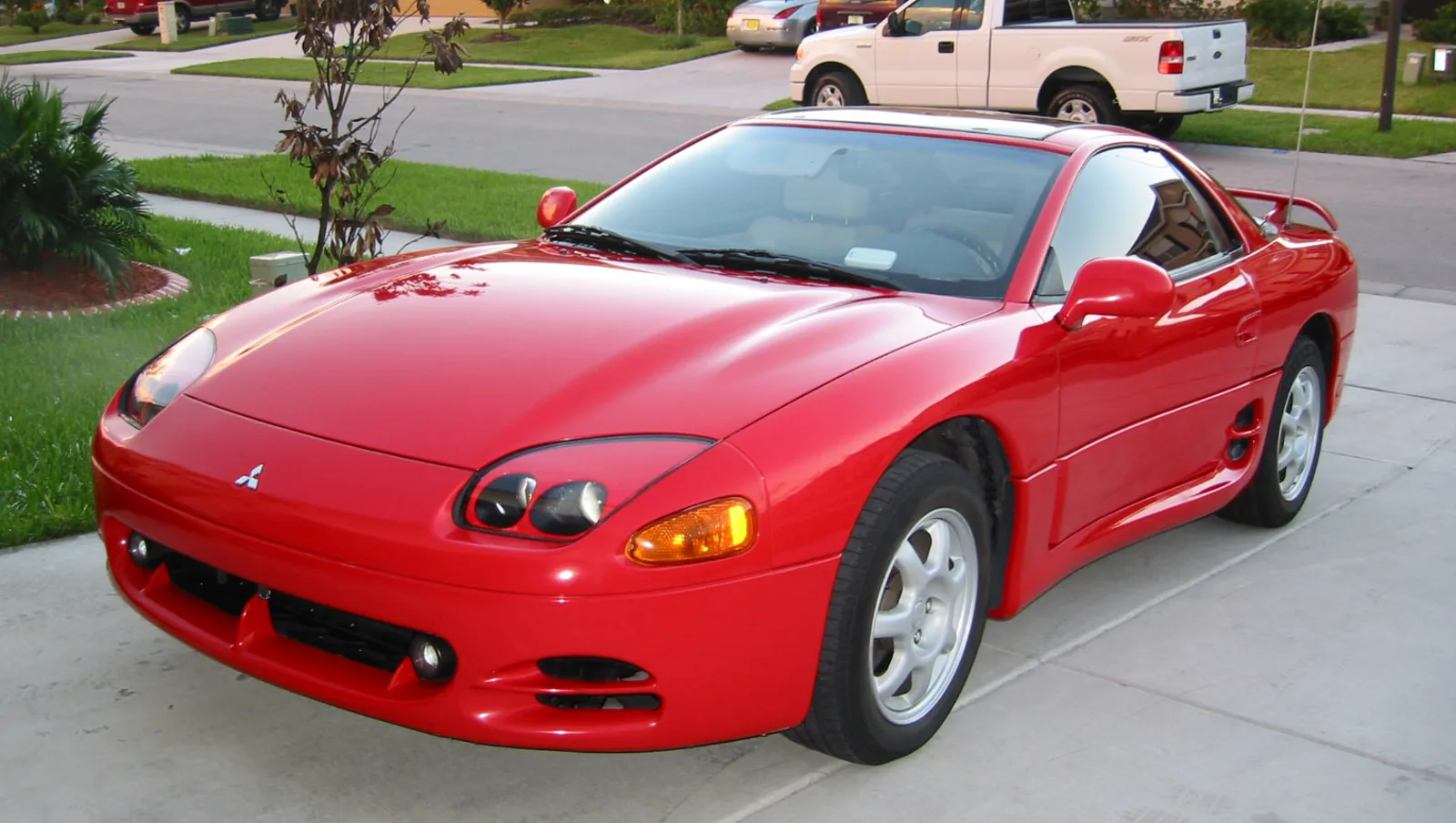
Known as the GTO in Japan and the 3000GT abroad, Mitsubishi's three-series grand tourer offered active aero, all-wheel drive and a Dodge Stealth twin.
The Mitsubishi 3000GT, sold as the GTO in Japan, was a front-engine 2+2 grand tourer built from 1990 to 2000 in three series. It used a 3.0-litre V6 with optional twin turbochargers, all-wheel drive and active aerodynamics, and a Dodge Stealth twin was sold in North America.
Mitsubishi revived the GTO name for a flagship that competed with the Mazda RX-7, Nissan 300ZX, Honda NSX, Subaru SVX and Toyota Supra. It was marketed in North America as the 3000GT and as the Dodge Stealth, a captive import built on the same line in Nagoya.
Why was the car called the GTO in Japan and 3000GT abroad?
Mitsubishi resurrected the GTO name after the HSR and HSX concepts at the 1989 Tokyo Motor Show. The company feared that enthusiasts abroad would object to the name, which was associated with the Ferrari 250 GTO and the Pontiac GTO, so it marketed the car as the 3000GT outside Japan.
The Japanese name came from the Galant GTO, a two-door hardtop of the early 1970s. GTO stood for Gran Turismo Omologata, meaning the car met motorsport homologation requirements.
A Nagoya-built grand tourer with four-wheel steering and active spoilers, sold under two names and one stubborn GTO legacy.
What was the 3000GT built on and what engines did it use?
The 3000GT was based on the Mitsubishi Sigma and Diamante and kept their transverse 3-litre 24-valve V6 with front-wheel drive. Naturally aspirated and twin-turbo versions were offered, and all-wheel drive, active aerodynamics, four-wheel steering and adaptive suspension were available on the higher-spec cars. All of them left the same Nagoya line, so export cars shared the core engineering of the Japanese models.
In North America the base 3000GT and SL had a DOHC V6 with 222 hp (166 kW), while the VR-4 and R/T Turbo produced 300 hp (224 kW) at 5,500 rpm from twin turbochargers. A 3.0-litre SOHC V6 with 164 hp (122 kW) powered the base Stealth.
Transmissions were a five-speed Getrag 440 manual, with a four-speed INVECS automatic offered on all but the turbocharged models. European cars used TD04-13G turbochargers at 13 psi (0.9 bar), compared with 9 psi (0.6 bar) on Japanese and US cars, to cope with sustained high speeds.
The European engine was rated at 286 PS (210 kW; 282 hp), and those cars reached showrooms in the autumn of 1992.
How did the first-series 3000GT work?
Early models were internally designated Z16A and used full-time four-wheel drive and four-wheel steering, which Mitsubishi called AWC. The Active Aero Control System gave the car a drag coefficient of Cd=0.33, with automatically deploying spoilers at the front and rear. The first series also had pop-up headlamps.
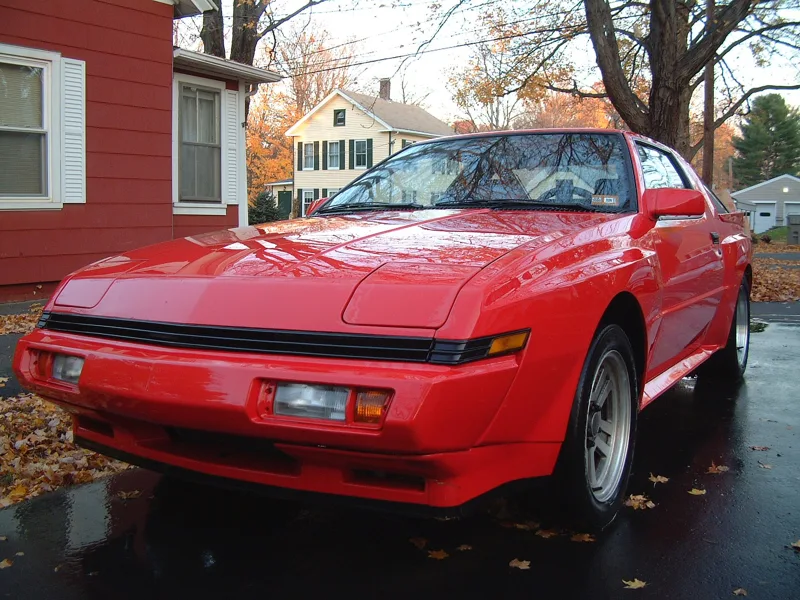
The first series had blister caps on the bonnet to clear the electronic control units, and an Active Exhaust System with sport and tour modes. The Dodge Stealth had a cross-hair front bumper and a crescent-shaped rear spoiler, and it did not carry active aerodynamics.
In 1993 the engine moved to four-bolt mains and a forged crankshaft, although some early production cars kept the cast crank.
What changed in the Series 2 facelift?
The 1994 facelift, Series 2, used projector-beam headlights and integrated sheet-metal blisters on the bonnet. Turbo output rose to 320 hp (239 kW) and torque to 315 lb ft (427 N.m), while Japanese models kept 280 PS (206 kW; 276 hp), and the interior was redesigned with dual airbags.
The VR-4 got a six-speed Getrag 446 manual with revised ratios, and 18-inch chrome wheels on 245/40 tyres from 1995. The base and SL cars used 16-inch wheels on 225/55 tyres.
Several features were dropped as prices rose. The tuneable exhaust went after 1994, the ECS after 1995 and the active aerodynamics after 1996. The Dodge Stealth ended in 1996, leaving only Mitsubishi-badged cars.
What was the GTO MR?
The GTO MR appeared in Japan in August 1994 as a lightweight variant. It deleted four-wheel steering, ABS, the ECS system and active aero, and used a 4.154 final drive ratio. It weighed 1,650 kg (3,638 lb), and its AWD split stayed at 45% front and 55% rear. Its chassis numbers began with Z15A, the code of the two-wheel-steer Series 2 cars.
Best Motoring, a Japanese television programme, filmed the MR beating the lighter R32 Skyline GT-R over a mile in acceleration. AP Racing six-pot brakes were an option on the N1 spec car.
How fast was the first-series 3000GT?
Automotive magazines quoted 0-60 mph times between 4.9 and 6.0 seconds for the first series, with quarter-mile times of 13.6 to 13.9 seconds at 95 to 98 mph. Dodge claimed 4.89 seconds for the 1991 R/T Turbo, and magazines praised the car's strong acceleration, grip and all-season AWD.
How did the second-generation 3000GT drive?
Road tests recorded 0-60 mph in 4.8 to 5.4 seconds for the second-generation VR-4, with a quarter mile in 13.5 seconds at 101 to 105 mph. Heavy but comfortable, the car could be driven quickly, although it understeered and offered little feedback.
The 1994 changes made every model lighter. The VR-4 came to 3,737 lb (1,695 kg) and the SL to 3,263 lb (1,480 kg). Popular Mechanics later tested a 1999 VR-4 at 13.44 seconds for the quarter mile, at 101.7 mph (163.7 km/h).
What was the third series like?
The 1997 to 2000 cars had an SOHC engine added after the Stealth ended, and a 1999 facelift brought a new front bumper, headlamps, turn signals and sail panels. Only the 1999 VR-4 carried the inverted-airfoil Combat Wing, and 1999 was the last year the car was sold in the US.
Japanese production ceased in 2000 as sales slowed and side-impact rules loomed, and two final cars were sold after that.
How did the 3000GT sell in Japan?
Japanese versions were sold through Mitsubishi's Car Plaza retail chain. Buyers paid additional annual road tax, and higher taxes applied because the car was classed as large under Japan's exterior dimension rules. The launch coincided with the softening economy that became known as the bubble economy.
Was there a retractable hardtop 3000GT?
Yes. Chrysler and Mitsubishi had ASC convert coupes into retractable hardtops, sold as the GT Spyder or VR4 Spyder for 1993 to 1995 and then as the Spyder SL and Spyder VR4 for 1995 and 1996. The conversion was described as the first fully automated retractable hardtop since the 1959 Ford Skyliner.
What was the Beckenbauer Edition?
The Beckenbauer Edition was a 1994 limited run honouring Franz Beckenbauer. All were painted Lamborghini yellow. Each car had a numbered plate signed by Beckenbauer, a Remus sports exhaust, OZ Futura rims and a C-Netz car phone. Only 30 were made, and they were sold through 1995.
What are the 3000GT specifications?
| Specification | Detail |
|---|---|
| Type | Front-engine 2+2 grand tourer; GTO in Japan, 3000GT abroad |
| Years | 1990 to 2000, three series |
| Engine | 3.0-litre 24-valve V6 |
| Drag coefficient | Cd=0.33 with Active Aero Control System |
| Series 1 turbo output | 300 hp (224 kW) in North America; 286 PS (210 kW; 282 hp) in Europe |
| Series 2 turbo output | 320 hp (239 kW); 280 PS (206 kW; 276 hp) in Japan |
| Transmission | Five-speed Getrag 440; six-speed Getrag 446 on VR-4 from 1994 |
| VR-4 weight, Series 2 | 3,737 lb (1,695 kg) |
| 1999 VR-4 quarter mile | 13.44 seconds at 101.7 mph (163.7 km/h) |
| Production | About 86,151 3000GTs and 65,303 Stealths |