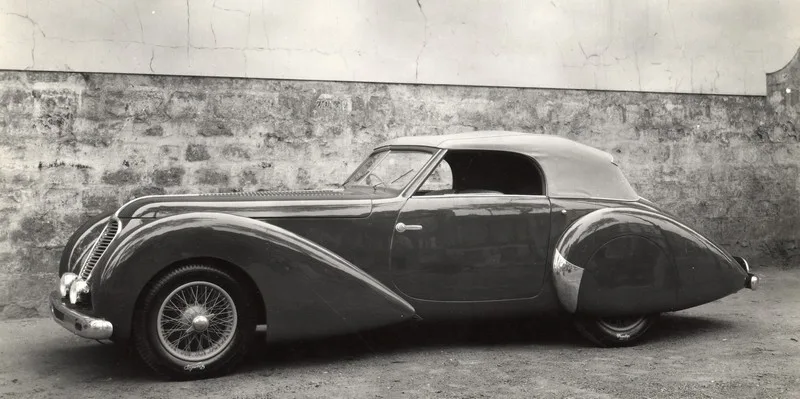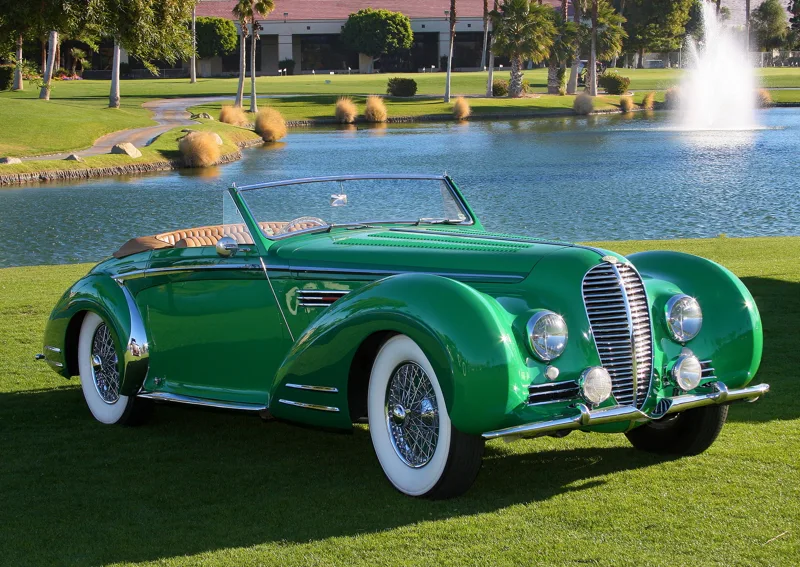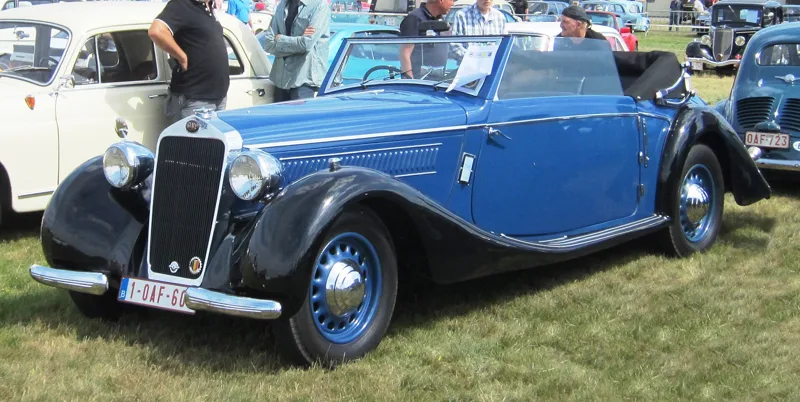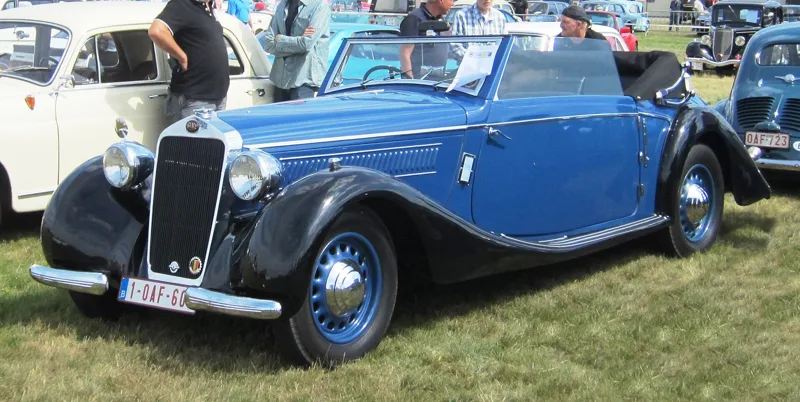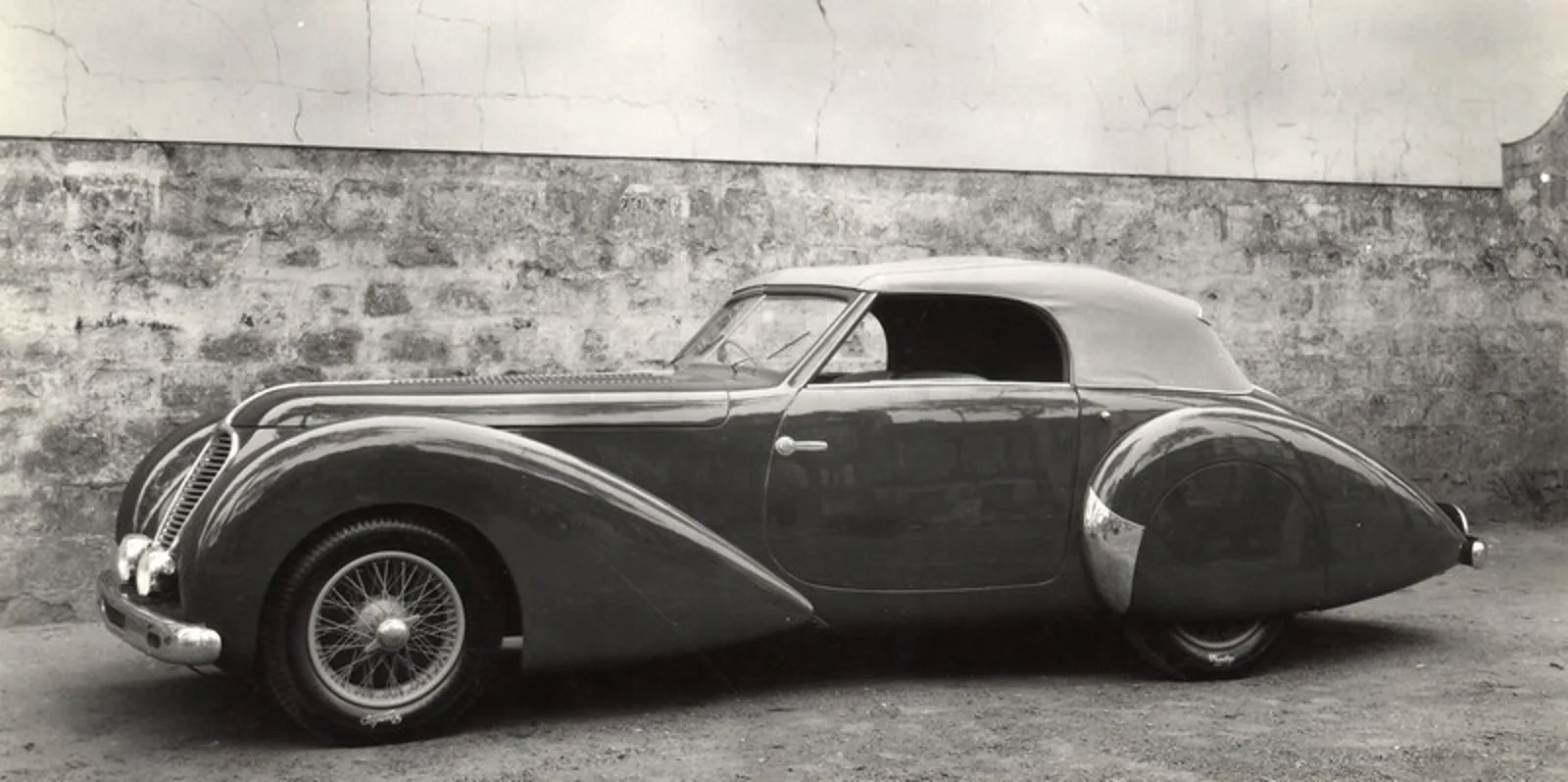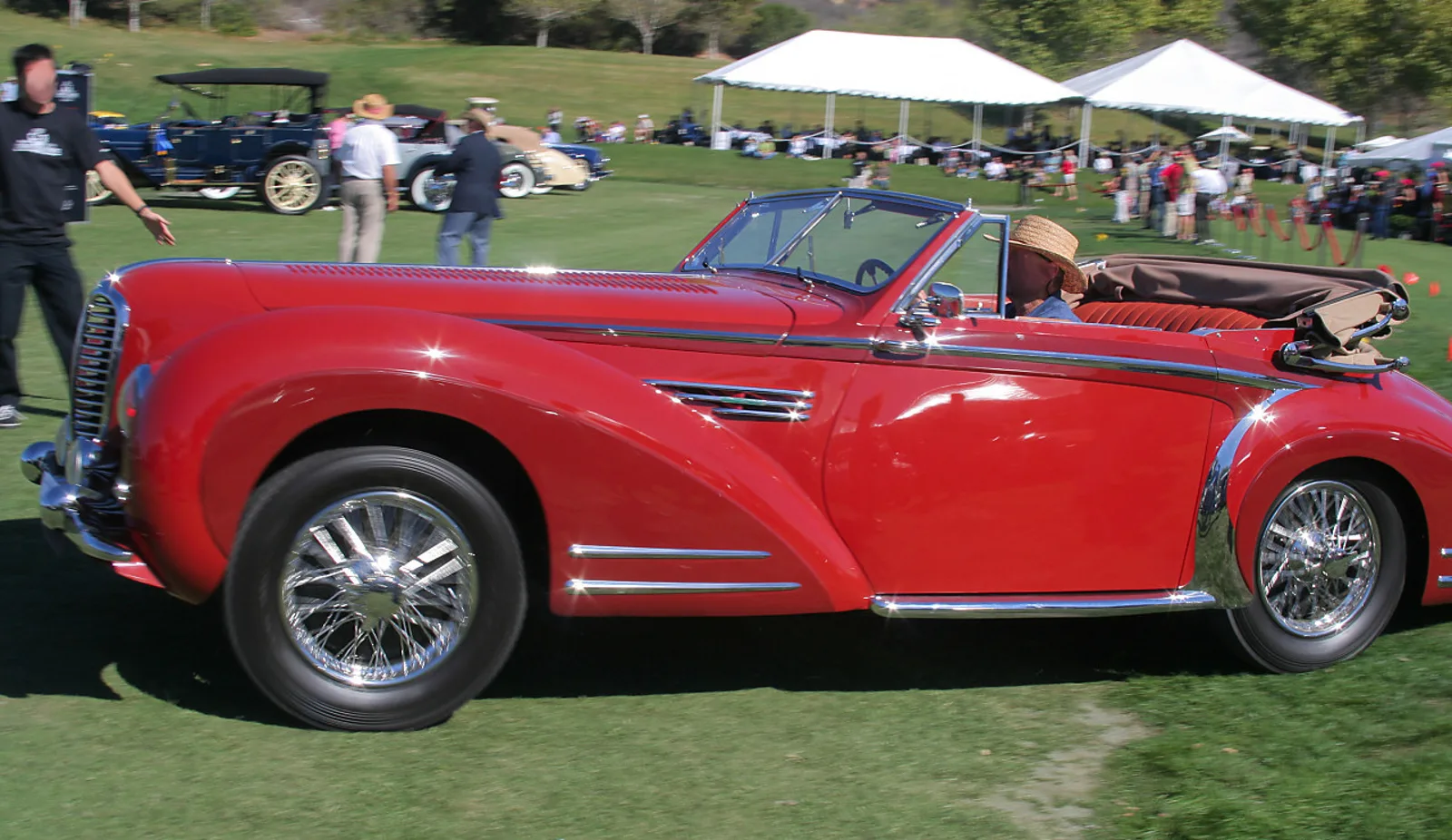
A post-war six-cylinder luxury car with a Dubonnet front suspension, bodies from outside coachbuilders and a production run that ended in 1951.
The Delahaye 175 was a 4.5-litre French luxury car built from 1948 to 1951 in three wheelbases, with 107 cars recorded. Its Dubonnet front suspension and heavy coachwork caused reliability problems that damaged the company's reputation.
The Delahaye 175 was a coachbuilt luxury car from the French maker Delahaye, built as a 4.5-litre series after the Second World War. Records confirm 107 cars across three wheelbases, and production ran from 1948 to 1951 before the company itself closed in 1954.
This profile covers the plans that came before the car, its chassis and engine, the suspension problems that followed, the racing variants and the production figures.
Where did the Type 175 come from?
The V12 Type 165 grand-tourer had raised Delahaye's prestige before the war, but it could not be sustained economically. The Type 175 replaced it in early 1948. Charles Weiffenbach, who ran the firm, intended to unveil the car at the October 1939 Paris Auto Salon, but the show was cancelled without notice as the German invasion loomed.
The shareholders wanted a simpler 4.5-litre engine, one litre larger than the Type 135, along with a new chassis. France was plunged into war in early June 1940, and that plan stopped with it.
The prototype was presented to shareholders for production approval in March 1944. Chief design-engineer Jean Francois had died in April of that year, and Delahaye had nobody qualified to take his place, so the schedule slipped further.
A post-war six-cylinder luxury car whose Dubonnet suspension and heavy bodies undermined a promising design.
When did the Type 175 reach production?
Production parts began in late November 1947, and deliveries extended into early 1948. The car was shown again at the Paris Auto Salon, which returned in October 1946 with a show chassis that had a partially built Letourneur et Marchand body.
The company's wider position was also shaped by the 1945 Pons plan, a five-year programme to rebuild French industry and attract foreign capital. Delahaye was designated to build sports and luxury cars for export, and over 80 percent of its chassis were sent to France's colonies.
Delahaye needed cash in the meantime. The Types 135 and 148L were re-introduced after the war to generate cashflow, and the Delage D6-70 continued as it had before the war, while the straight-eight Delage D8-120 was discontinued.
What made the Type 175 chassis different?
The 175, 178 and 180 chassis introduced a semi-monocoque concept with a welded stressed-steel floor-pan. The chassis was larger, wider and heavier than the Type 135, with boxed side-rails in place of open channels.
The cockpit sides were parallel-sided rectangles rather than tapering frame rails, which set a precedent for the series. The four-wheel independent suspension was a first for Delahaye, and the cockpit floor was welded to the chassis as a stressed member.
The rear axle used an independent De Dion layout with semi-elliptical springs. The brakes were dual Lockheed hydraulic units with deeply finned drums, and the four-speed semi-automatic Cotal gearbox was made by MAAG.
Delahaye also built the car as its first model exclusively in left-hand drive. It rode on eighteen-inch wheels, and its front design introduced the heart-shaped grille that became known as the Delahaye face.
Who designed the Delahaye face?
Philippe Charbonneaux, an in-house industrial designer, shaped the postwar front. His work gave the car a narrow, elongated, heart-shaped grille, flanked by lower side grilles with horizontal bars.
Coachbuilders were expected to follow the new front treatment. Joseph Figoni, Henri Chapron, Jacques Saoutchik and Marcel Pourtout were allowed some artistic licence within that brief.
What engine did the Type 175 use?
Power came from a naturally aspirated 4.5-litre overhead-valve inline six. It had seven main bearings rather than four. The standard car was reported at 140 horsepower, and the 175S option raised that to 161.
The optional 175S had three Solex 40-AiP carburettors and Rudge wire wheels. The 178 and 180 used a single Solex carburettor and steel wheels, and they were otherwise close to the short-wheelbase car.
The engine carried the 183 casting code. Early units were stamped Type 1AL-183, while most production engines were stamped Type 2AL-183. The change was made for production efficiency and manufacturing cost.
What was wrong with the Dubonnet suspension?
The Dubonnet front suspension proved problematic unless it was fastidiously maintained. Oil-seal leaks caused seizures and suspension collapses, and parts failures damaged Delahaye's reputation.
Delahaye was obliged to buy back defective cars to avoid litigation and negative publicity. The number of early cars affected was never disclosed.
The Dubonnet system had a longer history. It had been licensed to General Motors in 1933 and was also used by Alfa-Romeo, Simca and Vauxhall. After the war only Vauxhall and Delahaye kept it.
Why were the 175 cars so heavy?
Coachbuilders mounted hardwood body-frames under mild steel panels on chassis that were already heavy. The excessive weight hurt acceleration and speed, and it made handling worse.
Just Henri Chapron and Olivier Lecanu-Deschamp had experience forming and welding aluminium. Other coachbuilders used steel sheets fastened mechanically over hardwood frames, which made their bodies inordinately heavy.
Custom bodies were often too heavy for what the chassis had been engineered to carry. In dry conditions the cars were fast, but wet-weather handling was unpredictable, and poor-quality high-tensile steel from the early post-war era added to the problem.
How good was the 175S in competition?
Delahaye developed 175S racing engines for Charles Pozzi and for Eugene Chaboud, co-owner of the Ecurie Lutetia team and a French champion driver. They reportedly had a 9.1:1 compression ratio and three dual-choke carburettors, which delivered over 220 horsepower.
Those two racecars were reportedly comparable in power to three of the four Type 145 cars. The 175S also won the 1951 Monte Carlo Rally, although the result was not a commercial success.
Car 815042 finished twelfth in the Carrera Panamericana. Another Motto-bodied 175S coupe, 815051, was barred on a technicality.
How many Delahaye 175s were built?
Production was recorded from early 1948 to mid 1951, and 107 cars were built across the three-wheelbase series. The breakdown was 51 Type 175 cars, 38 Type 178 cars and 18 Type 180 cars.
Club Delahaye has recorded 25 surviving cars. Reportedly 12 of the Type 175s survive, along with 7 Type 178s and 6 Type 180s.
The Type 175 chassis were numbered 815001 to 815051. The show chassis was cycled back into production after the October 1949 show, and it probably went into the tail-end of 175S output.
What were the three wheelbases?
The Type 175 had a 2.95-metre wheelbase, the Type 178 a 3.15-metre one and the Type 180 a 3.35-metre one. All three series shared the 4.5-litre engine.
The Type 180 was built mainly for heads of state, dignitaries and corporate executives. Two Chapron-bodied armoured limousines were built in 1948 for the leaders of the French Communist Party.
A prototype Delage D180 was developed on the same basis, but it never went into production.
When did the Delahaye 175 leave production?
The Types 175, 178 and 180 ceased production in 1951. Delahaye introduced the Type 235 that same year, but it was only an updated version of the Type 135.
Output across Delahaye and Delage dropped from 511 in 1949 to 41 in 1952, then 36 in 1953. The company then suffered a 1953 fire that destroyed most of its administration and drawing office files.
How did Delahaye end?
Managing director Charles Weiffenbach tried to merge with several French automakers, without success. He then arranged a shareholder-approved merger in which Delahaye was the minority partner with Hotchkiss.
Delahaye closed for good on 31 December 1954. Hotchkiss itself merged with Brandt in 1956.