From a 1906 workshop to the Fleche d'Or and a 2024 revival, the Baroque coachbuilder shaped French luxury cars.
Saoutchik was a French coachbuilder founded in 1906 in the Paris area, known for baroque bodies and transformables in the 1920s and 1930s. It closed in 1955. A new company, formed in the Netherlands in 2016, revealed a 2024 sports car.
Saoutchik was a French coachbuilder working from Neuilly-sur-Seine, a suburb of Paris, and one of the leading names of the 1920s and 1930s. Its bodies were ornate, often expensive and sometimes theatrical, and the firm is remembered for transformables and pantograph doors. A new Saoutchik company, formed in the Netherlands in 2016, revealed its first design in 2024.
Who founded Saoutchik and where did the firm start?
Iakov Saoutchik founded the company in 1906, after training as a cabinetmaker and marrying that year. He started as a coachbuilder with no roots in carriage building. His workshop was on rue Dulud, and the first chassis he bodied was reportedly an Isotta Fraschini.
Accounts differ on whether Iakov was born in Ukraine or in Minsk, in what is now Belarus, and both places were then part of the Russian Empire. The family emigrated to France in 1899, and Iakov worked as a cabinetmaker until 1906.
Saoutchik's ambition was to become a leading maker of individually built car bodies, and he reached that position within a few years. The oldest known surviving car he bodied is a 1907 Clement-Bayard 10CV, and he stayed at the front of international coachbuilding until individual coachbuilding declined after the Second World War.
Transformables, pantograph doors and a low, flamboyant style made Saoutchik one of France's most famous body makers.
What were transformables and why did Saoutchik lead in them?
Transformables were big four-door cars with a top that opened fully and retractable side windows, which gave full weather protection and open-air motoring at once. Saoutchik was among the first coachbuilders to make them, which set his name apart from torpedo and phaeton makers.
The structure was demanding. Compared with the convertible sedan, which Americans use for a related type, the transformable had no fixed side frames or roof bars, so its top had to be stable, rigid and easy to work.
Saoutchik also built roadsters called torpedo brevete, a name meaning patented, on large Mercedes-Benz chassis. Appliques of nickel, later chrome, traced the main lines of each body, and some bodies used wood. The aim was a sense of spectacle that went beyond the chassis line.
Which chassis did Saoutchik dress in the 1920s and 1930s?
Saoutchik built bodies for large Mercedes-Benz chassis, along with Hispano-Suiza, Panhard & Levassor and Renault 40CV cars. Those bodies were usually more conservative than his later work. A Rolls-Royce Phantom II of 1930 (68 GN) was dressed as a Cabriolet de Ville in black, with subtle Art Deco detailing.
Saoutchik was one of the first to build extremely low-slung bodies, which he did in the early 1930s. Those designs looked more playful than the strict, formal structures of the contemporary Voisin. Buyers of such cars often went to other coachbuilders, among them Binder, Kellner and the Darrin partnerships.
A 1929 Bentley with a short chassis was bodied for an American customer as a three-position convertible, with a top that could open fully or only over the front seats, and an integrated trunk. Saoutchik combined French and British styling cues and used nickel silver appliques on it.
What was the Fleche d'Or?
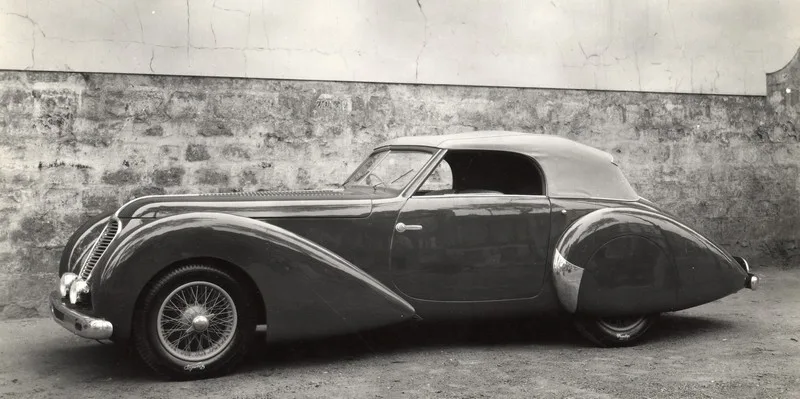
The Fleche d'Or was a berline constructed in 1932 on a Bucciali chassis, standing only 1.48 metres high on a length of 6.36 metres. Its front-wheel drive removed the propshaft that had forced a high floor, which made the ultra-low body possible.
Bucciali, with Tracta, pioneered front-wheel drive in the 1920s, but the TAV 12 was the biggest car of its type at that point. It also beat the two best-known American front-drive cars of its day, the Cord L-29 and the Ruxton.
The hood took almost half the length of the car. Huge wheels, panes that were more like visual slits, helmet-shaped fenders and no running boards completed the ultra-low look. Two spare wheels sat at the rear, which was accepted as a cost to traction.
Along each side ran flying stork ornaments, an almost deliberate contrast with the formal lines of the rest of the body. The original drawings went back to Paul-Albert Bucciali.
How did the rivalry with Figoni et Falaschi shape the 1930s?
Saoutchik and Figoni et Falaschi competed closely, both building the Baroque designs that defined French coachwork of the period. Delahaye and Talbot-Lago chassis were the favourites of both firms. The rivalry won awards at Concours d'Elegance events and kept both businesses going through the economic crisis.
Jacques Saoutchik complained in 1935 about the Americanisation of French coachbuilding, and the influence showed on Renault, Mathis and Rosengart cars. The French response also produced excesses of shape that now look pompous and exaggerated. For a few years this contest set the pace of French car fashion.
Which Hispano-Suiza bodies did Saoutchik build?
Saoutchik's Hispano-Suiza J12 and K6 bodies were mostly conservative, reflecting buyers who wanted formal cars. Most J12s received representative bodies, such as chauffeur-driven limousines, landaulets or transformables. The K6 work included a 1935 convertible that survives today. Their restraint suited the taste of the customers who commissioned them.
One J12 two-seater convertible had a "mother-in-law seat" and was made for a French industrialist. Pablo Picasso later owned it for many years. In the 1970s Italian maker Rio used it as the basis for a scale model.
In 2010 a Saoutchik transformable on a 1936 J12 chassis sold at auction for US$1.54 million. A 1935 convertible based on the smaller Hispano-Suiza K6 was also preserved.
What were the pantograph doors?
Pantograph doors were a sliding hinge system that Jacques Saoutchik patented in the mid-1930s. The door slid out to the side, then ran parallel to the body on struts before clearing the opening. Very few cars were built with this system.
The handle sits in the middle of the door's optical centre line, which is the clue to recognising the system when the car is shut. Only two otherwise conservative convertibles with this door are known.
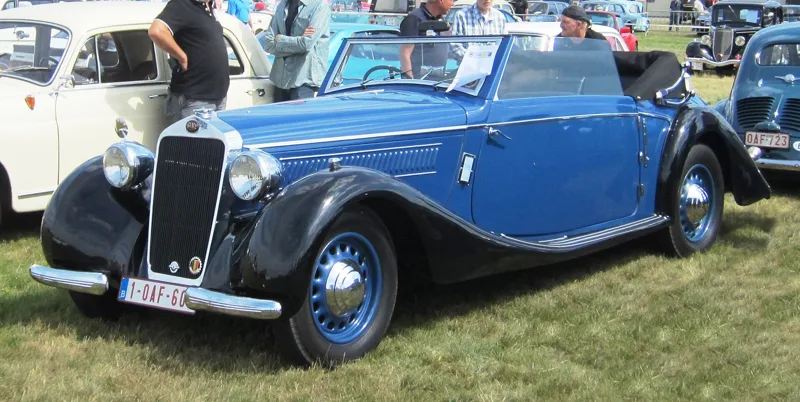
One was built on a 1939 Delage D8-120 chassis and could not be finished before the war began. It was delivered to the Elysee Palace in 1945 and became the first government car of President Charles de Gaulle. Originally black, like all government vehicles, it was later shown in red-bronze.
Saoutchik probably did not make that colour change, but he was one of the first French coachbuilders to use metallic paints. Today the car is finished in silver over black. A second car with pantograph doors, built on a Renault Suprastella chassis for General Marie-Pierre Koenig (1898-1970), is thought to have been lost.
What was the Dubonnet Xenia?
The Dubonnet Xenia of 1938 was a test vehicle for engineer and racing driver Andre Dubonnet, who was developing his Hyperflex suspension. It used a 1932 Hispano-Suiza H6 chassis that Dubonnet had bought in 1934, and it later gained hydraulic brakes.
Saoutchik's name was not on the design. Its drawings came from Jean Edouard Andreau, a designer and aerodynamics specialist, and the car has a very early panoramic windscreen as a result.
What one-offs did Saoutchik build on British chassis?
In 1938 Saoutchik gave a Jaguar SS100 a one-off roadster body on an early chassis, numbered 39107, and the car still exists. In 1940 he bodied a rare Bentley Mark V chassis that belonged to a sister of King Faruq of Egypt. The chassis had first been destined for Binder, and it arrived just before the war began.
The SS100 kept the factory's hood, radiator grille and headlights with their struts, but its fenders were massive and its rear longer and more curved than the original. The Bentley's restrained lines suggest the Binder style, which fits the car's first intended coachbuilder.
What happened to Saoutchik after the Second World War?
After the Second World War business fell as carmakers built their own self-supporting bodies. A high luxury tax under de Gaulle's government hit the market hard. Paul Saoutchik, who had taken over management in 1952, could not reverse the decline, and the company ceased operations in 1955.
The dwindling market pushed coachbuilders toward more extravagant designs. Those bodies were heavy and thirsty, with oversized fenders and bumpers that strained the front axle, and fewer customers were willing to pay for them.
A 1948 Cadillac convertible shows the late style: wide chrome strips run across the fenders, and the radiator mask was modelled on a shield. The car still exists and sold for US$649,000 at auctions in 2006 and 2010.
Figoni & Falaschi continued briefly after the war, and other makers joined the contest, including Franay, Freestone and Webb, and the newcomer Facel-Metallon, which later built cars under the Facel Vega name.
Which chassis did Saoutchik use after 1932?
After Antonio Lago separated the Suresnes factory from the Sunbeam-Talbot-Darracq group in 1932, Talbot-Lago cars became popular with coachbuilders, Saoutchik included. Delahaye's Type 235 and the Pegaso Z-102 also carried his work, and no more than 100 Pegaso cars were produced.
Talbot-Lago cars had robust six-cylinder engines of 2.7 to 3 litres with overhead valves. The Type 26 Grand Sport had a four-litre engine and almost 200 bhp, which made it one of the most powerful versions.
Saoutchik's Talbot-Lago designs sat between the flamboyant work of Figoni & Falaschi and the more reserved Chapron convertibles. They were elegant, and far less expansive than the Delahaye.
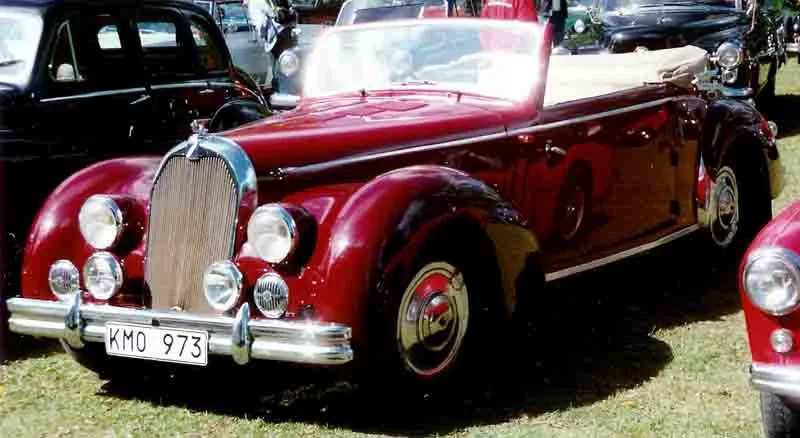
Delahaye's Type 235 drew bodies from several coachbuilders, among them Antem, Chapron, Figoni & Falaschi and Saoutchik. A 1951 cabriolet kept a fender line from the older style, and in 1953 Paul Saoutchik showed a pillarless coupe with a fastback tail, a design that would today be called a hardtop.
Did the Saoutchik name return?
Yes. The revived Saoutchik firm was set up in the Netherlands in 2016, specialising in automotive design, engineering and industrial design. In 2024 it partnered with Ugur Sahin Design to reveal the Saoutchik 300 GTC. Its first new design was a sports car, and the company plans a limited run of that model.
The 300 GTC takes its cues from the Mercedes-Benz 300SL and 680S, and its underpinnings come from the current Mercedes-Benz SL. The carbon fibre body panels come from Pogea Racing in Germany. The company plans 15 examples for what it calls extremely discerning clients.
Key Saoutchik bodies at a glance
| Year | Car | Note |
|---|---|---|
| 1907 | Clement-Bayard 10CV | Oldest known surviving Saoutchik car |
| 1929 | Bentley with short chassis | Three-position convertible for an American customer |
| 1930 | Rolls-Royce Phantom II (68 GN) | Cabriolet de Ville in black with Art Deco detailing |
| 1932 | Bucciali TAV 12 Fleche d'Or | Front-wheel drive; 1.48 metres high |
| 1935 | Hispano-Suiza K6 convertible | Preserved today |
| 1938 | Dubonnet Xenia | Test vehicle for the Hyperflex suspension |
| 1938 | Jaguar SS100 roadster | One-off body on chassis 39107 |
| 1939 | Delage D8-120 | Pantograph doors; delivered in 1945 |
| 1948 | Cadillac Sixty Two convertible | Sold for US$649,000 at auctions in 2006 and 2010 |
| 1951 | Pegaso Z-102 | Built to 1957, no more than 100 cars |
| 2024 | Saoutchik 300 GTC | 15 examples planned |