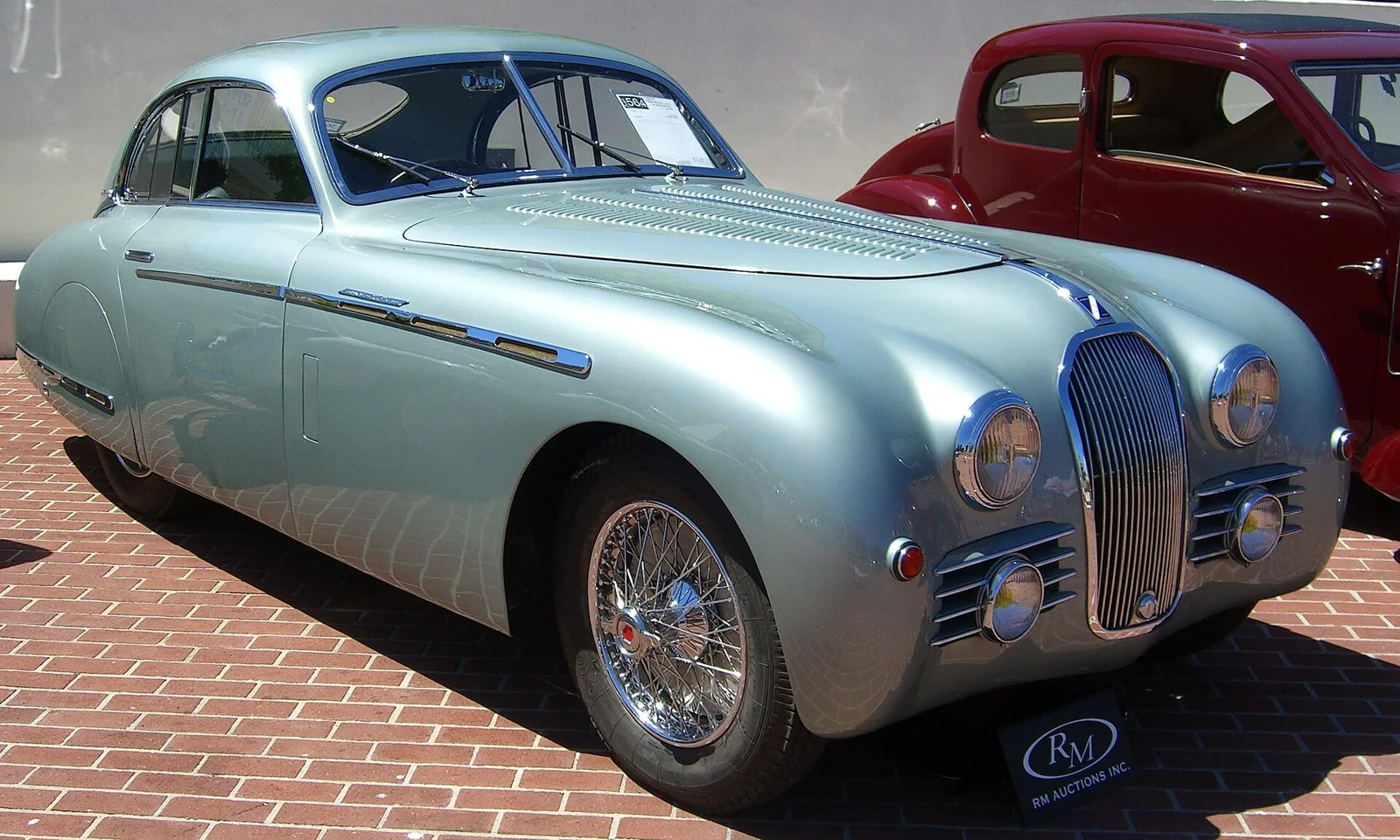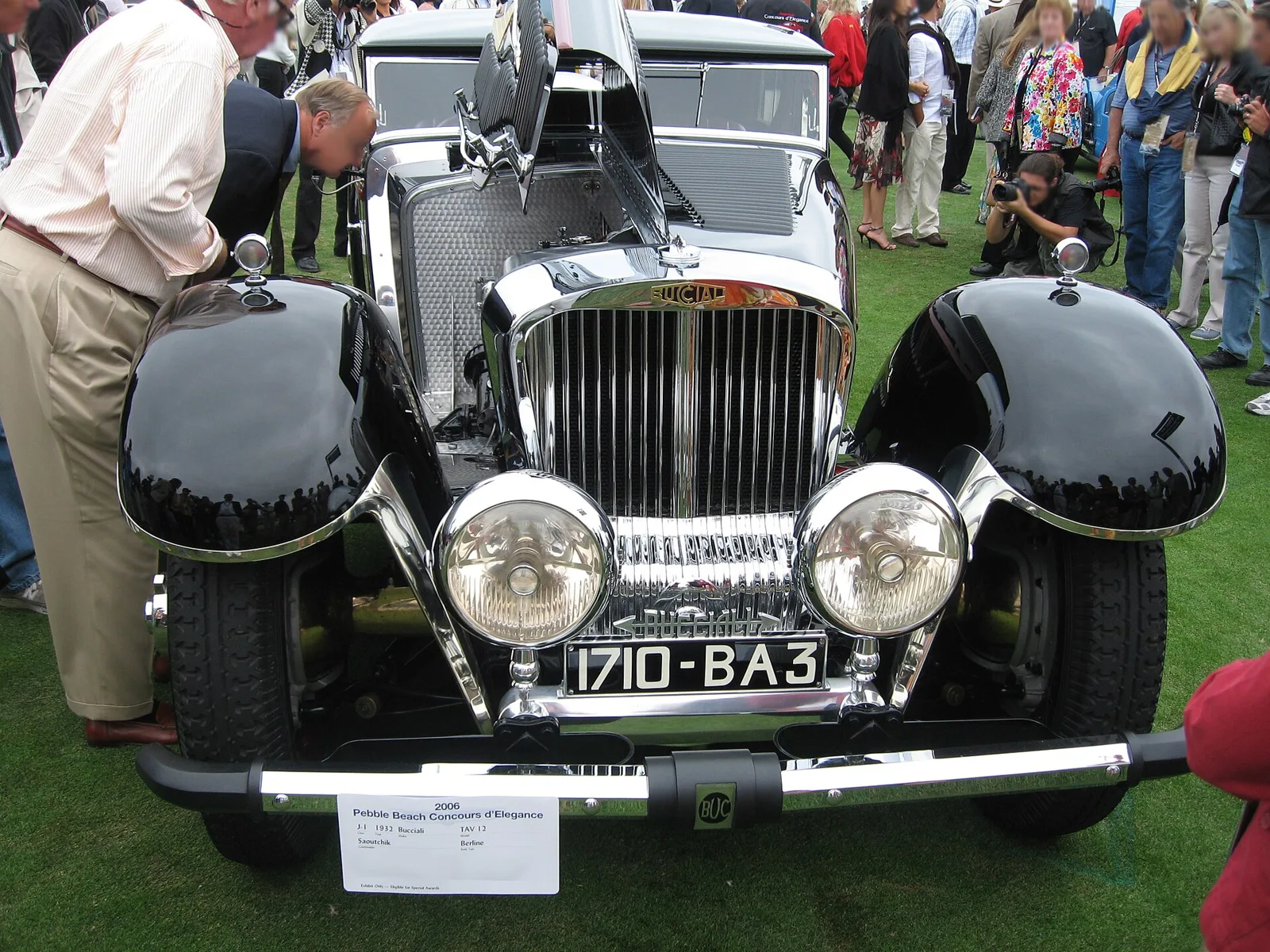
A 1932 four-door limousine with a 12-cylinder Voisin engine, a body nicknamed the golden arrow, and a life that ended in pieces before the war.
The Bucciali TAV 12 was a front-wheel-drive limousine from the French maker Bucciali, completed in April 1932 with a 4,886 cc 12-cylinder Voisin engine. Only one example is known to exist, and the car was broken into individual parts before the war.
The Bucciali TAV 12 was the last car built by the French firm Bucciali, a front-wheel-drive limousine completed in April 1932 for a businessman client. Its 12-cylinder Voisin engine and very low body set it apart from its contemporaries, and only one example is known to have survived. The car was dismantled before the Second World War and rebuilt from 1976 onward.
What is the Bucciali TAV 12?
The Bucciali TAV 12 is a four-door limousine from the early 1930s, with front-wheel drive and a 12-cylinder engine bought from Voisin. It is also known as the Type 7 and the 8-32. It was shown at the Paris Motor Show in October 1932, and only one example is known to exist.
The four-door body was nicknamed la fleche d'or, which means the golden arrow. The chassis and body were priced separately.
A single front-wheel-drive limousine built for one client, and the last model from a firm of brothers.
What does the name TAV 12 mean?
TAV stands for Traction Avant, the French term for front-wheel drive. The 12 is usually read as the cylinder count, although some reports link it to the tax class instead. The car is also known as the Type 7.
Who were the Bucciali brothers?
Angelo Bucciali (1889-1981) and Paul-Albert Bucciali (1887-1946) were brothers from a Corsican family, born in Boulogne-sur-Mer. After the First World War they founded Societe Bucciali Freres in Courbevoie, and the company built small sports cars from 1922.
Those sports cars were conventionally styled, and conventional car production ended at the close of 1925. From 1926 the firm worked as an automotive engineering design house, and it presented a new design at each October Paris Motor Show that followed.
Why did Bucciali focus on front-wheel drive?
From 1926 the brothers concentrated on front-wheel-drive designs, an approach that had drawn attention after Harry Miller's Miller 122 surprised at the Indianapolis 500 in 1925. The company's first front-wheel-drive car was the TAV 1, which drew on ideas from Robert Dimitri Sensaud de Lavaud.
Later developments resembled the 1929 Cord L-29, and the brothers sold rights to some of their ideas to the Peerless Motor Company. Peerless failed in 1931 before it could use them. The brothers often announced mass production, but the literature doubts how serious they were about it.
Who commissioned the TAV 12?
The TAV 12 was built for Georges Roure, who had watched the 16-cylinder Double Huit at the 1930 Paris Motor Show. It was built for a client rather than primarily for show.
Roure first ordered a copy of a 1930 convertible fitted with a V16. The brothers could not supply one, because the V16 on display in 1930 was a prototype with no working internals. Roure then ordered an American 8-cylinder Continental engine before changing to a 12-cylinder Voisin unit.
How did the convertible differ from the limousine?
The first version was a two-door convertible that appeared in the fall of 1931. Its body came from Emile Guillet, the owner of a coachwork factory, and the customer soon gave it up because he disliked its lines.
The convertible was taken to Nice in November 1931, where it won an honorary prize. The four-door Berline that replaced it, nicknamed la fleche d'or, was begun in early 1932 and was delivered in April 1932 after the chassis and body were finished.
How big was the TAV 12 Berline?
The four-door Berline measured 6360 mm long on a 4089 mm wheelbase and stood only 1480 mm high. It rode on 24-inch wheels, and its body was described as the lowest car of its time.
The body was of mixed construction, with steel sheet on a wooden frame. Paul-Albert Bucciali is credited with the design, and the metal parts were made at Saoutchik in Neuilly-sur-Seine. The car had no running boards, and its headlamps sat on the front bumper.
A stylised stork appeared on the hood vents, a nod to the Escadrille des Cigognes, and two spare wheels were stacked at the rear. Critics described the bodywork as sensational but impractical.
How was the TAV 12 engineered?
The TAV 12 used a steel frame, front-wheel drive and independent suspension at both ends, a layout Paul-Albert Bucciali had patented in 1928. Its 4,886 cc 12-cylinder engine came from Voisin, and its output is given as 180 bhp (132 kW) or 120 bhp (88 kW) depending on the report.
- The Voisin engine was designed for a rear-wheel-drive car, but it sat inverted in the Bucciali, which put the flywheel and clutch at the front.
- Four Zenith carburettors prepared the mixture.
- The four-speed gearbox was the firm's own design, laid crosswise ahead of the engine, with the differential ahead of that.
- Front drum brakes were internal and worked through the drive shafts.
What did the TAV 12 cost?
The chassis cost 130,000 French francs and the body 85,600 French francs, so the two costs can be read separately for a car built to a client's order. Roure took delivery in April 1932 and sold it shortly afterwards to a Parisian banker.
The car was presented at the Paris Motor Show in October 1932, which was the last time Bucciali had a stand at that show. A TAV 30 convertible stood alongside it, and that car was powered by a Lycoming eight-cylinder engine.
Was the TAV 12 mass produced?
No. Only one car of this type is known to exist, and the literature considers a single unit to be the probable total. One report claims that two similar Voisin-engined cars were built in 1932, but there is no proof for that claim.
A two-year-old TAV 30 chassis later received a limousine-style body, although it kept its eight-cylinder Lycoming engine. The brothers also planned a 1933 limousine during the autumn of 1932, but it was never built, because development ended in early 1933 for financial reasons.
What happened to the TAV 12 after the 1930s?
The car was dismantled into individual parts before the Second World War. In the late 1930s the Berline body was carried on a Bugatti T46 chassis.
The Bugatti T46 was built from 1929 to 1936 and was known as the Petite Royale. Its wheelbase was half a metre shorter than that of the Bucciali, so the front of the body had to be cut back substantially to fit.
The Bucciali chassis was rediscovered later, and a French collector bought it. In 1976 the body and chassis reached an American owner, who set about rebuilding the car.
How was the TAV 12 rebuilt?
The American collector kept the original engine, gearbox and front-wheel drive, so much of the mechanical heart of the car was genuine. Some chassis parts, the rear wings and the bonnet were remade entirely, and the reconstruction finished more than ten years after 1976.
The car has been ready to drive again since the early 1990s. It appeared at the Pebble Beach Concours d'Elegance in 2006,.
What are the TAV 12 specifications?
| Specification | Detail |
|---|---|
| Type | Front-wheel-drive limousine, 1931-1932 |
| Engine | 12-cylinder Voisin, 4,886 cc, four Zenith carburettors |
| Power | 180 bhp (132 kW); other reports 120 bhp (88 kW) |
| Transmission | Four-speed, Bucciali design, transverse |
| Wheelbase | 4089 mm |
| Length | 6360 mm |
| Height | 1480 mm |
| Wheels | 24 inches |
| Chassis price | 130,000 French francs |
| Body price | 85,600 French francs |
| Survivors | One known example |