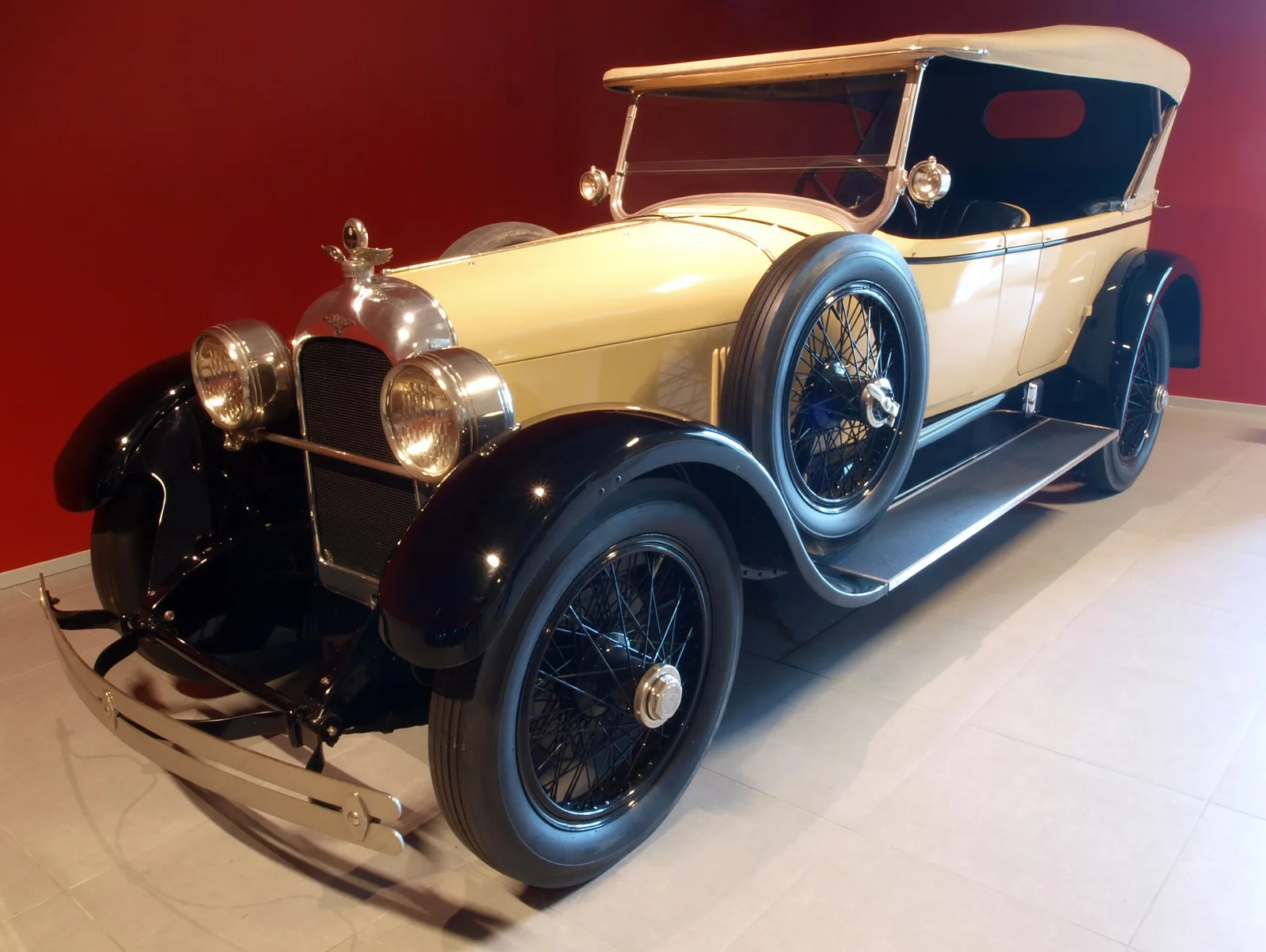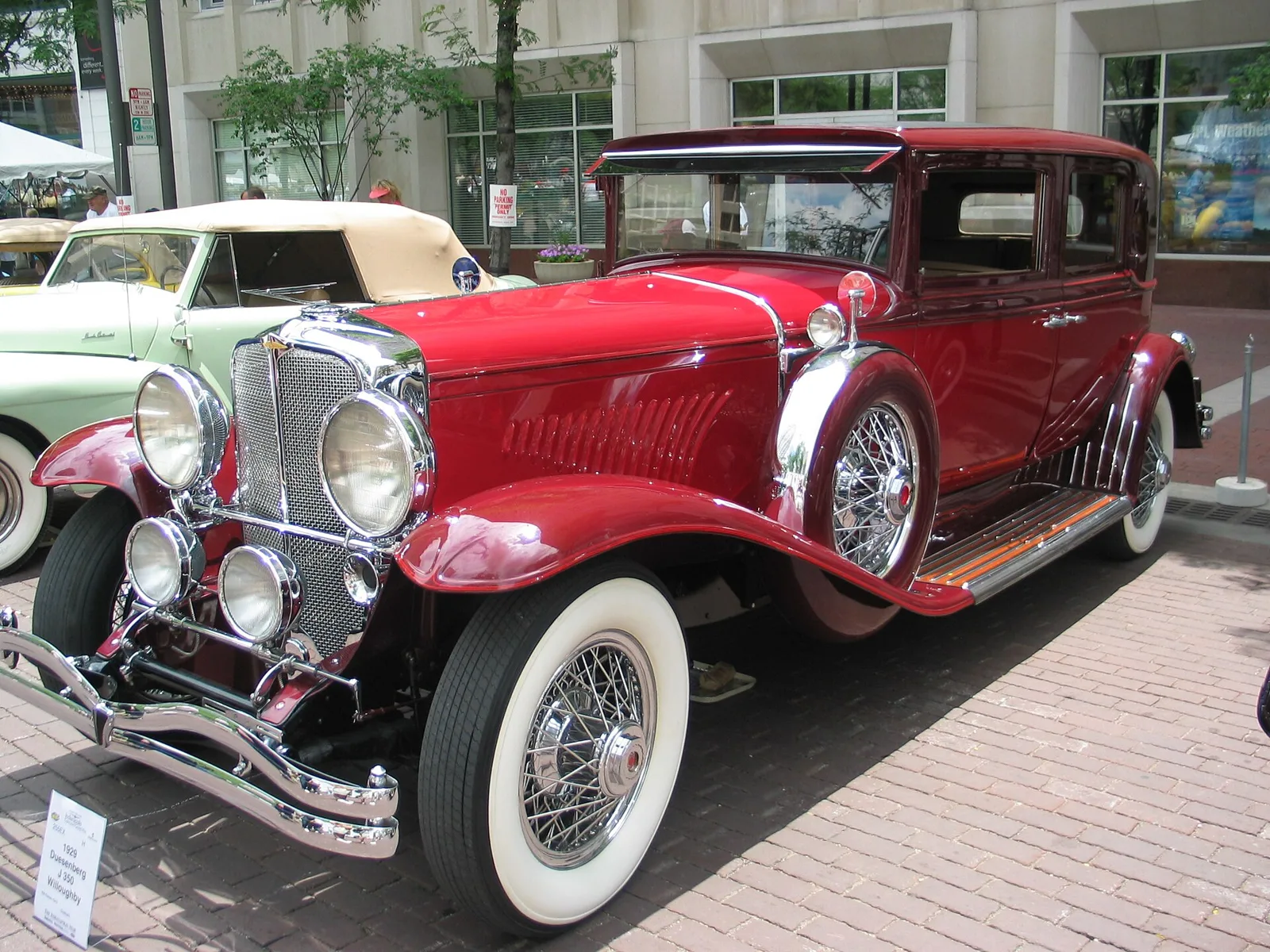
A supercharged straight eight built to beat the world's finest, from the 1928 New York debut to the Gary Cooper SSJ.
Built from 1928 to 1937, the Duesenberg Model J was powered by a 420 cu in straight eight that made 265 hp in normal form. E. L. Cord had bought the company in 1926, and the supercharged SJ and SSJ later gave the marque its legendary reputation.
The Duesenberg Model J was a luxury car that debuted in 1928 and was offered for ten more years, until the company that built it went bankrupt in 1937. It was meant to rival the most powerful and luxurious cars in the world. Introduced the year before the Wall Street crash, it became the status symbol of a generation of wealthy buyers.
Who owned Duesenberg when the Model J was created?
E. L. Cord, the owner of the Auburn Automobile Company, bought the Duesenberg Motor Corporation on October 26, 1926. He wanted the brothers' engineering skill and brand name to produce a car that could rival Hispano-Suiza and Rolls-Royce in size, power and luxury. The new company was renamed Duesenberg, Inc.
Fred Duesenberg stayed on as vice president in charge of engineering and experimental work. His brother August, known as Augie, had played a key role in the Model A and its rare X variant, but he had no part in the original J design. According to the historian Marshall Merkes, Cord did not want Augie around, so Augie ran racing work in a separate enterprise in a building apart from the main plant.
A straight eight built to rival the finest cars in the world, which ended in a 1937 bankruptcy and became a collector's icon.
When did the Model J reach the public?
The revived company introduced the Model J on December 1 at the 1928 New York Car Show, and it was shown at the Paris Salon in 1929. The first example, J-101, was a dual-cowl phaeton with LeBaron sweep panels, in silver and black. Roughly 200 cars had been built when the Depression struck in October 1929, and another 100 orders were filled in 1930.
That fell short of the original goal of 500 cars a year. Most engines and chassis were built in 1929 and 1930, but the Depression and the high price meant many were sold and bodied in later years, so the year given for a particular J usually refers to when it was bodied.
What powered the Model J?
The engine was a 420 cu in (6,900 cc) straight eight, based on the racing engines of the 1920s. Although Duesenberg designed it, Lycoming, another Cord company, built it. Without a supercharger, it made 265 horsepower (198 kW), drawing on dual overhead camshafts and four valves per cylinder.
The car reached 116 mph (187 km/h), and it could reach 89 mph (143 km/h) in second gear. Other cars had bigger engines, but none produced more power, and the Model J was the fastest and most expensive American automobile on sale.
How were Model J bodies designed and sold?
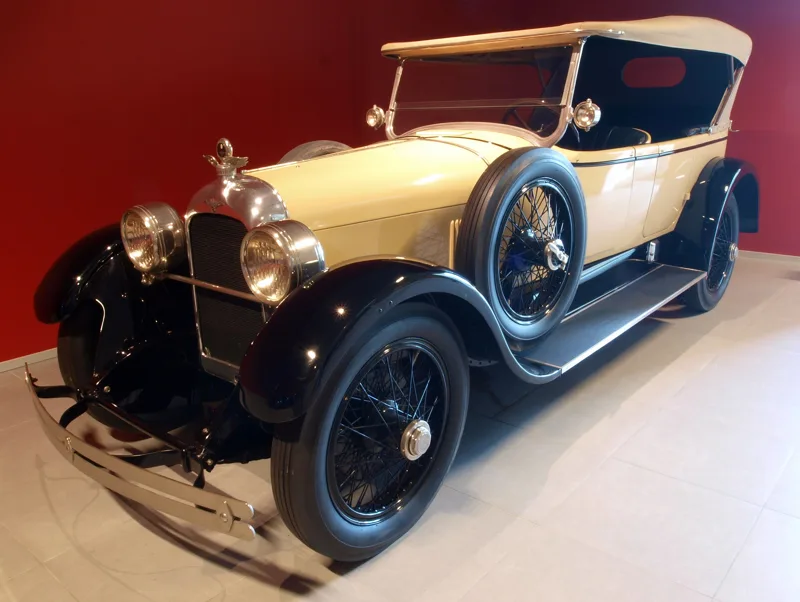
As was normal for luxury makers, the factory showed only the chassis and engine. The body and interior were custom-made by a coachbuilder to suit the owner. Most chassis shared the same fenders, headlamps, radiator, hood and instrument panel, so the coachwork made each car distinct.
About half the Model Js carried bodies designed by the company's chief body designer, Gordon Buehrig, and built under the La Grande name by company branches in several US cities and by smaller dealers. The rest came from independent American coachbuilders such as Derham, Holbrook, Judkins, LeBaron, Murphy, Rollston, Walker, Weymann and Willoughby, plus European houses such as Franay, Gurney Nutting and Saoutchik.
The bare chassis cost US$8,500, rising to US$9,500 after 1932. At a time when the average American physician earned less than $3,000 a year, most finished cars sold for between $13,000 and $19,000, and two American-bodied examples reached $25,000.
How did the chassis and gearbox change?
The Model J came on a short 142.5 in (3.62 m) wheelbase or a long 153.5 in (3.90 m) version. Special-order SSJs were cut to 125 in (3.18 m), and a few cars were stretched to 160 in (4.06 m) or more. The dashboard had mechanically timed lights prompting oil changes and battery checks.
The first major change replaced the four-speed gearbox, which could not cope with the engine's power, with an unsynchronised three-speed. Duesenberg then kept that layout and never moved to a fully synchronised gearbox in the mid-1930s, unlike nearly every other American maker. That made the car harder to drive and dated it by the end of its run. The factory closed in 1937.
What was the supercharged SJ?
Duesenberg's marketing boasted that only another Duesenberg could pass a Duesenberg, and even then the first owner had to agree. The claim was backed by the supercharged SJ, which Fred Duesenberg developed on the 142.5 in wheelbase and introduced in May 1932 with 320 hp (239 kW).
The SJ was reputed to reach 104 mph (167 km/h) in second gear and around 130 mph (209 km/h) in top. Reports gave around eight seconds for the 0 to 60 mph (0 to 97 km/h) run and 17 seconds to 100 mph (0 to 161 km/h), in spite of the unsynchronised transmission. Duesenbergs generally weighed around two and a half tons, and up to three tons was not unusual with heavy coachwork.
The supercharger sat beside the engine, and the vertical drive shaft forced a redesigned exhaust. The first Monel eight-into-one manifold cracked too often, so a four-branch arrangement replaced it, with pipes running through the right side of the hood and front fender. Cord registered the flexible metal exhaust conduit as a trademark and used it on his supercharged Cords and Auburns.
Fred Duesenberg died of pneumonia on July 26, 1932, after injuries from an accident while driving a Murphy SJ convertible. Augie then led engineering, while Harold T. Ames took the presidency of Duesenberg, Inc. Only 36 SJs were built.
What was the Duesenberg Special?
With sponsor backing, the speed racer Ab Jenkins commissioned the Duesenberg Special in 1935. It was built on a supercharged Model J rolling chassis with a modified front axle and a high rear axle ratio, and Augie Duesenberg tuned its engine. Its ram's horn twin-carburettor inlet manifold later appeared on other supercharged Js.
In October 1935 Jenkins set a one-hour mark of 153.97 mph (247.79 km/h), then a 135.57 mph (218.18 km/h) average over twenty-four hours at the Bonneville Salt Flats. The twenty-four-hour mark stood until 1961. After a Curtiss Conqueror aircraft engine replaced the Duesenberg unit, the car was renamed the Mormon Meteor.
What was the Twenty Grand?
The Twenty Grand was a one-off 1933 Rollston Arlington torpedo-bodied SJ sedan. It was the second most expensive Duesenberg ever built, and it is widely regarded as the most beautiful. It had a 320 hp supercharged DOHC engine and was made for the Dream Car exhibition at the 1933 Century of Progress in Chicago. It is now in the Nethercutt Collection.
What were the SSJ and JN?
The short-wheelbase SSJ had a 125 in (3,200 mm) wheelbase, and its twin-carburettor set-up lifted output to close to 400 hp (298 kW), using the ram's horn manifold. Only two were built, both as lightweight open roadsters from the Central Manufacturing Company, an Auburn subsidiary in Connersville, Indiana. Each had an external spare tyre and round taillights.
The first SSJ went to the actor Gary Cooper in 1935. The second was lent to Clark Gable in 1936, and the two actors are said to have raced each other in the Hollywood Hills.
The JN, a name the company never used, was an attempt to refresh an ageing design. Only 10 were made in 1935, all with Rollston coachwork. They had 17-inch wheels instead of 19-inch, skirted fenders, bullet-shaped taillights and bodies set lower on the frame rails. Supercharged JNs were called SJNs.
Who owned the Model J?
The Model J became a status symbol in the United States and Europe. Its owners included Al Capone, Greta Garbo, Howard Hughes and Mae West, along with European royalty. King Alfonso XIII of Spain was a keen motorist, and he took his Duesenberg J into exile after the Second Spanish Republic was proclaimed.
The last Duesenberg chassis was built for Father Divine, on a 178-inch wheelbase. The car weighed 7,800 lb (3,500 kg), with room for ten passengers. Built by Bohman and Schwartz and delivered in October 1937, the 22 ft (6.7 m) car was known as Father Divine's Throne Car because its rear top section could be removed to expose two raised seats.
New York had supported the Model J at first, because it was the financial capital in 1929. As the Depression deepened, Hollywood became the main market, and stars such as James Cagney posed beside the car to promote their careers. Styling evolved gradually up to the 1937 model, keeping the stately lines while becoming more integrated.
Of the 481 Model Js built between 1928 and 1937, about 378 survive. Some are believed lost in the war, particularly those exported to Europe, while others were broken up or altered beyond recognition in the late 1940s and early 1950s.
What happened to Duesenberg after 1937?
Production ended in 1937 when Cord's financial empire collapsed, but two more Duesenbergs were completed between 1937 and 1940. The first was delivered by Rollson to the German artist Rudolf Bauer in April 1940, and it is the longest Duesenberg and the last one delivered. The last car ever made was assembled from leftover parts.
During the Second World War the marque lost popularity, and by 1941 to 1942 used cars were cheap, with advertised prices averaging around $700. Some Model Js were offered for $300 to $400, and some sold for only $100 or $200.
Collectors revived interest in the 1950s. Several were advertised in The New York Times in autumn 1950 at prices as low as $500, and by 1959 a decent example cost at least $4,000. A record $12,000 changed hands in a private sale that year. By 1969 a Model J could fetch between $20,000 and $75,000, and in 1974 an auction set a record of $205,000 for one, surpassing the $153,000 that Adolf Hitler's personal Mercedes-Benz 770 had fetched the year before.
What have Duesenbergs sold for recently?
The Duesenberg Special, the Mormon Meteor, was sold by Gooding & Co. at auction in August 2004 for $4.5 million. A second SJ fetched $4.4 million at RM Auctions in Monterey, California, in 2007.
In 2018 a Duesenberg SSJ that had belonged to Gary Cooper sold at auction for $22 million, the highest price ever paid for an American car. Liberace used a replica SJ covered in crystals on stage, and that car is now displayed in Las Vegas.
What are the Duesenberg Model J specifications?
| Specification | Detail |
|---|---|
| Years built | 1928 to 1937 |
| Engine | 420 cu in (6,900 cc) straight eight, built by Lycoming |
| Output (normal) | 265 hp (198 kW) |
| Top speed (normal) | 116 mph (187 km/h) |
| Output (SJ) | 320 hp (239 kW), supercharged, from May 1932 |
| Output (SSJ) | Close to 400 hp (298 kW), 125 in (3,200 mm) wheelbase |
| Wheelbases | 142.5 in (3.62 m) short; 153.5 in (3.90 m) long |
| Chassis price | US$8,500, rising to US$9,500 after 1932 |
| Production | 481 Model Js; about 378 survive; 36 SJs built |