BMW's first hybrid drivetrain, first turbocharged V12 and a long-wheelbase sibling, with armoured, Alpina and royal-wedding variants along the way.
BMW's fifth-generation 7 Series ran from 2008 to 2015 as the F01 short-wheelbase and F02 long-wheelbase sedans. It introduced BMW's first hybrid drivetrain and a turbocharged V12, and it gave way to the G11 in July 2015.
BMW built the F01 and F02 as its fifth-generation full-size luxury sedan from 2008 to 2015, in short-wheelbase (F01) and long-wheelbase (F02) form. Enthusiasts and owners usually lump both together as the F01. It was the first BMW to offer a hybrid drivetrain, an 8-speed automatic or a turbocharged V12.
Production passed to the G11 generation in July 2015, closing the run of a car that also spawned an armoured variant, a hybrid sedan and a tuned Alpina model.
Where did the fifth-generation 7 Series come from?
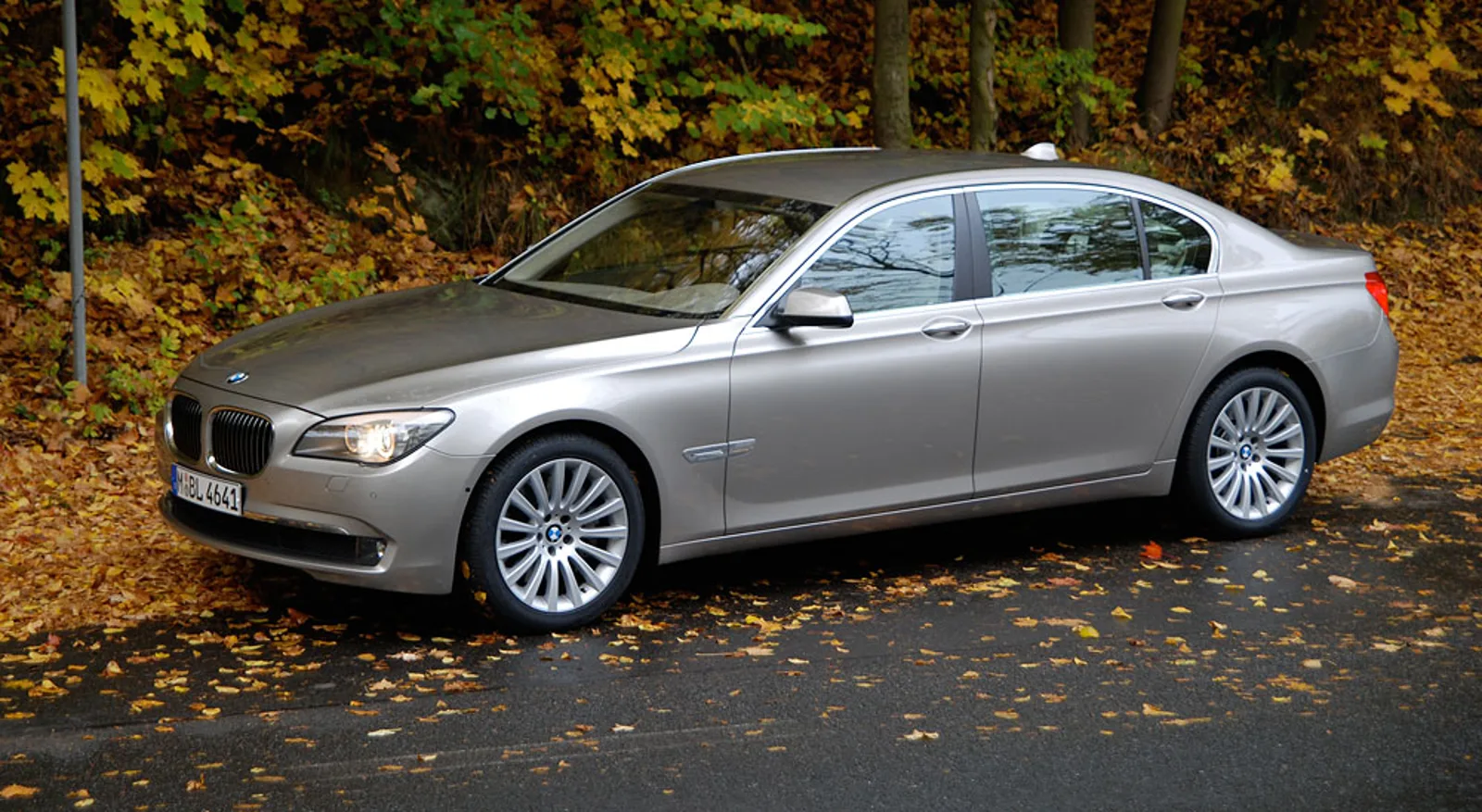
The exterior was styled by Karim Habib, who kept elements of the E65 predecessor. The headlamps echoed the E65's but were smaller, while a wider, bigger grille ran further into the front apron. The changes kept the car recognisable as a 7 Series while modernising its face.
The F01 was larger than the car it replaced. Overall length grew by 43.2 mm (1.7 in) and the wheelbase by 81.3 mm (3.2 in), and the car put on weight too. Against the outgoing 7 Series, the wheelbase was already 8 cm longer.
Moscow's Red Square hosted the F01's debut on 8 July 2008. Paris in October and Los Angeles in November came next on the launch calendar.
BMW's first hybrid, its first turbocharged V12 and a long-wheelbase sibling, all in one fifth-generation sedan.
What technology did the F01 offer?
Buyers could choose rear-wheel steering, called Integral Active Steering, along with xDrive all-wheel drive and an eight-speed automatic. Pedestrian recognition for night vision, blind-spot monitoring and rear-seat massage were also on the list. These features were aimed at making the big car easier to place in tight spaces.
The radar cruise control could now bring the car to a complete stop and pull away again from a standstill, marketed as Stop and Go cruise control. Side cameras in the front bumper helped with merging into and leaving narrow spaces.
Combining those cameras with the front and rear units produced a virtual overhead view for parking. The instrument cluster used an LCD backdrop behind physical gauge needles, and a lane departure warning, first fitted to the E60 5 Series in 2007, arrived on a 7 Series for the first time.
How did the interior depart from the E65?
The F01 moved away from the unconventional cabin of the E65 in a few key places. The shifter left its column stalk for the centre console, and the seat switches migrated from the console to the outer edge of the seat base.
Both moves were practical changes away from the E65 layout.
Which engines did the F01 range use?
The range spanned turbocharged sixes and V8s, with a V12 at the top. Power ran from the six-cylinder units up to the V12 flagship. The 760i and 760Li used a V12 redesigned as a twin-turbocharged 6.0L, codenamed N74, to keep ahead of the 750i, which relied on a turbocharged V8.
In some markets the V12 was offered only with the long-wheelbase body. The 740i used the turbocharged N54 six.
What was the ActiveHybrid 7?
The ActiveHybrid 7, coded F04, was the first BMW vehicle with a hybrid drivetrain. Under the bonnet sat the 750i engine plus an electric motor rated at 15 kW (20 hp), giving 210 N-m (155 lb-ft) of torque, paired with an 8-speed automatic.
The motor sat inside the transmission housing, replacing the alternator and starter. A lithium-ion battery lived under the boot floor, and the system was based on Daimler AG's two-mode hybrid. BMW claimed a 15% improvement in fuel consumption and emissions over the non-hybrid model.
The hybrid's wheelbase was 14 cm (5.5 in) longer than a regular 750i, and the car weighed 100 kg (221 lb) more.
Reviewers doubted the benefit. EPA ratings of 13.8 L/100 km (17 mpg-US) city and 9.0 L/100 km (26 mpg-US) were not much better than those of the cheaper 740i, which managed 13.8 L/100 km (17 mpg-US) city and 9.4 L/100 km (25 mpg-US) on the highway. The 740i was also 108 kg (239 lb) lighter over the front axle than the 750i.
How did the ActiveHybrid 7 change in 2012?
From late 2012 the hybrid dropped the 750i's turbo 4.4-litre V8 for the 740i's turbo 3.0-litre six, and its motor rose to 41 kW (55 hp). The 2012 to 2015 car was offered only as a long-wheelbase model. Buyers wanting the hybrid therefore had to choose the longer body.
Economy improved markedly, with ratings of 10.7 L/100 km (22 mpg-US) for city driving and 7.8 L/100 km (30 mpg-US) for highway driving.
What was the Alpina B7?
The B7 started life as a 750i derivative, entering production for the 2011 model year. Alpina tuned the twin-turbo 4.4-litre N63 V8 to 373 kW (500 hp) and 700 N-m (516 lb-ft), keeping the regular 750i's fuel-economy figures. Alpina hand-builds its engines, as the next paragraph explains.
Compared with the standard N63, the Alpina engine had high-performance pistons, strengthened cylinder heads and extra coolers for engine and transmission oil. Bigger but lighter turbos took boost from 0.8 bar (11.6 psi) up to 1.0 bar (14.5 psi).
Each engine is hand-built at Alpina's Buchloe site, then goes to BMW for fitting, and the finished car returns to Alpina for final work. Alpina's engine gave less peak power than the S63 in the F10 M5 but more torque.
The B7 used a ZF 6HP26 six-speed automatic with heavy-duty gears, a strengthened driveshaft, differential and rear axles, and it could be specified with rear-wheel drive or xDrive.
The late-2012 update lifted power to 397 kW (532 hp), and top speed reached 312 km/h (194 mph), or 310 km/h (193 mph) for xDrive cars. It was first shown at Pebble Beach in August 2012, and cars went on sale straight afterwards.
In North America the B7 is sold by BMW and carries BMW VINs, while the B7 BiTurbo sold in Europe and Japan is sold as an Alpina.
What were the High Security cars?
The 750Li and 760Li High Security models were the first cars certified to the BRV 2009 and VR7 ballistic protection ratings. Protection covered the underbody, with 60 mm (2.4 in) multi-layer laminated glass and armour on the doors, roof, pillars, front footwell and rear bulkhead.
Added mass called for uprated shock absorbers and strut tops. Buyers could add a passenger-to-driver intercom, an alarm, a temperature-sensing extinguisher, gas sensors and a fresh-air supply. The High Security models were unveiled at GPEC 2012.
Was there a royal wedding limousine?
For the wedding of Prince Albert II of Monaco and Charlene Wittstock, BMW supplied 200 limited-run 7 Series limousines in 2011. The cars were based on the 740Li, and the run was small and bespoke, which made these cars rare within the F01 line-up.
Which transmissions did the F01 use?
The F01 used four automatics: the 6-speed ZF 6HP 19 and 6HP 26, and the 8-speed ZF 8HP 70 and 8HP 90. From 2009 to 2012 most models had the 6-speed with Steptronic, while the 760i and 760Li had the 8-speed from the start.
From the 2013 model year, every other F01 used the 8-speed Steptronic gearbox.
How did the model years change?
BMW usually made changes each September for the following model year, so the 2009 changes were for the 2010 car. Most buyers therefore met each update as a new model year rather than a mid-year change. The 2008 launch range comprised the 740i, 750i and 750Li petrol models, plus the 730d diesel.
All-wheel drive reached the 7 Series for the first time in 2009, through the 750i xDrive and 750Li. The V12-engined 760i and 760Li flagships joined the range, followed by a 740d diesel and the M Sport Package.
US sales began in 2009 with the 750i and 750Li, and a long-wheelbase 730Li went on sale for Asian markets only.
In 2010 the ActiveHybrid 7 and ActiveHybrid 7L appeared, alongside the 740d xDrive and the Alpina B7 and B7X. In the US the 740i and 740Li became the first six-cylinder 7 Series on sale since 1992.
What changed in the 2013 facelift?
The facelift cars began production in July 2012 as 2013 models. Most of the work was mechanical, with the rest focused on technology. They debuted at Pebble Beach and the Monaco Yacht Show in 2012, and the 8-speed automatic became standard.
The ActiveHybrid 7 switched from the N63 V8 to an N55 six-cylinder, and the 750i and Alpina B7 moved from the N63 to the N63TU, which added variable valve lift, known as Valvetronic. The 740i moved from the N54 to the N55, also with Valvetronic and a single twin-scroll turbocharger, and it gained an xDrive option.
A 750d arrived with the triple-turbo N57S six-cylinder diesel. The 730d and 740d moved to the N57TU, gaining up to 10 kW (13 bhp) and 20 N-m (15 lb-ft). The 730i was discontinued.
Other changes included full-LED headlamps, a revised kidney grille and front spoiler, a Full Black Panel Display with electronically shown gauge needles, and self-levelling air suspension at the rear as standard.
Driver assistance also grew. The night vision system gained Dynamic Light Spot pedestrian targeting, the BMW Parking Assistant could steer itself into a parallel space, and Attention Assistant detected driver drowsiness. Active Protection added collision avoidance, and Enhanced Active Cruise Control handled traffic jams.
Only in America, fifteen V-12 25th Anniversary Edition cars were built in 2013, marking 25 years of BMW V12s. Based on the 760Li, they carried a recommended retail price of $159,695.
How well did the 7 Series sell in the United States?
In the US, 740i and 740Li models took 10% of 7 Series sales, and the 760Li took 2%. Some 70% of US 7 Series sales were long-wheelbase L models, which shows how strongly American buyers favoured the stretched body. Such numbers point to a market that wanted space in the back.
Marketing took the car into the arts. Marking ten years of the Tate Modern, BMW lent a 7 Series to Spanish artist Marti Anson, who used it to ferry artists to the gallery. The car stood in the Turbine Hall during the show.
BMW Group Russia provided cars for opening-night premieres at the Bolshoi Theatre from 2004. In 2011, twenty vehicles, including F01 7 Series and F07 5 Series GT models, served the theatre's historic stage re-opening.
What are the main F01 specifications?
| Specification | Detail |
|---|---|
| Generation years | 2008 to 2015 |
| Body variants | F01 short wheelbase; F02 long wheelbase |
| Wheelbase gain over outgoing car | 8 cm |
| Length gain over E65 | 43.2 mm (1.7 in) |
| Wheelbase gain over E65 | 81.3 mm (3.2 in) |
| ActiveHybrid 7 motor | 15 kW (20 hp), 210 N-m (155 lb-ft) |
| Alpina B7 engine | 373 kW (500 hp), 700 N-m (516 lb-ft) |
| Updated Alpina B7 power | 397 kW (532 hp) |
| High Security glass | 60 mm (2.4 in) thick laminated |
| Royal wedding limousines | 200 units, based on the 740Li |