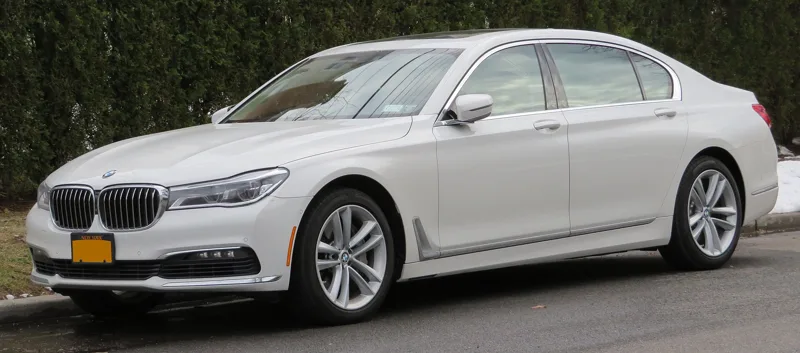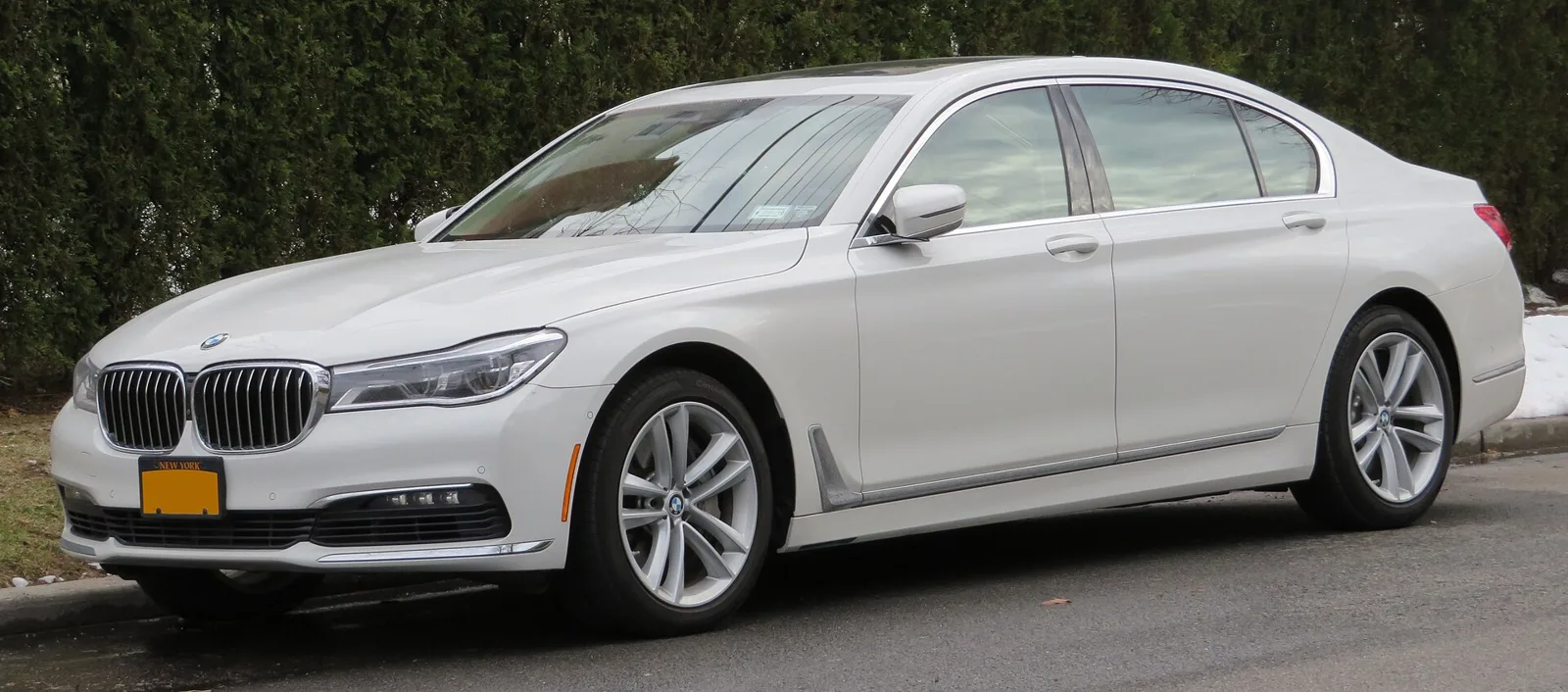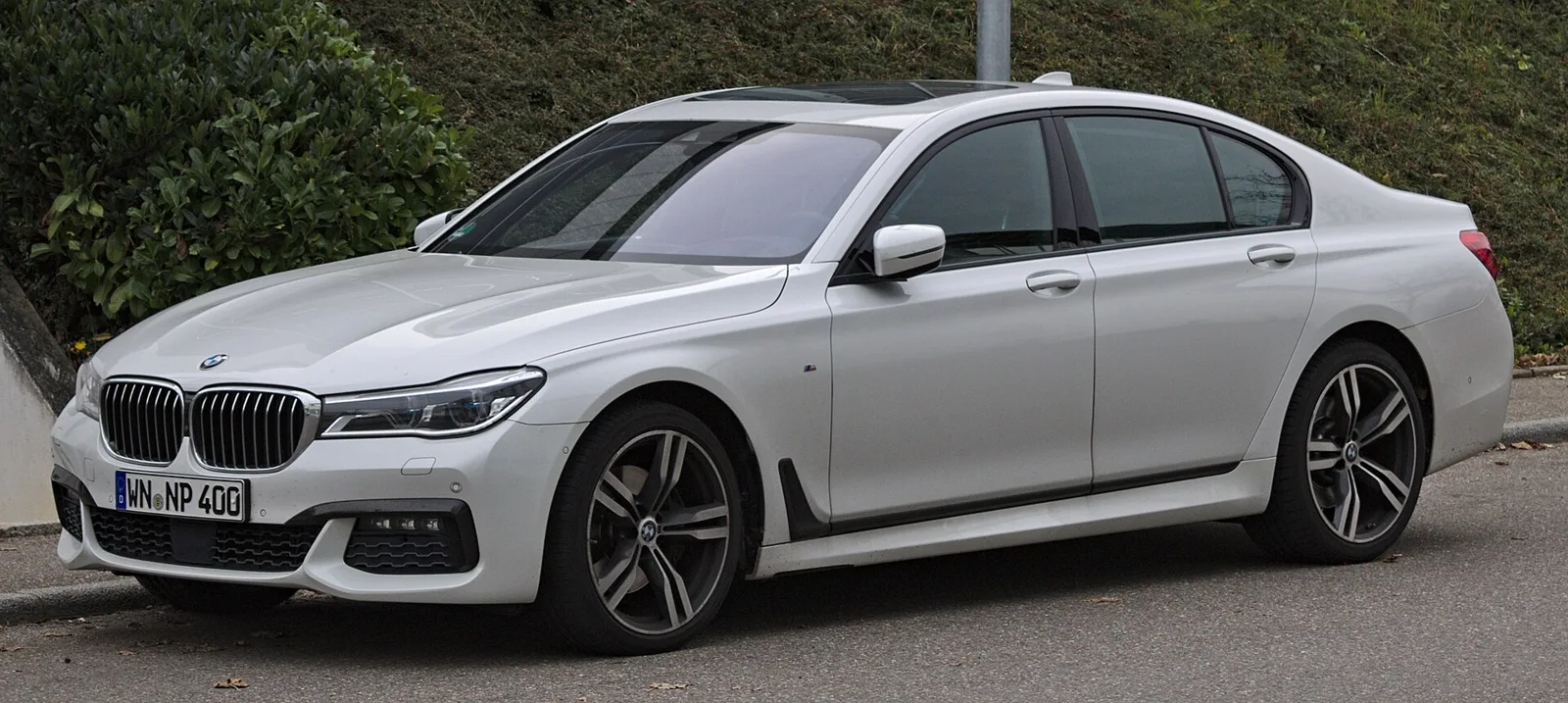
A 2015 luxury saloon built on the new CLAR platform, with a carbon-fibre passenger cell, a plug-in hybrid, a 600 hp Alpina and a V12 that closed the line in 2022.
Built from 2015 to 2022, the BMW 7 Series G11 was the sixth generation of BMW's luxury saloon, in short and long wheelbase forms. The CLAR-based car used a carbon-fibre passenger cell, gained a plug-in hybrid, and ended its run with a V12 limited edition.
The BMW G11 is the sixth generation of the 7 Series, a luxury saloon that BMW built from 2015 to 2022 in short-wheelbase G11 and long-wheelbase G12 forms. It was the first BMW passenger car built on the CLAR platform, and it used carbon-fibre-reinforced polymer in its passenger cell.
When did the G11 go on sale?
BMW unveiled the G11 on 10 June 2015 at its headquarters in Munich, and the car was shown publicly at the 2015 International Motor Show Germany. The international launch followed at the Frankfurt show in September 2015, where the car was introduced to a wider audience.
Production began in July 2015 at the Dingolfing plant in Germany, and global sales started in October 2015. The lead exterior designer was Nader Faghihzadeh, and Alexey Kezha later worked on the facelift.
Long-wheelbase versions carry an L in their name, so the G12 is the long-wheelbase G11 and the 740Le is the long-wheelbase 740e. In everyday use the two bodies are often grouped together under the G11 name.
A carbon-fibre passenger cell, a plug-in hybrid and a V12 that ended a long line of BMW engines.
What was special about the G11 platform?
The G11 and G12 were the first passenger BMWs to use the modular CLAR, or cluster architecture, platform. CLAR brought in technology first seen in BMW's i models, most notably carbon-fibre-reinforced polymer, known as CFRP, for structural chassis parts. The move put a BMW i material into a core saloon for the first time.
The passenger cell mixes CFRP, tensile steel and aluminium. That combination cut weight, lowered the centre of gravity and kept the axle load split at 50/50. CFRP is lighter than steel and aluminium, and it also stiffens the structure where steering forces are highest.
Aluminium also featured in the doors, the boot lid, the brakes, the wheel hubs and the rear arms, cutting weight and unsprung mass. Overall, the G11 body weighed 40 kg (88 lb) less than the car it replaced.
How did the G11 keep its drag low?
The G11 used a large kidney grille with shutters that open only when the engine needs more air, cutting aerodynamic drag when they stay closed. Air openings behind the front wheel arches smooth the airflow through the wheel housings and reduce turbulence.
Together these measures brought the drag coefficient down to a low figure for a car of this size.
What suspension and steering did the G11 have?
The previous model's self-levelling air suspension was revised. Air springs sit on both axles, and electronically controlled shock absorbers adjust their damping to the road and the driving conditions. Damping changes automatically as conditions change, which lets the ride suit each surface.
An active anti-roll system was available, and an optional electro-hydraulic actuator sped up the damper response. Four-wheel steering arrived on all-wheel drive cars for the first time, sold under the name Integral Active Steering.
What technology did the G11 cabin offer?
The iDrive 6.0 system took input from a conventional control wheel, a touchscreen and voice commands, and it could recognise gestures through a 3D scanner called Gesture Control. Drivers could also save a particular gesture and link it to a chosen function.
Several driver assistance systems were reworked to act with more autonomy. The parking system relied on radar and a stereo camera at the back to park the car on its own, and a digital key fob could start the process. The cruise control could read speed limits and adjust the car's speed to match them.
The lane driving assist warned of possible side or rear collisions and could detect lane markings and traffic. It could also alter steering responsiveness to make longer journeys more comfortable. M Performance add-ons were available on any model, among them a black grille, carbon mirrors, side skirts and facelift sport brakes.
Which engines powered the G11?
The range combined a 4.4-litre V8 with three members of BMW's modular B-series family: two 3.0-litre inline-sixes in petrol and diesel form, and a 2.0-litre inline-four for the hybrid. The petrol cars were the 730i and 730Li, while the diesels were the 725d and 725Ld.
Each model could be ordered with all-wheel drive and was paired with an eight-speed ZF Steptronic automatic. The 750i, 750Li, 740i, 740Li, 740d, 740Ld, 750d and 750Ld were offered with the xDrive option. The transmission could also link to satellite navigation to adjust its shift timing to the road ahead.
What was the 740e iPerformance?
The 740e and 740Le were the first plug-in hybrid 7 Series. They replaced the ActiveHybrid 7, which had moved from a mild hybrid based on the 750i to a full hybrid based on the 740i in 2014, and the car was sold as a BMW iPerformance model rather than as part of the BMW i sub-brand.
The iPerformance name was announced in February 2016 for all BMW plug-in hybrids. The 740e made its debut at Geneva in 2016, alongside the M760Li xDrive and the i8 Protonic Red Edition, and sales began in Germany in July 2016.
The hybrid shares its drivetrain with the BMW X5 xDrive40e. Its electric range is 40 km (25 miles) under the NEDC test, falling to 37 km (23 miles) in xDrive form. The EPA rated the all-electric range at 23 km (14 miles), and the car burns some petrol during that distance, so the real figure can run from zero to 23 km.
How quick was the 740e iPerformance?
A 192 kW (257 hp) turbo four, a 2.0-litre inline unit, works with an electric motor to deliver 240 kW (322 hp) and 500 Nm (369 lb ft) of torque. The 740e reaches 100 km/h from rest in 5.6 seconds, the long-wheelbase version is 0.1 seconds slower, and the xDrive is 0.2 seconds quicker.
Charging takes under four hours from a domestic socket, or under three hours from a wall box. On the NEDC cycle the standard car is rated at 2.100 L/100 km with 49 g/km of CO2, and the xDrive version rises to 2.300 L/100 km with 53 g/km.
What made the Alpina B7 stand out?
BMW North America announced the Alpina B7 xDrive in February 2016. It was shown at Geneva that year and sold from September. It used a modified 4.4-litre twin-turbo V8, the N63M30, which made 600 hp (447 kW; 608 PS), with 800 Nm (590 lb ft) of torque.
Its electronically limited top speed was 310 km/h (193 mph), and it reached 100 km/h from rest in 3.7 seconds. BMW sold the B7 only in the United States and Canada, while Alpina sold it elsewhere as the B7 Bi-Turbo, with a limit of 330 km/h (205 mph).
The facelifted B7 was unveiled on 11 February 2019, with 0 to 100 km/h in 3.6 seconds and the 330 km/h top speed no longer limited worldwide. Public introduction came at the 2019 Geneva show, and deliveries began in July.
What did the M760Li xDrive offer?
The M760Li xDrive sat at the top of the 7 Series range. It was unveiled in February 2016 and shown at Geneva the same year. Its N74B66 engine is a 6.6-litre twin-turbo V12 producing 448 kW (601 hp; 609 PS). Torque is 800 Nm (590 lb ft).
The standard limit was 250 km/h (155 mph), rising to 305 km/h (190 mph) with the optional M Driver's Package. It was the first 7 Series to carry the M Performance badge, and it came with M Performance transmission tuning, 19-inch M Sport brakes, an M Sport exhaust and Integral Active Steering as standard.
The M760Li was also the first V12 BMW to offer xDrive as standard, a break from earlier V12 models that were rear-wheel drive only. It had a 20-inch alloy wheel design, Cerium Grey trim on the mirror caps, air breathers and tailpipe finishers, and V12 badges on the C-pillars.
An Excellence version added a more luxurious interior and exterior treatment in place of the sportier standard look.
What was the Final V12 edition?
BMW announced a limited edition on 18 January 2022, called simply The Final V12. It was the last series production BMW to use a V12 engine, and it was built only for the United States, with just 12 examples sold to the public.
BMW invited previous owners of V12 BMWs to buy one.
What changed in the 2019 facelift?
The updated 7 Series was unveiled on 16 January 2019 as a 2020 model year car, and production began in March. The facelift brought a bigger kidney grille, the same one used on the X7, which was 40 percent larger than before, along with sleeker headlights and optional laser headlights.
Inside, a new 12.3-inch instrument cluster and a 10.25-inch infotainment screen arrived, with iDrive 7.0, updated graphics and menus, and a new voice assistant. The Extended Traffic Jam Assistant allowed hands-off driving up to 56 km/h (35 mph) in urban traffic, with cameras watching that the driver stayed alert.
The 740i and 740Li received a turbocharged B58 inline-six making 250 kW (335 hp) and 450 Nm (332 lb ft). The 750i and 750Li took the M850i engine, producing 390 kW (523 hp) and 750 Nm (553 lb ft), and the 750 lost its rear-wheel drive version, leaving the 740i as the only rear-drive model.
The 740e gave way to the 745e iPerformance, which used a turbocharged inline-six shared with the X5 xDrive45e. Combined with the electric motors it produced 290 kW (389 hp) and 600 Nm (443 lb ft), and a new 12 kWh battery extended its electric range. The updated range went on sale in April 2019.
The M760Li's power fell to 430 kW (577 hp) in Europe, because Otto particle filters were fitted to meet emissions rules, and to 447 kW (600 hp) in the US. Torque rose to 850 Nm (627 lb ft) in both markets.
Where was the G11 built?
The G11 was built at the BMW Group plant in Dingolfing, Germany, where production had begun in July 2015. Knock-down kits were assembled in Jakarta and at the BMW plant in Rayong, Thailand, and India built the car at Chennai.
In Malaysia the facelifted 745Le was sold as the 740Le, and Thai buyers could choose the 730Ld, the 745Le xDrive or the M760Li xDrive.
How did the G11 do in reviews?
IEEE Spectrum placed the 2016 7 Series among its top ten tech cars of that year. The recognition came in the car's first full year on sale, after its late 2015 launch, and it honoured the first BMW passenger cars on the CLAR platform.
The G11's headline technology included the gesture control system and the autonomous parking feature.
What are the BMW 7 Series G11 specifications?
| Specification | Detail |
|---|---|
| Generation | Sixth 7 Series; G11 short wheelbase, G12 long wheelbase |
| Production | 2015 to 2022, Dingolfing, Germany |
| Platform | CLAR, CFRP passenger cell |
| Body weight | 40 kg (88 lb) less than predecessor |
| Aero details | Grille shutters and wheel-arch air openings |
| Transmission | Eight-speed ZF Steptronic automatic |
| 740e iPerformance | Turbo 2.0-litre inline-four plus electric motor; 240 kW (322 hp); 500 Nm (369 lb ft) |
| 740e 0 to 100 km/h | 5.6 seconds |
| 740e NEDC electric range | 40 km (25 miles); 37 km (23 miles) xDrive |
| Alpina B7 xDrive | 4.4-litre twin-turbo V8 N63M30; 600 hp (447 kW; 608 PS); 800 Nm (590 lb ft) |
| Alpina B7 top speed | 310 km/h (193 mph) limited; 0 to 100 km/h in 3.7 seconds |
| M760Li engine | 6.6-litre twin-turbo V12 N74B66; 448 kW (601 hp; 609 PS); 800 Nm (590 lb ft) |
| M760Li top speed | 250 km/h (155 mph) standard; 305 km/h (190 mph) with M Driver's Package |
| 2019 740i engine | B58 inline-six, 250 kW (335 hp); 450 Nm (332 lb ft) |
| 2019 750i engine | M850i engine, 390 kW (523 hp); 750 Nm (553 lb ft) |
| 2019 745e | 290 kW (389 hp); 600 Nm (443 lb ft); 12 kWh battery |