Curtain airbags, satellite navigation and a built-in television arrived with BMW's flagship saloon, along with a hydrogen-powered fleet and an armoured limousine.
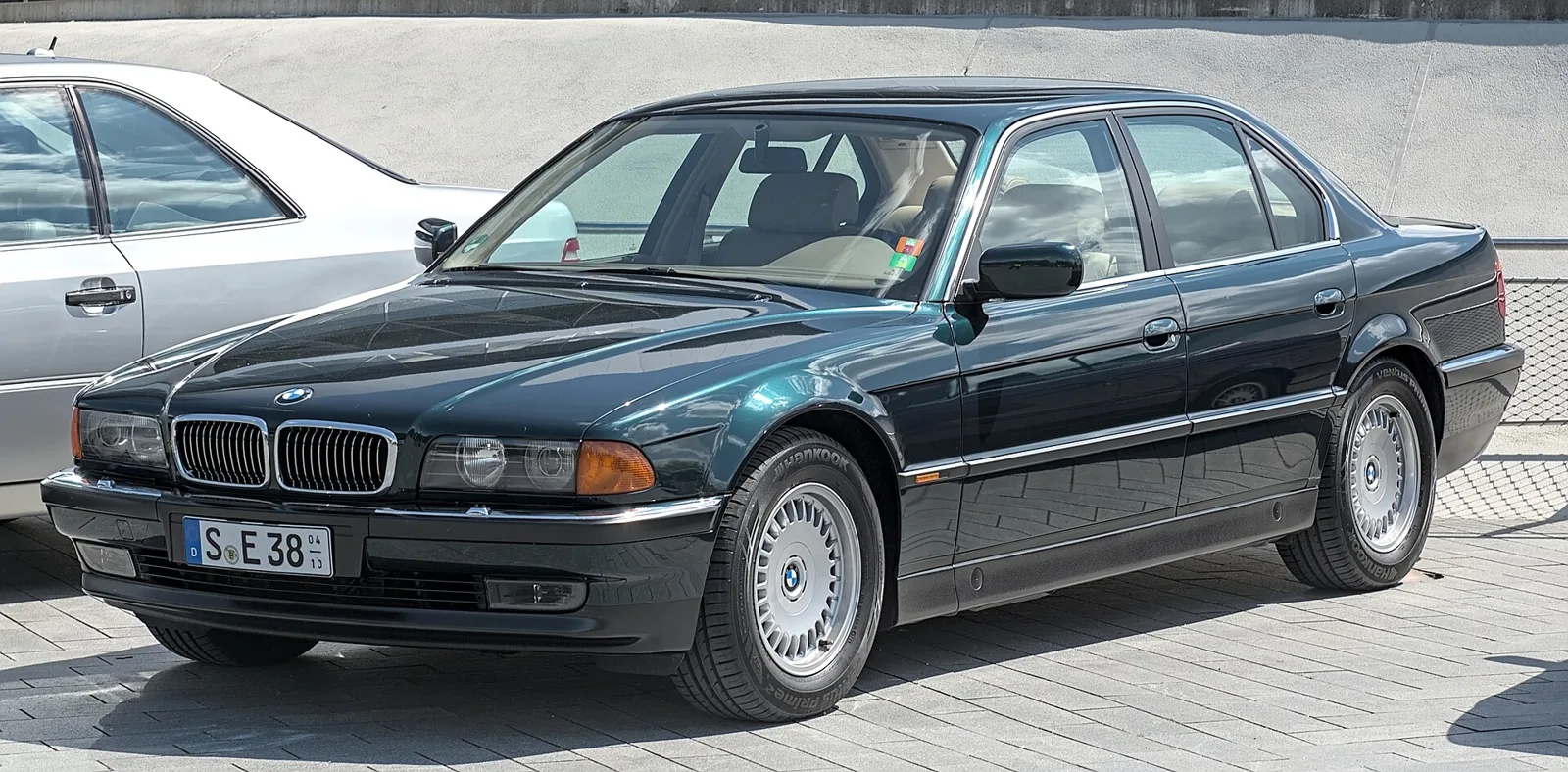
Built from 1994 to 2001 in short, long and limousine wheelbases, the BMW E38 was the third-generation 7 Series. Its firsts included curtain airbags and satellite navigation for a European car, and 340,242 examples were built before the E65 took over.
BMW's large saloon took on a new generation in 1994, when the E38 replaced the E32 7 Series. Its engines ran from petrol and turbo-diesel straight-sixes and V8s up to a petrol V12 flagship, and buyers could choose one of three wheelbase lengths.
The E38 is remembered for a long list of firsts, including curtain airbags and a built-in television. It was also the last 7 Series to offer a manual gearbox, and it was built until 27 July 2001, when the E65 took over.
What made the E38 a technology leader?
The E38 was the first car to offer curtain airbags and the first European car with satellite navigation, a system called CARIN that BMW developed with Philips. It was also the first BMW with a built-in television and the first 7 Series offered with a diesel engine.
The navigation system was one part of a wider electronic network. The in-car entertainment, navigation, television and communications equipment were linked through an automotive communication system called I-bus, and the multi-function steering wheel carried controls for audio, phone, cruise control and air recirculation.
Safety equipment kept pace. Side tubular airbags, named the Head Protection System, were fitted as standard equipment. In late 1997, the E38 and the E39 5 Series became the world's first cars to offer side impact head airbags, which were designed to keep their inflation for up to seven seconds to give rollover protection.
Curtain airbags, satellite navigation and a built-in television in one flagship saloon, with 340,242 built.
How was the E38 developed?
Development began in early 1988, and styling work ran from 1988 to 1990 under design director Claus Luthe. Dr. Wolfgang Reitzle took over from April 1990, and Boyke Boyer's concept design was chosen and refined into production form. The board approved the final design in February 1991, 36 months before the planned start of production.
Design patents followed. German patents were filed on 27 April 1993 using a pre-production prototype as the design representation, and US patents came on 27 October 1993. Those dates show how far ahead the car was planned, with production scheduled to start on 17 February 1994.
When did production start and how many E38s were built?
Pilot production began on 23 July 1993 for the pilot models. Series production of the 730i and 740i started in April 1994 for the June 1994 German launch, and the E38 was unveiled on 18 February 1994 for the 1995 model year. A total of 340,242 cars were built before the last one rolled off the line.
The production figures by model show where demand sat. The 740i reached 88,000 cars and the 740iL reached 81,000, making them the two biggest sellers. The 728i and 735i ran to 38,000 and 21,000 respectively, the 730i reached 21,000, and the diesel 725tds and 730d reached 9,000 and 12,000.
Which engines and gearboxes did the E38 offer?
The range covered six-cylinder and V8 engines, running on petrol or turbo-diesel, with a V12 at the top. A 5-speed ZF 5HP automatic was available on every model, and in many markets a 5-speed manual was offered for the 725tds, 728i, 730i and 735i. The 740i was the model offered with a 6-speed manual.
The V8 models were revised during the run. The M62 engine replaced the M60 in the V8 cars in 1996, and the 740i and 740iL engine capacity grew from 4.0 L to 4.4 L. The early V8 models used a Nikasil bore coating, which failed in countries where petrol had high sulphur content.
The 1998 facelift, known as Life-Cycle Impulse, brought the 740d with an M67 twin-turbocharged diesel V8. Variable valve timing spread through the range: single-VANOS on the 735i and 740i, and double-VANOS on the 728i.
What did the E38 offer in comfort and safety?
The E38 came with ASC+T traction control, Dynamic Stability Control, headlight washers and xenon HID headlamps with automatic levelling. Active Comfort Seats arrived in 1998, using two fluid-filled bladders that alternated in height to reduce fatigue for the driver and front passenger.
Other equipment included Electronic Damper Control, called EDC III, and Park Distance Control. Buyers could also specify auto-dimming and power-folding mirrors, a power moonroof and a sunblind for the rear window. Rain-sensing wipers were available, along with dual-zone or tri-zone climate control and electric adjustment for the driver's seat and steering wheel.
The Sport Package brought revised steering, suspension, exterior trim and wood interior trim. Certain sports models also received a shorter differential ratio and a higher torque converter stall speed, which allowed 0-97 km/h (60 mph) in 5.9 seconds.
What was the L7 limousine?
From 1997 to 2001 BMW sold the L7, an extended-wheelbase limousine that was 250 mm (9.8 in) longer than the iL models. Its overall length was 5.37 m (211.4 in), and it was based on the 750iL with an electronically limited top speed of 250 km/h (155 mph).
Inside, the rear compartment offered power-adjusted seats, footrests, drop-down trays, a refrigerator, a screen for rear passengers, a video deck and a fax machine. The 2000 and 2001 models offered an optional privacy window partition to separate the driver from the rear passengers.
BMW built 899 L7 examples, and they were sold only in the Middle East, Southeast Asia and Europe.
Which armoured and high-security versions were built?
The Protection Line was built from 2000 to 2001 on the 740iL and 750iL. It used body armour, bullet-resistant glass and run-flat tyres, and an intercom let occupants speak with people outside while the windows and doors stayed shut.
A higher-level High-Security version, known internally as the 750iL S, was sold in Europe with protection up to B6/7. It weighed an extra 950 kg (2,094 lb) compared with the standard 750iL. Its features included explosive cord around the windscreen to allow quick removal, hydraulically actuated windows and a gas sensor that closed the air flaps when irritants were detected.
Fire suppression was triggered by a button or by extreme temperatures in the engine bay or near the fuel tank. A breathing air system drew air from a cylinder in the boot. The Security model used even thicker glass than the Protection cars.
What was the hydrogen 750hL?
The 750hL was a hydrogen-capable 7 Series with a twelve-cylinder engine, and BMW presented a fleet of fifteen of them in Berlin on 11 May 2000. The twelve-cylinder engine ran on either hydrogen or petrol. On hydrogen it produced 150 kW (201 hp), accelerated from 0 to 100 km/h in 9.6 seconds and reached 226 km/h (140 mph).
The hydrogen was cooled to minus 253 degrees Celsius and held in a double-walled steel tank behind the rear seat back. The tank held 140 litres and added 350 km (217 mi) of range. A fuel cell rated at 5 kW (7 hp) at 42 volts ran as an auxiliary power unit rather than a drive unit.
The cars saw public use. They shuttled visitors at Expo 2000 in Hanover, and from February to November 2001 they toured in the CleanEnergy WorldTour 2001 through Dubai, Brussels, Milan, Tokyo, Los Angeles and Berlin. By November 2001 the fleet had covered over 150,000 km, and a hydrogen run at the Nurburgring took 9 minutes and 53 seconds.
Did Alpina build versions of the E38?
Yes. Alpina produced the B12 5.7 and the B12 6.0, based on the 750i and 750iL respectively. The B12 5.7 used an electric catalytic converter from 1995, which Alpina developed with Emitec and BMW before the system appeared on the 750 in 1999.
The 750 E-CAT used heating coils inside the catalytic converter assemblies, energised just after engine start to bring the catalyst to operating temperature quickly. The system required a two-battery arrangement, and it helped the car qualify for low emission vehicle designation.
How did the E38 change across its model years?
Production for the 1995 model year started with the 725tds, 730i and 730iL, 740i and 740iL, and 750i and 750iL. Standard equipment included dual-zone climate control, electric front seats with a three-position driver memory, front-seat side airbags, a six-disc CD changer and satellite navigation.
The 1996 range added the 728i and 735i, along with the M62 V8 and the option of an S-EDC electronic sports suspension. In late 1997, the front passenger head airbags were introduced, and by 1998 the car had DSC III as standard across the 7 Series.
The 1999 model year brought the facelift with revised headlights and taillights and the 740d. Xenon headlamps, rain-sensitive wipers and GPS navigation became standard on US models from March 1999. In September 2000 the satellite navigation screen grew to 6.5 inches, and a radar-based Active Cruise Control became available as an option.
The final year of production, 2001, brought body-coloured side skirts and bumper facias, along with clear turn signal lenses. The sport package became available on the 750iL, and a Motorola StarTAC or TimePort mobile phone with the BMW Assist telemetry system was standard equipment.
Was the E38 in films?
The E38 had a notable role in the 1997 James Bond film Tomorrow Never Dies, starring Pierce Brosnan. Sixteen production cars were modified so they could be driven from the back seat, which made it look as though Brosnan steered the car with a mobile phone. The vehicle was a 740iL that BMW re-badged as the 750iL for the film.
BMW used the film in a marketing push during the 1997 holiday season. The promotion included a $14,000 R1200C motorcycle with the purchase of a 750iL, and BMW used clips from the film in its campaign. One of the modified cars survives today, on display at the Museum Industriekultur in Nuremberg.
A black 1996 750iL became widely known for a different reason when rapper Tupac Shakur was shot in it. The car was later sold at auction in Las Vegas for $1,750,000.
Who came after the E38?
The E38 was succeeded by the E65 7 Series in 2001. The last E38 rolled off the line on 27 July 2001, and BMW had built 340,242 cars across the generation.
What are the BMW E38 specifications?
| Specification | Detail |
|---|---|
| Production years | 1994 to 2001 |
| Successor | E65 7 Series, from 2001 |
| Wheelbases | Short (i), long (iL) and Limousine (L7) |
| Automatic gearbox | 5-speed ZF 5HP on all models |
| Manual gearboxes | 5-speed in many markets; 6-speed on the 740i |
| Total production | 340,242 cars |
| Last car built | 27 July 2001 |
| L7 limousine | 5.37 m (211.4 in) long; 899 built |
| 750hL hydrogen | 150 kW (201 hp); 0-100 km/h in 9.6 seconds; 226 km/h (140 mph) |
| Protection Line | Built 2000 to 2001 on the 740iL and 750iL |