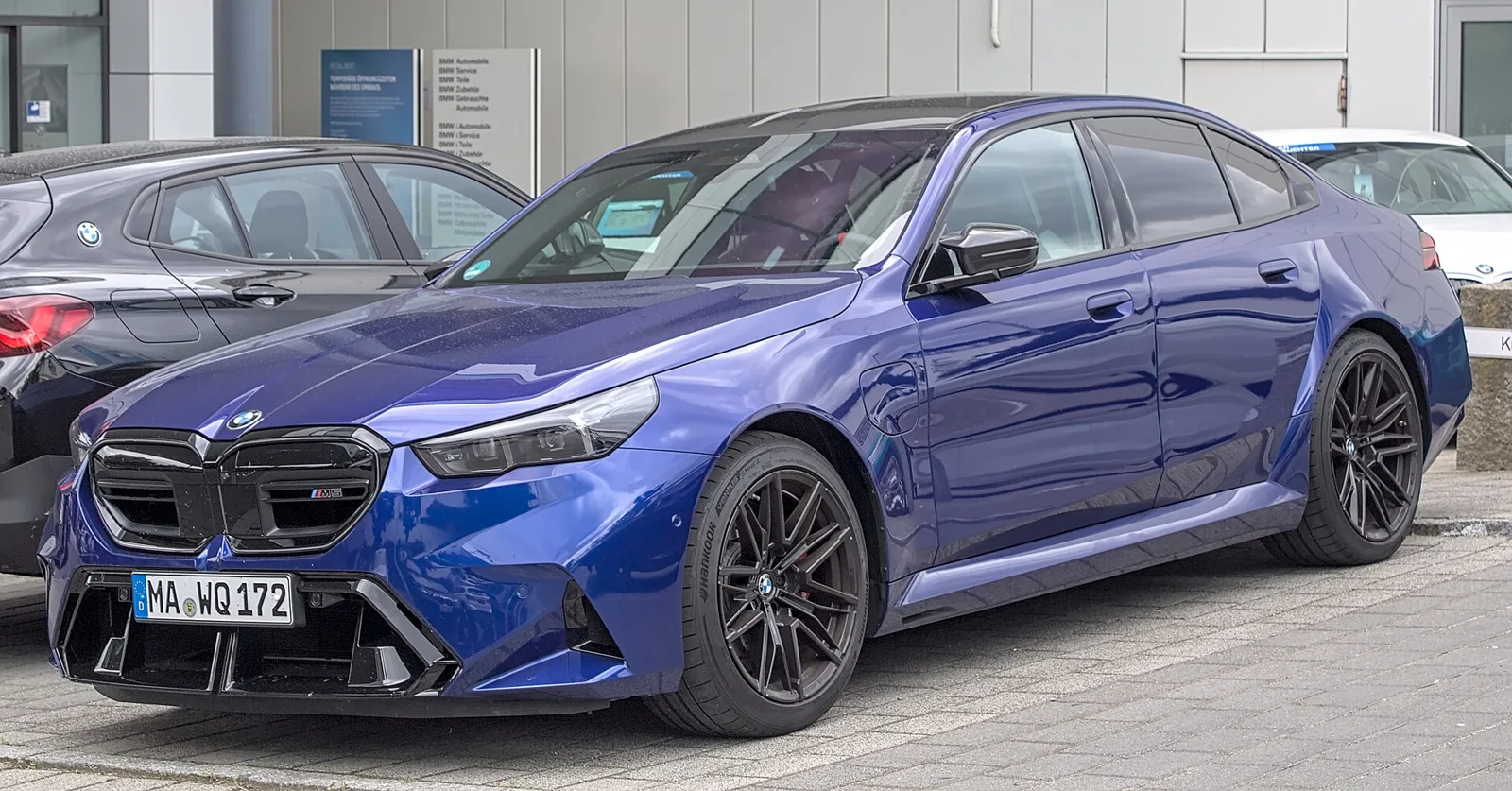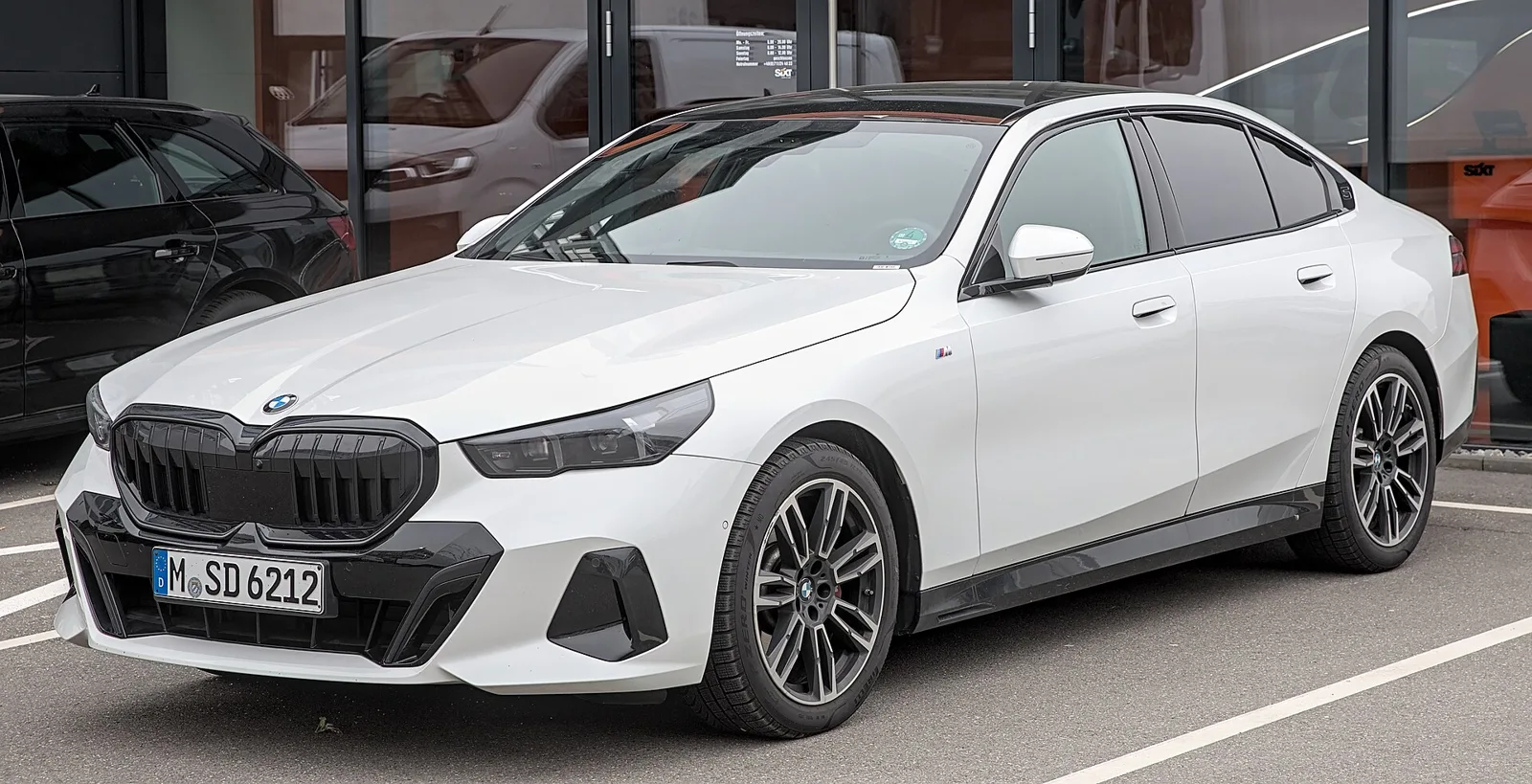
Four early generations, four chassis codes and a steady run of firsts, from the 1972 E12 to the aluminium-suspended E39.
The BMW 5 Series began with the 1972 E12 saloon and moved through the E28, E34 and E39 by 2004. Each generation added firsts, from diesel and ABS to V8s, all-wheel drive, aluminium front suspension and a V8 M5 in the E39.
The 5 Series was the first BMW to carry the word "Series" in its name, and the three-digit naming it introduced is still in use. By 29 January 2008 the line had reached its five millionth car, a 530d saloon in Carbon Black Metallic. Behind that total sits a family of four early generations, the E12, E28, E34 and E39, each of which changed what a BMW executive saloon could be.
BMW 5 Series chassis codes and generations
BMW labels each generation with an internal code, which is why car-park conversations are full of "E34" and "E39". An E-code was used from 1972 to 2010, an F-code from 2010 to 2016 and a G-code since 2017. The 5 Series replaced the New Class saloons, ranks as BMW's second-best seller after the 3 Series, and is the company's oldest nameplate still in production.
| Code | Built | Bodies | M model |
|---|---|---|---|
| E12 | 1972-1981 | Saloon | None; M535i is the forerunner (160 kW, 215 bhp) |
| E28 | 1981-1988 | Saloon | M5 with S38B35 and M88/3 sixes |
| E34 | 1987-1996 | Saloon, Touring | M5, 232 kW (311 hp), later 250 kW (335 hp) |
| E39 | 1995-2004 | Saloon, Touring | M5 with 4.9-litre S62 V8, 394 horsepower |
The first BMW to carry the word Series in its name, and the three-digit naming still used today.
The BMW E12, the 1972 car that started it
The E12 was the first 5 Series, built from 1972 to 1981 as a saloon only. Its roots go back to the 1970 Geneva Motor Show, where BMW unveiled the 2200ti Garmisch, a two-door concept developed with Bertone as a possible successor to the New Class. Eberhard von Kuenheim, then chairman of the supervisory board, named the French designer Paul Bracq chief of design that year; Marcello Gandini of Bertone worked on the exterior alongside him. A road-legal prototype in 1971 looked a good deal like a Fiat 132.
Several things were new for BMW. BMW used computers for the first time to work out crumple zones at each end, the roof carried a rollover structure, and the body recorded a drag coefficient of 0.44. It was also the first BMW with the turn-signal stalk on the left of the steering wheel.
Engines began with the 2-litre M10 four-cylinder from the New Class, with revised cylinder heads. The 520 used a Stromberg carburettor and the 520i a Kugelfischer injection pump. Rumours had suggested a 2.2-litre four and a small six, and a 523 was indeed developed but never put into series production; a small six eventually arrived in 1977 as a 2-litre 520. Most higher models took the M30 straight-six used in the New Six saloons and E9 coupes.
A September 1976 facelift followed the arrival of the E23 7 Series, with styling overseen by Claus Luthe. The fuel filler moved to the side of the car, the taillights widened and the bonnet gained a power bulge that accentuated the kidney grille. The 520 also switched to the M20 straight-six and is often called the 520/6.
For Sweden, with its stringent emissions standards, BMW developed a fuel-injected 528i that entered production in June 1977. It sold well enough to replace the carburetted 528 in most markets.
Racing-bred E12s and the first M-badged 5 Series
From 1974 BMW Motorsport offered the Motorsport 530, 530i and 533i as special-order upgrades. The 530 used the 180 PS (132 kW; 178 hp) carburetted engine from the 3.0S, and the 530i the 200 PS (147 kW; 197 hp) injected unit from the 3.0Si. The first M-badged 5 Series, the M535i, began production in 1980 with a 3.5 L (214 cu in) M90 straight-six rated at 160 kW (215 bhp), a five-speed manual gearbox and a total of 1,650 cars, 240 of them kits for South Africa.
That country produced its own special. The 530 MLE was a homologation car for racing, with 218 built, using aluminium or thinner steel panels and a 132 kW (177 bhp) 3.0 L engine.
E12 in America and South Africa
US sales began for the 1975 model year with just the 530i. American rules demanded larger bumpers able to withstand a 5 mph (8 km/h) impact, which added 206 mm (8.1 in) to the length, and emissions kit that included exhaust gas recirculation, an air pump and Thermal Reactors. The reactors were blamed for burned valves, overheating and warped or cracked cylinder heads. A separate cylinder-head defect on the 530i prompted a lawsuit, and in 1980 BMW offered replacement heads even when the warranty had expired. For 1979 the 528i took over from the 530i, with a catalytic converter that required unleaded fuel.
In South Africa the E12 arrived in March 1974, assembled at Rosslyn from kits. When the E28 took over, the tooling travelled there and E12 production carried on with E28 interiors, a car known as the E12/8. The end of that run is variously dated to September 1985 and to 1984.
The E28 in brief
Built from 1981 to 1988, the E28 offered petrol fours and sixes at first. Diesel power came in 1983, a first for the range. It was also the first 5 Series with a driver-angled centre console and optional ABS brakes. Most significantly, the E28 M5 launched the line of high-performance M5 models that has continued ever since.
BMW E34: V8s, all-wheel drive and the Touring
Development ran from July 1981 to early 1987. Ercole Spada penned the first proposal in 1982, Claus Luthe guided the work and J Mays finalised the design in mid-1985. Much of the look derived from the E32 7 Series, and attention to aerodynamics gave the basic saloon a drag figure of 0.30. Production proper started that November, and the saloon was shown to the world press a month later.
The saloon measured 4,720 mm (185.8 in) long, 1,750 mm (68.9 in) wide and 1,412 mm (55.6 in) tall on a 2,760 mm (108.7 in) wheelbase. It brought a long list of firsts for the 5 Series: all-wheel drive in the 525iX, a V8, a wagon, stability control, traction control, a six-speed manual and adjustable damping. Nine engine families were used over its life, which is an unusually large range.
The Touring's arrival date varies: 1990, 1991 (when the 520iT and 525iT appeared) and September 1992 are all given. The E39 took over from it in December 1995, though the Touring stayed in production until June 1996.
Which E34 sold best
The 525i was the most popular E34, with 434,549 built, ahead of the 520i at 426,971. The four-cylinder 518i, sold only in Europe, reached 53,248. At the other end, the all-wheel-drive 525iX managed only 9,366, and the 540i, added in 1993 with the M60 V8, 26,485. The 530i existed in two versions, an inline-six from 1988 to 1990 and a V8 from 1993 to 1995, together making 57,570 cars.
Despite its badge, the 535i did not have a 3.5-litre engine. The M30 in it displaced 3.4 litres (207 cu in), and 97,679 were built including the Alpina B10 BiTurbo versions. V8 cars wore a wider grille, which became available on other models in 1994.
Diesel followed, with the 524td in 1988, then the 525tds in 1991 and a cheaper 525td in 1993. There was no facelift as such. Updates arrived gradually, mostly each September, so the changes for 1988 belong to the 1989 model year. Wiring also varied with engine and year, in two broad types often described as high and low, which matters when retrofitting options.
The E34 M5 and the oddities
Built from September 1988 to August 1995, the E34 M5 came as a saloon and, the first time for an M5, as a Touring. Its S38 straight-six began at 3.6 L (220 cu in) and 232 kW (311 hp). A 3.8 L (232 cu in) version rated at 250 kW (335 hp) was shown at the 1991 Frankfurt Motor Show alongside the debut of the M5 Touring. In the final year the five-speed manual gave way to a Getrag six-speed.
The range had some curiosities. The 518g ran on natural gas as well as petrol, was sold only in Germany in 1995 and reached just 298 cars. A 518iev prototype combined lead-acid batteries and an electric drive with a petrol four and a continuously variable transmission, and Deutsche Post and others trialled it in the late 1990s. In North America a 540i M-Sport was built in 1995 in a run of 205, and 70 numbered 540i LE saloons went to Australia, all with manual gearboxes.
Alpina's B10 BiTurbo, introduced in March 1989 after a $3.2 million research investment, produced 360bhp. It sold well despite costing nearly twice the price of an M5, ended in 1995 after 507 saloons, and was considered, along with the Lotus Carlton, one of the fastest saloons in the world.
BMW E39 vs E34: what changed
Work on the E39 began in 1993 and ended in 1995, though the final design by Joji Nagashima was chosen in June 1992 and later frozen under new design chief Chris Bangle. Selection to start of production took 39 months. The car made its debut at Frankfurt in September 1995, European saloon sales began that December and the wagon followed with production in November 1996.
Against the E34, the wheelbase grew by 68 mm (2.7 in) and the overall length by 55 mm (2.2 in). Torsional rigidity rose by 40 percent, which cuts body flex and lets the suspension work more accurately. The stiffer shell added 10 kg (22 lb) to the chassis, offset by lighter aluminium suspension parts. The wagon was 85 mm (3.3 in) longer than the E34 version and about 40 kg (88 lb) heavier.
Aluminium is the headline. The E39 was the first 5 Series with aluminium for all major front-suspension components, saving 21 kg (46 lb), and it used a four-link rear layout called Z-link, similar to the E38 7 Series. Rack and pinion steering appeared on four- and six-cylinder models, while V8s stayed with a recirculating ball box. Unlike the E34 and the E60 that followed, the E39 was never offered with all-wheel drive.
Engines, diesels and the clever extras
Launch petrol engines were the M52 straight-six and the M62 V8. In late 1998 technical updates added double VANOS to the six and single VANOS to the V8. The year 2000 facelift swapped the M52 for the M54, and the 530i version headed Ward's 10 Best Engines in 2002 and again in 2003.
Diesel started with the M51 turbo six. The M57 arrived in the 530d in 1998, and in 1999 the 520d brought the first four-cylinder diesel ever offered in a 5 Series.
The Touring was the first BMW to use air suspension. Pneumatic springs at the rear kept the car at a set height as load changed, correcting itself when the ride height moved more than 10 mm. The E39 was also among the first cars, with the E38 7 Series, to offer curtain airbags, and navigation maps moved from CD-ROM to DVD in 2002. Until September 1999 a latent heat accumulator was optional: an insulated tank that stored engine heat for several days by turning a salt from solid to liquid, then used it to warm the engine and cabin at the next start.
The E39 M5 and special versions
Introduced at the 1998 Geneva Motor Show, the M5 was the first to use a V8. The 4.9-litre S62 produced 394 horsepower, and every car sold was a saloon with a six-speed manual. A single M5 Touring was built but never sold. Production ran from 1998 to 2003.
Alpina offered B10 versions of the E39 from January 1997 to May 2004, including a B10 V8 S with 375 bhp and a 0-60 mph time of 5.4 seconds. The first diesel Alpina, the D10 Biturbo, was based on the 530d, and only 94 were made. For clients with other needs, the 540i Protection light-armoured model reached Europe in September 1997 and North America in January 1998, with aramid fibre armour and bullet-resistant glass.
Where this goes next
The E-code era ended with the E60 generation, and the 5 Series is now in its eighth generation, coded G60, G61 and G68. BMW revealed it on 24 May 2023, with production starting in the summer of 2023 at the Dingolfing plant and first deliveries from around October 2023. Alongside petrol and plug-in hybrid versions it includes a battery-electric model named the i5, offered as the eDrive40, xDrive40 and M60 xDrive.