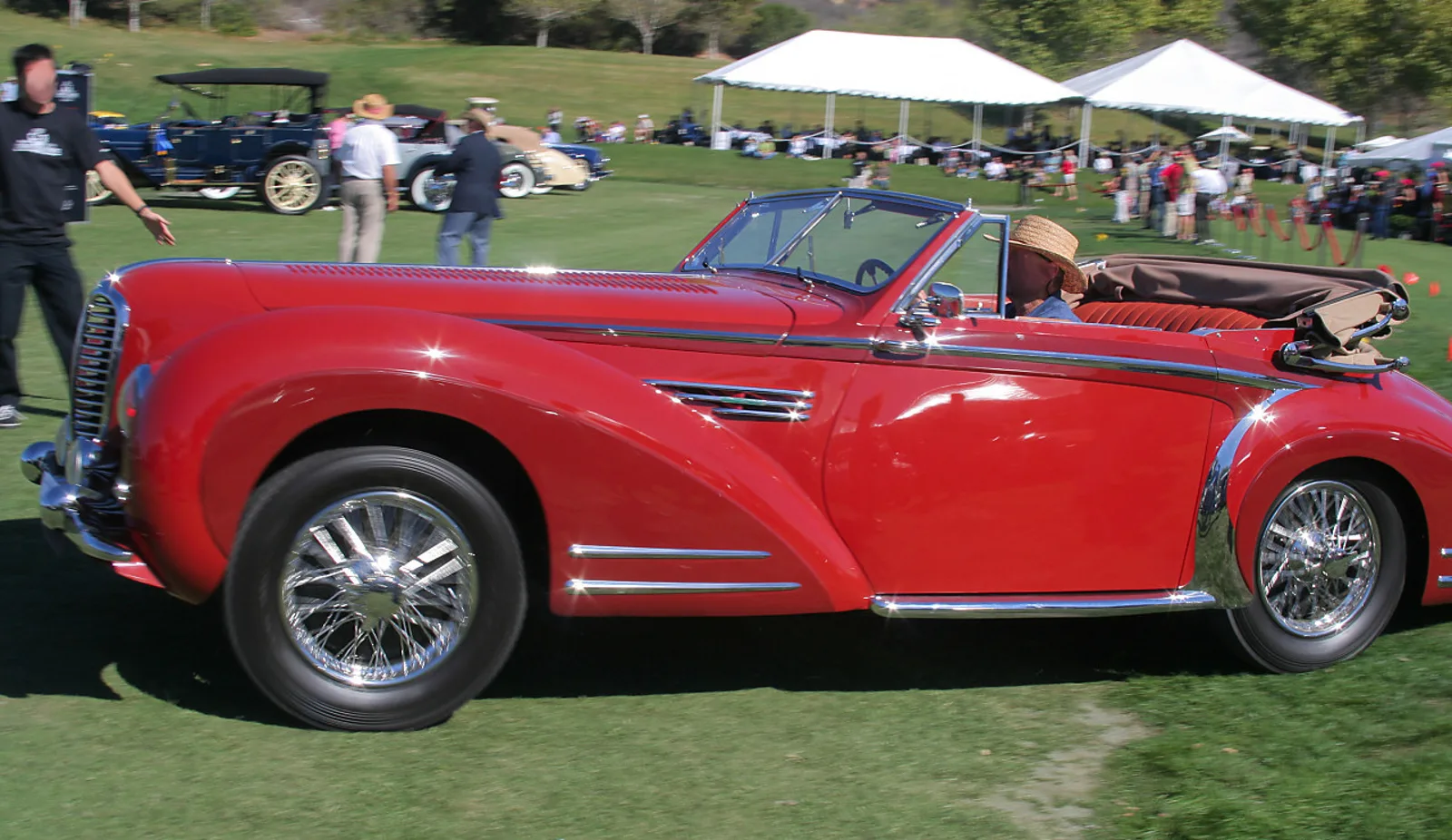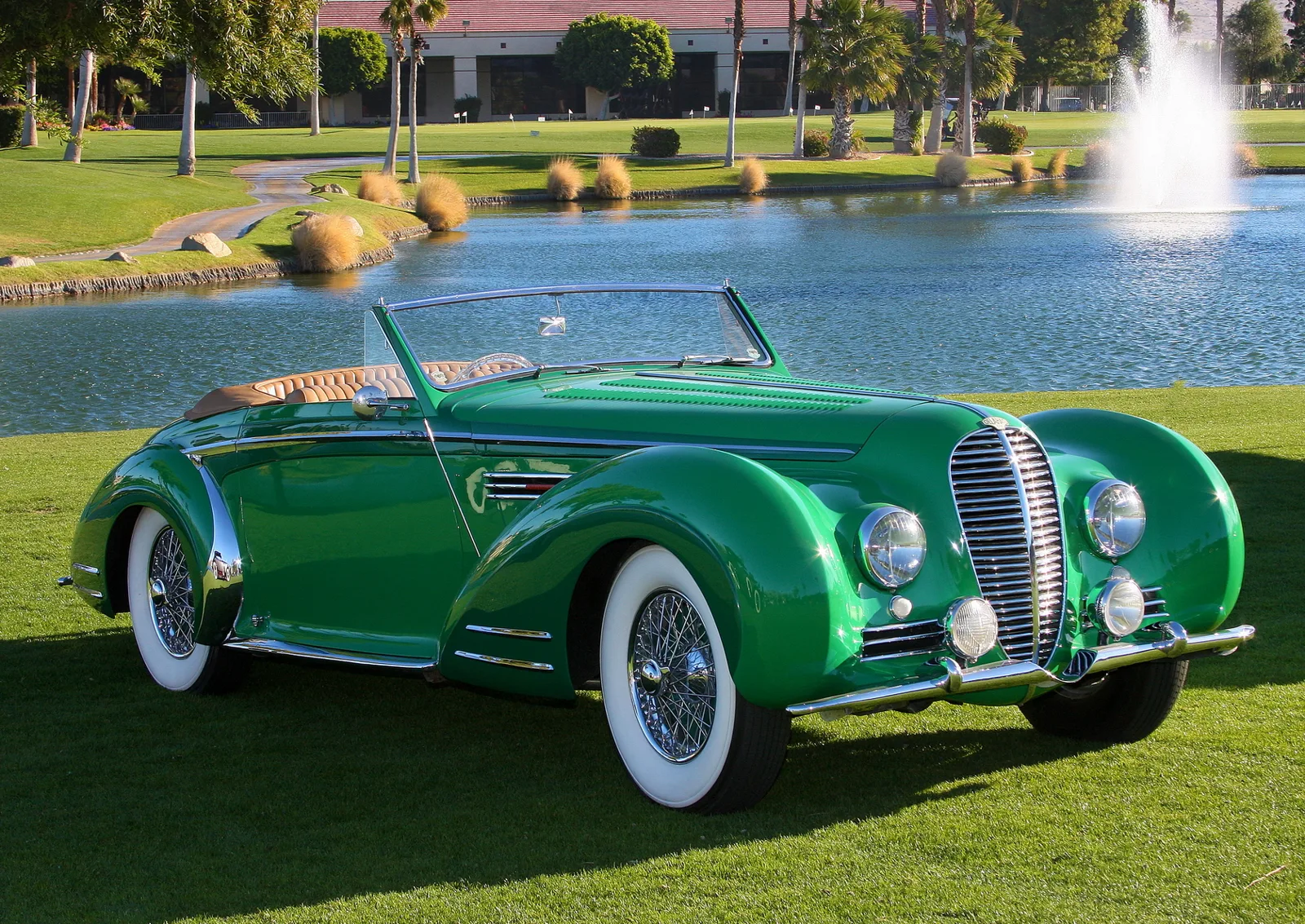
Two sporting cars from industrial builders: a French six derived from a truck engine, and a Spanish V8 with a De Dion rear end and a world record.
The Delahaye 135 was a French sporting tourer built from 1935 to 1954 on a truck-derived 3.2-litre six, and it won Le Mans in 1938. The Pegaso Z-102 was a Spanish V8 sports car built from 1951 to 1958, with 84 made and a supercharged record of 243.079 km/h.
On 25 September 1953, on a road at Jabbeke in Belgium, a supercharged Pegaso Z-102 averaged 243.079 km/h (151.042 mph) over a flying kilometre, beating a record held by a Jaguar XK120 and making the Spanish car the fastest production car in the world at the time. Pegaso was better known for trucks and motor coaches. The French Delahaye 135, built from 1935 to 1954 on an engine derived from a truck unit, won Le Mans in 1938.
What was the Delahaye 135?
Engineer Jean Francois designed the Delahaye 135, which stayed in production from 1935 until 1954 in a huge range of body styles. It was a luxury car, but also a sporting tourer that proved popular for racing. It was first shown in 1935, and its nickname, Coupe des Alpes, came from its success in the Alpine Rally. The car marked Delahaye's decision to build sportier cars than before.
Its 3.2-litre overhead-valve straight-six, with a four-bearing crankshaft, was derived from one of Delahaye's truck engines. The same engine went into the calmer 138, which had a longer wheelbase of 3,160 mm (124 in). In twin-carburettor form the 135 made 95 hp (71 kW), while a version with three downdraught Solex carburettors made 110 hp (82 kW) and could reach 148 km/h (92 mph). The 138 had one carburettor and 76 hp (57 kW), with a sportier 90 hp (67 kW) edition.
The chassis had independent front suspension on leaf springs, a live rear axle and cable-operated Bendix brakes, on standard 17-inch spoked wheels. Buyers could pick a partially synchronised four-speed manual gearbox or a four-speed Cotal pre-selector, a gearbox in which the driver chooses the next ratio on a small lever and then engages it with a pedal.
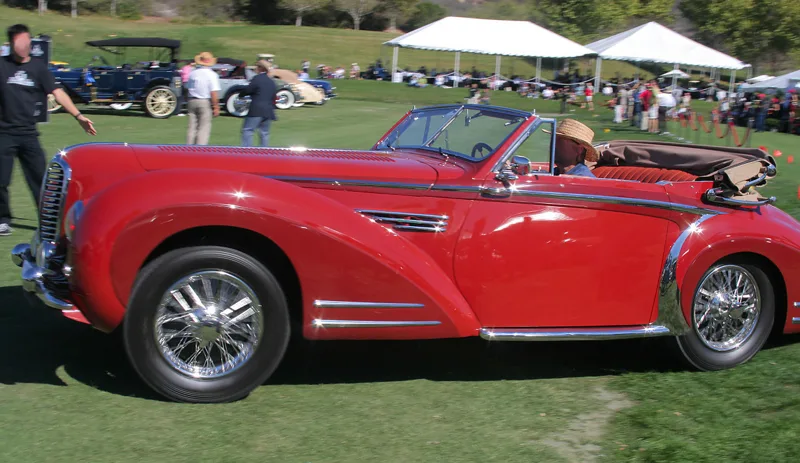
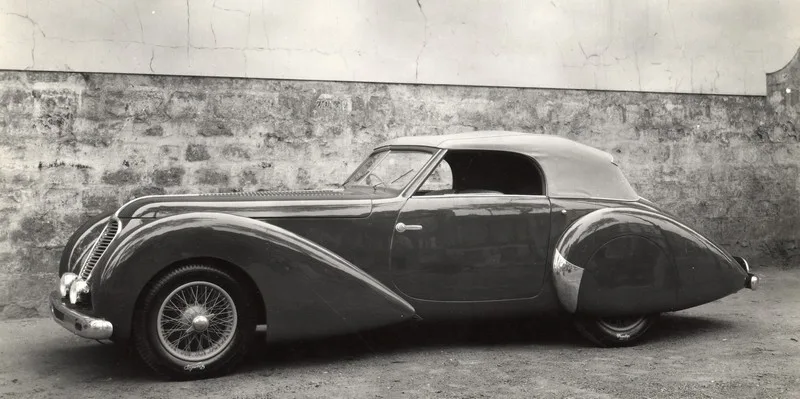
Because Delahaye sold a chassis rather than a finished car, the list of firms that clothed the 135 reads like a roll call of French coachbuilding. Figoni & Falaschi, Letourneur et Marchand, Alphonse Guillore, Marcel Pourtout, Freres Dubois, Jacques Saoutchik, Marius Franay, Henri Chapron, Faget-Varnay and Antem all built bodies, among others. Production of the 3.2-litre version ended with the German occupation in 1940 and did not restart after the war.
A Spanish truck maker's supercharged V8 beat the Jaguar XK120's speed record at Jabbeke in 1953.
What were the Delahaye 135M, 135MS, 148 and Type 235?
A bigger engine of 3,557 cc arrived in 1936 in the 135M. The car was largely unchanged, and the new engine gave 90, 105 or 115 hp with one, two or three carburettors. As with the 135 and 138, a less sporty long-wheelbase sister car was made, the 148, with a wheelbase of 3,150 mm, or 3,350 mm as a seven-seater. On the two shorter wheelbases there was also a 134N, with a 2,150 cc four-cylinder version of the 135's six.
The 135MS followed quickly, with 120 to 145 hp on offer and more than 160 hp in competition tune. It was the version most often seen in competition, and it stayed available until 1954, when new owners Hotchkiss called a halt. The MS had a 2.95 m wheelbase, while competition models sat on a shortened 2.70 m chassis.
After the war the 148, 135M and 135MS came back, along with a brief return of the 134. They were joined by an entirely new series that had been under development before the war and used an engine one litre larger: the Delahaye 175 and 175S, the 178 and the 180. When the large-displacement chassis series ended in 1951, the 135M was updated and introduced as the Type 235 in a last effort to save Delahaye. It carried ponton-style bodywork by Philippe Charbonneaux. Delahaye offered the 235 until the firm's demise in 1954, but only 84 were built.
How did a Renault body end up on the Delahaye Type 168?
One odd Delahaye came from a business quarrel. Presented in December 1938 and built until war began in 1940, the Type 168 used the 148L chassis and engine, code 148N, under Renault Viva Grand Sport bodywork, on the same 315 cm wheelbase. It had artillery wheels rather than spoked ones, which made small differences to the track.
The hybrid arose because Renault had tried to move in on Delahaye's lucrative near monopoly on fire vehicles. After Delahaye complained, Renault gave up the contracts it had won, but in return Delahaye had to buy a number of Viva Grand Sport bodyshells. To limit how many shells it was forced to buy, Delahaye fitted the unpopular Wilson pre-selector box, even though its marketing material referred to the Cotal version. It worked. With war halting car production, supposedly no more than thirty were built. They were strong, wide and fast, like their Viva Grand Sport half sisters, and proved popular with the army, many being converted to run on producer gas. Very few, if any, survive.
How did the Delahaye 135 do in competition?
The 135 was a successful racing car in the late 1930s. It won the Monte Carlo Rally in 1937 and the 24 Hours of Le Mans in 1938, when Chaboud and Tremoulet drove the winner and two more Delahayes took second and fourth. A standard 135 came seventh at Le Mans in 1935, and in 1937 135MS cars finished second and third. In 1939 two 135MS cars reached sixth and eighth, and after the war the by-then veteran 135MS finished fifth, ninth and tenth. At the 1936 French Sports Car Grand Prix at Montlhery, 135s took second, third, fourth, fifth, seventh, eleventh and twelfth places. Competition cars also placed second and third in the 1936 Mille Miglia and set the all-time record at the Ulster Tourist Trophy. John Crouch won the 1949 Australian Grand Prix in a 135MS.
How do the Delahaye 135 versions compare?
| Version | Engine and power | Notes |
|---|---|---|
| 135 | 3.2-litre six, 95 hp with twin carburettors, 110 hp with three Solex | 148 km/h (92 mph) in three-carburettor form |
| 138 | Same six, 76 hp, or 90 hp in the sportier edition | Longer wheelbase of 3,160 mm |
| 135M | 3,557 cc, 90, 105 or 115 hp | Introduced in 1936 |
| 148 | 135M engine | Wheelbase 3,150 mm, or 3,350 mm as a seven-seater |
| 135MS | 120 to 145 hp, over 160 hp in competition | Wheelbase 2.95 m, or 2.70 m for competition cars |
| Type 235 | Updated 135M | Ponton-style body of 1951; 84 built |
What was the Pegaso Z-102?
The Pegaso Z-102 was a Spanish sports car built in coupe and cabriolet form from 1951 to 1958. Pegaso was an established maker of trucks and motor coaches that built sports cars for seven years. Its chief technical manager was Wifredo Ricart, formerly chief engineer at Alfa Romeo, where he had designed the Tipo 512, and he penned the original Z-102 design.
The Z-102 began in 1951 as two prototypes, a coupe and a drophead. Both had steel bodies that proved too heavy, so Pegaso switched to alloy. Even so the cars stayed heavy and hard to drive, and racing success barely existed. The cars were built with no regard to cost, so the Z-102 soon proved too expensive to keep making and was dropped after 1958. A simplified, cheaper Z-103, with 3.9, 4.5 and 4.7-litre engines, was put into production but had little success. Only 3 were built.
How many Pegaso Z-102 cars were built, and who bodied them?
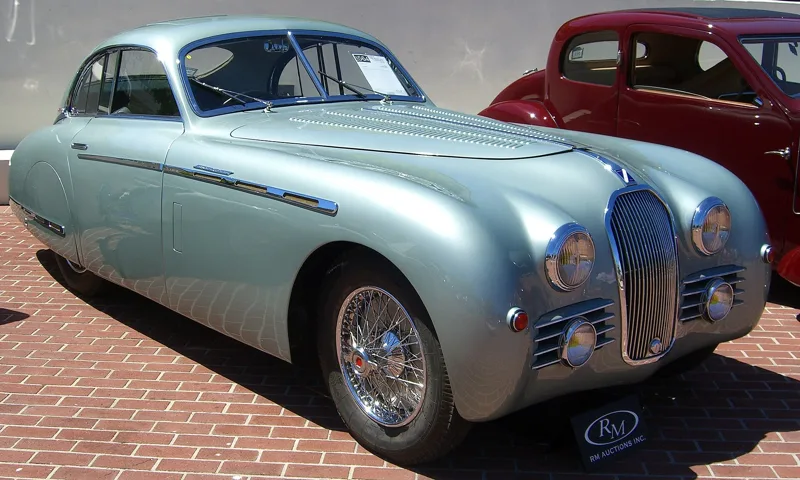
Pegaso built 84 Z-102s in all. Of the 84, 28 were cabriolets and the rest fixed-roof coupes. Enasa, Pegaso's parent company, bodied 19, 11 of them Berlinettas. Early cars carry Pegaso-made bodies, but most were bodied by Carrozzeria Touring, which built on Ricart's original design by redesigning the grille, lowering the car, repositioning the fog lights and simplifying details to give a cleaner profile. That Touring style is the best known and the most numerous. The French coachbuilder Saoutchik bodied 18 cars, 3 of them convertibles, as well as one of the original prototypes, and Serra bodied a handful.
Enasa also built a version called the Cupola. Its design came from sketches by Spanish students who had been challenged to draw the cars of the future, and Enasa took the prominent ideas from those drawings and built the car. Only two Cupolas are known to have been made. One was bought by the Dominican dictator Rafael Trujillo, and the one known survivor is owned by the Louwman Museum.
What engine and chassis did the Pegaso Z-102 have?
The Z-102 had a pressed steel chassis and an alloy body, and everything except the coachwork was made in-house at Pegaso's Barcelona factory. The main frame beams were drilled with big lightening holes, and the wheel wells beneath the body were made to carry load as stressed members.
It entered production with a four-cam, all-alloy, 2.5-litre (2,472 cc) V8 with dry-sump lubrication, as in the prototypes. Later cars used 2.8-litre (2,816 cc) and 3.2-litre (3,178 cc) DOHC desmodromic 32-valve V8 engines, with multiple carburettors or an optional supercharger, making up to 360 hp (268 kW). A desmodromic engine closes its valves with a second cam rather than relying on springs alone. The standard 2.5-litre unit had chain-driven camshafts, dual distributors and a limit of 6000 rpm. A second version for lightweight bodies and competition had gear-driven camshafts, Bosch magneto ignition and a limit of 6800 rpm.
Power ranged from 175 hp (130 kW) to 360 hp (268 kW) and reached the rear wheels through a five-speed non-synchromesh transaxle. The base Z-102 was good for 192 km/h (120 mph), and in supercharged trim it reached 243 km/h (151 mph).
The rear-drive layout was unusual. The transmission sat in the rear, joined to the differential in a transaxle arrangement, but unusually it lay behind the differential, carried in a reverse A-frame that narrowed to a point at the tail of the chassis, with a fuel tank on each side of the gearbox. The rear suspension was De Dion, in which a rigid tube links the two rear wheels while the differential stays bolted to the chassis. To hold the tube against sideways movement, Pegaso skipped the usual Watt's linkage or Panhard rod. A small wheel at the tube's midpoint ran up and down in a vertical channel on the front of the differential instead.
How did the Pegaso Z-102 race, and what was the Jabbeke record?
Enasa registered two Z-102s for the 1952 Monaco Grand Prix, which was held that year for sports racing cars. Chassis 0113 and 0115 were entered for Juan Jover (number 52) and Joaquin Palacios (number 54), with a third car in reserve. Pegaso entered three Z-102s at Le Mans in 1953. Coming up to the corner after the Dunlop bridge, Jover misjudged his speed and put his Z-102 Spyder into the barriers at over 200 km/h (120 mph). His left leg was badly hurt, and Pegaso pulled its other cars out. In 1954 the cars entered the Carrera Panamericana with Joaquin Palacios, who achieved promising results in the early stages before an accident ruined an excellent final position.
The Jabbeke record came on 25 September 1953. Celso Fernandez drove a Z-102 Touring BS/2.8, the Barchetta used earlier at Le Mans, with a 2.8-litre engine and a single supercharger. He broke four official records of the Royal Automobile Club de Belgique. The most prominent was the flying-start kilometre, at an average of 243.079 km/h (151.042 mph), beating the Jaguar XK120's time. The Z-102 BSS/2.5 Bisiluro Especial Competicion, a twin-supercharged 2.5-litre car built to take on the records, could not be used because of a blown engine.
Did the Pegaso Z-102 win at concours events?
Show success came more easily than racing success. A Z-102 coupe by Saoutchik, owned by Baron Thyssen-Bornemisza and fitted with leopard-skin seats and gold controls, won the Grand Prix d'Elegance at Enghien-les-Bains, France, in 1953. The 1952 Cupola, the sole survivor of the two thought to have been made, took the Chairman's Choice Award and Best of Show Concours de Sport at Amelia Island in 2016. Pegaso then had a class of its own at Pebble Beach in 2023, where nine of the finest examples in the world were gathered.