One film made over $200 million on a shoestring, one flopped despite a star, and one car came home from Australia.
American Graffiti is a 1973 comedy-drama about a night of cruising in Modesto, Genevieve a 1953 comedy about veteran cars racing to London, Stroker Ace a 1983 NASCAR comedy starring Burt Reynolds, and Race the Sun a 1996 film about a Hawaiian high-school solar car team.
Burt Reynolds turned down the role that won Jack Nicholson an Academy Award so he could make a stock car comedy for his friend Hal Needham. He later called it a turning point from which his career never recovered. The film, Stroker Ace, was a major commercial disappointment, and the actor said it was where he lost his fans.
Cars carry the story in four very different films: American Graffiti, a nostalgic summer night of cruising; Genevieve, a comedy about two veteran cars racing home from Brighton; Stroker Ace, the NASCAR comedy that flopped; and Race the Sun, a family film about a high-school solar car. Their fortunes could hardly be more varied.
American Graffiti and the cruising cars of Modesto
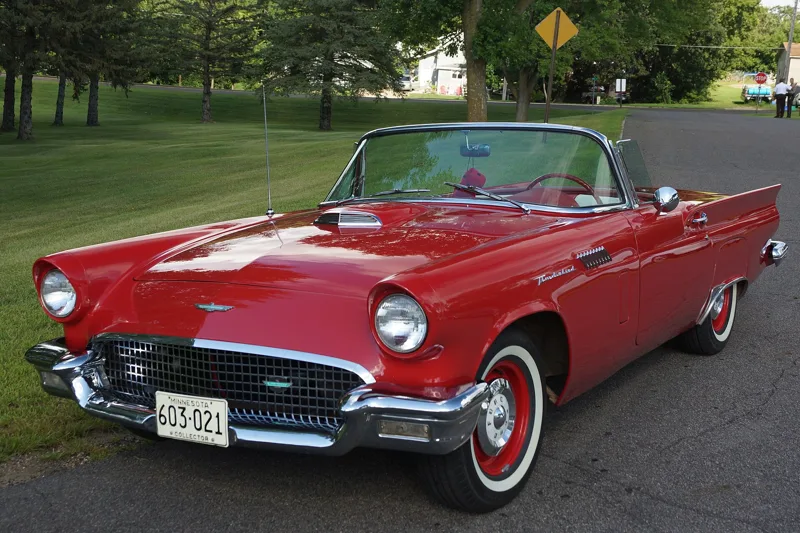
George Lucas directed American Graffiti, a 1973 comedy-drama that Francis Ford Coppola and Gary Kurtz produced from a script by Lucas, Gloria Katz and Willard Huyck. Its setting is Modesto, California, in 1962, and it tracks a handful of teenagers across one summer night spent cruising to rock and roll. The cars are the social network. On Sunday, 2 September 1962, the last day of summer vacation, four friends meet at Mel's Drive-In. Curt Henderson sees a blonde at the wheel of a white Ford Thunderbird, silently telling him she loves him, and spends the night hunting for her. John Milner is the confident drag-racing king. Terry "The Toad" Fields takes charge of Steve's car and loses it to thieves, admitting only at the end that he rides a Vespa scooter.
The race comes late. Bob Falfa goads John into a drag race on Paradise Road outside the city. Terry starts it and John takes the lead, but Bob's tyre blows out, his car swerves into a ditch and rolls over before bursting into flames. Laurie and Bob crawl out before it explodes, and John helps his rival to safety. In the morning Curt flies out of town and glimpses the white Thunderbird on the road beneath him. An epilogue gives each friend's fate: John killed by a drunk driver in 1964, Terry reported missing in action in South Vietnam in 1965, Steve an insurance agent, and Curt a writer in Canada.
Lucas drew the story from his own teenage years cruising in Modesto. By his account, cruising had vanished and he felt driven to record how his generation went about meeting girls. The characters are pieces of him: Curt reflects his personality at USC, John his teenage street-racing years and the Kustom Kulture hot rod crowd in Modesto, and Terry his awkward freshman year. Lucas also built the film around his fascination with the radio personality Wolfman Jack, who reads Curt's message on air.
A budget of $777,000 produced one of the most profitable films on record.
How American Graffiti got made
Getting the film financed was hard. Every major studio turned Lucas down at first. United Artists gave him $10,000 to develop a screenplay, but rejected the result, partly because licensing the 75 songs he wanted would cost too much and partly because it felt too experimental. Metro-Goldwyn-Mayer, Paramount, 20th Century Fox and Columbia all passed, and American International Pictures decided it was not violent or sexual enough. Universal Pictures finally agreed, giving Lucas total artistic control and final cut on condition of a strict low budget. That cost him an opening scene in which the Blonde Angel drove her Thunderbird through an empty drive-in theatre.
Universal first projected a $600,000 budget and added $175,000 once Coppola, fresh from The Godfather, signed on as producer. Filming began in San Rafael, but the crew was refused permission to shoot beyond a second day, so production moved to Petaluma. Universal had planned a television release. Instead the finished film, made for $777,000, earned over $200 million at the box office and in home video. It briefly became the highest-grossing film in Universal's history, ahead of Airport, until The Sting overtook it in 1974. It received five Academy Award nominations including Best Picture, and in 1995 the Library of Congress added it to the National Film Registry. Along with Easy Rider, it was one of the first films to replace a traditional score with hit songs matched to individual scenes.
Genevieve and the London to Brighton run
Henry Cornelius produced and directed Genevieve, a British comedy from 1953 written by William Rose and starring John Gregson, Dinah Sheridan, Kenneth More and Kay Kendall. It has been called perhaps the most successful British comedy film ever made. Two couples enter the yearly London to Brighton Veteran Car Run. Wendy McKim and her husband Alan, a young barrister, drive Genevieve, a Darracq dating from 1904. A pushy advertising man, Ambrose Claverhouse, follows in a 1905 Spyker with his latest girlfriend, the model Rosalind Peters, and her St. Bernard.
After a night in Brighton, Alan impulsively bets Ambrose 100 pounds that he can beat him back to London, though racing is against club rules. Each man cheats, with Ambrose sabotaging Alan's engine and Alan having Ambrose stopped by police. After a warning from traffic police, they call it off, then restart. Near the end, Ambrose's Spyker catches its tyres in tramlines and goes the wrong way, and Genevieve's brakes fail, so the car rolls onto Westminster Bridge and wins. The film's opening credits thank the Veteran Car Club of Great Britain, adding that any resemblance between the characters' behaviour and the club's members is emphatically denied; the real event is not a race.
Making Genevieve
Cornelius had made Passport to Pimlico at Ealing Studios before going independent. Ealing boss Michael Balcon turned down Genevieve, and Rank's Earl St John agreed to take it to his board only if the budget stayed at 115,000 pounds. The board offered 70% of the money, and Cornelius found the rest from the National Film Finance Corporation. According to cinematographer Christopher Challis, Cornelius mortgaged his house for the completion guarantee.
The original choices for the male leads, Guy Middleton and Dirk Bogarde, turned the roles down, and Kenneth More and John Gregson stepped in. The shoot spanned 57 days between October 1952 and February 1953, and about three quarters of it took place outdoors, which was unusual then. Challis claimed no film had been shot on location in all weathers before, since the tiny budget meant filming every day whatever the light. The shoot went 20,000 pounds over budget, and the insurance company covered the gap. Kenneth More recalled it as hell, though Sheridan said they got on well.
The themes of the score were composed and performed by Larry Adler, who agreed to write them in return for 2.5% of the producer's profits, a deal that proved lucrative. When the film opened in the US, his name was left off the credits because of his perceived left-wing sympathies, and conductor Muir Mathieson was credited instead. Kay Kendall's trumpet solo was mimed to jazz trumpeter Kenny Baker. Adler recalled that Rank hated the film at first and shelved it; after J. Arthur Rank himself saw it and liked it, attitudes changed. Bosley Crowther of The New York Times ranked it among the funniest farces in years.
The Genevieve cars
The script called for British cars, a Wolseley or Humber for Alan and a Lanchester for Ambrose, but no owner would lend one. Norman Reeves lent his Darracq and Frank Reese lent his Spyker. That Darracq had been called Annie until the film's success, when it was permanently renamed Genevieve. It came home in 1992 after 34 years in Australia and takes part in the London to Brighton Run every year. In July 2002 it toured the filming locations with another Spyker for a 50th anniversary rally. As of 2012, Genevieve and Ambrose's Spyker were on show at the Louwman Museum in The Hague.
Stroker Ace and the NASCAR comedy that flopped
Hal Needham directed Stroker Ace, a 1983 stock car comedy in which Burt Reynolds plays Stroker Ace, a three-time Winston Cup champion from Waycross, Georgia, who drives the number 7 Ford Thunderbird. He is arrogant and loses his old sponsor, Jim Catty of Zenon Oil, by dumping wet concrete on him. His new backer is Clyde Torkle, who owns the Chicken Pit fried chicken chain. The car carries the slogan "The Fastest Chicken in the South," and Stroker's unread contract requires him to make personal appearances in a chicken costume. His rival is young driver Aubrey James, in the number 10 Four-Star Whiskey Buick Regal.
The finale turns on a bet. If Stroker wins the championship he must keep selling chicken for two more years, and if he loses he is freed. He tries to drop back, but his ego will not let him; a jack malfunction leaves him sixth, Torkle releases him, and Stroker then wins the title by flipping his car as he crosses the finish line. The lucrative offer for Torkle's franchise turns out to be fake.
Making and reception of Stroker Ace
The story came from Stand on It, a 1973 novel by William Neely and Robert K. Ottum presented as the memoir of an invented driver. First Artists bought the rights in 1977 as a vehicle for Paul Newman, and producer Walter Wood read the book in 1978. Wood wanted an innocent, light comedy, with Needham, who ran the NASCAR team Mach 1 Racing in partnership with Reynolds, directing. Reynolds' fee was reportedly $5 million, with finance from Warner Bros. and Universal. Alongside Reynolds were Loni Anderson, Jim Nabors, Ned Beatty, Bubba Smith and Parker Stevenson, and real NASCAR names turned up too, among them Dale Earnhardt, Richard Petty, Cale Yarborough, Kyle Petty, Benny Parsons and Tim Richmond. It was shot at Charlotte Motor Speedway, Talladega Superspeedway and Atlanta Motor Speedway. Ry Cooder wrote a rockabilly score that the director disliked; Charlie Daniels performed the theme.
Critics were unkind. Vincent Canby of The New York Times dismissed it as a witless retread of the earlier Needham and Reynolds road comedies. Roger Ebert gave it one and a half stars out of four, and Gene Siskel gave it none. It was nominated for five Golden Raspberry Awards, including Worst Picture and Worst Director, and Nabors won Worst Supporting Actor. On Rotten Tomatoes it has an 18% approval rating from 17 reviews. The producer wrote that Reynolds had been the top box-office draw for five years, with few good reviews, but the film was still a major commercial disappointment.
Its legacy lives on in NASCAR. For the 2019 Southern 500, Rick Ware Racing based the throwback paint scheme on its number 51 car for B. J. McLeod on Stroker's number 7. In 2021 Spire Motorsports ran a Stroker Ace scheme on its number 7 with Corey LaJoie, while Justin Haley drove a replica of Aubrey James's scheme.
Race the Sun and the high-school solar car
Charles T. Kanganis directed Race the Sun in 1996, with Halle Berry and James Belushi leading a cast that included Casey Affleck, Eliza Dushku and Kevin Tighe. Barry Morrow, co-winner of the 1988 Oscar for the Rain Man screenplay, wrote and co-produced it. The story borrows loosely from the solar car team of Konawaena High School, which placed 18th in the 1990 World Solar Challenge, led all the high school entries and was the first school team to complete the event.
In the film, a teacher named Sandra Beecher joins Kona Pali High School in Hawaii and persuades six students who consider themselves "lolo" (stupid) to build a solar car. The race is two months away. Daniel Webster, a surfer, designs the car, Braz is the mechanic, Marco the lead driver and Gilbert the computer expert. After a cockroach gives Daniel the idea for a more ergonomic design, they build the "Cockroach". Daniel's idea of an extra battery lets the team qualify by completing the required hundred laps, and they travel to Australia for the six-day World Solar Challenge against a European team led by Hans Kooiman.
The race is a catalogue of mishaps: a broken ball joint on day one, a sandstorm on day two, a driver disqualified for drinking, a fever, a driver delirious with heat, then an electrical fire on the last day. Gilbert ends up driving, and the car crosses the line with its wheels coming off. The film ends with the team finishing third, which differs from the real team's 18th place overall. It opened to $1.1 million and grossed $1.9 million in the US. Stephen Holden of The New York Times liked that the film puts people ahead of gadgets, and the San Francisco Chronicle's Peter Stack compared it to Cool Runnings for solar cars, calling it corny and predictable but sunny and charming.
The four films side by side
| Film | Year | Director | Car at the centre | Result |
|---|---|---|---|---|
| American Graffiti | 1973 | George Lucas | Cruising cars and a drag racer in Modesto | Over $200 million on a $777,000 budget |
| Genevieve | 1953 | Henry Cornelius | 1904 Darracq and 1905 Spyker | Called perhaps the most successful British comedy ever |
| Stroker Ace | 1983 | Hal Needham | Number 7 Ford Thunderbird stock car | Five Golden Raspberry nominations |
| Race the Sun | 1996 | Charles T. Kanganis | Solar car called the Cockroach | Grossed $1.9 million in the US |